As an Amazon Associate I earn from qualifying purchases.
A 3000-watt generator can be a practical middle ground between a small camping generator and a much larger home backup unit. Depending on its rated output, fuel capacity, and design, a generator in this class can handle common loads such as refrigerators, lights, chargers, power tools, and many RV appliances.
However, not every generator marketed around 3000 watts is the same. Some models produce 3000 watts of continuous or rated power, while others reach 3000 watts only as a starting or surge figure. Runtime, noise, weight, fuel capacity, RV compatibility, and carbon monoxide protection can also vary significantly.
For 2026, this comparison looks at five portable models that fall around the 3000-watt category: the Champion Power Equipment 4000W Inverter, maXpeedingrods MXR3500, WEN 56360iX, Chic Muse 3000W, and Honda EU3000iS.
The goal is not simply to compare wattage. Instead, the important question is which combination of power, portability, runtime, noise, and features makes sense for your particular use.
Top 3000-Watt Generators
| Generator Model | Starting/Maximum Output | Rated/Running Output | Fuel | Noise | Weight |
|---|---|---|---|---|---|
| Champion Power Equipment 4000W Inverter | 4,000W | 3,000W class | Gasoline | 64 dBA | Less than 49 lb |
| maXpeedingrods MXR3500 | 3,500W | 3,000W | Gasoline | 58 dB | 47 lb |
| WEN 56360iX | 3,600W | 2,900W | Gasoline | 65 dBA at 1/4 load | 46 lb |
| Chic Muse 3000W | 3,000W | 2,500W | Gasoline | 60 dB | About 54 lb |
| Honda EU3000iS | 3,000W | 2,800W | Gasoline | 50–57 dBA | 130.7 lb |
The specifications above show why wattage alone should not determine your purchase. For example, the Honda EU3000iS has substantially more weight than the other portable models, while the maXpeedingrods provides 3,000 watts of rated output in a 47-pound package.
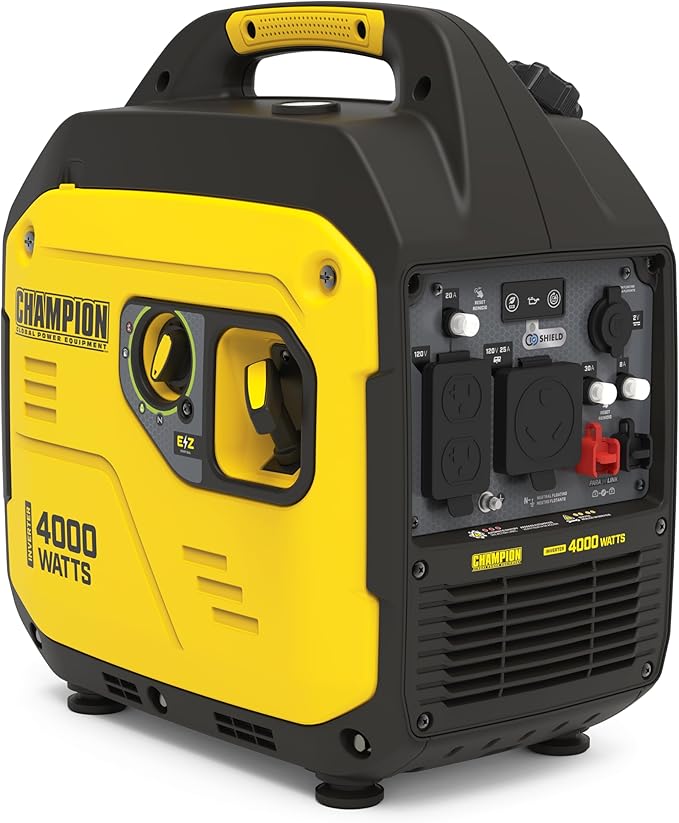
1. Champion Power Equipment 4000W Inverter Generator
The Champion Power Equipment 4000W Inverter Generator is aimed at users who want more surge capacity while keeping the generator relatively portable. The model uses inverter technology and includes Champion’s CO Shield carbon monoxide auto-shutdown system.
Champion lists the generator as a 4000-watt inverter with a 149cc engine, a 64 dBA noise rating, and up to 10 hours of runtime. The company also describes the unit as weighing less than 49 pounds, which makes it considerably easier to move than many larger open-frame generators.
The key advantage here is the combination of higher starting output and a relatively lightweight design. The additional starting capacity can be useful when powering equipment with motors or compressors that briefly require more power when they start.
For camping, tailgating, emergency power, or occasional jobsite use, this configuration can make sense when portability is important but you do not want to step down to a much smaller generator.
One thing to keep in mind is that 64 dBA is not exceptionally quiet compared with some smaller inverter generators. Noise should therefore be considered alongside the generator’s output and intended location rather than assuming that every inverter generator is automatically quiet.
Best suited for: Buyers who want a relatively lightweight inverter generator with additional starting capacity.
2. maXpeedingrods MXR3500 Portable Inverter Generator
The maXpeedingrods MXR3500 produces 3,500 starting watts and 3,000 running watts, placing it directly in the useful range for people searching for a 3000-watt portable generator.
The manufacturer lists a 4-liter fuel tank, 47-pound net weight, 58 dB noise level, Eco Mode, parallel capability, CO protection, and a 120V 30-amp RV outlet. It also includes two 120V 20-amp outlets and USB connections.
Runtime depends heavily on the load. The published figure is up to 8.3 hours at 25% load and approximately 4.5 hours at 50% load. That distinction matters because a generator will consume fuel faster as the electrical load increases.
The MXR3500 also uses inverter technology and is rated for clean power suitable for sensitive electronics. For an RV owner, the 30-amp RV receptacle is particularly useful because it avoids relying exclusively on standard household-style outlets.
Its 47-pound weight is another advantage. Compared with larger conventional generators, the suitcase-style design is easier to move and store.
However, buyers should not interpret the 58 dB specification as meaning the generator will always operate at exactly that noise level. Generator noise varies with load and operating conditions.
Best suited for: RV users, campers, and homeowners who want 3,000 watts of rated output in a relatively lightweight package.
3. WEN 56360iX 3600-Watt Portable Inverter Generator
The WEN 56360iX is another inverter generator designed around the 3000-watt class. It produces up to 3,600 surge watts and 2,900 rated watts from a 149cc engine.
The current WEN specifications list a 46-pound weight, making it one of the lighter generators in this comparison. It also includes an RV-ready TT-30R receptacle, two 120V receptacles, a 12V DC receptacle, and two 5V USB ports.
WEN lists a noise level of approximately 65 dBA at quarter load, so it should not be described as a 46 dBA generator. The earlier specification sometimes associated with this model is not consistent with WEN’s current product information.
The 56360iX also includes a CO Watchdog sensor that automatically shuts down the generator when dangerous carbon monoxide levels are detected. A fuel-shutoff feature is designed to use remaining fuel in the carburetor before shutdown, which can help reduce problems associated with stale fuel.
The manufacturer states that the generator can provide up to five hours of runtime at half load, depending on operating conditions. It also supports Eco Mode, which adjusts engine operation according to the connected load.
Another useful feature is its ability to operate in parallel with another compatible WEN inverter generator using the appropriate connection kit.
With its 46-pound weight and RV-ready outlet, the WEN is particularly practical for users who value portability and RV compatibility.
Best suited for: Campers and RV owners who want a lightweight inverter generator with an RV outlet and multiple charging options.
4. Chic Muse 3000W Portable Inverter Generator
The Chic Muse 3000W Portable Inverter Generator is the smallest-output option in this comparison. It provides 3,000 starting watts and 2,500 running watts, making it better suited to moderate loads than generators that provide a full 3,000 watts of rated output.
The published specifications list a 4.8-liter fuel tank, approximately 60 dB of noise, and a weight of about 54 pounds. The generator also includes USB charging, DC output, Eco Mode, and parallel capability.
One important distinction is the difference between its starting and running capacity. Although the product is marketed as a 3000W generator, its continuous running output is 2,500 watts. That means users should calculate the total continuous load of their equipment before deciding whether this model provides enough capacity.
This generator may work well for basic camping equipment, lights, chargers, small appliances, and other moderate loads. It can also provide temporary backup power for selected household devices during an outage.
It should not, however, be treated as a substitute for a larger whole-home generator. Large central air conditioners, electric water heaters, electric ranges, and other high-demand appliances can exceed the available output.
For buyers who mainly need portable electricity rather than maximum capacity, the Chic Muse provides a straightforward option in a compact generator category.
Best suited for: Users with moderate power requirements who want a gasoline inverter generator with a 3000-watt starting rating.
5. Honda EU3000iS 3000-Watt Inverter Generator
The Honda EU3000iS is one of the most established models in this category. Honda specifies 3,000 watts maximum output and 2,800 watts rated output, powered by a 196cc Honda GX200 engine.
The EU3000iS is designed for RV use, camping, and basic home backup. Honda specifically lists applications such as refrigerators, furnaces, microwaves, computers, and many RV air-conditioning systems among its potential uses, although not all loads can be powered simultaneously.
Noise varies with load. Honda lists 57 dB(A) at rated load and 50 dB(A) at one-quarter load.
Runtime is another area where the original specifications for this model need correction. Honda currently lists 6.9 hours at rated load and up to 19.6 hours at one-quarter load from its 3.4-gallon fuel tank.
The biggest trade-off is weight. At 130.7 pounds dry, the EU3000iS is dramatically heavier than the 46- to 54-pound models in this comparison. It does support an optional wheel kit, which can make movement easier, but this is not a lightweight generator.
The EU3000iS does offer electric starting, inverter technology, CO-MINDER carbon monoxide detection, Eco Throttle operation, parallel capability, and a 30-amp locking outlet.
Potential buyers should also check current regional availability before purchasing. Honda’s current product information states that the EU3000iS is not for sale in California.
Best suited for: Buyers who prioritize established Honda engineering, long low-load runtime, RV capability, and quieter operation over low weight.
What Can a 3000-Watt Generator Run?
A generator in the 3000-watt class can power many everyday devices, but the exact combination depends on the generator’s rated wattage and the starting requirements of appliances with motors or compressors.
Typical loads can include:
- Refrigerator or freezer
- Television
- Wi-Fi router
- LED lighting
- Laptop and phone chargers
- Fans
- Small microwave
- Coffee maker
- Power tools
- Portable fans
- Selected RV appliances
The most important number is the generator’s rated or running output. Starting watts provide additional short-term capacity for equipment that requires extra power when its motor starts.
For example, a refrigerator may consume considerably less power once running than it requires for a brief starting surge. The same principle applies to pumps, compressors, and some power tools.
Before connecting several appliances at once, add their running watt requirements and compare the total with the generator’s rated output. Then account for starting watts when motors or compressors are involved.
3000-Watt Generator vs. 3500W or 4000W Generator
The wattage printed in a product’s name can sometimes be misleading if you do not distinguish between maximum and rated output.
A generator advertised as 3500 watts may provide 3000 watts continuously. Similarly, a 4000-watt inverter generator may provide approximately 3000 watts of usable continuous capacity while offering additional starting power.
For that reason, compare rated watts first, then look at maximum or starting watts.
If your expected continuous load is close to 3000 watts, having additional headroom can be useful. Running a generator continuously near its maximum capacity leaves less room for startup surges and additional devices.
For lighter applications, a smaller generator can also make more sense because it may weigh less and consume less fuel when the electrical load is low.
What to Look for in a 3000-Watt Portable Generator
Rated and Starting Watts
Start with rated watts because this determines how much electrical load the generator can continuously support.
Then check starting watts for refrigerators, pumps, compressors, air conditioners, and power tools.
Noise Level
Noise specifications should always be compared under similar test conditions. A generator’s sound level can change depending on engine speed and electrical load.
For camping or residential use, a lower published dB rating can be useful, but it should not be the only factor.
Runtime
Runtime numbers are meaningful only when the load is specified. A generator that runs for eight hours at 25% load will not necessarily run for eight hours at 50% or 100% load.
When comparing products, look for runtime at a similar load.
Weight and Portability
Weight becomes especially important if the generator will be loaded into a vehicle, moved around a campsite, or stored between uses.
The difference between a 46-pound inverter generator and a 130-pound generator is significant even when both are marketed around the 3000-watt class.
RV Compatibility
If you own an RV, check whether the generator includes a 30-amp TT-30R or another compatible RV connection.
Do not assume that a generator’s total wattage automatically means it has the outlet configuration you need.
Carbon Monoxide Protection
Portable gasoline generators produce carbon monoxide, an odorless and potentially deadly gas. Look for a model equipped with an appropriate CO detection and automatic shutdown system.
Most importantly, never operate a fuel-burning portable generator inside a home, garage, basement, or other enclosed or partially enclosed space.
Final Thoughts
A 3000-watt portable generator can be a useful choice when you need more capacity than a small camping generator but do not want to move a large open-frame generator.
The models in this comparison take different approaches.
The Champion Power Equipment 4000W Inverter combines higher starting capacity with a relatively low weight. The maXpeedingrods MXR3500 provides 3,000 watts of rated output and a 30-amp RV connection in a 47-pound package. The WEN 56360iX focuses on portability and RV-friendly connectivity while providing 2,900 rated watts. The Chic Muse 3000W is designed for more moderate loads with 2,500 running watts. The Honda EU3000iS offers 2,800 rated watts, electric start, strong low-load runtime, and established inverter-generator features, but its 130.7-pound weight makes it a very different proposition from the lightweight models.
Before buying, compare the appliances you actually plan to run rather than choosing solely from the number printed on the generator’s name. Check rated watts, starting watts, runtime at a stated load, noise, weight, fuel capacity, outlet configuration, RV compatibility, and carbon monoxide protection.
For 2026, those details are more useful than simply looking for the generator with the highest wattage number.