As an Amazon Associate I earn from qualifying purchases.

When you’re traveling in an RV, reliable power can make a big difference, especially when you’re camping without a reliable electrical hookup. A good dual fuel inverter generator can run an RV air conditioner, refrigerator, microwave, electronics, and other essentials while giving you the option to use gasoline or propane. The right choice depends on how much power your RV needs, how much noise you can tolerate, and how easily you can transport and store the generator.
Whether you’re boondocking, camping at an RV park, or keeping a generator available for emergencies, inverter technology can provide stable electrical power for sensitive electronics. Dual-fuel capability adds another layer of flexibility by allowing you to switch between gasoline and propane when one fuel is more convenient than the other.
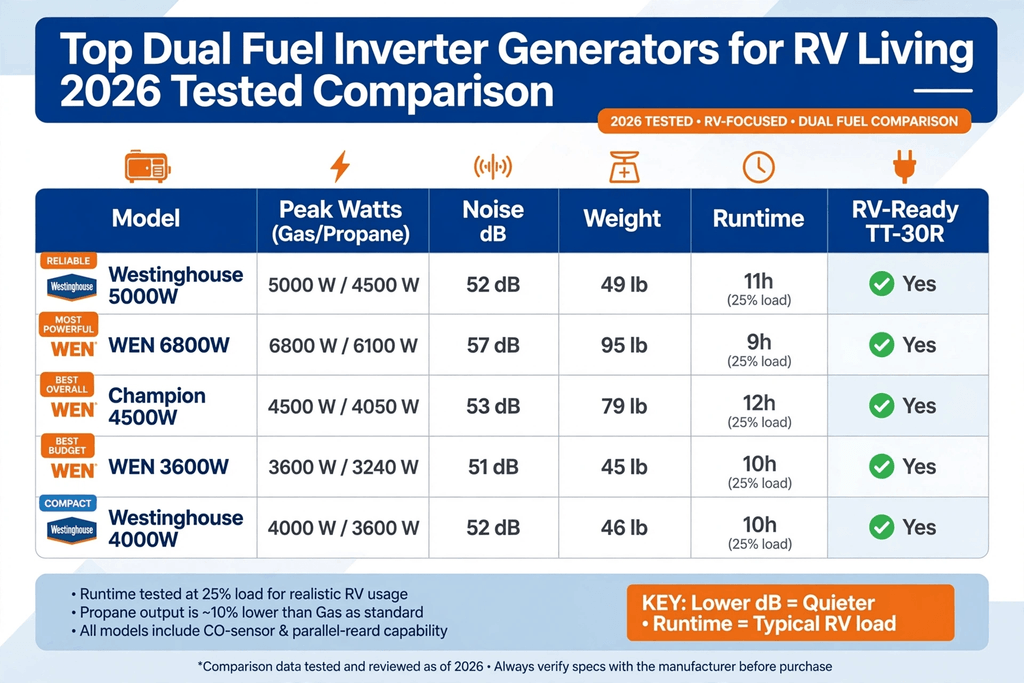
This guide compares dual fuel inverter generators from WEN, Champion, and Westinghouse, focusing on usable output, RV compatibility, fuel flexibility, noise, runtime, portability, and features that matter when you’re actually camping.
Best Dual Fuel Inverter Generators for RV Use in 2026
| Generator | Gasoline Output | Propane Output | RV Outlet | Best For |
|---|---|---|---|---|
| WEN DF680iX | 6,800 surge / 5,100 rated W | 6,000 surge / 4,500 rated W | TT-30R | Higher-power RV setups |
| Champion 4000W Dual Fuel | 4,000 / 3,000 W | 4,000 / 2,700 W | TT-30R | Lightweight RV use |
| Westinghouse iGen4000DFc | 4,000 / 3,300 W | 3,600 / 2,970 W | TT-30R | Convenience and portability |
| Champion 4500W Dual Fuel | 4,500 / 3,500 W | 4,500 / 3,150 W | TT-30R | Larger RV power needs |
| WEN DF360iX | 3,600 / 2,900 W | 3,500 / 2,600 W | TT-30R | Smaller RVs and lighter loads |
Why Choose a Dual Fuel Inverter Generator for RVs?
Dual-fuel technology lets RV owners choose between gasoline and propane based on availability, storage preferences, runtime requirements, and operating conditions. Gasoline is widely available and often provides higher output, while propane can be convenient to store for longer periods and can be useful when you already carry propane for other RV appliances.
Inverter generators are also useful for RVs because they produce regulated electrical power designed to reduce voltage and frequency fluctuations. Many current inverter models specify less than 3% total harmonic distortion (THD), which is useful when powering electronics such as laptops, televisions, chargers, and other sensitive equipment.
Benefits of Dual Fuel Inverter Generators for RVs
- Quieter operation – generally better suited to camping environments than conventional open-frame generators
- Stable electrical power – useful for electronics and other sensitive equipment
- Fuel flexibility – switch between gasoline and propane depending on availability, runtime needs, and your RV setup
- Portability – lightweight models are easier to load and unload, while larger units may use wheels and telescoping handles for easier movement
- RV-ready connections – many models include a 120V TT-30R outlet for direct connection to a typical 30-amp RV setup
In-Depth Product Reviews
WEN DF680iX 6800-Watt Dual Fuel Inverter Generator
Check Amazon Price: Click Here
The WEN DF680iX is the highest-output model in this group and is aimed at RV owners who need more headroom than a typical 3,000- to 4,000-watt portable inverter can provide. It produces up to 6,800 surge watts and 5,100 rated watts on gasoline, or 6,000 surge watts and 4,500 rated watts on propane.
The generator also provides 120V/240V capability, an RV-ready TT-30R outlet, electric start, a telescoping handle, and onboard wheels. WEN lists the generator at 64 dBA at 25% load.
Features:
- 224cc dual-fuel engine
- 6,800 surge / 5,100 rated watts on gasoline
- 6,000 surge / 4,500 rated watts on propane
- 120V/240V operation with voltage selector
- Electric start with recoil backup
- TT-30R RV outlet
- Fuel shutoff
- CO shutdown sensor
- Wheels and telescoping handle
Best For: RV owners who need higher output for multiple appliances, larger air conditioners, or heavier electrical loads.
Champion 4000-Watt Dual Fuel Inverter Generator
Check Amazon Price: Click Here
The Champion 4000W Dual Fuel Inverter is a compact option for RV owners who want a relatively lightweight generator without giving up the ability to run on propane. The current model produces 4,000 starting watts and 3,000 running watts on gasoline, or 4,000 starting watts and 2,700 running watts on propane.
It also includes a 120V TT-30R RV outlet, parallel capability, CO Shield, and a 149cc engine.
Features:
- 149cc four-stroke engine
- 4,000 starting / 3,000 running watts on gasoline
- 4,000 starting / 2,700 running watts on propane
- 120V TT-30R RV outlet
- Parallel capability
- CO Shield carbon monoxide shutdown
- 64 dBA at 23 feet
- Up to 10 hours of gasoline runtime at 25% load
- Up to 25 hours on a 20-lb propane tank at 25% load
Best For: RV owners who prioritize a lighter, compact generator and mainly need enough output for common RV appliances and moderate electrical loads.
Westinghouse iGen4000DFc Dual Fuel Inverter Generator
Check Amazon Price: Click Here
The Westinghouse iGen4000DFc focuses on convenience and portability rather than maximum output. It produces 4,000 peak watts and 3,300 rated watts on gasoline, or 3,600 peak watts and 2,970 rated watts on propane.
The generator includes a TT-30R RV-ready outlet, remote start, a telescoping handle, wheels, an LED display, and automatic low-oil and carbon monoxide shutdown.
Features:
- Dual-fuel gasoline and propane operation
- 4,000 peak / 3,300 rated watts on gasoline
- 3,600 peak / 2,970 rated watts on propane
- TT-30R RV-ready outlet
- Remote start
- LED information display
- Telescoping handle and wheels
- Automatic low-oil shutdown
- Automatic carbon monoxide shutdown
- Up to 7 hours of runtime at 25% load on gasoline
Best For: RV owners who value remote starting, an information display, and easier portability.
Champion 4500-Watt Dual Fuel Inverter Generator
Check Amazon Price: Click Here
The Champion 4500W Dual Fuel Inverter gives RV owners more running power than the 4000W class while retaining a relatively conventional portable-generator design. The 212cc engine produces 4,500 starting watts and 3,500 running watts on gasoline, or 4,500 starting watts and 3,150 running watts on propane.
Champion rates this model at 61 dBA from 23 feet and lists up to 14 hours of gasoline runtime or 21 hours on a 20-lb propane tank at 25% load.
Features:
- 212cc four-stroke engine
- 4,500 starting / 3,500 running watts on gasoline
- 4,500 starting / 3,150 running watts on propane
- 120V TT-30R RV outlet
- Electric and recoil start
- Intelligauge with power meter
- Parallel capability
- CO Shield
- Less than 3% THD
- 61 dBA at 23 feet
Best For: RV owners who need additional running-watt capacity for air conditioning and other higher-demand appliances without moving into a much larger generator.
WEN DF360iX 3600-Watt Dual Fuel Inverter Generator
Check Amazon Price: Click Here
The WEN DF360iX is the smaller and lighter option in this group, making it a practical choice for RV owners who don’t need the output of a 4,000- or 6,800-watt generator.
It produces 3,600 surge watts and 2,900 rated watts on gasoline, or 3,500 surge watts and 2,600 rated watts on propane. It also includes an RV-ready TT-30R outlet, USB ports, fuel shutoff, and WEN’s CO Watchdog shutdown sensor.
Features:
- 149cc four-stroke engine
- 3,600 surge / 2,900 rated watts on gasoline
- 3,500 surge / 2,600 rated watts on propane
- TT-30R RV outlet
- Two USB ports
- Fuel shutoff
- CO Watchdog shutdown sensor
- Parallel capability
- 65 dBA at quarter load
- Three-year limited warranty
Best For: Smaller RVs, lighter electrical loads, and travelers who prioritize a more compact generator over maximum output.
Buying Guide: What to Look For in a Dual Fuel Inverter Generator for RVs
1. Power Output
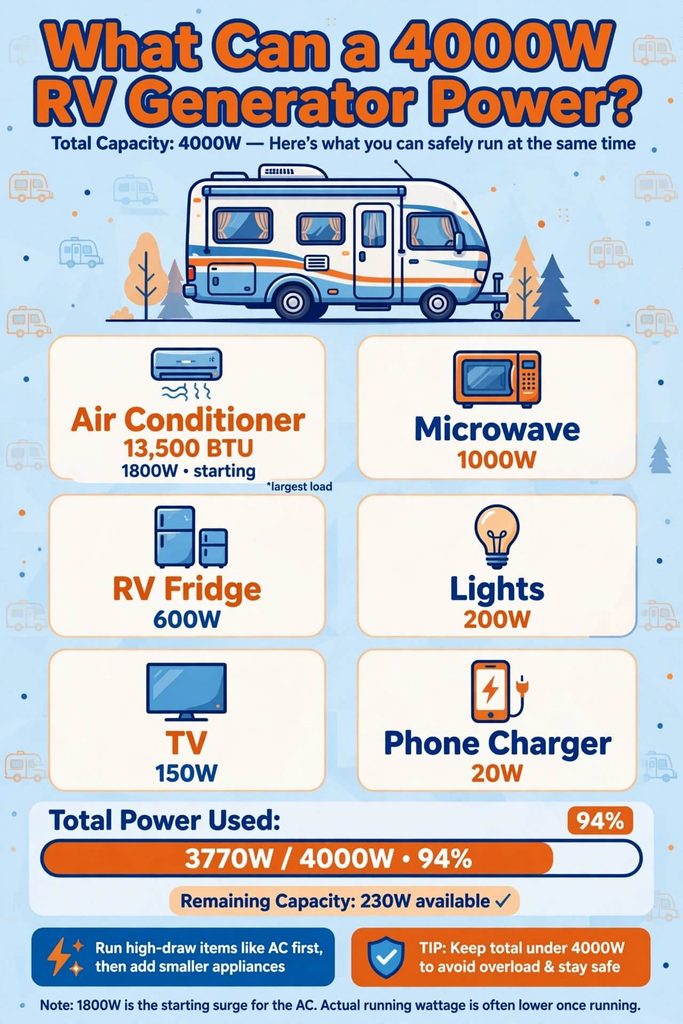
Start by adding the running wattage of the appliances you expect to use at the same time, then allow additional capacity for startup loads from motors and compressors.
An RV air conditioner is often one of the largest loads, but the generator also needs to handle other equipment that may be running at the same time. If your RV has a 13,500 BTU or 15,000 BTU air conditioner, check its electrical specifications rather than choosing a generator based on BTU alone.
Remember that starting watts and running watts are not the same thing. A generator may advertise a high starting-watt figure, but its rated or running-watt output is the number that matters for sustained loads.
2. Fuel Efficiency and Runtime
Compare runtime figures carefully because manufacturers usually publish them at a specific load, such as 25% load. A generator that runs for 10 hours at 25% load will not necessarily run for 10 hours while powering an RV air conditioner.
Propane runtime and output can also differ from gasoline performance, so check both sets of specifications before buying.
3. Noise Level
Noise matters in RV parks and other camping environments. Compare the manufacturer’s noise rating and make sure you are comparing measurements taken under similar conditions.
For example, the current Champion 4500W Dual Fuel model is rated at 61 dBA from 23 feet, while the WEN DF360iX is listed at 65 dBA at quarter load. Actual sound levels can change with electrical load and distance.
4. Portability
Consider both weight and how the generator is moved. A 50-pound-class inverter is much easier to load and unload than a 100-pound unit, but larger generators may compensate with wheels and telescoping handles.
Before buying, check the generator’s dimensions as well as its weight to make sure you have a practical place to transport and store it in your RV.
5. RV-Ready Outlets
For a typical 30-amp RV, look for a generator with a 120V TT-30R outlet. This allows you to connect the RV using the appropriate 30-amp RV cord without relying on adapters.
Also check whether the generator provides household outlets, USB ports, or parallel connections if those features matter to your setup.
If your RV uses a 50-amp connection, don’t assume that a generator with a TT-30R outlet can supply the full electrical capacity of the RV’s 50-amp service.
6. Inverter Technology
One reason inverter generators are popular for RV use is their ability to provide regulated electrical power for electronics. However, specifications vary by model, so check the manufacturer’s stated THD rating instead of assuming every inverter generator meets the same specification.
Several of the models in this guide are rated at less than 3% THD.
7. Carbon Monoxide Safety
Never operate a portable generator inside an RV, inside a garage, or in another enclosed or partially enclosed area. Generator exhaust contains carbon monoxide, which can build up quickly in enclosed spaces.
Use the generator outdoors and position it so exhaust is directed away from the RV, doors, windows, vents, and other openings.
A built-in CO shutdown system is an additional safety feature, not a replacement for proper generator placement and ventilation.
Conclusion: Choosing a Dual Fuel Inverter Generator for Your RV
The right dual fuel inverter generator depends on how much power your RV actually needs. The WEN DF680iX is aimed at RV owners who need substantially more output, while the Champion 4500W Dual Fuel provides more running-watt capacity for larger electrical loads.
The Champion 4000W, Westinghouse iGen4000DFc, and WEN DF360iX are suited to RV owners who place more emphasis on portability and moderate power requirements.
Before buying, compare rated watts rather than focusing only on the advertised starting-watt figure. Also check the generator’s TT-30R connection, propane and gasoline output, noise rating, runtime at a comparable load, weight, and carbon monoxide safety features.
For 2026, the most important thing is not simply choosing the generator with the highest wattage. Choose a model that matches your RV’s electrical requirements while remaining practical to transport, operate, and store.