As an Amazon Associate I earn from qualifying purchases.
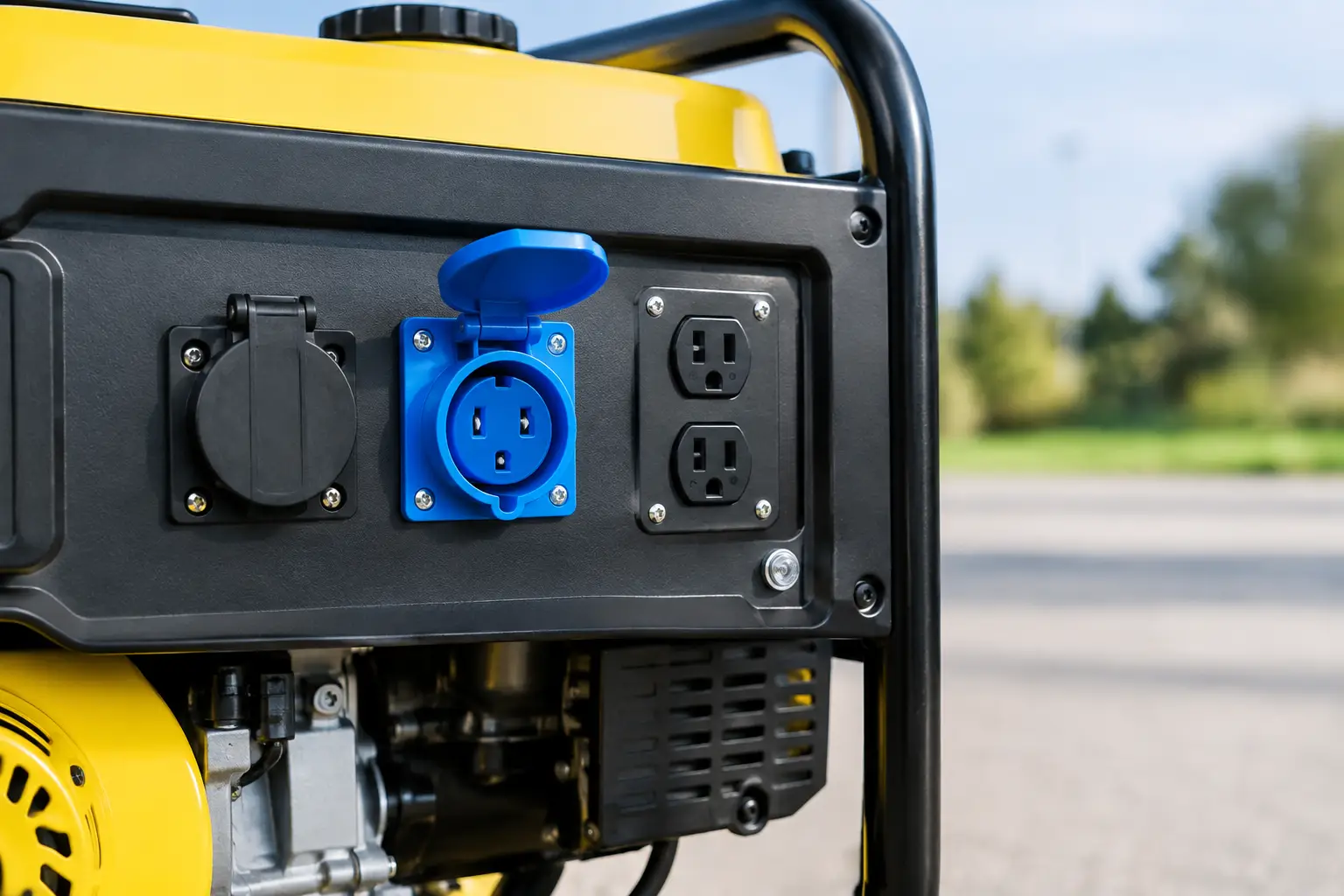
A generator can have enough running watts to power your refrigerator, well pump, RV, or workshop tools and still be the wrong choice for your equipment if it has the wrong outlets. Generator receptacle types determine which plugs fit, what voltage is available, and how much current a connection is designed to handle.
The most common generator outlets include 5-20R household receptacles, L5-30R locking outlets, TT-30R RV outlets, L14-30R transfer-switch connections, and 14-50R outlets for larger loads. Although some have the same amperage rating, they are not interchangeable.
If you’re shopping for a portable generator, choosing a power cord, or planning a home backup system, start by identifying the receptacle configuration rather than judging an outlet by its appearance.
Generator Receptacle Types at a Glance
Use this table to compare common North American generator outlets before looking at the details.
| Receptacle type | Nominal voltage | Amperage | Common application | |—|—|—|—| | NEMA 5-15R | 120 V | 15 A | Household appliances and light-duty equipment | | NEMA 5-20R | 120 V | 20 A | Tools, appliances, and heavier household loads | | NEMA L5-30R | 120 V | 30 A | Higher-capacity 120 V equipment | | NEMA TT-30R | 120 V | 30 A | RVs with 30-amp service | | NEMA L14-30R | 120/240 V | 30 A | Portable generator home backup | | NEMA 14-50R | 120/240 V | 50 A | 50-amp RVs and compatible high-capacity connections | | California Standard CS6364 family | Depends on exact model | Commonly 50 A | Heavy-duty portable power and distribution equipment |
These are common configurations, not a list of outlets found on every generator. Always verify the exact designation, voltage, amperage, breaker rating, and wiring diagram in the manufacturer’s documentation. California Standard connections, in particular, should be identified by their exact model rather than assumed to be interchangeable with NEMA outlets.
How to Read Generator Receptacle Numbers
NEMA configurations use letters and numbers to identify standardized plug and receptacle designs. Once you understand the code, you can narrow down the correct cord or adapter without guessing from the shape alone.
Take L14-30R as an example:
- L identifies a locking configuration.
- 14 identifies the particular NEMA configuration.
- 30 indicates a 30-amp rating.
- R means receptacle, the female connection.
- P means plug, the male connection.
For example, an L14-30R receptacle accepts the matching L14-30P plug. An L5-30P may also have a 30-amp rating, but its configuration and electrical capabilities are different.
The most important rule is simple: match the complete designation, not just the amperage. A 30-amp plug does not automatically fit every 30-amp outlet, and the same applies to 50-amp connections.
Voltage, Amperage, and Generator Wattage
Three electrical ratings determine whether a generator outlet is suitable for your equipment: voltage, amperage, and the generator’s available power.
120-volt versus 120/240-volt outlets
A 120 V receptacle is suitable for many household appliances, lights, battery chargers, and portable tools.
A 120/240 V receptacle provides two 120 V hot legs and can supply compatible 240 V equipment. It can also supply 120 V loads when the generator and connection are correctly configured.
This distinction matters when powering a well pump, workshop machine, or selected household circuits during an outage. A 120 V L5-30R cannot become a true 120/240 V source simply by using an adapter.
How many watts can a generator outlet provide?
A useful first calculation is:
Watts = Volts × Amps
For example:
- A 120 V, 20 A connection has a nominal capacity of 2,400 watts.
- A 120 V, 30 A connection has a nominal capacity of 3,600 watts.
- A 120/240 V, 30 A connection can provide up to 7,200 volt-amperes across both legs under balanced conditions and within its ratings.
- A 120/240 V, 50 A connection can provide up to 12,000 volt-amperes across both legs under balanced conditions and within its ratings.
These calculations are not a guarantee of usable continuous wattage. Actual output depends on the generator’s rated capacity, the receptacle’s circuit breaker, the load distribution between the two legs, and the equipment connected.
A generator rated for 5,000 running watts cannot deliver 7,200 watts just because it has an L14-30R outlet. The generator’s overall output and the outlet’s individual limits both matter.
Common 120-Volt Generator Receptacles
NEMA 5-15R and 5-20R household outlets
The 5-15R is the familiar three-slot household receptacle rated for 125 V and 15 A. The 5-20R is rated for 125 V and 20 A and usually has a T-shaped neutral slot that distinguishes it from a standard 15-amp receptacle.
These outlets are common on portable and inverter generators used for lights, refrigerators, fans, chargers, and smaller power tools.
Before connecting equipment, check whether multiple receptacles share the same breaker or a combined output limit. Two outlets do not necessarily provide twice the available power.
Cord selection matters, too. Long or undersized extension cords can cause excessive voltage drop and overheating. Use grounded, outdoor-rated cords with a wire gauge appropriate for the load and cord length. Keep connections dry and inspect cords for damaged insulation, loose plugs, or exposed conductors.
NEMA L5-30R locking outlet
The L5-30R is a 125 V, 30 A locking receptacle. Its matching plug twists into place, helping prevent accidental disconnection when a cord is pulled or equipment vibrates.
It is useful for higher-capacity 120 V applications, including compatible distribution equipment and certain portable power setups.
However, the L5-30R is a 120 V configuration. It does not provide the two hot legs required for a conventional 120/240 V home backup connection. If your well pump or other equipment requires 240 V, verify that the generator has a suitable outlet and sufficient output.
NEMA TT-30R RV receptacle
The TT-30R is a 125 V, 30 A receptacle designed for RVs with 30-amp service. It is common on generators marketed for camping and travel trailers.
Although the amperage rating matches the L5-30R, the two outlets have different plug configurations. They should not be treated as interchangeable simply because both are rated for 30 A.
A generator with a TT-30R can simplify an RV setup by allowing the appropriate RV power cord to connect directly. Before running the air conditioner, microwave, electric water heater, and battery charger together, check the generator’s available running watts and the combined demand of those appliances.
A 30-amp RV connection supplies 120 V, not 240 V. This is one of the most important distinctions to understand when comparing generator receptacles.
120/240-Volt Generator Receptacles
NEMA L14-30R: A common home backup connection
The L14-30R is a 125/250 V, 30 A, four-wire locking receptacle. It has two hot conductors, a neutral, and an equipment grounding conductor.
It is commonly used with compatible generator cords, inlet boxes, and transfer equipment for selected household circuits. A properly designed 30-amp system may support a refrigerator, lighting, a furnace blower, a sump pump, and other selected loads, provided the total demand stays within the generator’s capacity.
An L14-30R is commonly paired with a 30-amp generator cord.
The cord, inlet, transfer switch, and generator must all be compatible. A 30-amp inlet does not increase the generator’s output, and a transfer switch does not eliminate the need to manage connected loads.
For home backup, use a properly installed transfer switch or approved panel interlock and inlet arrangement. Have a qualified electrician verify the installation against applicable electrical codes and the equipment manufacturer’s instructions.
NEMA 14-50R: A common 50-amp connection
The 14-50R is a 125/250 V, 50 A, four-wire straight-blade receptacle. It is commonly used for 50-amp RV service and may also be installed on larger portable generators.
Its four conductors serve two hot legs, a neutral, and an equipment grounding connection. Unlike a locking receptacle, the plug does not twist into place.
For an RV, a 14-50R can provide the connection required by a compatible 50-amp shore-power cord. The generator must still have enough running watts to operate the air conditioners and other equipment you intend to use.
A compatible 50-amp generator extension cord may be appropriate for certain setups, but confirm the plug configuration, cable rating, and intended application before purchasing.
A 14-50R may also be used in a properly designed backup-power setup. The correct inlet and transfer equipment must match the connection, and the generator must support the intended load.
What about L14-50R and other high-capacity locking outlets?
Do not assume that every locking receptacle with a 50-amp rating belongs to the same standardized configuration. L14-30R is a common NEMA designation for a 30-amp, 125/250 V locking connection. A supposed L14-50R should not be treated as an ordinary, interchangeable NEMA standard without checking the exact manufacturer’s specifications.
Some generators use other locking configurations or proprietary high-capacity connections. Their voltage, conductor arrangement, and compatible accessories must be verified from the product documentation.
California Standard CS6364 connections
California Standard connectors are another family of heavy-duty locking connections used in portable power and distribution equipment. Certain models are rated for 50 A and use a four-wire arrangement, but the exact electrical ratings and mating configuration depend on the specific model.
A California Standard connection is not interchangeable with a NEMA L14-30R or 14-50R simply because the amperage appears similar.
If your generator has a CS-style outlet, identify the exact model and purchase a compatible cord or distribution accessory. Do not rely on a generic “50-amp generator cord” description alone.
Which Generator Receptacle Do You Need?
The best outlet depends on what you want to power and how you plan to connect it.
| Intended use | Receptacle to consider | What to verify | |—|—|—| | Lights, chargers, and small appliances | 5-15R or 5-20R | Circuit rating and extension cord capacity | | Higher-capacity 120 V equipment | L5-30R | Confirm that all loads operate at 120 V | | Travel trailer with 30 A service | TT-30R | RV power cord and generator running watts | | Selected household circuits during an outage | L14-30R | Transfer switch, inlet, cord, and generator capacity | | RV with 50 A service | 14-50R | RV requirements and available generator output | | Heavy-duty distribution equipment | Exact compatible CS-style connection or other specified configuration | Manufacturer’s wiring and accessory specifications |
For a small workshop, a generator with household outlets may be adequate for chargers and light-duty tools. Equipment with a high starting current, such as some pumps and motors, may require more capacity than its normal running wattage suggests.
For a one-house backup system, choose the generator based on the circuits you need to run rather than the largest receptacle available. If you have a 240 V well pump, for example, a generator with only 120 V outlets will not meet that requirement.
Generator Adapters: What They Can and Cannot Do
Adapters are useful when the generator outlet and the equipment cord use compatible electrical arrangements but different plug configurations. They do not create extra generator capacity or change the source voltage.
Before using an adapter, verify all of the following:
- The input and output voltage are appropriate for the equipment.
- The adapter has the correct conductor arrangement, including neutral and ground where required.
- Its current rating is suitable for the intended load.
- The connected cord, receptacle, and circuit protection are correctly rated.
- The adapter is listed or otherwise approved for its intended use and suitable for the environment.
For example, an adapter may let you connect a lower-rated cord to a higher-capacity generator outlet, but the connected equipment remains limited by the lower-rated components and their protection. Never assume that an adapter makes a 120 V outlet suitable for a 240 V appliance.
Avoid homemade adapters, exposed live conductors, and double-male cords sometimes called suicide cords. Never plug a generator into a household wall outlet to energize a home circuit. This can create dangerous backfeed conditions and expose utility workers and other people to energized wiring.
Grounding, Neutral Bonding, and GFCI Protection
Generator receptacles are only one part of electrical compatibility. Grounding, neutral bonding, and ground-fault circuit interrupter (GFCI) protection also affect how a generator should be connected.
Some portable generators have a floating neutral, while others have a neutral bonded to the frame. The correct arrangement depends on the generator’s design, how it is being used, and the transfer equipment involved.
Do not install a bonding plug or modify the generator’s wiring simply because an online recommendation describes a different model. Follow the owner’s manual and the transfer equipment manufacturer’s instructions. A qualified electrician should confirm compatibility when connecting a portable generator to a home’s electrical system.
GFCI protection helps reduce shock hazards, particularly where electrical equipment may be exposed to damp conditions. If a GFCI trips, identify and correct the underlying problem rather than bypassing the protection.
Never operate a portable generator in a garage, basement, or other enclosed space. Keep it outdoors, away from doors, windows, and vents, following the manufacturer’s clearance instructions to reduce carbon monoxide exposure.
Common Generator Receptacle Mistakes to Avoid
Several mistakes can lead to equipment damage, overheating, or electrical hazards.
Choosing by amperage alone: A TT-30R and L5-30R are both 30 A, 120 V configurations, but their plug patterns differ. An L14-30R adds a different conductor arrangement and 120/240 V capability.
Assuming the outlet determines generator wattage: A receptacle’s rating is not the same as the generator’s total rated output. Check both.
Using an undersized cord: A cord can physically fit and still be unsuitable for the load or distance. Check its ampacity, length, conductor size, and environmental rating.
Overloading the generator: Motors and compressors may draw significantly more current during startup. Account for starting demand as well as normal running loads.
Connecting incompatible RV equipment: A 30-amp RV service is normally 120 V, while a 50-amp RV connection typically uses 120/240 V. Confirm the RV’s requirements before choosing an adapter.
Improvising a home connection: Use an approved transfer arrangement installed in accordance with applicable codes. Never backfeed a home through a wall receptacle.
Frequently Asked Questions
How do I identify the outlets on my generator?
Look for the designation printed beside the receptacle or in the owner’s manual. Codes such as 5-20R, TT-30R, L5-30R, L14-30R, and 14-50R identify specific configurations. Confirm the voltage and amperage on the generator’s specifications before buying a cord.
What is the difference between TT-30R and L14-30R?
A TT-30R is a 125 V, 30 A RV receptacle intended for 30-amp RV service. An L14-30R is a 125/250 V, 30 A, four-wire locking receptacle commonly used for compatible home backup equipment. They have different plug configurations and electrical capabilities.
Can a 30-amp generator power a house?
It can power selected household circuits if the generator provides the required voltage, has sufficient running and starting capacity, and connects through correctly rated transfer equipment. It will not necessarily power every appliance simultaneously. Large heating and cooling equipment may exceed the available capacity.
Can I use a 50-amp cord on a 30-amp generator?
Only if the connection is made with a properly rated, compatible adapter or cord assembly designed for that application. The available power remains limited by the generator, its outlet, and the lowest-rated component in the connection. A larger cord does not increase the generator’s output.
Is a locking generator outlet better than a straight-blade outlet?
A locking outlet helps prevent accidental disconnection, which can be useful for portable equipment and certain backup connections. A straight-blade outlet may be entirely appropriate for an RV or another application designed around that configuration. The correct choice depends on the equipment, environment, and manufacturer’s specifications.
Final Checklist Before Buying a Generator Cord
Before ordering a generator cord, adapter, or inlet box, check these five items:
- Exact receptacle designation: Match the complete configuration, not just the amperage.
- Voltage: Confirm whether your equipment needs 120 V or 120/240 V.
- Amperage and wire rating: Check the cord, adapter, inlet, and connected equipment.
- Generator output: Make sure the generator can handle both running loads and motor startup demands.
- Connection safety: For home backup, use a properly installed transfer switch or approved interlock arrangement, and follow the generator manufacturer’s grounding and neutral-bonding instructions.
The right generator receptacle is the one that matches your equipment and delivers the power your generator can safely supply. Once you understand the difference between household, RV, locking, and high-capacity connections, choosing the correct cord or planning a backup-power setup becomes much easier.