As an Amazon Associate I earn from qualifying purchases.
If your home has a natural gas connection, a tri-fuel generator can give you another option when the power goes out. Instead of depending entirely on gasoline stored at home, you can run a compatible generator on gasoline, propane, or natural gas, switching between fuels when conditions change.
For home backup, however, the most important number is not the headline wattage on the box. If you plan to use natural gas most of the time, you need to look at the generator’s rated or running watts on natural gas. Natural gas usually produces less power than gasoline, so sizing the generator from its gasoline rating can leave you with less available capacity than expected.
I compared the specifications and features of several high-output tri-fuel generators for 2026, including their natural-gas output, 120/240V capability, transfer-switch readiness, starting systems, CO protection, and overall suitability for home backup.
Featured Natural Gas Generators
| Generator | Gasoline Running Watts | Natural Gas Running Watts | Fuel Type | Best Use |
|---|---|---|---|---|
| Westinghouse 14500W Tri-Fuel | Up to 11,500W | Up to 9,500W | Gas, Propane, Natural Gas | Larger home backup |
| WEN TF1450X | 11,500W | 8,750W | Gas, Propane, Natural Gas | Flexible home backup |
| Westinghouse 18,000W Tri-Fuel | Varies by configuration | Verify current listing | Gas, Propane, Natural Gas | High-output applications |
| DuroMax XP13000HXT | 10,500W | 8,500W | Gas, Propane, Natural Gas | High-demand backup |
| Westinghouse 13,500W Tri-Fuel | Model dependent | Model dependent | Gas, Propane, Natural Gas | Medium to large loads |
Important: Generator specifications can vary by model revision and fuel. Always verify the current manufacturer’s specifications before installation.
Westinghouse 14500W Tri-Fuel Generator
Check Amazon Price Click Here!
The Westinghouse 14500W Tri-Fuel is designed for homeowners who need substantial portable backup power without moving to a permanently installed standby generator.
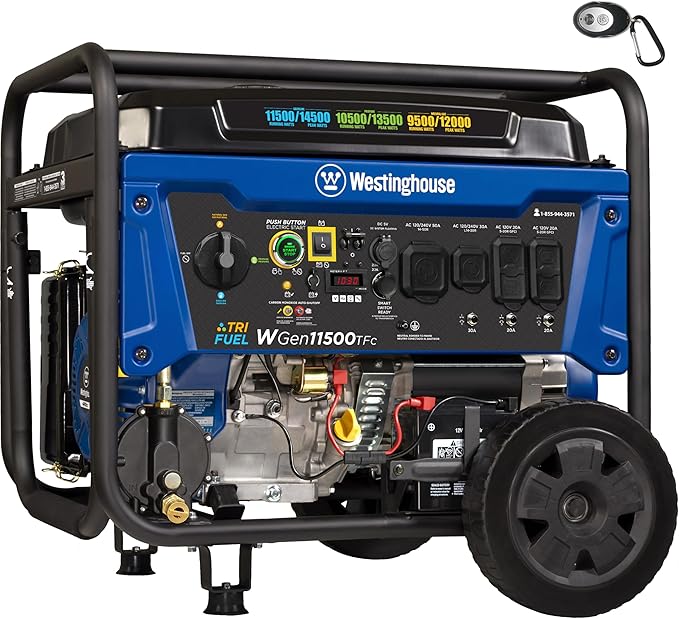
One important detail is that the advertised wattage changes depending on the fuel being used. The current Westinghouse WGen11500TFc, for example, is rated at 14,500 peak and 11,500 running watts on gasoline, compared with 13,500 peak and 10,500 running watts on propane and 12,000 peak and 9,500 running watts on natural gas.
That difference matters when planning your home backup system.
If natural gas is your primary fuel, the 9,500 running-watt rating is the figure you should use when determining which appliances and circuits you can operate simultaneously.
The generator is also designed for home backup applications, with 120/240V output and transfer-switch compatibility. Westinghouse lists remote and electric starting, a 550cc engine, a 9.5-gallon gasoline tank, and up to 19 hours of runtime at a 25% load when operating on gasoline.
Key features
- Tri-fuel operation
- Up to 11,500 running watts on gasoline
- Up to 10,500 running watts on propane
- Up to 9,500 running watts on natural gas
- 120/240V output
- Transfer-switch ready
- Remote and electric start
- Carbon monoxide sensor
- Large 9.5-gallon gasoline tank
- Heavy-duty 550cc engine
For a homeowner with a natural gas connection who also wants gasoline and propane available as backup fuel sources, this type of high-output tri-fuel generator offers considerable flexibility.
WEN TF1450X 14,500W Tri-Fuel Generator
Check Amazon Price Click Here!
The WEN TF1450X is another high-output option worth considering if you want a portable generator that can use all three major fuel sources: gasoline, propane, and natural gas.
WEN currently lists the TF1450X at 14,500 surge watts and 11,500 running watts on gasoline. On propane, it produces 12,500 surge watts and 10,300 running watts, while natural gas provides 10,500 surge watts and 8,750 running watts.
That makes the natural-gas rating particularly important for buyers who plan to connect the generator to a household gas supply.
The TF1450X operates at 120V and 240V, making it suitable for appropriately configured transfer-switch applications. It includes an electric starter with recoil backup and has a 500cc four-stroke OHV engine.
WEN also includes a natural-gas quick-connect adapter, although the manufacturer notes that the natural-gas hose itself is sold separately.
Key features
- 14,500 surge watts on gasoline
- 11,500 running watts on gasoline
- 10,300 running watts on propane
- 8,750 running watts on natural gas
- 120/240V operation
- Electric start with recoil backup
- 500cc OHV engine
- CO Watchdog automatic shutdown
- Transfer-switch-ready outlets
- Natural-gas quick-connect adapter
- Three-year limited warranty
The WEN is particularly interesting if you want high output while keeping the option to switch between three fuel sources.
Westinghouse 18,000W Tri-Fuel Generator
Check Amazon Price Click Here!
An 18,000-watt-class generator is aimed at buyers with significantly higher electrical demands than the average portable generator user.
This type of generator can make sense for larger homes, properties with multiple high-demand appliances, workshops, or situations where several essential circuits need to operate simultaneously.
However, buyers should pay close attention to the exact model number and current specification sheet. Generator wattage is often advertised using the gasoline peak rating, while the continuous rating is lower. The natural-gas output can be lower still.
That means you should never assume that an 18,000-watt gasoline peak rating equals 18,000 watts of continuous natural-gas power.
Before buying, check:
- Gasoline peak and running watts
- Propane peak and running watts
- Natural-gas peak and running watts
- 120/240V output
- Transfer-switch compatibility
- Required natural-gas pressure
- Outlet configuration
- CO protection
- Warranty and current model documentation
If you already have a transfer-switch installation and need more capacity than a 9,000-watt-class natural-gas generator can provide, a larger model may be worth considering. Just make sure the actual natural-gas rating matches your electrical requirements.
DuroMax XP13000HXT Tri-Fuel Generator
Check Amazon Price Click Here!
The DuroMax XP13000HXT is a true tri-fuel generator, not simply a dual-fuel model that can potentially be converted later. It is designed to operate on gasoline, propane, or natural gas.
DuroMax lists 13,000 peak watts and 10,500 running watts on gasoline, 12,000 peak and 9,500 running watts on propane, and 11,000 peak and 8,500 running watts on natural gas.
That 8,500-watt natural-gas running rating is the number to use when planning a natural-gas-powered home backup setup.
The generator uses a 500cc four-stroke OHV engine and provides 120/240V output. DuroMax also lists a 50A connection suitable for appropriately installed home-transfer applications.
Another useful feature is the built-in CO Alert system, which can automatically shut the generator down when dangerous carbon monoxide levels are detected.
Key features
- True tri-fuel operation
- 10,500 running watts on gasoline
- 9,500 running watts on propane
- 8,500 running watts on natural gas
- 120/240V output
- 500cc OHV engine
- Electric start
- CO Alert
- 50A outlet
- Transfer-switch compatible
- Natural-gas pressure requirement listed by the manufacturer
DuroMax specifies a natural-gas pressure requirement of 6.0 to 9.0 inches of water column and lists a full-load natural-gas requirement of approximately 225,000 BTU.
That information is important because having a natural-gas line at the house does not automatically mean the line has sufficient capacity for a large portable generator. Your gas system should be evaluated according to the generator manufacturer’s requirements and applicable local codes.
Westinghouse 13,500W Tri-Fuel Generator
Check Amazon Price Click Here!
A 13,500-watt-class tri-fuel generator can be a practical middle ground for homeowners who want substantial backup capacity without going all the way to the largest portable units.
The key consideration is once again the fuel-specific output.
If natural gas is your intended primary fuel, don’t size the system according to the 13,500-watt peak number shown in the product name. Instead, look for the model’s natural-gas running-watt rating and compare that figure with the loads you actually expect to operate.
Potential household loads can include:
- Refrigerator and freezer
- Lighting
- Internet equipment
- Television
- Sump pump
- Furnace blower
- Gas furnace controls
- Garage door opener
- Well pump
- Selected kitchen appliances
- Air conditioning, depending on generator capacity and startup requirements
The exact combination depends on your home’s electrical system and the starting requirements of individual appliances.
Natural Gas Generator Comparison: What the Numbers Really Mean
One of the biggest mistakes people make when shopping for generators is looking only at the largest wattage printed in the product name.
A generator can have three different output figures depending on the fuel and whether the number represents surge/peak or running/rated power.
For example, the DuroMax XP13000HXT is listed at:
- 13,000 peak / 10,500 running watts on gasoline
- 12,000 peak / 9,500 running watts on propane
- 11,000 peak / 8,500 running watts on natural gas
The same principle applies to the WEN TF1450X, which provides 11,500 running watts on gasoline but 8,750 running watts on natural gas.
Why running watts matter more
Running watts are the amount of power the generator is designed to provide continuously.
Peak or surge watts are additional short-term capacity available for starting certain motor-driven appliances.
Air conditioners, refrigerators, pumps, and some power tools can require considerably more power when their motors start than when they are already running.
For home backup, therefore, you need to consider both numbers, but the running-watt rating is the starting point for calculating your continuous electrical load.
How Many Watts Do You Need for Home Backup?
You don’t necessarily need to power everything in your house during an outage.
Many homeowners instead create a list of essential loads and use a transfer switch or other approved electrical solution to supply those circuits.
For example, a simplified backup plan might include:
| Appliance or Load | Approximate Running Power |
|---|---|
| Refrigerator | 100–800W |
| Freezer | 100–700W |
| LED lighting | 50–300W |
| Wi-Fi router | 10–30W |
| Television | 50–200W |
| Sump pump | 800–1,500W |
| Furnace blower | 400–800W |
| Microwave | 1,000–1,500W |
| Portable electric heater | 1,500W+ |
| Central air conditioner | Highly variable |
These are only rough planning ranges. Always check the actual nameplate, owner’s manual, or manufacturer specifications for your equipment.
Motor-driven appliances also have startup requirements that can be significantly higher than their running consumption.
This is why simply adding the numbers from a generic wattage chart is not enough when sizing a generator for an entire home.
Natural Gas vs. Gasoline vs. Propane
The biggest advantage of a tri-fuel generator is flexibility.
Natural Gas
Natural gas can be particularly convenient for stationary home backup because it is delivered through a utility line rather than stored in portable containers.
That means you don’t have to keep multiple gasoline cans filled before every storm.
The limitation is that your home’s natural-gas system must provide the pressure and flow required by the generator. The utility supply can also be affected by an emergency.
Gasoline
Gasoline generally provides the highest output on many tri-fuel generators.
It is also widely available in normal conditions.
The downside is storage. Gasoline needs proper storage and maintenance, and fuel availability can become an issue during widespread outages.
Propane
Propane is convenient for longer-term storage and can provide another backup option if gasoline is unavailable.
However, propane also produces different wattage and runtime figures than gasoline, so those numbers should be checked before making a purchase.
Why Tri-Fuel Makes Sense
The main advantage is not simply that the generator produces more power.
It is that you have three fuel options.
If gasoline is unavailable, you may have propane. If propane supplies become inconvenient, natural gas may remain available. That flexibility can be valuable during a prolonged outage.
Can a Natural Gas Generator Power an Entire House?
Sometimes, but it depends on the generator and the home’s electrical loads.
A large portable tri-fuel generator can provide substantial backup power, but it should not automatically be described as capable of powering every appliance in every home.
Central air conditioning, electric water heaters, electric ranges, well pumps, heat pumps, and other large loads can consume significant amounts of electricity.
The correct approach is to determine:
- Which appliances you actually need during an outage.
- Their running wattage.
- Their starting or surge requirements.
- Whether they operate at 120V or 240V.
- Which circuits should be backed up.
- Whether your generator has enough natural-gas output to handle those loads.
A licensed electrician can help determine the appropriate transfer equipment and circuits for your home.
Do You Need a Transfer Switch?
If you want to connect a portable generator to your home’s electrical panel, you need an appropriately rated and code-compliant method of connection.
A transfer switch can isolate selected household circuits from the utility supply while allowing the generator to power them.
This is important because a portable generator should not be connected to a household electrical panel through an improvised connection or by backfeeding a standard outlet.
The National Fire Protection Association recommends having a properly rated transfer switch installed by a qualified electrician when connecting a portable generator to house wiring.
Before buying a generator, check whether its output configuration matches the transfer equipment you plan to use.
Natural Gas Generator Safety
Fuel flexibility should never be confused with indoor safety.
A portable generator produces carbon monoxide, regardless of whether you plan to use gasoline, propane, or natural gas. Carbon monoxide is colorless and odorless and can become deadly quickly.
The U.S. Consumer Product Safety Commission recommends operating portable generators outside and at least 20 feet from the home, with the exhaust directed away from windows, doors, and vents.
Never operate a portable generator:
- Inside your home
- In a garage
- In a basement
- In a crawlspace
- Inside a shed
- On an enclosed porch
- Near doors, windows, or ventilation openings
Opening a garage door or window does not make an unsafe location safe.
A built-in CO shutdown system is an important safety feature, but it does not replace proper generator placement.
The CPSC specifically warns consumers not to rely on CO shutoff technology as a reason to operate a generator in an unsafe location.
You should also have functioning CO alarms in the home and follow the generator manufacturer’s instructions for operation, maintenance, fuel connections, grounding, weather exposure, and electrical connections.
What to Look for in a Natural Gas Generator
Before choosing a model, consider these features rather than focusing only on peak wattage.
1. Natural-Gas Running Watts
This is one of the most important specifications if natural gas will be your primary fuel.
2. 120/240V Output
For home backup, 120/240V capability can provide compatibility with appropriately configured transfer equipment and 240V loads.
3. Transfer-Switch Compatibility
Look for a generator with an outlet and configuration appropriate for your planned installation.
4. CO Shutdown Protection
A carbon monoxide sensor with automatic shutdown adds an important layer of protection.
5. Electric Start
Large generators are heavy. Electric starting is considerably more convenient than repeatedly pulling a recoil starter.
6. Fuel Selection
A true tri-fuel generator should clearly specify operation with gasoline, propane, and natural gas.
7. Natural-Gas Requirements
Check the required gas pressure and BTU demand before installation.
8. Runtime
Runtime figures should always be interpreted together with the fuel, tank size, and load percentage used for the manufacturer’s test.
9. Weight
Large portable generators can weigh well over 200 pounds. Wheels and handles are useful, but don’t assume a heavy generator will be easy for one person to move.
10. Warranty and Parts Availability
A generator may sit unused for months and then become essential during a storm. Warranty coverage, replacement parts, and service availability matter.
Are Natural Gas Generators Worth It for Home Backup?
For a home that already has a suitable natural-gas connection, a tri-fuel portable generator can be an attractive backup-power solution.
The biggest benefit is fuel flexibility.
You can use gasoline when maximum output is important, propane when you prefer stored fuel, or natural gas when you want to avoid repeatedly refilling a gasoline tank.
The tradeoff is that natural gas usually produces less power than gasoline on the same generator. That’s why the natural-gas running-watt specification should be one of the first numbers you check.
For example, the WEN TF1450X drops from 11,500 running watts on gasoline to 8,750 running watts on natural gas.
The DuroMax XP13000HXT shows a similar pattern, going from 10,500 running watts on gasoline to 8,500 running watts on natural gas.
This isn’t necessarily a disadvantage. It simply means the generator needs to be sized according to the fuel you expect to use.
Natural Gas Generator FAQs
Can a portable generator run on natural gas?
Yes. A true tri-fuel generator is designed to operate on gasoline, propane, and natural gas. However, the generator must be specifically rated for natural gas, and the home’s gas connection must meet the manufacturer’s pressure and flow requirements.
Does a generator produce less power on natural gas?
Generally, yes. Many tri-fuel generators have lower running and peak wattage ratings on natural gas than on gasoline. Always use the manufacturer’s natural-gas rating when calculating your available backup capacity.
Can I connect a natural gas generator directly to my house?
The generator should not be connected to household wiring through an improvised method. If you want to power selected home circuits, use an appropriately rated transfer switch or other code-compliant connection installed by a qualified electrician.
How far should a portable generator be from my house?
The CPSC recommends operating portable generators outdoors at least 20 feet from the home, with exhaust directed away from windows, doors, and vents.
Is natural gas safer than gasoline for a portable generator?
Natural gas has different storage and handling characteristics than gasoline, but the generator still produces exhaust and carbon monoxide. Fuel choice does not eliminate the need for proper outdoor placement and CO protection.
Can a tri-fuel generator run continuously during a power outage?
A natural-gas connection can eliminate the need to repeatedly refill a gasoline tank, but continuous operation still depends on the generator’s design, maintenance requirements, gas supply, electrical load, and manufacturer instructions. Do not assume that any portable generator is intended to run indefinitely without scheduled maintenance.
What size natural gas generator do I need?
Start by adding the running wattage of the essential appliances you want to operate and account for motor-starting loads. Then compare that total with the generator’s natural-gas running-watt rating, not its gasoline peak rating.
Do I need a licensed electrician?
If you are connecting the generator to your home’s electrical system through a transfer switch or similar equipment, professional installation is strongly recommended and may be required by local codes. The exact requirements vary by location and installation.
Final Thoughts
The best natural gas generator for your home depends less on the biggest number printed on the box and more on how much power you actually need on natural gas.
The Westinghouse 14500W-class tri-fuel generator provides substantial capacity and fuel flexibility for larger backup loads, while the WEN TF1450X offers 120/240V operation, tri-fuel capability, electric start, and CO Watchdog protection. The DuroMax XP13000HXT is another high-output option, with 8,500 running watts available on natural gas according to DuroMax’s current specifications.
Before buying, compare the natural-gas running watts, transfer-switch compatibility, 120/240V output, natural-gas pressure requirements, CO protection, and warranty.
Most importantly, don’t size a generator from its gasoline peak-watt number alone. If natural gas is going to be your primary fuel during an outage, that is the rating that should guide your backup-power plan.
And regardless of which model you choose, portable-generator safety comes first: operate the unit outdoors, keep it at least 20 feet from the home, direct exhaust away from openings, and follow the manufacturer’s instructions and applicable electrical and fuel codes.