As an Amazon Associate I earn from qualifying purchases.
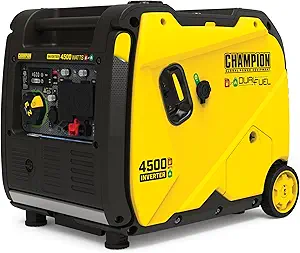
If you need portable power for an RV, campsite, tailgate, or essential home appliances during an outage, a dual-fuel inverter generator can give you more flexibility than a gasoline-only model. The Champion Power Equipment 201319 combines gasoline and propane operation with electric start, inverter technology, RV-ready connections, and a relatively low 61 dBA noise rating.
The big question in 2026 is whether this 4,500-watt Champion still makes sense when compared with newer portable generators.
For RV owners and people who want a portable backup generator for essential 120V loads, the Champion 201319 has a practical combination of power, fuel flexibility, runtime, and convenience. It is not a whole-house generator, however, and its nearly 100-pound weight is something you should consider before buying.
Check Amazon Price
Champion 201319 at a Glance
| Feature | Champion Power Equipment 201319 |
|---|---|
| Generator type | Dual-fuel inverter |
| Gasoline starting watts | 4,500W |
| Gasoline running watts | 3,500W |
| Propane starting watts | 4,500W |
| Propane running watts | 3,150W |
| Engine | 212cc Champion 4-stroke |
| Fuel | Gasoline or propane |
| Gasoline runtime | Up to 14 hours at 25% load |
| Propane runtime | Up to 21 hours with a 20-lb propane tank at 25% load |
| Noise level | 61 dBA at 23 feet |
| Start type | Electric and recoil |
| RV outlet | 120V 30A TT-30R |
| Household outlet | 120V 20A duplex |
| DC outlet | 12V regulated automotive-style |
| Parallel capable | Yes |
| CO protection | CO Shield automatic shutoff |
| THD | Less than 3% |
| Weight | 99.2 lb |
| Warranty | 3-year limited warranty |
What Is the Champion 201319?
The Champion 201319 is a 4,500-watt dual-fuel inverter generator designed primarily for recreational and portable backup applications.
It uses a 212cc engine and can operate on either gasoline or propane. On gasoline, it produces 4,500 starting watts and 3,500 running watts. When operating on propane, the starting output remains 4,500 watts while continuous output drops to 3,150 watts.
That distinction matters.
Starting watts provide extra power for appliances and equipment that require a surge when their motors start. Running watts are the amount of power the generator can continuously supply. When planning your load, the 3,500-watt gasoline rating or 3,150-watt propane rating is the number you should pay the most attention to.
The 201319 also uses inverter technology, which allows it to produce clean power with less than 3% total harmonic distortion. That makes it a more suitable choice for many modern electronics than a basic conventional generator.
Dual-Fuel Operation Is One of Its Biggest Advantages
The ability to use gasoline or propane is probably the most practical feature of the Champion 201319.
Gasoline gives you the higher 3,500-watt continuous output, while propane provides a convenient alternative when you prefer to keep gasoline use to a minimum or already store propane for other equipment.
Switching between the two fuel sources is handled through the generator’s EZ Start Dial.
This flexibility can be particularly useful during extended power outages. If gasoline becomes inconvenient to obtain, having a propane option gives you another way to keep the generator running.
There is a trade-off, though.
The generator produces 350 watts less continuous power on propane than on gasoline. Therefore, if you’re operating close to the generator’s maximum capacity, you need to account for that lower propane output.
For lighter loads, the difference may not matter much. For an RV air conditioner or several appliances running simultaneously, it can become more important.
How Long Does the Champion 201319 Run?
Runtime depends heavily on the electrical load, so the advertised maximum runtime should not be interpreted as how long the generator will run at full power.
Champion rates the 201319 for up to 14 hours on gasoline at a 25% load. With a 20-pound propane tank, the published runtime is up to 21 hours at a 25% load.
The gasoline tank holds approximately 2.25 gallons.
These numbers make the generator particularly attractive for overnight RV use or extended backup situations where minimizing refueling is important.
However, your actual runtime will change depending on what you connect to the generator. A refrigerator cycling occasionally will require much less energy than an air conditioner operating continuously, for example.
This is why the 25% load rating is best viewed as a comparison point rather than a guarantee of real-world runtime.
61 dBA Quiet Operation
Noise can make or break the experience of using a generator at a campsite.
Champion rates the 201319 at 61 dBA from 23 feet. That is considerably more appealing for RV camping than many traditional open-frame generators that produce substantially more noise.
The inverter design also allows the engine to adjust its speed based on the electrical demand when the appropriate operating mode is used.
For an RV owner, this can be useful when you need power without the constant loud engine sound associated with older portable generators.
Still, 61 dBA does not mean silent.
You should expect to hear the generator while it is running, especially when it is under heavier loads. Placement also matters. Hard surfaces can reflect sound, while nearby walls and structures can change how loud the generator seems.
Always follow campground rules regarding generator operating hours and placement.
Electric Start Makes a Difference
The Champion 201319 includes both electric and recoil starting.
The electric start is especially convenient when the generator is being used regularly. Instead of relying exclusively on a pull cord, you can start the engine with the push-button system.
The included battery powers the electric-start system.
The EZ Start Dial also simplifies the starting process by bringing the fuel and starting controls together in one location.
For emergency preparedness, this is more than a convenience feature. If you have to start the generator during a storm, cold weather, or a nighttime outage, a simple starting procedure can make the equipment easier to use.
Intelligauge Gives You More Useful Information
The built-in Intelligauge with Power Meter is another useful feature that the original article did not explain fully.
The display can provide information about:
- Voltage
- Frequency
- Current session runtime
- Total operating hours
- Power output
The power-output information is particularly useful because it gives you a quick indication of how much of the generator’s available capacity is being used.
That can help when adding appliances during an outage. Instead of guessing whether another load will push the generator too hard, you can monitor the output while operating your equipment.
The total operating-hours display is also useful for keeping track of maintenance intervals.
RV-Ready With a 30-A TT-30R Outlet
For RV owners, the Champion 201319 has one major advantage over many smaller portable generators: it includes a dedicated 120V 30A TT-30R RV outlet.
That means the generator is designed to connect directly to many RV electrical systems using the appropriate 30-amp generator cord.
The generator also includes a 120V 20A household duplex outlet and a regulated 12V DC automotive-style outlet.
The available connections are:
- One 120V 30A TT-30R RV outlet
- One 120V 20A household duplex outlet
- One 12V DC regulated automotive outlet
- Parallel connection capability
For many travel trailers and smaller RVs, this configuration makes more sense than buying a generator that requires additional adapters just to connect to the RV.
Keep in mind that having a 30A RV outlet does not mean the generator can supply unlimited power to every RV appliance simultaneously. You still have to stay within its running-watt capacity.
Can the Champion 201319 Run an RV Air Conditioner?
It can be a practical option for RV air-conditioning loads, but the answer depends on the specific air conditioner and what else is running.
The generator provides up to 3,500 running watts on gasoline and 3,150 running watts on propane, with 4,500 starting watts available for motor startup.
An RV air conditioner can draw significantly more power when its compressor starts than it does while running. Other appliances such as a microwave, refrigerator, coffee maker, or electric water heater can add to the load.
For that reason, you should check the electrical requirements of your particular RV equipment rather than assuming every combination will work simultaneously.
Many owner reviews report successful use with RV air conditioners, but individual results depend on the appliance configuration and electrical load.
CO Shield Adds an Important Safety Layer
The Champion 201319 includes CO Shield, an automatic carbon monoxide shutoff system.
The system monitors for carbon monoxide accumulation and can automatically shut down the engine if elevated CO levels are detected.
That is a useful safety feature, but it should never be treated as permission to operate the generator indoors.
A portable gasoline or propane generator produces carbon monoxide whenever the engine is running. The Champion 201319 must be operated outdoors and positioned away from occupied buildings, doors, windows, and vents.
Do not run it inside a garage, basement, shed, RV compartment, or other enclosed or partially enclosed space.
CO Shield is an additional safety system, not a replacement for proper generator placement and ventilation.
Clean Power for Electronics
The 201319 is an inverter generator and produces less than 3% THD.
That makes it suitable for many common electronic loads such as laptops, televisions, chargers, networking equipment, and other modern household electronics.
However, “clean power” should not be interpreted as a guarantee that every electronic or medical device can be connected without checking its requirements.
If you are powering medical equipment, always follow the equipment manufacturer’s instructions and electrical specifications.
For general household electronics, the inverter design is one of the advantages this model has over many conventional portable generators.
Parallel Capability Gives You a Path to More Power
The Champion 201319 is parallel capable.
With the appropriate optional parallel kit, compatible Champion inverter generators can be connected to increase the available power.
This can be useful for RV owners who eventually need more capacity than one generator can provide.
The optional setup can also provide a 50A RV connection through the parallel kit.
The important point is that parallel operation requires compatible equipment and the appropriate kit. It should not be assumed that any two generators can simply be connected together.
Portability: Convenient to Move, But Not Lightweight
At 99.2 pounds, the Champion 201319 is not a lightweight portable generator.
That is one of the biggest compromises of getting this much power in an inverter design.
The good news is that Champion includes solid wheels and a fold-down handle, making it considerably easier to move across a driveway, campsite, or other relatively smooth surface.
The bad news is that nearly 100 pounds is still nearly 100 pounds.
If you regularly need to lift the generator into a truck bed or trailer by yourself, its weight deserves serious consideration.
For storage and rolling transportation, however, the built-in mobility features make the size more manageable.
Maintenance Features
Champion includes several features intended to make routine maintenance easier.
The generator has a low-oil shutoff system, an oil drain tube, and a no-tool access panel for maintenance.
The engine uses 10W-30 oil, and the manufacturer lists an oil capacity of approximately 0.5 quart.
As with any gasoline generator, maintenance should not be ignored simply because the unit may be used only during emergencies.
If you keep gasoline in the system for long periods, fuel management becomes particularly important. Following the owner’s manual for storage, oil changes, fuel treatment, and periodic operation can help keep the generator ready when you actually need it.
Champion 201319 Technical Specifications
| Specification | Details |
|---|---|
| Model | Champion Power Equipment 201319 |
| Generator type | Inverter |
| Fuel | Gasoline and propane |
| Engine | 212cc, 4-stroke |
| Gasoline starting watts | 4,500W |
| Gasoline running watts | 3,500W |
| Propane starting watts | 4,500W |
| Propane running watts | 3,150W |
| Voltage | 120V |
| Frequency | 60Hz |
| Gasoline capacity | 2.25 gallons |
| Gasoline runtime | Up to 14 hours at 25% load |
| Propane runtime | Up to 21 hours with a 20-lb tank at 25% load |
| Noise | 61 dBA at 23 feet |
| Start system | Electric and recoil |
| RV outlet | 120V 30A TT-30R |
| Household outlet | 120V 20A duplex |
| DC outlet | 12V regulated automotive |
| THD | Less than 3% |
| Parallel capable | Yes |
| CO protection | CO Shield automatic shutoff |
| Weight | 99.2 lb |
| Dimensions | 23.2 x 17.7 x 20.1 inches |
| Warranty | 3-year limited warranty |
Champion 201319 for Home Backup Power
The 201319 can be useful during a power outage, but it is important to define what “home backup” means.
This is a portable 120V generator, not a whole-house standby generator.
It can provide power for selected essential loads such as:
- Refrigerator
- Freezer
- Lights
- Routers and networking equipment
- Televisions
- Chargers
- Small appliances
- Selected window or portable air conditioners
- Other compatible 120V equipment
The exact combination depends on the starting and running requirements of your appliances.
If you want to connect a portable generator to a home’s electrical system, use an appropriate transfer switch or other code-compliant equipment installed according to local requirements. Never attempt to backfeed a home through a standard wall outlet.
For larger homes or systems requiring 240V power, a larger generator or permanently installed standby system may be more appropriate.
Champion 201319 for RV Camping
RV use is where this generator makes particularly good sense.
The combination of a 30A TT-30R outlet, 4,500 starting watts, inverter power, electric start, and dual-fuel operation gives RV owners a useful combination of features.
It can provide enough capacity for many common RV electrical needs, although you still need to manage the total load.
Propane can also be convenient for RV owners who already carry propane tanks.
The 21-hour published runtime at 25% load is particularly attractive for overnight or extended camping because you don’t necessarily need to refuel every few hours.
What Owners Are Saying in 2026
Current retailer reviews provide a useful picture of how owners are using the generator.
Recent Lowe’s reviews repeatedly mention quiet operation, dual-fuel flexibility, electric starting, RV use, and backup power. Some owners also specifically mention using the generator during outages or with RV air conditioners.
The same reviews also reveal an important downside: the generator’s size and weight can be noticeable. Several owners describe it as easy to move with the wheels while acknowledging that it is still a roughly 100-pound machine.
That matches the published specification of 99.2 pounds.
Owner feedback should still be treated as individual experience rather than a guarantee of performance. Your results will depend on load, fuel, altitude, temperature, maintenance, and the particular appliances you connect.
Pros and Cons
Pros
- Dual-fuel operation with gasoline and propane
- 4,500 starting watts
- 3,500 running watts on gasoline
- 3,150 running watts on propane
- Electric start and recoil start
- RV-ready 30A TT-30R outlet
- 61 dBA published noise rating
- Inverter technology with less than 3% THD
- CO Shield automatic carbon monoxide shutoff
- Intelligauge with power-output information
- Up to 14 hours on gasoline at 25% load
- Up to 21 hours on a 20-lb propane tank at 25% load
- Parallel capability
- Wheels and fold-down handle
- 3-year limited warranty
Cons
- Nearly 100 pounds
- Propane provides less continuous power than gasoline
- Only 120V output
- Not designed to replace a whole-house standby generator
- Parallel kit is an additional purchase
- Actual runtime will be substantially shorter at higher loads
- Larger and heavier than many smaller RV inverter generators
Who Should Consider the Champion 201319?
The Champion 201319 makes the most sense if you want one generator that can handle several different roles.
It is particularly suited to:
RV owners: The 30A TT-30R outlet and 4,500-watt starting capacity make it a practical match for many 30A RV setups.
Campers: The 61 dBA rating and inverter design make it more suitable for recreational environments than many louder conventional generators.
Homeowners preparing for outages: Dual-fuel operation gives you another fuel option, while the 3,500-watt gasoline output can handle a useful collection of essential 120V loads.
Preparedness-focused buyers: Being able to store both gasoline and propane as available fuel sources can provide additional flexibility during extended outages.
Who Should Look Elsewhere?
The Champion 201319 is not necessarily the right generator for everyone.
A smaller inverter may make more sense if you mainly need to charge electronics, run a few lights, or power small camping equipment.
A larger generator may be preferable if you need substantially more continuous power.
And if your goal is automatic whole-house backup, especially for a home with 240V appliances, you should look at a properly sized standby generator and transfer-switch system instead.
The 201319 occupies a middle ground: more capable than a small suitcase-style inverter generator, but still portable enough to take camping or use as emergency backup.
Is the Champion 201319 Worth It in 2026?
The Champion Power Equipment 201319 remains a practical dual-fuel inverter generator in 2026, particularly for buyers who need a combination of RV compatibility, gasoline and propane operation, electric starting, and moderate portable backup capacity.
Its strongest points are easy to understand: 4,500 starting watts, 3,500 running watts on gasoline, 3,150 running watts on propane, a 30A RV outlet, 61 dBA operation, and up to 21 hours of advertised propane runtime at a 25% load.
The main compromises are equally clear.
At 99.2 pounds, this is not a generator you will want to carry long distances. It also produces only 120V power, and propane reduces its continuous output compared with gasoline.
For the right buyer, those limitations may be reasonable trade-offs for dual-fuel flexibility and RV-ready inverter power.
Final Verdict
The Champion 201319 is best viewed as a portable 4,500-watt-class dual-fuel inverter generator for RVs, camping, and essential 120V backup power.
It offers a useful balance between output and portability, while features such as electric start, CO Shield, Intelligauge, clean inverter power, and the 30A RV outlet make it easier to use than a basic conventional generator.
Its nearly 100-pound weight and 120V-only configuration are the two limitations to keep in mind.
If your priorities are dual-fuel flexibility, RV compatibility, quiet operation, electric start, and enough capacity for a range of essential loads, the Champion 201319 remains a model worth considering in 2026.
Check Amazon Price Click Here!