As an Amazon Associate I earn from qualifying purchases.
A power outage can change your plans quickly. Refrigerators stop running, heating and cooling systems may shut down, and essential devices can become difficult to keep charged. For RV owners, campers, and homeowners preparing for severe weather, having a portable generator ready can make a major difference.
A dual fuel generator gives you an important advantage over a gasoline-only model: you can run it on either gasoline or propane. Gasoline can provide higher output on many models, while propane is convenient to keep stored for emergencies because it does not degrade in the same way gasoline does.
The right choice, however, isn’t simply the generator with the biggest number on the box. You need to look at running watts, starting watts, fuel-specific output, runtime, noise, outlets, CO protection, portability, and whether the generator is compatible with your intended RV or home setup.
Below are five dual fuel generators from WEN and Westinghouse that cover different power requirements, from portable RV and recreational use to higher-output emergency backup.
Best Dual Fuel Generators for 2026
| Generator | Gasoline Output | Propane Output | Best For |
|---|---|---|---|
| WEN DF1100T | 8,300 running / 11,000 surge watts | 7,500 running / 9,500 surge watts | High-output emergency backup |
| Westinghouse WGen9500DF | 9,500 running / 12,500 peak watts | 8,500 running / 11,200 peak watts | Large home backup loads |
| WEN DF5600X | 4,500 running / 5,600 surge watts | 4,050 running / 5,000 surge watts | Mid-size home and RV use |
| Westinghouse 6,500-Watt Dual Fuel Generator | Up to 6,500 peak watts | Dual fuel | General backup and recreation |
| WEN DF680iX | 5,100 running / 6,800 surge watts | 4,500 running / 6,000 surge watts | RVs, electronics, and quieter operation |
Note: Starting or surge watts are the short-term power available for appliances with higher startup demands. Running or rated watts are the more important figure when determining what a generator can continuously support.
Why Choose a Dual Fuel Generator in 2026?
The biggest advantage of a dual fuel portable generator is simple: you have two fuel options.
That matters during an extended outage because fuel availability can change quickly. If gasoline is difficult to find, propane may still be available from a tank you already have. Conversely, gasoline can be useful when you need the higher output that many generators provide on gasoline.
Dual fuel generators are also useful outside emergency preparedness. Depending on the model, they can be used for:
- Home backup during power outages
- RV camping
- Tailgating
- Outdoor events
- Job sites
- Workshops
- Food trucks and mobile businesses
- Emergency charging
- Running selected household appliances
However, dual fuel does not mean that the generator produces identical power on both fuels. In many models, propane output is lower than gasoline output, so check the manufacturer’s specifications before sizing the generator for a particular appliance.
Gasoline vs. Propane: Which Fuel Should You Use?
There isn’t one correct fuel for every situation.
Gasoline
Gasoline is often the better choice when maximum output is important. Many dual fuel generators produce their highest rated and starting wattage when operating on gasoline.
The downside is storage. Gasoline can deteriorate over time, so long-term emergency storage requires proper fuel management and following applicable storage regulations.
Propane
Propane is attractive for emergency preparedness because properly stored propane can remain usable for a long time. It also gives you an alternative when gasoline is unavailable.
The tradeoff is that many generators produce fewer watts on propane.
For that reason, a practical emergency setup can involve keeping both fuels available rather than relying exclusively on one.
In-Depth Look at the Best Dual Fuel Generators
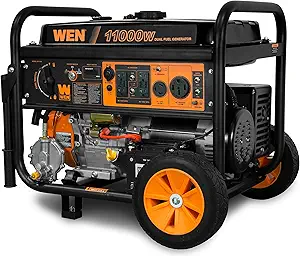
WEN DF1100T 11,000-Watt Dual Fuel Portable Generator
Check the WEN DF1100T on Amazon
Best for High-Output Emergency Backup
The WEN DF1100T is designed for situations where you need substantially more power than a compact RV generator can provide.
On gasoline, it produces up to 11,000 surge watts and 8,300 running watts. On propane, output drops to 9,500 surge watts and 7,500 running watts.
That distinction is important when planning your emergency loads.
The generator uses a 457cc four-stroke OHV engine and includes electric start. Its 6.6-gallon gasoline tank can provide up to 8.5 hours of runtime at half load according to WEN’s specifications.
It also has a 120/240V configuration, including a 50-amp NEMA 14-50R receptacle, making it more suitable for larger electrical loads and transfer-switch applications than smaller portable generators.
Key Features
- 11,000 starting and 8,300 running watts on gasoline
- 9,500 starting and 7,500 running watts on propane
- 457cc four-stroke OHV engine
- Electric start
- 120/240V operation
- 50A NEMA 14-50R outlet
- Four 120V GFCI outlets
- 6.6-gallon gasoline tank
- Up to 8.5 hours of runtime at half load
- Two-year warranty
Who Should Consider It?
The DF1100T makes the most sense for homeowners who need a higher-output portable generator for an outage and have a clear plan for which circuits or appliances they intend to power.
It can handle much more than a refrigerator and a few lights, but that doesn’t automatically mean it can power every appliance in a house simultaneously. Large HVAC systems, electric water heaters, electric ranges, well pumps, and other high-demand equipment can quickly consume available capacity.
Westinghouse WGen9500DF Dual Fuel Portable Generator
Check the Westinghouse WGen9500DF on Amazon
Best for Large Emergency Loads
The Westinghouse model in the original article was described simply as a 12,500-watt generator. A more useful way to identify it is by its actual model and output: the Westinghouse WGen9500DF.
It produces 12,500 peak watts and 9,500 rated watts on gasoline, while propane output is rated at 11,200 peak watts and 8,500 running watts.
That makes the difference between peak and continuous output especially important when comparing it with other generators.
Westinghouse lists up to 12 hours of runtime at 25% load using its 6.6-gallon gasoline tank. It also includes remote and electric starting and is designed to work with transfer and ST switches for home backup applications.
Key Features
- 12,500 peak / 9,500 running watts on gasoline
- 11,200 peak / 8,500 running watts on propane
- 457cc four-stroke OHV engine
- Remote and electric start
- 6.6-gallon fuel tank
- Up to 12 hours at 25% load
- 120/240V capability
- Transfer-switch ready
- GFCI protection
Who Should Consider It?
This generator is aimed at users who need a substantial amount of portable power during an outage.
It’s particularly relevant when you need to operate several larger household loads, but you should still calculate your actual running and starting wattage before connecting anything.
For a home installation, a properly installed transfer switch or other approved connection method is important. Never attempt to backfeed a house through a standard wall outlet.
WEN DF5600X 5,600-Watt Dual Fuel Portable Generator
Check the WEN DF5600X on Amazon
Best for Mid-Range Backup Power
The WEN DF5600X sits in a useful middle ground. It offers considerably more capacity than small recreational generators without moving into the size and weight of the largest home-backup models.
WEN rates it at 5,600 surge watts and 4,500 running watts on gasoline, with 5,000 surge watts and 4,050 running watts on propane.
It uses a 224cc engine and has electric start, along with a recoil starter as backup.
One of its more useful features for 2026 is the WEN Watchdog CO shutdown sensor, which automatically shuts down the generator if dangerous levels of carbon monoxide are detected around the unit.
The DF5600X also includes an RV-ready TT-30R outlet and a transfer-switch-ready L5-30R receptacle.
Key Features
- 5,600 starting / 4,500 running watts on gasoline
- 5,000 starting / 4,050 running watts on propane
- 224cc engine
- Electric and recoil start
- CO Watchdog shutdown sensor
- RV-ready TT-30R outlet
- Transfer-switch-ready L5-30R outlet
- 4.3-gallon gasoline tank
- Up to 12.5 hours at half load
- Three-year limited warranty
Who Should Consider It?
The DF5600X is a practical option if you want one generator that can cover a combination of home essentials, RV equipment, tools, and recreational loads without stepping up to a much larger generator.
Before buying, calculate the starting wattage of appliances such as refrigerators, sump pumps, air conditioners, and power tools. Several motors starting simultaneously can require considerably more power than their normal running wattage suggests.
Westinghouse 6,500-Watt Dual Fuel Generator
Check the Westinghouse dual fuel generator on Amazon
Best for General-Purpose Portable Power
The 6,500-watt-class Westinghouse dual fuel option provides a useful compromise for people who need more capacity than a compact recreational generator but don’t need a 10,000-watt-plus machine.
The original article presented this model mainly around its electric and recoil starting system. For a 2026 buying decision, however, the more important question is what you intend to power.
A generator in this class can be useful for selected home circuits, RV equipment, tools, refrigerators, lighting, and other moderate loads, depending on the specific running and starting wattage requirements.
Dual-fuel operation also gives you more flexibility when planning for an extended outage.
Key Features to Look For
- Gasoline and propane operation
- Electric start
- Recoil backup
- Portable wheel-and-handle design
- Multiple household outlets
- RV or transfer-switch compatibility, depending on configuration
- Emergency and recreational applications
Who Should Consider It?
This type of generator makes sense for someone who wants a versatile backup unit without going all the way to the largest portable models.
Because Westinghouse has multiple generators in this wattage range, verify the exact configuration, outlets, wattage ratings, and safety features shown on the current product listing before purchasing.
WEN DF680iX 6,800-Watt Dual Fuel Inverter Generator
Check the WEN DF680iX on Amazon
Best for RVs, Electronics, and Quieter Operation
The WEN DF680iX is different from the conventional open-frame generators above because it uses inverter technology.
It produces up to 6,800 surge watts and 5,100 rated watts on gasoline, or 6,000 surge watts and 4,500 rated watts on propane.
That makes the DF680iX particularly interesting for people who want a higher-output generator while still benefiting from the characteristics of an inverter design.
WEN rates the unit at about 64 dBA at quarter load. It also includes Eco Mode, fuel shutoff, CO Watchdog, a 120/240V L14-30R receptacle, an RV-ready TT-30R outlet, USB ports, and a three-year warranty.
Another interesting feature is its bonded-neutral 240V configuration, which WEN says can provide low-power Level 2 charging for compatible battery and hybrid electric vehicles.
Key Features
- 6,800 starting / 5,100 running watts on gasoline
- 6,000 starting / 4,500 running watts on propane
- 224cc dual-fuel engine
- Inverter technology
- Electric and recoil start
- CO Watchdog automatic shutdown
- Fuel shutoff
- 120/240V capability
- RV-ready TT-30R outlet
- Eco Mode
- USB ports
- Three-year limited warranty
Who Should Consider It?
The DF680iX is worth considering if your priorities include clean inverter power, RV compatibility, moderate noise, and enough output for more demanding loads.
It is still a substantial generator at roughly 95 pounds, so “portable” does not mean lightweight in the same sense as a small 2,000-watt camping inverter.
What Size Dual Fuel Generator Do You Need?
One of the biggest mistakes people make is choosing a generator based only on the largest wattage number advertised.
Instead, make a list of the appliances you expect to use simultaneously.
For example, you might want to operate:
- Refrigerator
- Freezer
- Several lights
- Wi-Fi router
- Television
- Furnace blower
- Sump pump
- Microwave
- Portable air conditioner
- Battery chargers
Add their running watts, then account for appliances with motors or compressors that require additional starting power.
The goal isn’t necessarily to power every appliance in your house. During an outage, many homeowners can reduce their electrical load by temporarily avoiding high-demand equipment such as electric dryers, electric water heaters, ovens, and other nonessential appliances.
For larger homes, the limiting factor may be an HVAC system or well pump rather than the home’s total square footage.
Inverter vs. Conventional Dual Fuel Generators
This is another important distinction that the original article did not explain.
Conventional Generators
Traditional open-frame generators are often attractive when you need a lot of power at a reasonable price.
They’re commonly used for:
- Home backup
- Construction
- Workshops
- Large tools
- Higher-demand appliances
The tradeoff is that they are generally louder and less compact than comparable inverter models.
Inverter Generators
Inverter generators are designed to produce cleaner, more stable electrical power and can adjust engine speed according to electrical demand.
That can make them particularly useful for:
- RVs
- Camping
- Electronics
- Tailgating
- Noise-sensitive locations
- Variable loads
The WEN DF680iX is the inverter model in this particular group.
For a large emergency backup application, however, a conventional dual fuel generator may offer a better combination of high output and price.
Dual Fuel Generator Safety: What You Need to Know
This section is more important than any wattage comparison.
Never operate a portable gasoline or propane generator inside your house, garage, basement, shed, crawlspace, or another enclosed or partially enclosed area.
The CDC recommends keeping a portable generator at least 20 feet away from doors, windows, and vents, with exhaust directed away from the building.
Carbon monoxide is colorless and odorless, and generator exhaust can become deadly quickly.
Follow these basic precautions:
Keep the Generator Outdoors
Place the generator outside and at least 20 feet away from the home, doors, windows, and vents.
Do not assume that opening a garage door or window makes indoor operation safe.
Point Exhaust Away From the Home
Position the generator so its exhaust is directed away from the house and other occupied buildings.
Wind direction can change, so periodically check the surrounding area and make sure exhaust isn’t being carried toward an opening.
Use CO Protection
Look for a generator equipped with an automatic carbon monoxide shutdown system, but don’t treat that feature as permission to operate the generator closer to the home.
The WEN DF5600X, DF680iX, and other newer models in the market include CO shutdown technology.
A battery-powered or battery-backup CO detector inside the home is also recommended by the CDC.
Never Refuel a Hot Generator
Shut the generator down and allow it to cool before adding gasoline.
Keep fuel containers away from ignition sources and store fuel according to local requirements and the manufacturer’s instructions.
Be Careful Around Water
Portable generators and wet conditions create an electrical shock hazard. Follow the manufacturer’s instructions regarding rain, moisture, grounding, cords, and generator covers.
Can a Dual Fuel Generator Power a Whole House?
Sometimes, but the answer depends on the home’s electrical loads.
A 9,500-running-watt generator has considerably more capacity than a 4,000-running-watt model, but that doesn’t mean it can automatically power every circuit in a home.
The biggest loads are often:
- Central air conditioning
- Heat pumps
- Electric furnaces
- Electric water heaters
- Electric ovens
- Well pumps
- Sump pumps
- Large workshop equipment
A properly installed transfer switch can allow a portable generator to supply selected household circuits.
If you want whole-home backup, have a qualified electrician determine your load requirements and install the appropriate equipment. Never connect a portable generator to household wiring by using an improvised connection or by backfeeding through a wall outlet.
Why Running Watts Matter More Than Peak Watts
Generator manufacturers often advertise the highest starting or surge wattage prominently.
That’s useful, but it isn’t the number you should use by itself when planning your electrical load.
Consider the WEN DF1100T:
- Gasoline: 11,000 surge watts
- Gasoline: 8,300 running watts
- Propane: 9,500 surge watts
- Propane: 7,500 running watts
The generator cannot continuously supply 11,000 watts simply because that is its advertised peak number. The continuous rating is substantially lower.
The same principle applies to smaller generators.
When comparing models, always look for:
Running watts + starting watts + fuel-specific output.
That gives you a much more realistic picture of what the generator can do.
How to Choose the Right Dual Fuel Generator
Before purchasing, ask yourself these questions:
1. What do I need to power?
Write down the appliances, tools, RV equipment, or electronics you expect to run.
2. What is their combined running wattage?
Add the normal operating wattage of the equipment you expect to use at the same time.
3. Which appliances have startup surges?
Refrigerators, pumps, air conditioners, compressors, and power tools can require additional power when starting.
4. Do I need 120V or 120/240V power?
If you need 240V equipment or want a generator compatible with certain transfer-switch setups, this can eliminate smaller models from consideration.
5. Do I need an RV-ready outlet?
If the generator will primarily be used with an RV, look for the appropriate TT-30R or other required connection.
6. How important is noise?
For camping and RV use, an inverter generator can be much more appropriate than a large open-frame generator.
7. Do I want remote start?
Remote start can be convenient during an emergency, particularly when the generator is positioned outside and away from the house.
8. Which fuel will I keep available?
A dual fuel generator only provides its full advantage if you actually maintain access to both gasoline and propane.
Final Thoughts
The best dual fuel portable generator for you depends on what you need to power rather than simply choosing the generator with the largest number on the label.
The WEN DF1100T and Westinghouse WGen9500DF are designed for substantially higher-output emergency backup, while the WEN DF5600X occupies a more manageable middle range.
For users who want inverter technology and RV compatibility, the WEN DF680iX offers a different combination of features, including 120/240V operation, CO shutdown, fuel shutoff, and dual-fuel capability.
The most important step before buying is to calculate your actual electrical requirements. Pay attention to running watts, starting watts, and the difference between gasoline and propane output.
And regardless of which model you choose, generator safety comes first. Portable fuel-burning generators must be operated outdoors, away from doors, windows, and vents. The CDC and CPSC recommend maintaining a distance of at least 20 feet and directing exhaust away from the home.
A properly sized dual fuel generator can provide useful backup power when the grid goes down, while also giving you the flexibility to use the same equipment for RV trips, camping, job sites, and other outdoor applications.