As an Amazon Associate I earn from qualifying purchases.

A good portable generator should give you useful power without making so much noise that it becomes the main feature of your campsite, backyard, or emergency setup.
That is why compact quiet generators have become so popular. Modern inverter generators can provide stable electricity for phones, laptops, lights, refrigerators, CPAP machines, and other electronics while using less fuel and producing less noise than many conventional portable generators.
For 2026, the sweet spot for many campers and homeowners is a portable inverter generator in the 2,000- to 3,500-watt range. Smaller models are easier to carry, while larger units provide enough capacity for heavier appliances and some RV applications.
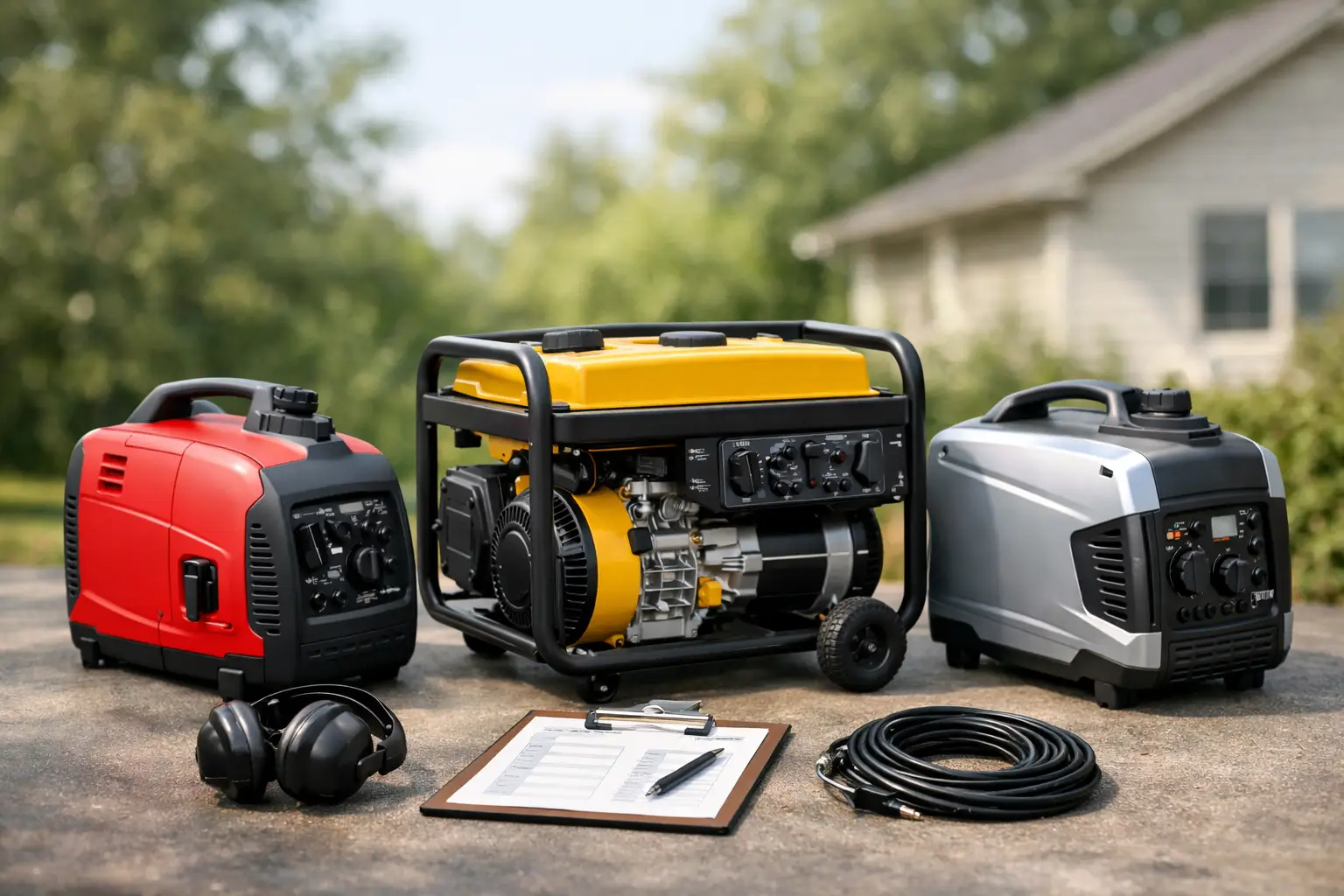
Below, I compare five compact and relatively quiet generators, including lightweight models for camping and higher-output options for RVs and emergency backup.
Best Compact and Quiet Generators of 2026
| Generator | Peak Watts | Running Watts | Noise | Weight | Best For |
|---|---|---|---|---|---|
| PowerSmart 1200W Portable Generator | 1,200W | Varies by configuration | Manufacturer markets it as quiet | Lightweight | Basic camping and small loads |
| ERAYAK 2400W Portable Inverter Generator | 2,400W | 1,800W | 52 dB at 25% load | About 43 lbs | Camping and small backup needs |
| PowerSmart 2500W Portable Inverter Generator | 2,500W | 1,900W | 52 dBA at 25% load; 59 dBA at full load | About 40 lbs | Portable general-purpose use |
| AMERISUN 2500W Inverter Generator | 2,500W | 1,900W | 69 dB at 23 ft. | About 40 lbs | Budget-conscious outdoor use |
| Westinghouse iGen5000 | 5,000W | 3,900W | As low as 52 dBA | 104.7 lbs | RVs and higher-power backup |
The biggest thing to remember is that peak watts are not the same as running watts. Peak or starting wattage is the temporary output available for appliances with startup surges. Running watts are what the generator can continuously provide.
For most buyers, running watts should be the first number to compare.
1. PowerSmart Gas Powered Portable Generator 1200W
Check Amazon Price Click Here!
The PowerSmart 1200W is aimed at buyers who want something small and simple rather than a generator capable of handling large appliances.
Its compact design makes it more practical for basic outdoor use, camping, tailgating, and emergency charging. It can be useful when your main goal is keeping smaller electronics and low-power equipment running rather than powering a refrigerator, air conditioner, or large kitchen appliance.
One limitation is important: this model should not automatically be treated as equivalent to a modern inverter generator simply because it is compact and marketed for quiet operation. Buyers who need clean inverter power for sensitive electronics should verify the exact model specifications before purchasing.
Pros
- Compact and easy to transport
- Suitable for basic outdoor power needs
- Simple option for light loads
- Useful when portability matters more than output
Cons
- Limited power capacity
- Not the best choice for larger appliances
- Buyers should verify the exact electrical configuration before purchase
- Not as versatile as a 2,000W- to 2,500W-class inverter generator
Best for
This generator makes the most sense for light-duty camping and basic portable power, especially when keeping weight and size to a minimum is the priority.
2. ERAYAK 2400W Portable Inverter Generator
Check Amazon Price Click Here!
The ERAYAK 2400W Portable Inverter Generator is a more capable choice for people who want a compact gasoline inverter generator without moving into the much heavier 3,000W-plus class.
The current ERAYAK 2400P specification lists 2,400 peak watts and 1,800 running watts. The manufacturer lists a noise level of approximately 52 dB at 25% load and 58 dB at 50% load, measured at 7 meters. It weighs around 43 pounds, depending on the listed configuration.
That combination makes it well suited to camping, tailgating, charging electronics, running lights, powering small appliances, and other situations where you don’t want to carry a large generator.
The inverter design is also useful for electronics that require stable electrical power.
Pros
- 2,400W peak output
- 1,800W continuous output
- Relatively lightweight
- Low published noise figures at partial load
- Inverter technology
- Suitable for camping and small backup applications
Cons
- 1,800W running output limits larger appliances
- Gasoline-only configuration
- Not designed for whole-home backup
- Noise increases as the load increases
Best for
The ERAYAK is a practical choice for camping, tailgating, small emergency loads, and portable electronics where size and noise matter.
3. PowerSmart 2500-Watt Portable Inverter Generator
Check Amazon Price Click Here!
The PowerSmart 2500W is one of the more interesting options in this group because it combines a compact form factor with enough output for many common camping and emergency tasks.
The generator is rated at 2,500 peak watts and 1,900 rated watts. Published specifications list approximately 52 dBA at 25% load and 59 dBA at full load, measured from 23 feet. It also includes an economy mode that adjusts engine speed according to demand.
That last point matters when you’re using a generator for smaller loads. An inverter generator does not necessarily need to run at maximum engine speed when you’re only charging a laptop, running lights, or powering a small appliance.
The unit also includes CO protection, low-oil shutdown, overload protection, USB connections, and parallel capability.
Pros
- 2,500W peak output
- 1,900W rated output
- Approximately 52 dBA at 25% load
- Eco mode
- CO safety protection
- Parallel capability
- Compact design
- Inverter power for sensitive electronics
Cons
- Not powerful enough for large central air-conditioning systems
- Noise rises at higher loads
- Gasoline-only operation
- Runtime depends heavily on the connected load
Best for
The PowerSmart 2500W is a good fit for camping, tailgating, emergency electronics, small appliances, and general portable power.
4. AMERISUN 2500-Watt Gas Powered Inverter Generator
Check Amazon Price Click Here!
The AMERISUN 2500W takes a different approach from the quieter models above. It offers similar peak output but has a significantly higher published noise rating.
The current AM5020C specifications list 2,500 starting watts and 1,900 rated watts, along with a 69 dB rating at 23 feet. The manufacturer also lists a 1.06-gallon fuel tank and approximately 5.5 hours of runtime at 50% load.
At roughly 40 pounds, it is still reasonably portable, but the 69 dB rating is important if your priority is minimizing generator noise.
For that reason, I would consider this model primarily when price, portability, and basic inverter functionality matter more than achieving the lowest possible sound level.
Pros
- 2,500W starting output
- 1,900W rated output
- Portable size
- CO Alert
- USB charging
- Inverter design
- Suitable for camping and emergency use
Cons
- 69 dB at 23 feet is considerably louder than the quietest models
- Not the best choice for noise-sensitive campgrounds
- Limited output for larger appliances
- Shorter runtime at higher loads
Best for
The AMERISUN is better suited to buyers looking for a portable 2,500W-class generator at a competitive price who are willing to accept more operating noise.
5. Westinghouse iGen5000
Check Amazon Price Click Here!
The Westinghouse iGen5000 belongs in a different size category from the smaller camping generators above.
It produces 5,000 peak watts and 3,900 running watts, making it substantially more capable for RV use, home emergency backup, and larger electrical loads. Westinghouse lists up to 18 hours of runtime on a 3.4-gallon gasoline tank, along with electric start, wireless remote start, an LED data display, wheels, and a telescoping handle.
Despite its higher output, the iGen5000 uses an enclosed inverter design and is rated as low as 52 dBA under the manufacturer’s specified conditions.
However, there is an obvious trade-off: this generator weighs approximately 104.7 pounds. That makes it portable in the sense that it has wheels and a handle, but it is not a generator most people will want to carry by hand for a long distance.
Pros
- 5,000 peak watts
- 3,900 running watts
- Up to 18-hour runtime under specified conditions
- Electric start
- Wireless remote start
- RV-ready outlet
- LED information display
- Wheels and telescoping handle
- Low published noise rating for its power class
Cons
- Much heavier than the other generators on this list
- Too large for lightweight camping
- Takes up more storage space
- Higher fuel requirements than small inverter models
Best for
The iGen5000 makes more sense for RVs, home emergency backup, tailgating, and higher-power outdoor applications than for backpacking-style camping.
How to Choose a Quiet Portable Generator in 2026
Buying a generator based only on the wattage printed on the box can lead to an expensive mistake. Noise, running watts, weight, runtime, fuel type, and safety features all affect how useful the generator will be in real life.
1. Check Running Watts Before Peak Watts
A generator advertised as a 2,500-watt generator may only provide around 1,900 watts continuously.
That’s not necessarily a problem. It simply means you need to calculate your expected load using the running wattage of your appliances.
For example, a small refrigerator, several LED lights, phone chargers, and a laptop may be manageable with a compact inverter generator. A large RV air conditioner or electric heater can require substantially more power.
Also remember that motors and compressors can require additional starting power.
2. Pay Attention to How the Noise Rating Was Measured
Noise specifications can be misleading if you compare numbers without checking the testing conditions.
A generator rated at 52 dBA may have been measured at a particular load and distance. The same generator will generally produce more noise when heavily loaded.
That’s why it is more useful to compare:
- Noise level
- Measurement distance
- Load percentage
- Whether the generator uses an inverter
- Whether it has an enclosed design
- Whether an Eco mode is available
For example, ERAYAK lists its 2400P at 52 dB at 25% load and 58 dB at 50% load.
The PowerSmart 2500W similarly lists approximately 52 dBA at 25% load and 59 dBA at full load.
That tells you much more than simply seeing the words “quiet generator” on a product listing.
3. Inverter Technology Matters
An inverter generator produces electricity differently from a conventional open-frame generator.
The engine can adjust its speed according to the electrical demand, which can reduce fuel consumption and noise during lighter loads. Inverter generators also produce stable electrical power that is well suited to many electronic devices.
This is one reason inverter models are popular for camping, tailgating, RV use, and portable emergency power. Consumer Reports also notes that inverter generators tend to be quieter and more compact than conventional portable generators.
4. Think About Weight Before Buying
A generator can be technically portable and still be difficult to move.
For camping, a generator around 40 to 50 pounds can usually be handled much more easily than a 100-pound model.
The Westinghouse iGen5000 is a good example. Its wheels and telescoping handle improve portability, but at about 104.7 pounds, it is in a completely different category from a 40-pound camping generator.
If you regularly load your generator into an SUV by yourself, weight should be one of your first considerations.
5. Consider Runtime, Not Just Tank Size
A larger fuel tank does not automatically mean better fuel economy.
Runtime depends on:
- Engine efficiency
- Fuel tank capacity
- Connected load
- Eco mode
- Generator design
- Weather and operating conditions
Manufacturers usually quote runtime at a specific load percentage, so don’t assume the advertised maximum runtime applies when the generator is operating near its rated capacity.
6. Look for CO Protection
Carbon monoxide is one of the most important safety concerns with gasoline generators.
A generator should never be used inside a home, garage, basement, shed, or other enclosed space, even if doors or windows are open. CPSC recommends operating portable generators outdoors at least 20 feet away from the home, with the exhaust directed away from windows, doors, and vents.
CO shutoff technology is an additional safety feature worth considering. It can automatically stop the generator when dangerous carbon monoxide levels are detected around the unit.
It is still not a substitute for proper generator placement.
7. Check Parallel Capability
If you think your power requirements might increase later, a parallel-ready inverter generator can provide some flexibility.
Some models allow two compatible generators to be connected using an appropriate parallel kit.
This can be useful when a single small generator is perfect for camping but you occasionally need additional capacity.
Always use the manufacturer’s approved parallel equipment and compatible generator models.
What Can a Compact Quiet Generator Actually Power?
This is where generator shopping becomes much easier.
A small inverter generator can be useful for:
- Smartphones
- Tablets
- Laptops
- LED lights
- Fans
- Small TVs
- Routers
- Chargers
- Small refrigerators
- CPAP machines
- Selected small kitchen appliances
Larger models may also handle:
- RV appliances
- Refrigerators and freezers
- Larger tools
- Multiple appliances simultaneously
- Some air-conditioning systems
However, the exact requirements vary considerably by appliance. Always check the appliance’s running and starting wattage rather than relying on a general wattage chart.
If an appliance has a motor or compressor, pay particular attention to its starting load.
Quiet Generator vs. Portable Power Station
If your top priority is zero engine noise, a gasoline generator is not technically silent.
Even a very quiet inverter generator still has an internal combustion engine.
A battery-powered portable power station is different. It does not burn gasoline or propane while operating, so there are no engine exhaust emissions and no engine noise.
Portable power stations can therefore be attractive for:
- Overnight camping
- Tent-friendly charging
- Indoor emergency electronics
- Quiet nighttime use
- Phones and laptops
- Small fans
- Lights
Gasoline inverter generators remain more practical when you need longer operating periods and can safely refuel outdoors.
The choice comes down to the type of power you need, how long you need it, and whether you have access to safe outdoor operating space.
Generator Safety Tips for Camping and Home Backup
Quiet operation should never take priority over safe operation.
Follow these basic rules whenever you use a portable gasoline generator:
Keep it outdoors
Never operate a gasoline generator inside a house, garage, basement, shed, tent, or other enclosed structure. Opening doors and windows is not enough to prevent dangerous CO buildup.
Maintain at least 20 feet of distance
CPSC recommends keeping portable generators at least 20 feet from the home, with exhaust directed away from the building.
Keep the generator dry
Follow the manufacturer’s instructions regarding rain and wet conditions. Electrical equipment can create shock hazards when exposed to water.
Don’t overload the generator
Exceeding the generator’s rated capacity can cause overheating and create a fire hazard. OSHA specifically advises users not to overload generators.
Refuel only after shutting it down
Turn the generator off and allow it to cool before adding fuel.
Use proper extension cords
If you need extension cords, use grounded cords that are rated for the total electrical load you intend to operate.
Follow the owner’s manual
Features and safety requirements vary between models. The owner’s manual should always take priority over a generic online recommendation.
Frequently Asked Questions
What is the quietest type of portable generator?
Inverter generators are generally among the quieter gasoline-powered portable generators because their engines can reduce speed when electrical demand is low. Noise still varies by model, load, and measurement distance.
Is 50 dB quiet for a generator?
A generator producing around 50 dB under a specified test condition is relatively quiet compared with many conventional portable generators. However, the number should always be evaluated together with the load percentage and measurement distance.
What size generator is best for camping?
For many camping setups, a generator in the 2,000W to 2,500W peak range provides a useful balance of portability and capacity. If you need to operate an RV air conditioner or several higher-draw appliances, you may need a larger generator.
Can a quiet generator run an RV?
It depends on the generator’s running watts and the RV’s electrical demands. A small 2,000W-class generator may handle basic RV loads, but air conditioners and other high-starting-load appliances can require considerably more capacity.
Can I use a portable generator inside my garage?
No. Portable gasoline generators should never be operated inside a garage, even with the garage door open. Carbon monoxide can build up rapidly. CPSC recommends using the generator outdoors and at least 20 feet away from the home.
Are inverter generators safe for laptops?
Inverter generators are designed to provide stable electrical output and are commonly used for sensitive electronics. However, always follow the generator manufacturer’s specifications and use appropriate surge protection when recommended.
Is a battery power station quieter than a gas generator?
Yes. A battery power station does not have a gasoline engine, so it can operate without the engine noise and exhaust emissions associated with a conventional fuel-burning generator.
Final Thoughts
The best compact quiet generator depends on what you actually need to power.
For very light loads, a small 1,200W-class unit can keep your setup simple and portable. Moving into the 2,000W to 2,500W range gives you considerably more flexibility for camping, tailgating, electronics, and emergency essentials without moving to a very large generator.
The ERAYAK 2400W stands out for its combination of compact size, 1,800W running output, and relatively low published noise figures. The PowerSmart 2500W offers another practical combination of output, portability, Eco mode, CO protection, and inverter technology. The AMERISUN 2500W provides similar headline wattage but has a substantially higher published noise rating, making it less attractive when low noise is the main priority.
For significantly higher electrical demands, the Westinghouse iGen5000 moves into a different category with 3,900 running watts, 5,000 peak watts, RV-ready capability, remote start, wheels, and a much larger overall footprint.
Before buying, focus on running watts, noise at a stated load, weight, runtime, fuel type, CO protection, and your actual appliances rather than choosing a generator simply because it has the highest peak-watt number.
And regardless of which model you choose, remember that a quiet generator is still a gasoline-powered engine: operate it outdoors, keep it at least 20 feet from the home, direct exhaust away from openings, and follow the manufacturer’s safety instructions.
Key Takeaways
- For basic portable power: PowerSmart 1200W
- For compact camping power: ERAYAK 2400W
- For a versatile 2,500W-class inverter: PowerSmart 2500W
- For a budget-oriented 2,500W option: AMERISUN 2500W
- For higher-power RV and backup use: Westinghouse iGen5000
- For truly silent operation: Consider a battery power station instead of a gasoline generator
The most important thing is not finding the generator with the biggest number on the box. It is finding the smallest, quietest unit that can comfortably handle the loads you actually expect to run.