As an Amazon Associate I earn from qualifying purchases.
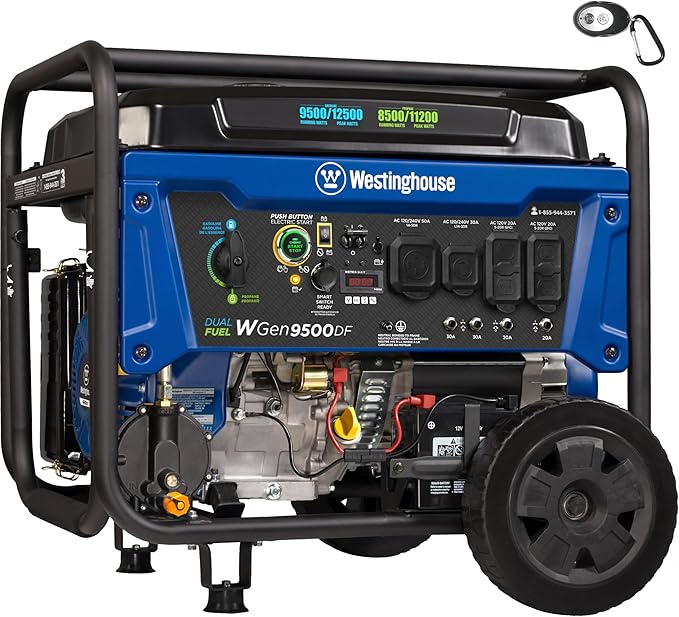
A portable generator with a 50-amp outlet can give you considerably more flexibility than a typical 30-amp model. For homeowners, that can mean connecting a generator to a properly installed transfer switch or interlock system. For RV owners, a 50-amp receptacle can provide the connection needed for larger fifth wheels and motorhomes. It can also be useful for demanding equipment at a job site or outdoor event.
But a 50-amp outlet alone does not tell you how much power a generator can actually produce. Running watts, peak watts, voltage, fuel type, outlet configuration, and transfer-switch compatibility all matter when comparing models.
For 2026, the market includes large dual-fuel and tri-fuel generators, conventional open-frame models, and newer inverter generators with 50-amp connections. Current search results also show increased competition from brands such as DuroStar, Generac, GENMAX and AIVOLT, in addition to Westinghouse and WEN.
Below, I focus on 50-amp portable generators that are relevant to home backup, RV use, outdoor power, and demanding equipment, while explaining what the 50-amp connection actually means.
Top 50 Amp Portable Generators in 2026
| Model | Fuel | Rated/Running Output | 50A Connection | Best Use |
|---|---|---|---|---|
| Westinghouse 12500 Watt Dual Fuel | Gas/Propane | Up to 9,500W gas | Yes | Home backup |
| Westinghouse WGen20000 | Gasoline | 20,000W | Two 50A outlets | Large-home backup |
| Westinghouse WGen14500TFc | Gas/Propane/NG | 14,500W gas | Yes | Large-home backup |
| Westinghouse 12000W Inverter | Gas/Propane | Model-dependent | Yes | Home/RV + cleaner power |
| WEN DF1100T | Gas/Propane | 8,300W gas | NEMA 14-50R | Home/RV |
| DuroStar DS13000MX | Gas/Propane | Up to 10,500W | Yes | Home backup |
| Generac GP9500 | Gas/Propane/NG | Model-dependent | 50A configuration | Home backup |
| AIVOLT 7500W Dual Fuel | Gas/Propane | Up to 6,300W | 50A RV outlet | RV/outdoor use |
Always verify the exact model number and current specifications before purchasing, since manufacturers can update configurations and retailers may sell different versions of similarly named generators.
What Is a 50 Amp Portable Generator?
A 50 amp portable generator is generally a portable generator equipped with a 50-amp receptacle, commonly a NEMA 14-50R. On a 120/240V split-phase system, that connection can supply power to both 120V and 240V loads when the generator is designed and configured for it.
The important distinction is that having a 50A outlet does not automatically mean the generator produces 12,000 watts continuously.
For example, a generator with a 50A receptacle may have a rated output below 12,000 watts. The outlet describes the connection’s maximum current capability, while the generator’s rated wattage tells you how much power its engine and alternator are actually designed to provide.
That distinction is particularly important when shopping for a generator for central air conditioning, well pumps, electric water heaters, ranges, or other high-demand appliances.
A current 50-amp generator guide from The RV Geeks also explains that RV 50-amp service uses split-phase power with two 120V hot legs, neutral, and ground, which is why understanding the electrical configuration matters when selecting a generator.
Westinghouse 12500 Watt Dual Fuel Home Backup Generator
The Westinghouse 12500-watt dual-fuel generator is designed for homeowners who want substantial portable backup power without moving all the way into the enormous output class of 20,000-watt machines.
Its dual-fuel capability gives you the choice between gasoline and propane. That can be useful during extended outages because you are not dependent on a single fuel source.
The generator is also designed around home-backup applications, with a 50-amp connection and transfer-switch compatibility depending on the exact configuration.
Why Consider the Westinghouse 12500W?
- Dual-fuel operation
- 50-amp connection
- Electric/remote starting on applicable configurations
- Suitable for home emergency backup
- Useful for larger appliances and HVAC-related loads
- GFCI protection on applicable outlets
The key number to pay attention to is running watts, rather than simply the advertised peak-watt figure. Starting watts are important for motors and compressors, but the generator needs enough continuous output to handle the loads once they are running.
Westinghouse WGen20000 28,000 Peak Watt Generator
If you need substantially more power than a typical 10,000- to 14,000-watt portable generator, the Westinghouse WGen20000 moves into a different class.
Westinghouse rates this generator at 28,000 peak watts and 20,000 running watts. It uses a 999cc V-Twin engine and a 17.17-gallon fuel tank. The manufacturer lists up to 11 hours of runtime under its stated testing conditions.
It also includes two 120/240V 50A NEMA 14-50R outlets, along with 30A and household receptacles.
Why It Stands Out
The biggest advantage here is the amount of continuous power available.
A 20,000-watt rated output provides considerably more headroom for a large home than an 8,000- or 10,000-watt generator. That does not mean you can run every electrical appliance simultaneously, but it gives you much more flexibility when several high-demand loads operate at the same time.
The WGen20000 also includes electric start, transfer-switch-ready connections, GFCI outlets, CO shutdown technology, and a digital display for operating information.
Keep in Mind
This is a very large portable generator. Its capacity is impressive, but portability is relative. Moving a generator of this size requires more effort and planning than moving a smaller RV-oriented unit.
Westinghouse 11000 Watt Dual Fuel Inverter Generator
The Westinghouse 11,000-watt dual-fuel inverter generator is an interesting alternative for shoppers who want a 50-amp connection while also looking for inverter-generator technology.
Current 2026 search results specifically feature this model among 50-amp generators, with remote start and a 50A connection.
Why an Inverter Generator Matters
Traditional open-frame generators and inverter generators use different approaches to producing electricity.
An inverter generator can provide a cleaner, more stable electrical output, making inverter technology attractive when you need to power sensitive electronics such as computers, televisions, chargers, and other electronic equipment.
The Westinghouse model also supports dual-fuel operation, giving users gasoline and propane as fuel choices.
For a homeowner, the combination of 50A capability, inverter technology, remote start, and dual-fuel operation can be useful when the generator will serve more than one purpose.
Westinghouse WGen14500TFc Tri-Fuel Generator
The Westinghouse WGen14500TFc is one of the more flexible options for homeowners who want a high-output generator with three fuel choices.
It operates on:
- Gasoline: 18,000 peak / 14,500 running watts
- Propane: 16,000 peak / 13,000 running watts
- Natural gas: 14,400 peak / 11,600 running watts
Those are manufacturer-listed figures.
The generator has a 713cc engine, a 10.5-gallon fuel tank, electric start, remote start, a 50A NEMA 14-50R connection, and transfer-switch-ready connections. Westinghouse lists up to 12 hours of runtime on gasoline under its specified conditions.
Why Tri-Fuel Can Be Useful
Gasoline is easy to obtain in many situations, while propane can be stored for longer periods when handled correctly. Natural gas can be particularly convenient for homes that already have an appropriate natural-gas supply and professionally installed connection.
The trade-off is that output changes depending on the fuel being used.
If maximum generator capacity is important, pay attention to the rated watts for the specific fuel, not just the headline peak watt number.
WEN DF1100T 11,000-Watt Dual Fuel Generator
The WEN DF1100T remains a relevant option for buyers looking for a more traditional dual-fuel portable generator with a 50-amp outlet.
According to WEN, it produces:
- Gasoline: 11,000 surge watts / 8,300 running watts
- Propane: 9,500 surge watts / 7,500 running watts
It has a 457cc four-stroke OHV engine, electric start, a 6.6-gallon fuel tank, and a 120/240V NEMA 14-50R 50A outlet. WEN also lists four 120V GFCI outlets and a 30A twist-lock outlet.
Where the WEN Makes Sense
The DF1100T can be a practical choice for users who need:
- A 50A connection
- Dual-fuel capability
- 120V/240V operation
- Electric start
- A wheel and handle kit
- Home backup capability
- RV or outdoor power
Its 8,300-watt gasoline running output is much lower than the 20,000-watt Westinghouse, so it should not be treated as an equivalent substitute for a very large whole-home generator.
DuroStar DS13000MX 13,000-Watt Dual Fuel Generator
The DuroStar DS13000MX is another large dual-fuel option appearing in current 2026 50-amp generator results. It provides gasoline and propane operation and is designed around home backup, RV, and emergency applications.
Its larger engine and output class make it more suitable for demanding loads than many smaller 50A RV generators.
When comparing it with a Westinghouse or WEN model, look beyond peak watts. Compare:
- Rated/running watts
- 50A receptacle configuration
- Fuel consumption
- Transfer-switch compatibility
- CO safety system
- Warranty
- Weight and dimensions
- Availability of replacement parts and service
Those details can have more practical importance than a small difference in advertised peak wattage.
Generac GP9500 Tri-Fuel Portable Generator
Generac is another brand now appearing in 2026 comparisons of 50-amp-capable generators. Current search results list the GP9500 in a tri-fuel configuration, giving buyers another option beyond the Westinghouse/WEN-focused selection in the original article.
A tri-fuel generator can be particularly useful for emergency preparedness because gasoline, propane, and natural gas give you different fueling options.
However, as with other tri-fuel generators, output varies by fuel. Always check the manufacturer’s specifications for the exact configuration before comparing it directly with a gasoline-only or dual-fuel model.
AIVOLT 7500W Dual Fuel Generator
The AIVOLT 7500W is worth considering when the primary goal is 50-amp RV power rather than maximum whole-home output.
Current 2026 search results list this model with a 50A RV-ready outlet, dual-fuel operation, wheels, and CO protection.
Its lower power output is an important distinction.
A generator does not become a high-capacity whole-home generator simply because it has a 50A outlet. A 7,500-watt-class generator has considerably less available running power than a 12,000-, 14,500-, or 20,000-watt machine.
For an RV owner whose electrical requirements fit within that output, however, the smaller size can be an advantage.
What Can a 50 Amp Generator Power?
The answer depends on the generator’s actual running wattage, not simply the presence of a 50A outlet.
A sufficiently powerful generator may be able to operate combinations of:
- Refrigerator
- Freezer
- Sump pump
- Well pump
- Furnace blower
- Central or portable air conditioning
- Lights
- Television
- Internet equipment
- Microwave
- Selected kitchen appliances
- Power tools
- Battery chargers
Some large generators can support multiple 240V loads as well.
However, you should calculate the electrical requirements of your specific appliances before deciding what a generator can run.
Starting Watts vs. Running Watts
Motors and compressors often require more electricity when they start than they consume once running.
For example, an air conditioner may have a relatively manageable running load but require a much larger surge when its compressor starts.
That’s why you should consider both:
Running watts: the power required while the appliance is operating.
Starting/peak watts: the additional power required when certain equipment starts.
A generator with a high peak rating but insufficient running capacity can still be a poor match for a heavily loaded home.
50 Amp RV Generator vs. 50 Amp Home Backup Generator
These terms are sometimes used interchangeably, but they are not necessarily the same thing.
50 Amp RV Generator
For an RV, the main concern is usually whether the generator provides the correct 120/240V 50A RV connection and enough continuous power for the RV’s electrical system.
Large fifth wheels and Class A motorhomes can have substantial electrical loads, especially when multiple air conditioners are operating.
50 Amp Home Backup Generator
For home backup, you also need to consider:
- Transfer switch or approved interlock
- Generator inlet
- Panel configuration
- 120V and 240V loads
- Electrician installation
- Generator grounding and bonding requirements
- Local electrical code
A 50A outlet does not make a generator an automatic whole-home backup system.
How to Choose a 50 Amp Portable Generator in 2026
1. Start With Your Running-Watt Requirement
Make a list of the appliances you actually intend to operate during an outage.
Do not simply add every appliance in your home. Identify which ones need to operate simultaneously.
Then account for starting loads from motors and compressors.
2. Check the 50A Outlet Type
Look for the exact receptacle designation.
A NEMA 14-50R is common on larger 120/240V generators and is particularly relevant to RV and home-backup applications.
Also check whether the generator includes additional 30A and 120V outlets.
3. Decide Between Gas, Dual Fuel, and Tri-Fuel
Gasoline
Gasoline is widely available and generally provides strong output, but long-term storage requires proper fuel management.
Dual Fuel
Gasoline and propane provide two fuel options. This can be useful during prolonged outages.
Tri-Fuel
Gasoline, propane, and natural gas provide the most flexibility, particularly for homeowners who already have a suitable natural-gas connection.
But remember that the generator’s output can change depending on the fuel.
4. Consider Inverter Technology
If sensitive electronics are an important part of your backup plan, look at the generator’s THD specification and electrical design.
Do not assume that every portable generator provides identical electrical output.
Some newer 50A generators use inverter technology, while many large traditional generators use conventional alternators.
5. Look for CO Protection
Carbon monoxide is one of the most important hazards associated with portable gasoline and propane generators.
A CO detection and automatic shutdown system can provide an additional safety layer, but it does not make indoor generator operation safe.
Never operate a fuel-burning portable generator inside a house, garage, basement, crawlspace, or other enclosed or partially enclosed area.
6. Think About Runtime
A generator advertised with “10 hours of runtime” does not necessarily run for 10 hours at full load.
Runtime depends on:
- Fuel capacity
- Load
- Fuel type
- Engine efficiency
- Operating conditions
Always check the load percentage associated with the manufacturer’s runtime claim.
7. Don’t Ignore Weight
Large 50A generators can weigh hundreds of pounds.
Wheels and handles help, but they do not turn a 200- or 300-pound generator into something that one person can easily lift.
Think about where you will store it and how you will move it before buying.
50 Amp Generator Safety Tips
Portable generators require careful setup and operation.
Keep the generator outside
Operate the generator outdoors in a well-ventilated location and away from doors, windows, and ventilation openings.
Never operate it inside an attached garage, even if the garage door is open.
Never backfeed a house
Do not connect a portable generator directly to a household wall outlet.
For home backup, use an appropriately installed transfer switch, interlock system, inlet, and wiring that comply with applicable electrical requirements.
Use the correct cables
A 50A generator cord should match the generator’s receptacle and the equipment being powered.
Avoid improvised adapters or undersized extension cords.
Keep the generator dry
Generators should be protected from rain and standing water while still maintaining adequate ventilation and exhaust clearance.
Let the generator cool before refueling
Gasoline is highly flammable. Shut down the generator and allow it to cool before adding fuel.
Follow the owner’s manual
Fuel requirements, grounding, maintenance, load limits, oil specifications, and connection procedures vary between models.
Frequently Asked Questions
Is a 50 amp generator better than a 30 amp generator?
A 50A-capable generator can provide a larger connection for certain RV and home-backup applications, but the outlet rating alone does not determine total generator capacity. Compare the generator’s running watts and peak watts with your actual electrical requirements.
How many watts do I need for a 50 amp RV?
There is no single wattage requirement for every 50A RV. Your needs depend on appliances, air conditioners, heating systems, water heaters, and other equipment. Calculate the running and starting loads you expect to use simultaneously.
Can a 50 amp generator power a whole house?
Some high-output 50A generators can provide substantial whole-home backup power, but whether one can run your entire house depends on the home’s electrical loads and the generator’s rated output. A properly installed transfer switch or approved interlock system is also required for panel connection.
Does a 50 amp generator produce 12,000 watts?
Not necessarily. A 120/240V 50A connection can represent up to 12,000 watts at full theoretical capacity, but the generator itself may have a lower or higher rated output. Always use the manufacturer’s running-watt specification when determining capacity.
Is dual fuel better than gasoline?
Dual-fuel generators provide an additional fuel option, which can be useful during extended outages. Gasoline, propane, and generator output characteristics differ, so the right choice depends on how you plan to store fuel and operate the generator.
Can I connect a 50 amp generator directly to my house?
No. A portable generator should not be connected to a household outlet to energize the home. Home integration should use the appropriate inlet, transfer switch or approved interlock system, and properly installed wiring.
Are 50 amp generators good for RVs?
Yes, provided the generator has the appropriate 120/240V 50A RV connection and enough running wattage for the RV’s electrical loads. Large RVs can have substantial power requirements, particularly when running multiple air conditioners.
Final Thoughts
The best 50 amp portable generator for your situation depends less on the “50 amp” label and more on how much continuous power you actually need.
For moderate home backup or RV use, an 8,000- to 11,000-watt-class generator may provide a useful balance of capacity and portability. Larger homes with multiple high-demand appliances may require a 12,000- to 15,000-watt generator or more. The Westinghouse WGen20000 moves considerably higher, with 20,000 running watts and two 50A outlets.
Fuel flexibility is another major consideration in 2026. Dual-fuel models provide gasoline and propane options, while tri-fuel generators add natural gas. The Westinghouse WGen14500TFc, for example, provides 14,500 running watts on gasoline, 13,000 on propane, and 11,600 on natural gas.
For RV owners, make sure the generator has the correct 50A configuration and sufficient output for the RV’s actual loads. For home backup, pay equal attention to the transfer-switch connection, electrical installation, safety features, and total running wattage.
The most important rule is simple: choose the generator based on your actual electrical load, not simply the size of its 50-amp outlet.
That approach will help you avoid paying for substantially more generator than you need while also reducing the risk of buying a unit that cannot handle your essential loads during an outage.