As an Amazon Associate I earn from qualifying purchases.
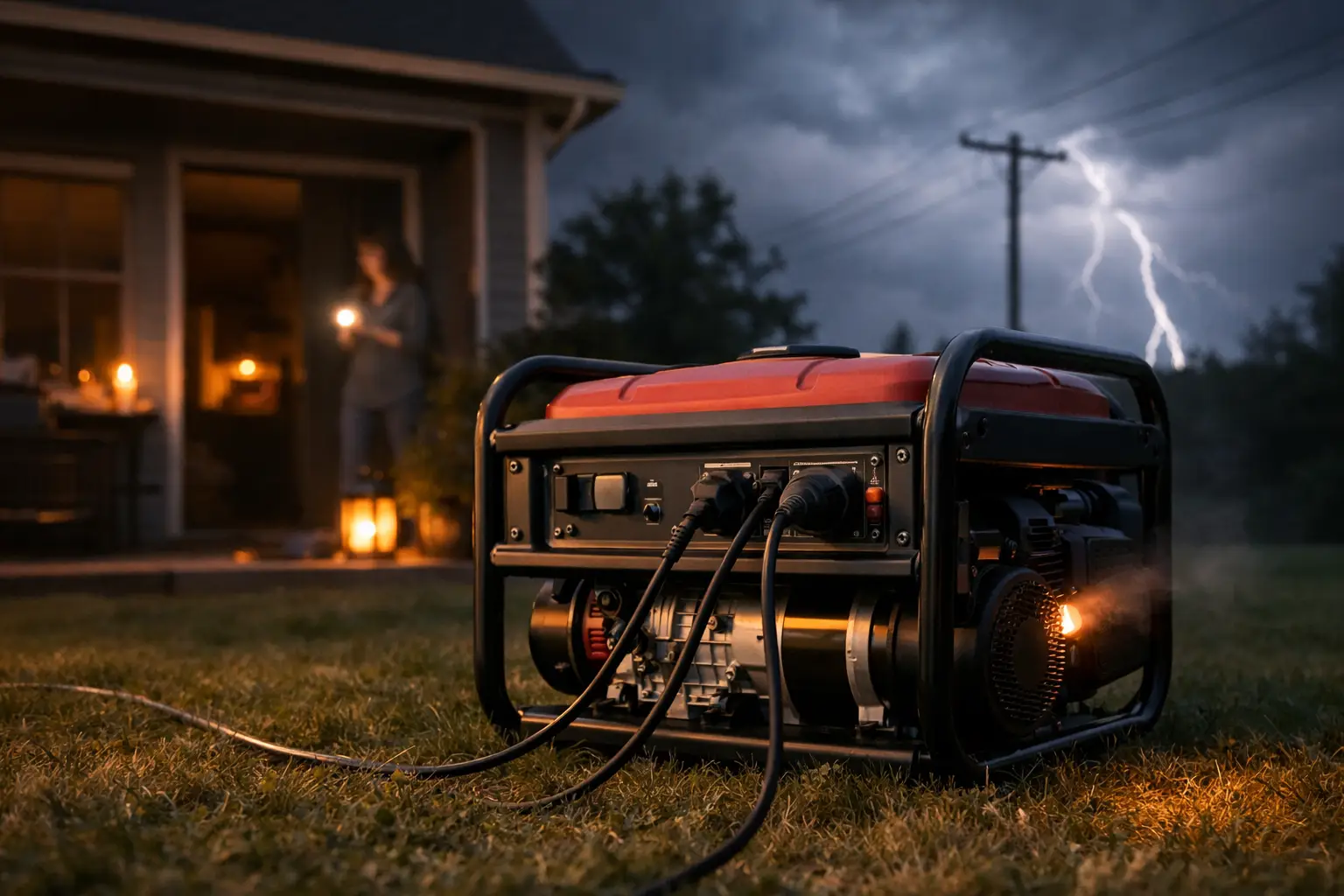
When you need enough portable power to run several large appliances at the same time, a 50 amp generator connection can make a major difference. It is commonly used with larger portable generators, home backup systems, RVs, and other applications where a standard 30 amp connection may not provide enough capacity.
However, choosing a 50 amp generator is not simply about finding the highest wattage number. You also need to consider running watts, starting watts, fuel type, 120/240V capability, outlet configuration, generator cords, and the way the generator will connect to your home or RV.
A 50 amp, 120/240V connection can theoretically carry up to 12,500 watts at 250 volts, but the generator itself determines how much power is actually available. For example, a generator with 9,500 running watts does not suddenly produce 12,500 continuous watts simply because it has a 50 amp outlet.
For 2026, dual-fuel generators remain particularly useful for backup power because they allow you to choose between gasoline and propane. Gasoline generally provides the higher output on many portable models, while propane can be convenient for longer-term storage and emergency preparedness.
This guide looks at several Generators & Accessories available through Amazon US, including large dual-fuel generators, an inverter generator, a 50 amp generator cord, and a generator cord and inlet-box kit.
Best 50 Amp Generators and Accessories for 2026
| Product | Type | Output / Rating | Fuel | Key Feature |
|---|---|---|---|---|
| Westinghouse 12500 Watt Dual Fuel Home Backup Portable Generator | Portable Generator | 12,500 peak / 9,500 running W on gas | Gasoline / Propane | Remote start, 120/240V, 50A outlet |
| WEN DF1100T 11,000-Watt Dual Fuel Generator | Portable Generator | 11,000 surge / 8,300 running W on gas | Gasoline / Propane | 120/240V and 50A outlet |
| Westinghouse iGen11000DFc | Inverter Generator | 11,000 peak / 9,000 running W on gas | Gasoline / Propane | Digital inverter technology |
| PlugSaf 50 Amp Generator Cord, 25FT | Generator Cord | Up to 50A / 125-250V | N/A | NEMA 14-50P to SS2-50R |
| VEVOR 50 Amp Generator Cord and Power Inlet Box Kit | Cord + Inlet Box | Up to 50A | N/A | 25-ft cord and pre-drilled inlet box |
What Does a 50 Amp Generator Actually Mean?
The term 50 amp generator can be confusing because the amperage rating describes the electrical connection, not necessarily the generator’s total continuous wattage.
For a 120/240V connection, the theoretical maximum at 50 amps is approximately 12,000 to 12,500 watts depending on the voltage used for the calculation. The generator’s actual running wattage remains the more important figure when deciding what appliances you can operate continuously.
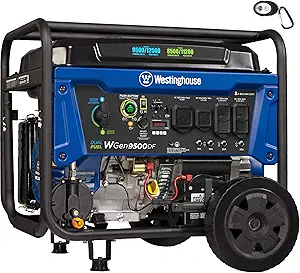
For example, the Westinghouse WGen9500DF produces 9,500 running watts and 12,500 peak watts on gasoline. On propane, its output drops to 8,500 running watts and 11,200 peak watts.
That distinction matters when you are powering equipment with motors.
A refrigerator, well pump, sump pump, air conditioner, furnace blower, or other motor-driven appliance can require considerably more power for a brief period when starting. This is why you should look at both running watts and starting watts rather than choosing a generator based only on its advertised peak number.
A 50 amp outlet is therefore best viewed as part of the generator’s power-delivery system. It does not automatically mean that the generator can continuously supply 50 amps at full capacity.
Westinghouse 12500 Watt Dual Fuel Home Backup Portable Generator
The Westinghouse 12500 Watt Dual Fuel Home Backup Portable Generator is designed for users who need substantial portable power without moving to a permanently installed standby generator.
On gasoline, it provides 9,500 running watts and 12,500 peak watts. Propane output is rated at 8,500 running watts and 11,200 peak watts. It uses a 457cc four-stroke OHV engine and includes electric and remote starting, along with recoil backup starting.
One of its most useful features for home backup is the combination of 120V and 240V capability. The generator includes a 120/240V 14-50R outlet, along with a 30 amp transfer-switch-ready connection and household GFCI receptacles.
Why the 50 amp outlet matters
The 14-50R outlet gives the generator a way to deliver its available 120/240V power through a higher-capacity connection. This can be useful when a properly installed home inlet and transfer equipment are designed around a 50 amp connection.
The important point is that the generator’s 9,500 running watts on gasoline remain the continuous power limit. The 50 amp receptacle does not increase the engine’s output.
Gasoline or propane?
Gasoline provides the higher rated output on this model. Propane provides somewhat less power but gives users another fuel option, which can be useful when gasoline availability is limited or when propane is already part of an emergency-preparedness setup.
The generator is rated for up to approximately 12 hours of operation on its 6.6-gallon gasoline tank under the manufacturer’s stated conditions.
Who should consider it?
This type of generator makes sense for homeowners who need substantial emergency power, RV owners with large electrical loads, and contractors who need a portable source of high-capacity power.
Keep in mind that approximately 210 pounds of generator weight makes this a machine for rolling into position rather than casually carrying around a job site.
WEN DF1100T 11,000-Watt 120V/240V Dual Fuel Portable Generator
The WEN DF1100T takes a slightly different approach, combining dual-fuel capability with 120/240V output and an accessible control layout.
According to WEN, the generator produces 11,000 surge watts and 8,300 running watts on gasoline. When operating on propane, it produces 9,500 surge watts and 7,500 running watts.
That makes the generator suitable for users who want a substantial amount of portable power but do not necessarily need the full output of larger 12,000-watt-class machines.
Dual-fuel operation
The DF1100T can run on either gasoline or propane. A selector dial is used to choose the fuel source, giving users flexibility when preparing for outages or using the generator away from home.
Gasoline delivers the higher rated output, while propane provides an alternative fuel source for emergency use.
120V and 240V operation
One of the important features is its selectable 120/240V operation. WEN also lists a NEMA 14-50R 120V/240V 50 amp outlet, along with four 120V GFCI household receptacles and a 120V 30A twist-lock outlet.
This combination makes it more versatile than a generator designed strictly around conventional household outlets.
Other useful features
The DF1100T uses a 457cc four-stroke OHV engine, electric starting, and a 6.6-gallon fuel tank. WEN states that it can operate for up to 8.5 hours at half load on gasoline.
It also comes with an LPG connection hose, wheel and handle kit, and a two-year warranty.
Who is it for?
The WEN DF1100T is worth considering if you want a dual-fuel generator with 120/240V flexibility and a 50 amp receptacle without moving into an even larger generator class.
For home backup, however, you should calculate your actual running and starting loads before assuming that 8,300 running watts will cover everything in the house simultaneously.
Westinghouse iGen11000DFc 11,000-Watt Dual Fuel Inverter Generator
The Westinghouse iGen11000DFc stands out from the conventional open-frame generators above because it uses digital inverter technology.
According to the manufacturer’s manual, the generator is rated at 9,000 running watts and 11,000 peak watts on gasoline, while propane operation produces 8,100 running watts and 10,000 peak watts.
Why choose an inverter generator?
Inverter generators use a different electrical architecture than traditional conventional portable generators. One of the reasons people consider them is their ability to produce regulated electrical power suitable for a wider variety of electronic loads.
The inverter design can also make this type of generator attractive to RV owners and homeowners who want a high-output generator with features beyond a basic conventional portable unit.
Gasoline and propane flexibility
Like the other two generators in this guide, the iGen11000DFc is dual fuel.
Gasoline provides the higher rated output, while propane gives you another option when you want to avoid relying entirely on stored gasoline.
The difference in output between the two fuels is important when calculating your load. On gasoline, you have 9,000 running watts; on propane, that falls to 8,100 running watts.
What makes it different?
The main reason to consider this Westinghouse model over a conventional generator is its inverter design rather than simply its wattage.
If you are looking for a generator primarily for basic construction equipment and large resistive loads, a conventional generator may already meet your needs. If you also care about inverter technology and the type of power supplied to electronics, this model deserves closer consideration.
PlugSaf 50 Amp Generator Cord, 25FT
A powerful generator is only useful if you have the correct way to move that power to the equipment that needs it.
The PlugSaf 50 Amp Generator Cord is a 25-foot cable designed around a 50 amp connection. The listed configuration uses a NEMA 14-50P male plug and SS2-50R twist-lock female connector, with heavy-duty STW construction and 6/3 + 8/1 AWG conductors.
Why connector type matters
A 50 amp generator does not automatically use the same connector as every other 50 amp device.
Before buying a cord, check:
- Generator outlet type
- Inlet-box connector type
- Voltage
- Amperage
- Cord length
- Conductor size
- Certification and product markings
The PlugSaf configuration is particularly relevant when the generator has a NEMA 14-50 outlet and the receiving inlet uses an SS2-50 style twist-lock connection.
Is 25 feet enough?
For many home backup installations, 25 feet can provide useful flexibility without creating an unnecessarily long cable run.
Longer is not always better. Cable resistance and voltage drop become more important as the distance increases, particularly with high-current loads. A properly sized cord should be selected for the actual installation rather than simply buying the longest cable available.
The cord should also be fully laid out during operation rather than tightly coiled, and connections should remain protected from water and physical damage.
VEVOR 50 Amp Generator Cord and Power Inlet Box Kit, 25FT
The VEVOR 50 Amp Generator Cord and Power Inlet Box Kit is useful for buyers who want the cord and outdoor inlet hardware as part of the same package.
The current 25-foot version uses 6/3 + 8/1 AWG STW cable, a NEMA 14-50P male connector, an SS2-50R twist-lock connector, and an SS2-50P power inlet box. VEVOR also identifies the cord and inlet box as ETL certified.
What comes in the kit?
The package is designed around three major components:
- 25-foot 50 amp generator cord
- Outdoor power inlet box
- Storage and installation accessories
The inlet box has a pre-drilled design and a detachable plug intended to simplify installation. VEVOR also describes the enclosure as having a rust-resistant coating and a flip cover.
Why an inlet box is important
A generator inlet box provides a dedicated connection point between the generator cord and the home’s electrical system.
This is considerably different from running a cord through a window or attempting to feed a home’s electrical panel through an ordinary receptacle.
For a residential backup system, the inlet box needs to be part of a properly designed electrical installation using appropriate transfer equipment or a listed panel interlock.
Professional installation
The inlet box itself is only one component of the installation.
The wiring between the inlet, breaker panel, transfer switch or interlock must comply with applicable electrical codes. If you are not qualified to perform electrical work, have the installation completed by a licensed electrician.
The goal is to prevent the generator from backfeeding the utility system, which can create a serious hazard for utility workers and damage equipment.
How to Choose the Right 50 Amp Generator
Buying a generator based solely on its advertised peak wattage is one of the easiest ways to end up with a system that does not perform as expected.
Instead, consider these factors.
1. Calculate your running wattage
Start by listing the appliances and equipment you expect to operate at the same time.
Typical examples include:
- Refrigerator
- Freezer
- Lights
- Internet equipment
- Television
- Sump pump
- Well pump
- Furnace blower
- Portable heaters
- Microwave
- Power tools
Add their running wattage together.
2. Account for starting watts
Motors can require additional power when they start.
This is particularly important for:
- Central air conditioners
- Well pumps
- Sump pumps
- Refrigerators
- Compressors
- Some power tools
A generator may have enough continuous capacity but still struggle if several large motors attempt to start simultaneously.
3. Decide between gasoline and dual fuel
A gasoline-only generator can be straightforward if gasoline is your preferred fuel.
A dual-fuel generator gives you another option.
For emergency preparedness, having access to both gasoline and propane can provide additional flexibility. Just remember that many generators produce less power on propane than they do on gasoline.
4. Check the 120/240V output
If you intend to use the generator for home backup, verify that it provides the voltage configuration required by your transfer equipment and electrical system.
Do not assume that every generator advertised with a high wattage is configured the same way.
5. Check the actual outlet
A generator can have high wattage but still lack the connection you need.
Look specifically for:
- NEMA 14-50
- SS2-50
- L14-30
- 120V household outlets
- 120/240V capability
The outlet and cord must match the intended setup.
6. Consider generator noise and size
Large portable generators are generally heavier and louder than smaller inverter generators.
If you plan to use the generator near a home, campsite, or RV, noise and physical size should be part of the decision.
7. Look at safety features
For portable fuel-burning generators, safety features and correct placement are critical.
Carbon monoxide is an invisible and potentially deadly hazard. A portable generator should be operated outdoors, away from doors, windows, and other openings, following the manufacturer’s required clearance and exhaust-direction instructions.
Never operate a gasoline or propane generator inside a house, garage, basement, crawlspace, or other enclosed area.
50 Amp Generator Cord: What Should You Check?
The generator is only one part of the system. A properly selected cord matters just as much.
Before purchasing a cable, verify all of the following:
Amperage: Make sure the cord is rated for the current your system requires.
Voltage: Confirm that the cable and connectors support the generator’s voltage configuration.
Connector type: A NEMA 14-50 connection is not interchangeable with every twist-lock configuration.
Conductor size: Larger-current circuits require appropriately sized conductors. The correct size can also depend on installation conditions and cable length.
Length: Choose enough length to position the generator safely without creating unnecessary cable runs.
Certification: Look for appropriate product certification and markings.
Outdoor suitability: Generator cords used outdoors should be designed for the environment in which they will operate.
Generator Inlet Box vs. Extension Cord
These two products serve different purposes.
A heavy-duty generator cord connects the generator to the receiving connection.
A power inlet box provides a dedicated connection point, usually mounted outside the house.
For a residential backup system, the inlet box is typically connected to the home’s transfer equipment or an appropriately designed panel interlock system.
That means you should not think of a generator cord as a replacement for a properly installed inlet and transfer system.
A complete setup might look like this:
Generator → 50A generator cord → outdoor inlet box → transfer switch/interlock → selected household circuits
The exact configuration depends on the generator, electrical panel, local requirements, and equipment being installed.
Can a 50 Amp Generator Power an Entire House?
Sometimes, but it depends on the generator and the home’s electrical loads.
A generator producing around 9,000 to 9,500 running watts can power a substantial number of household circuits, but that does not mean every appliance can run simultaneously.
For example, a home with central air conditioning, an electric water heater, electric range, electric dryer, well pump, refrigerator, and multiple other high-demand loads could exceed the generator’s continuous output.
The better approach is to identify the essential circuits and calculate their combined running and starting requirements.
A properly installed transfer switch or panel interlock can then be configured according to the generator’s capacity and the home’s electrical system.
Important Safety Considerations
A 50 amp generator setup involves significantly more electrical energy than a typical small portable generator, so installation and operation should be taken seriously.
Never use a male-to-male “suicide cord” to energize a home’s electrical system. Backfeeding through a household receptacle can leave exposed energized prongs and can send electricity onto utility lines.
The proper approach is a dedicated generator inlet connected through suitable transfer equipment or a properly engineered and listed interlock system.
Also remember:
- Operate fuel-burning generators outdoors.
- Keep exhaust away from doors, windows, and vents.
- Follow the manufacturer’s required clearances.
- Use a properly rated generator cord.
- Inspect plugs and cables before use.
- Keep connections dry and protected.
- Never exceed the generator’s rated output.
- Allow the generator to cool before refueling.
- Follow local electrical codes.
- Have permanent electrical connections installed by a qualified electrician.
Frequently Asked Questions
Is a 50 amp generator better than a 30 amp generator?
A 50 amp connection can provide a higher potential power path than a 30 amp connection, but that does not automatically make one generator better for every situation. The right choice depends on your required wattage, appliances, RV or home electrical system, and available connections.
How many watts can a 50 amp generator provide?
A 50 amp, 120/240V connection can theoretically support up to approximately 12,000 watts at 240V, or 12,500 watts at 250V. The generator itself may produce considerably less continuous power, so always use its rated running wattage when planning loads.
Do I need a 50 amp cord for a 50 amp generator?
If you intend to use the generator’s 50 amp output at its rated capacity, you need an appropriately rated 50 amp connection and cord with compatible connectors. The generator outlet, cable, inlet, and electrical installation should all be matched correctly.
Can I connect a 50 amp generator directly to my breaker panel?
A portable generator should not simply be connected directly to a household panel without appropriate transfer equipment. A properly designed installation uses a transfer switch or a listed panel interlock and generator inlet to prevent dangerous backfeeding.
Is dual fuel worth considering for emergency backup?
Dual fuel gives you the option of using gasoline or propane. That flexibility can be useful during extended outages, but propane operation often has a lower rated output than gasoline. Check the manufacturer’s specifications before planning your household load.
Can a 50 amp generator run central air conditioning?
It may, but you need to check the air conditioner’s running and starting requirements. The generator must have enough available starting power for the compressor and enough continuous capacity for the air conditioner along with the other loads you want to operate.
What size cord do I need for a 50 amp generator?
The correct conductor size depends on the cord’s rating, connector configuration, length, installation conditions, and applicable electrical requirements. Many 50 amp generator cords use 6 AWG conductors, but you should verify the specific cable’s rating rather than selecting wire size based only on the phrase “50 amp.”
Can I use a 50 amp generator cord with an RV?
Potentially, but you must match the generator outlet, RV connection, voltage, and cord configuration. A 50 amp RV connection is not automatically identical to every 50 amp generator connection.
Final Thoughts
A reliable 50 amp generator setup is more than a high-wattage generator. The generator, fuel system, outlet configuration, cord, inlet box, and transfer equipment all need to work together.
For users who need substantial backup power, the Westinghouse 12500 Watt Dual Fuel Generator provides 9,500 running watts on gasoline and 8,500 on propane, along with a 50 amp 120/240V outlet.
The WEN DF1100T offers a slightly lower output with dual-fuel operation, 120/240V capability, and a NEMA 14-50R outlet.
The Westinghouse iGen11000DFc takes a different approach with inverter technology while still offering substantial dual-fuel output.
For the connection side, the PlugSaf 50 amp cord provides a 25-foot 14-50P-to-SS2-50R configuration, while the VEVOR kit combines a 25-foot 50 amp cord with a dedicated power inlet box.
The most important step before buying any of them is to determine how much power you actually need. Once you know your running wattage, starting wattage, voltage requirements, and connection type, it becomes much easier to build a reliable backup-power system instead of simply choosing the generator with the largest number on the box.