As an Amazon Associate I earn from qualifying purchases.
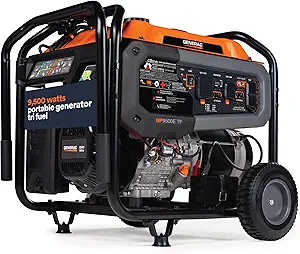
If you need a portable generator with enough output to run several major appliances during a power outage, the Generac GP9500E TF deserves a closer look. It combines 9,500 running watts on gasoline, tri-fuel capability, electric starting, a 7.5-gallon fuel tank, and COsense carbon-monoxide protection in a conventional open-frame design.
Unlike smaller portable generators designed primarily for refrigerators, lights, and electronics, the GP9500E TF is built for substantially heavier loads. It can run on gasoline, liquid propane, or natural gas, although its available output changes depending on the fuel being used.
For 2026, one of the most important things to understand about this generator is that its maximum gasoline output is 9,500 running watts and 12,500 starting watts, not 12,000 starting watts as older descriptions sometimes state. On propane, the rated output drops to 8,550 running watts and 11,250 starting watts, while natural gas provides 7,000 running watts and 9,000 starting watts.
That makes the GP9500E TF particularly interesting for homeowners who want multiple fuel options rather than relying exclusively on gasoline.
Generac GP9500E TF Specifications
| Feature | Specification |
|---|---|
| Model | Generac GP9500E TF |
| Model Number | 8063-0 |
| Configuration | 49-State |
| Fuel Types | Gasoline, propane, natural gas |
| Running Watts – Gasoline | 9,500W |
| Starting Watts – Gasoline | 12,500W |
| Running Watts – Propane | 8,550W |
| Starting Watts – Propane | 11,250W |
| Running Watts – Natural Gas | 7,000W |
| Starting Watts – Natural Gas | 9,000W |
| Engine | 500cc Generac OHV |
| Voltage | 120/240V |
| Frequency | 60 Hz |
| Start System | Electric start and recoil |
| Fuel Tank | 7.5 gallons |
| Runtime at 50% Load | Up to 9.5 hours on gasoline |
| Propane Runtime | About 4.5 hours with a 20-lb tank at 50% load |
| AVR | Yes |
| Fuel Gauge | Yes |
| Low-Oil Shutdown | Yes |
| CO Protection | COsense |
| Wheels | 9.5-inch never-flat |
| Weight | 219 lb |
| Residential Warranty | 3 years limited |
| Commercial Warranty | 2 years limited |
The specifications above are based on Generac’s current documentation for the GP9500E TF model 8063-0.
Power Output: 9,500 Running Watts and 12,500 Starting Watts
The main reason to consider the GP9500E TF is its power output.
When operating on gasoline, it produces 9,500 running watts and 12,500 starting watts. The distinction matters because many appliances with electric motors require significantly more power when they start than they do once they are running.
Refrigerators, freezers, sump pumps, air conditioners, well pumps, and some power tools can create these temporary startup demands.
The 12,500-watt starting capacity gives the GP9500E TF more headroom than a generator that only offers 9,000 or 10,000 starting watts.
However, 9,500 watts does not mean you can simply connect every major appliance in the house at the same time. Your actual electrical load still has to remain within the generator’s continuous output, while startup surges need to be considered separately.
This is especially important when powering equipment with electric heating elements or large compressors.
Output Changes Depending on the Fuel
One of the biggest advantages of the GP9500E TF is also something buyers need to understand correctly: the generator does not produce the same wattage on all three fuels.
According to Generac’s specifications:
- Gasoline: 9,500 running watts / 12,500 starting watts
- Propane: 8,550 running watts / 11,250 starting watts
- Natural gas: 7,000 running watts / 9,000 starting watts
This means gasoline provides the highest rated output.
Propane gives you another convenient option, particularly for emergency preparedness because propane can be stored for extended periods when properly handled.
Natural gas can be particularly convenient for a home that already has an appropriate gas supply, but the lower available output needs to be taken into account when calculating your electrical loads.
In other words, tri-fuel capability is about flexibility, not getting maximum wattage from every fuel.
Tri-Fuel Operation
The GP9500E TF can operate using gasoline, liquid propane, or natural gas.
That can be useful during extended outages because fuel availability isn’t always predictable.
For example, you might normally use gasoline but switch to propane if you have stored propane tanks available. A home with an appropriate natural-gas connection may have another option for longer-duration operation.
The ability to use three fuels can also make the generator more practical for people who want a backup system without depending on a single fuel source.
There is an important limitation, though: natural-gas operation requires an appropriate connection and fuel supply. It should not be treated as simply connecting a household gas line without proper installation.
7.5-Gallon Fuel Tank and Runtime
The GP9500E TF has a 7.5-gallon gasoline tank.
Generac lists a gasoline runtime of approximately 9.5 hours at 50% load for the 49-state model. It also lists approximately 4.5 hours at 50% load when using a 20-pound propane tank.
At a lighter 25% load, the published gasoline runtime increases to approximately 14 hours.
Actual runtime will vary depending on the electrical load, fuel, temperature, altitude, maintenance condition, and other operating factors.
This is an important distinction from saying the generator simply “runs all day.” Runtime is highly dependent on how much electricity you’re asking it to produce.
For a prolonged outage, fuel planning is therefore just as important as generator wattage.
500cc Generac OHV Engine
The GP9500E TF uses a 500cc Generac OHV engine with splash lubrication.
The overhead-valve design is intended to provide efficient engine operation while keeping the mechanical layout relatively straightforward.
The generator also incorporates automatic voltage regulation, which helps maintain voltage as electrical loads change.
For a portable generator in this power class, engine maintenance remains important. Regular oil changes, air-filter inspection, spark-plug maintenance, and proper fuel storage can have a significant effect on long-term reliability.
Electric Start and Recoil Backup
Starting the GP9500E TF is straightforward.
It includes an electric start system powered by an included battery, while also retaining a recoil starting mechanism.
The electric start is particularly useful for a generator this large because pulling a recoil starter on a 500cc engine isn’t something everyone will find convenient.
Having recoil as a backup is also useful if the battery is discharged or the electric-start system cannot be used.
Control Panel and Outlets
The GP9500E TF is designed to handle both conventional 120V loads and larger 120/240V applications.
The control panel includes 120V GFCI-protected outlets along with 120/240V connections for heavier loads. Generac also uses a 50-amp receptacle protected by a 40-amp breaker on this generator class.
That last point is worth understanding.
A 50-amp receptacle does not mean the generator can continuously deliver a full 50 amps at 240V. Generac specifically explains that the receptacle is protected by a 40-amp breaker because the generator’s actual continuous output is lower.
This makes the outlet useful for compatible connections, but buyers should not assume that the presence of a 14-50-style receptacle turns the generator into a 12,000-watt or 50-amp continuous power source.
Can It Power a House?
The GP9500E TF can provide substantial backup power for a home, but it should not automatically be described as a generator that powers an entire house without limitations.
A better way to think about it is essential-circuit backup.
Depending on the electrical requirements of your home, the generator can potentially support combinations of loads such as:
- Refrigerator
- Freezer
- Sump pump
- Well pump
- Gas furnace blower
- Lighting
- Television
- Internet equipment
- Microwave
- Window air conditioner
- Selected power tools
The exact combination depends on the starting and running wattage of every appliance.
If you’re connecting the generator to a home’s electrical system, use the appropriate transfer equipment and have the installation performed according to applicable electrical requirements. Never backfeed a home’s electrical system through a standard wall outlet.
What About Central Air Conditioning?
This is one area where generator sizing becomes particularly important.
A central air conditioner can have a significant startup surge, and the generator must have enough starting capacity to handle it along with the other loads already operating.
The GP9500E TF’s 12,500 starting watts on gasoline provide substantial surge capacity, but that doesn’t guarantee compatibility with every central HVAC system.
Before purchasing the generator specifically for air conditioning, check the HVAC unit’s electrical specifications and starting requirements.
You should also account for refrigerators, pumps, lighting, and other appliances that may already be operating when the air conditioner starts.
COsense Carbon Monoxide Protection
One of the most important safety features is COsense technology.
Generac describes COsense as a system designed to detect hazardous carbon monoxide conditions and automatically stop the generator when dangerous levels are detected.
However, COsense is not a substitute for safe generator placement.
Portable generators produce carbon monoxide and must be operated outdoors and away from occupied buildings, doors, windows, and ventilation openings.
Never operate the GP9500E TF inside a house, garage, basement, shed, or other enclosed or partially enclosed location.
The automatic shutdown system is an additional safety feature, not permission to operate the generator in an unsafe location.
Portability: Powerful but Heavy
Calling the GP9500E TF “portable” is technically correct, but the word can be misleading.
This is not a generator you casually lift into the back of a vehicle.
The documented unit weight is approximately 219 pounds, with dimensions of roughly 27.5 × 27.1 × 27.6 inches.
Fortunately, Generac equips it with a folding handle and 9.5-inch never-flat wheels.
That makes it considerably easier to roll across a driveway or relatively flat surface.
Still, buyers should think of portability as roll-around portability, not lightweight portability.
If you expect to regularly transport a generator between job sites, weight should be part of your purchasing decision.
Durability and Outdoor Use
The GP9500E TF uses a steel-tube cradle designed to provide a strong protective frame.
The covered outlets add protection against environmental exposure, while the open-frame design provides the traditional layout commonly found on high-output portable generators.
This type of construction makes sense for homeowners and contractors who prioritize power output and serviceability over the enclosed appearance of an inverter generator.
At the same time, the generator should still be protected from direct exposure to rain and other severe weather while operating, according to the manufacturer’s instructions.
Noise Level
One potential downside is noise.
The GP9500E TF is an open-frame conventional generator, not a quiet enclosed inverter generator.
Generac does not provide a published official decibel rating for the model in the documentation reviewed here. Independent testing and reviews have described it as clearly audible, which is typical for a generator in this output class. Bob Vila also noted that the generator is noticeable when operating, particularly at close range.
If quiet operation is one of your highest priorities, a smaller inverter generator may be a better fit.
If your priority is producing several thousand watts for emergency backup, however, the open-frame design is a more familiar trade-off.
Safety and Protection Features
The GP9500E TF includes several built-in protections designed to reduce the risk of equipment damage and unsafe operation.
These include:
- COsense carbon monoxide protection
- Low-oil shutdown
- Circuit-breaker protection
- GFCI-protected receptacles
- Covered outlets
- Automatic voltage regulation
Generac lists low-oil shutdown as a standard protection feature on the GP9500E TF.
Even with these features, safe operation depends on correct placement, grounding and electrical connections, fuel handling, maintenance, and following the owner’s manual.
Maintenance
A generator this powerful shouldn’t be treated as an appliance you buy and forget about.
Regular maintenance is important, particularly if the GP9500E TF is intended for emergency preparedness.
Routine maintenance can include:
- Checking engine oil
- Changing oil at the recommended intervals
- Inspecting or replacing the air filter
- Checking the spark plug
- Inspecting fuel connections
- Maintaining the starting battery
- Running the generator periodically according to the manufacturer’s recommendations
- Using proper fuel-storage practices
The GP9500E TF uses approximately 1.06 quarts of oil, with Generac specifying 10W-30 or SAE 30 depending on operating conditions.
Following the current owner’s manual is more important than relying on a generic generator maintenance schedule.
49-State Configuration: What Buyers Should Know
The GP9500E TF model 8063-0 is identified by Generac as a 49-State configuration.
This matters if you’re shopping in California or another location with specific emissions requirements.
Generac also currently lists a separate GP9500E Tri-Fuel 50-State version, so buyers should verify the exact model number and regulatory configuration before purchasing.
Don’t assume that every listing carrying the GP9500E name represents exactly the same configuration.
Who Is the Generac GP9500E TF Best For?
The GP9500E TF makes the most sense for buyers who need substantial portable power and want the flexibility of three fuel options.
It can be a good fit for:
Homeowners Preparing for Extended Outages
The combination of gasoline, propane, and natural gas gives homeowners more fuel flexibility than a gasoline-only generator.
The 7.5-gallon gasoline tank also provides considerably more capacity than the small tanks found on compact portable generators.
Contractors and Jobsite Users
The 9,500-watt continuous gasoline output provides enough capacity for multiple power tools and other demanding equipment, provided the combined electrical load stays within the generator’s limits.
The steel frame and large wheels are also useful when the generator needs to be moved around a work area.
Emergency Preparedness
Tri-fuel operation is particularly interesting for people who want multiple backup options.
Gasoline can provide maximum output, propane can serve as a stored alternative, and natural gas can be useful for homes with an appropriate supply and connection.
RV and Heavy-Duty Outdoor Applications
The available 120/240V connections make the GP9500E TF more versatile than smaller generators.
However, buyers should verify the exact electrical requirements of their RV or equipment before purchasing.
Who Should Consider a Smaller Generator?
Not everyone needs nearly 10,000 running watts.
If your main goal is simply to keep a refrigerator running, charge phones, power a few lights, and operate a modem or television, a smaller generator may consume less fuel and be easier to move.
The GP9500E TF makes more sense when you actually need its higher output.
That is one of the most important questions to ask before buying: How many watts do you really need?
Buying a 219-pound generator when a much smaller unit can handle your essential loads isn’t necessarily an advantage.
Generac GP9500E TF Pros and Cons
Pros
- 9,500 running watts on gasoline
- 12,500 starting watts on gasoline
- Tri-fuel capability
- 8,550 running watts on propane
- 7,000 running watts on natural gas
- 7.5-gallon gasoline tank
- Electric and recoil starting
- COsense carbon monoxide protection
- Automatic voltage regulation
- GFCI-protected outlets
- 120/240V output
- Never-flat wheels
- Folding handle
- 3-year residential limited warranty
Cons
- Approximately 219 pounds
- Open-frame design is relatively loud
- Gasoline provides the highest output; propane and natural gas produce less
- Not designed for powering every household load simultaneously
- 50-amp-style receptacle is protected by a 40-amp breaker
- 49-state configuration requires buyers to verify suitability for their location
Generac GP9500E TF vs. Smaller Portable Generators
The GP9500E TF occupies a different category from 3,000- or 4,000-watt portable generators.
A smaller generator is easier to transport, usually consumes less fuel, and can be sufficient for basic emergency loads.
The GP9500E TF is intended for situations where you need substantially more electrical capacity.
That additional capability comes with trade-offs: more weight, more fuel consumption, more noise, and a larger footprint.
The choice therefore shouldn’t simply be based on buying the generator with the biggest wattage number.
Instead, calculate the running and starting watts of the appliances you actually intend to operate.
Final Verdict on the Generac GP9500E TF
The Generac GP9500E TF is a high-output portable generator designed around one major advantage: fuel flexibility combined with substantial electrical capacity.
Its gasoline rating of 9,500 running watts and 12,500 starting watts gives it enough capacity for demanding emergency and jobsite applications, while propane and natural gas provide alternatives when gasoline isn’t the preferred fuel.
The trade-offs are equally important.
At about 219 pounds, this is a heavy generator. It’s also an open-frame model, so buyers shouldn’t expect quiet inverter-generator operation. And its output falls when switching from gasoline to propane or natural gas.
Those limitations don’t necessarily make it a poor choice; they simply define what kind of buyer the GP9500E TF is designed for.
Independent testing from Bob Vila found that the generator handled demanding combinations such as a freezer, window air conditioner, microwave and power tools during testing, although not all simultaneously. Pro Tool Reviews has also highlighted the GP9500E in the high-output portable-generator category, noting its tri-fuel operation, power output and practical limitations.
For someone who needs serious portable backup power and wants gasoline, propane, and natural gas flexibility, the GP9500E TF is a much more interesting proposition than the generic “9,500-watt generator” description suggests.
Just make sure you calculate your actual electrical loads, verify the exact model and state configuration, and plan for its substantial weight before ordering.