As an Amazon Associate I earn from qualifying purchases.
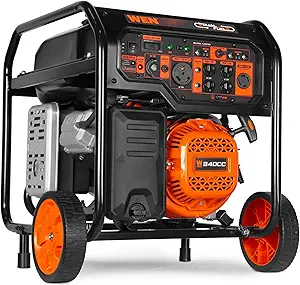
When you need dependable electricity during a power outage, at an RV campsite, or on a remote jobsite, a 6000 watt generator can be a practical middle ground between small portable generators and much larger home-backup units.
The important thing is to look beyond the number printed on the box. A generator advertised around 6,000 watts may have a different combination of starting watts and running watts, while inverter generators, conventional generators, and battery power stations work in very different ways.
For this 2026 guide, I compared the five models below based on power output, fuel flexibility, outlet configuration, portability, runtime, power quality, and safety features. I also kept models that are slightly above or below the 6,000-watt class because they can make sense depending on how much continuous power you actually need.
Best 6000 Watt Generators on Amazon US in 2026
| Generator Model | Power Class | Fuel / Power Source | Best For |
|---|---|---|---|
| WEN DF8000X | 8,000 starting / 6,500 running | Gasoline / Propane | Home backup and heavy-duty outdoor use |
| Könner & Söhnen KS 6000iEHS CO | 5,500 starting / 5,000 running | Gasoline / Propane | Quiet inverter-style backup and RV use |
| A-iTECH AT10-260001 | 6,000 starting / 5,500 running | Gasoline / Propane | Affordable home and jobsite power |
| Anker SOLIX F3800 | 6,000W continuous | Battery / Solar | Quiet home backup and off-grid power |
| Westinghouse WGen11500TFc | Up to 14,500 starting / 11,500 running | Gasoline / Propane / Natural Gas | High-demand home backup |
1. WEN DF8000X Dual Fuel Portable Generator
Check Amazon Price Click Here!
The WEN DF8000X is one of the most interesting choices if you are looking for a generator in the 6,000-watt running-power range but want some additional headroom for startup surges.
This is a conventional dual-fuel portable generator rather than an inverter model. On gasoline, it produces 8,000 starting watts and 6,500 running watts. On propane, the output is rated at 7,200 starting watts and 5,850 running watts.
That makes the DF8000X slightly more powerful than a strict 6,000-running-watt generator, but it fits the category well for buyers who want extra capacity without moving all the way into a large 10,000- or 12,000-watt machine.
Key Features
- 8,000 starting watts / 6,500 running watts on gasoline
- 7,200 starting watts / 5,850 running watts on propane
- Dual-fuel operation
- 340cc engine
- Electric start with recoil backup
- 120/240V capability
- 30A RV-ready TT-30R outlet
- 30A 120/240V transfer-switch-ready L14-30R outlet
- CO shutdown sensor
- 6.7-gallon gasoline tank
- Up to approximately 10.5 hours of runtime at half load
- Wheel kit for easier transportation
The WEN is particularly attractive for homeowners who want to run several essential appliances simultaneously. Its 120/240V output also makes it more useful for home backup than many smaller portable generators.
The main trade-off is that it does not provide the low-THD inverter output found on some newer enclosed generators. For general appliances, pumps, tools, refrigerators, and similar loads, that may not be a problem, but buyers who specifically prioritize inverter-style power should look at the next options.
Best for: Homeowners who want extra power, dual-fuel flexibility, and 120/240V capability without buying a much larger generator.
2. Könner & Söhnen KS 6000iEHS CO Dual-Fuel Inverter Generator
Check Amazon Price Click Here!
The Könner & Söhnen KS 6000iEHS CO is a very different approach to the 6,000-watt class.
Despite the model name, its current U.S. specification is 5,500 starting watts and 5,000 running watts on gasoline, with approximately 10% less output when operating on LPG. That makes it better described as a 5,000-watt-class generator rather than a true 6,000-running-watt generator.
Its advantage is the combination of dual-fuel operation, enclosed inverter technology, electric start, and carbon-monoxide protection.
Key Features
- 5,500 starting watts / 5,000 running watts on gasoline
- Approximately 4,950 starting / 4,500 running watts on LPG
- Gasoline and propane operation
- Inverter technology
- Less than 3% THD
- 120/240V output
- 30A 120/240V outlet
- Electric and recoil start
- Built-in carbon monoxide shutdown
- 2.9-gallon fuel tank
- LED information display
- USB-C/QC3.0 output
- Approximately 86.9 lb
- Enclosed design for quieter operation
The low-THD inverter output is one of the biggest reasons to consider this model. If you regularly power laptops, televisions, communication equipment, chargers, or other sensitive electronics, clean power can be an important consideration.
Its lighter weight is another advantage. At under 90 pounds, it is significantly easier to move than many open-frame generators in this general power range.
The downside is straightforward: 5,000 running watts is not the same as 6,000 running watts. If your calculated load is already close to 5,000 watts, this is not the model to choose simply because “6000” appears in its name.
Best for: Buyers who prioritize quieter operation, inverter power, portability, and dual-fuel flexibility over maximum continuous wattage.
3. A-iTECH AT10-260001 Dual-Fuel Portable Generator
Check Amazon Price Click Here!
If your target is a generator that comes close to the 6,000-watt class without paying for a much larger machine, the A-iTECH AT10-260001 deserves consideration.
The current specifications list 6,000 starting watts and 5,500 running watts on gasoline. When operating on LPG, the available output is lower.
Unlike the Könner & Söhnen, this is not an inverter generator. It uses a conventional alternator with AVR regulation.
Key Features
- 6,000 starting watts / 5,500 running watts on gasoline
- Dual-fuel gasoline and LPG operation
- 322cc OHV engine
- Electric start with recoil backup
- 120/240V output
- 30A L14-30R outlet
- GFCI-protected 120V outlets
- CO sensor
- Low-oil shutdown
- 4-gallon fuel tank
- Up to 12 hours at 25% load on gasoline
- Approximately 158 lb
- Folding handle and wheels
- EPA and CARB certifications listed by the manufacturer
The 5,500 running-watt gasoline rating puts the A-iTECH close to the sweet spot for many homeowners who need to operate a refrigerator, freezer, lights, sump pump, television, internet equipment, and selected appliances during an outage.
It is also useful for jobsite and outdoor applications where inverter technology is not necessarily the main priority.
One important detail is power quality. Because this is a conventional AVR generator rather than an inverter model, I would not choose it solely because of its 6,000-watt starting figure. Instead, consider the actual appliances you plan to connect and their electrical requirements.
Best for: Buyers looking for an affordable dual-fuel generator with around 5,500 watts of continuous gasoline output.
4. Anker SOLIX F3800 Portable Power Station
Check Amazon Price Click Here!
The Anker SOLIX F3800 deserves a place on this list, but it is important to clarify what it is.
It is not a gasoline generator. It is a portable battery power station designed to deliver electricity from a large LiFePO4 battery, with solar charging and expandable storage.
Its AC output is rated at 6,000 watts continuous, making it one of the closest matches in this list to a true 6,000-watt output requirement.
Key Features
- 6,000W continuous AC output
- 9,000W surge output
- 3,840Wh battery capacity
- LiFePO4 battery chemistry
- 120/240V dual-voltage output
- Solar charging up to 2,400W
- Expandable battery capacity
- Up to six expansion batteries
- Wi-Fi and Bluetooth app connectivity
- NEMA 14-50 and L14-30 outlets
- UPS functionality
- Approximately 132.3 lb
- 5-year warranty
The biggest advantage over a conventional fuel generator is the operating experience.
There is no gasoline to store, no engine oil to change, and no engine noise or exhaust while the battery is supplying power. That makes the F3800 particularly interesting for indoor-adjacent backup applications where a conventional generator cannot safely be operated.
However, battery capacity matters just as much as output.
A 6,000W inverter does not mean the F3800 can supply 6,000 watts for an unlimited amount of time. The 3,840Wh battery capacity determines how long the stored energy lasts. Running a constant 6,000W load would drain the battery much faster than running a refrigerator, lights, networking equipment, and a few smaller appliances.
Solar input and expansion batteries can significantly change the overall system, which is why the F3800 is better thought of as a home energy storage system rather than a traditional portable generator.
Best for: Buyers who want 6,000W-class output without gasoline, engine exhaust, or conventional generator noise.
5. Westinghouse WGen11500TFc Tri-Fuel Generator
Check Amazon Price Click Here!
The Westinghouse WGen11500TFc is the outlier in this comparison.
It is not a 6,000-watt generator. It is a much larger 11,500-running-watt tri-fuel generator that I would consider when your power requirements go substantially beyond what a typical 6,000-watt-class machine can handle.
On gasoline, it provides 14,500 starting watts and 11,500 running watts. On propane, the output is 13,500 starting / 10,500 running watts, while natural gas provides 12,000 starting / 9,500 running watts.
Key Features
- 14,500 starting / 11,500 running watts on gasoline
- 13,500 starting / 10,500 running watts on propane
- 12,000 starting / 9,500 running watts on natural gas
- Gasoline, propane, and natural gas operation
- Remote and electric start
- CO sensor with automatic shutdown
- 120/240V output
- 30A and 50A outlets
- Transfer-switch ready
- GFCI outlets
- Low-THD output
- 9.5-gallon fuel tank
- Up to 19 hours at 25% load on gasoline
- Approximately 230 lb
The reason to consider this model is not portability. At around 230 pounds, it is a serious piece of equipment.
Its strength is whole-home and high-demand backup potential.
If you have a larger house with several high-demand loads, such as a central air-conditioning system, refrigerator, freezer, sump pump, lighting circuits, and other essential appliances, an 11,500-running-watt generator gives you substantially more headroom than the 5,000–6,500-watt class.
The tri-fuel capability is another major advantage during extended outages. Gasoline and propane are useful options, while natural gas can provide a longer-term fuel source for homes with an appropriate connection.
Best for: Larger homes and buyers who need considerably more power than a typical 6,000-watt-class generator can provide.
6000 Watt Generator Comparison for 2026
| Model | Gasoline Running Watts | Propane / Other | Inverter | Fuel Options | CO Shutoff | 120/240V | Approx. Weight |
|---|---|---|---|---|---|---|---|
| WEN DF8000X | 6,500W | 5,850W LPG | No | Gas/Propane | Yes | Yes | 139 lb |
| K&S KS 6000iEHS CO | 5,000W | ~4,500W LPG | Yes | Gas/Propane | Yes | Yes | 87 lb |
| A-iTECH AT10-260001 | 5,500W | Lower on LPG | No | Gas/Propane | Yes | Yes | 158 lb |
| Anker SOLIX F3800 | 6,000W AC | Battery/Solar | Yes | Battery/Solar | N/A | Yes | 132 lb |
| Westinghouse WGen11500TFc | 11,500W | 10,500W LPG / 9,500W NG | No | Gas/Propane/NG | Yes | Yes | 230 lb |
The key takeaway is that “6,000 watts” does not describe all five models equally. The WEN is slightly above the class, the K&S and A-iTECH are slightly below it in continuous output, the Anker provides exactly 6,000W of continuous AC output from a battery system, and the Westinghouse is a much higher-output alternative.
That distinction is important when comparing generators online.
What Can a 6000 Watt Generator Run?
A generator’s running-watt rating determines the amount of electrical load it can sustain. Starting watts provide additional short-term capacity for appliances with electric motors or compressors.
A generator around this class may be capable of handling combinations such as:
- Refrigerator
- Freezer
- Sump pump
- Furnace blower
- Lights
- Wi-Fi router and networking equipment
- Television
- Computers and chargers
- Microwave
- Small power tools
- Selected window air conditioners
- RV appliances
However, you should not simply add the running watts and assume everything will start simultaneously.
Motors and compressors can require significantly more power during startup. A refrigerator, well pump, sump pump, or air conditioner may therefore create a temporary surge that needs to be considered when sizing your generator.
For home backup, make a list of the appliances you actually need during an outage and calculate both their running and starting requirements.
Starting Watts vs. Running Watts
This is one of the most important things to understand before buying a generator.
Running watts, sometimes called rated watts, are the amount of power the generator can continuously provide.
Starting watts, also called surge or peak watts, are the additional short-term power available when equipment with motors or compressors starts.
For example, the WEN DF8000X provides 6,500 running watts and 8,000 starting watts on gasoline.
That does not mean you can continuously operate an 8,000-watt load.
You should size the generator around its running-watt capacity and then make sure there is enough starting-watt headroom for your largest motor-driven appliances.
Is a 6000 Watt Generator Enough for Home Backup?
For many homes, a generator in this general range can be enough for essential-load backup, but it is not automatically a whole-house solution.
A 5,000–6,500 running-watt generator can be a good fit if you want to keep important circuits operating while selectively managing larger appliances.
For example, you might run:
- Refrigerator
- Freezer
- Sump pump
- Furnace blower
- Lights
- Internet equipment
- Television
- A few kitchen appliances
You may need a larger generator if you want to operate central air conditioning, electric water heating, multiple large appliances, or several high-demand loads simultaneously.
This is where the Westinghouse WGen11500TFc becomes relevant. Its 11,500 running watts provide substantially more capacity than the typical 6,000-watt class.
Dual Fuel vs. Gasoline-Only Generators
Dual-fuel generators can run on gasoline and propane.
That gives you another fuel option during a prolonged outage and can make storage easier because propane can be stored for long periods when handled correctly.
Gasoline usually provides the highest output on dual-fuel generators, while propane generally produces somewhat less power.
For example, the WEN DF8000X produces 6,500 running watts on gasoline but 5,850 running watts on propane.
If maximum output is your priority, gasoline may be preferable. If fuel-storage flexibility matters more, dual fuel can be attractive.
Tri-fuel generators take the idea one step further by adding natural gas.
Inverter Generator vs. Conventional Generator
Inverter generators and conventional generators have different strengths.
An inverter generator electronically produces and regulates its electrical output and is generally associated with cleaner power and quieter operation.
A conventional generator typically uses an alternator and voltage regulation system to produce AC power.
If you frequently power sensitive electronics, look closely at the manufacturer’s power-quality specifications, including THD, rather than assuming every generator produces identical electricity.
The Könner & Söhnen KS 6000iEHS CO, for example, is an inverter model with less than 3% THD according to its current specifications.
The WEN DF8000X and A-iTECH AT10-260001 are conventional generator designs, so they should not be marketed as inverter generators.
Do You Need 120V or 240V?
For basic camping or outdoor equipment, 120V may be enough.
For home backup, however, 120/240V capability can be much more useful.
Many larger appliances and home electrical systems use 240V circuits. A generator with an appropriate 120/240V outlet can therefore provide more flexibility for backup applications.
If you plan to connect a portable generator to selected home circuits, you should use an appropriate transfer switch or interlock system and follow local electrical requirements. Never attempt to backfeed your home’s electrical system through a standard wall outlet.
Generator Safety: What to Know in 2026
Carbon monoxide is one of the most important safety concerns with portable fuel-powered generators.
A generator should never be operated inside a house, garage, basement, shed, crawlspace, or other enclosed or partially enclosed space.
The CDC recommends operating portable generators outdoors more than 20 feet from windows, doors, and vents. The exhaust should also be directed away from the home.
A CO shutdown sensor is a valuable safety feature, but it does not make indoor operation safe.
You should also:
- Keep the generator dry and follow the manufacturer’s wet-weather instructions.
- Use properly rated outdoor extension cords when appropriate.
- Allow the generator to cool before refueling.
- Store gasoline safely and away from ignition sources.
- Keep children and pets away from the operating generator.
- Maintain the generator according to the owner’s manual.
- Install working CO alarms inside the home.
CPSC guidance in 2026 continues to emphasize keeping portable generators outside and at least 20 feet from the home, with exhaust directed away from windows, doors, and other openings.
How to Choose the Right 6000 Watt Generator
Before buying, consider these six factors.
1. Running Wattage
This should be your first consideration. Add the continuous wattage of the appliances you plan to use and leave room for startup surges.
2. Starting Wattage
Check the startup requirements of refrigerators, pumps, air conditioners, compressors, and power tools.
3. Fuel Type
Gasoline is common, while dual-fuel models add propane flexibility. Tri-fuel models add natural gas.
4. Power Quality
If you regularly power sensitive electronics, compare THD specifications and consider an inverter generator or power station.
5. 120/240V Capability
For home backup, 120/240V output can be considerably more useful than a generator limited to 120V.
6. Weight and Portability
A generator producing around 6,000 watts is not lightweight. Check the actual weight and wheel/handle design before assuming you can easily move it yourself.
Which 6000 Watt Generator Should You Choose?
The right choice depends on how closely your actual power requirements match each category.
Choose the WEN DF8000X if you want a conventional dual-fuel generator with 6,500 running watts on gasoline and useful 120/240V capability.
Choose the Könner & Söhnen KS 6000iEHS CO if quieter operation, inverter technology, low THD, and lower weight are more important than reaching 6,000 running watts.
Choose the A-iTECH AT10-260001 if you want a straightforward dual-fuel generator with 5,500 running watts on gasoline and a relatively affordable configuration.
Choose the Anker SOLIX F3800 if you want 6,000W of battery-based AC output without gasoline, engine exhaust, or conventional generator noise.
Choose the Westinghouse WGen11500TFc if your actual requirement is much higher than 6,000 watts and you need tri-fuel flexibility for serious home backup.
Final Thoughts
The phrase “6000 watt generator” can be misleading because manufacturers and retailers do not always use the same terminology.
Some models advertise their starting watts, while others emphasize running watts. Battery power stations use another set of measurements, including watt-hours for stored energy.
For most buyers, the smartest approach is to start with the loads you actually need to power and then choose a generator with enough continuous running-watt capacity, plus sufficient starting-watt headroom.
The WEN DF8000X provides extra capacity above the 6,000-watt class, while the A-iTECH stays relatively close to it at 5,500 running watts. The Könner & Söhnen offers a lighter inverter-oriented option, while the Anker SOLIX F3800 provides 6,000W of battery-based AC output. At the other end, the Westinghouse WGen11500TFc is the choice for buyers who have moved well beyond the requirements of a typical 6,000-watt generator.
Whatever model you choose, prioritize correct sizing, safe installation, proper ventilation, and carbon-monoxide protection. A generator is most useful when it can provide the power you need without creating another hazard during an outage.