As an Amazon Associate I earn from qualifying purchases.
Running an air conditioner from a solar generator is no longer limited to expensive off-grid systems. In 2026, portable power stations have enough battery capacity and inverter output to run many window AC units, portable air conditioners, RV air conditioners, and some mini-splits during a power outage.
The catch is that not every solar generator can start an air conditioner, and even a power station with enough output may not have enough battery capacity to keep the AC running for very long.
If you’re looking for the best solar generator for an air conditioner, you need to consider three things together: inverter output, battery capacity, and solar charging capability. The AC’s actual running wattage and startup surge matter just as much.
A soft-start device can also make a major difference when an air conditioner’s compressor has a high startup demand.
Below, I’ll compare the solar generators and AC soft-start products from this guide, explain what has changed for 2026, and show you how to estimate realistic runtime before buying.
Quick Answer: What Size Solar Generator Do You Need for an Air Conditioner?
For a small 5,000–8,000 BTU window air conditioner, a quality 1,000–2,000W power station with at least 1,000Wh of battery capacity can be a practical starting point.
For an 8,000–12,000 BTU AC, I’d look for a 2,000W-or-higher inverter and roughly 2,000Wh of battery capacity if you want useful runtime rather than a short emergency cooling session.
Larger portable ACs, RV roof air conditioners, and mini-splits can require substantially more power. For those applications, a 2,400–4,000W-class power station provides considerably more headroom.
For central air conditioning, a small portable solar generator usually isn’t the right solution. You need a much larger 120/240V system, sufficient battery storage, and an appropriate connection method.
A Simple Rule of Thumb
| Air Conditioner | Typical Running Power* | Suggested Solar Generator |
|---|---|---|
| 5,000 BTU window AC | 450–600W | 1,000W+ inverter / 1,000Wh+ |
| 8,000 BTU window AC | 600–900W | 1,500–2,000W / 1,500Wh+ |
| 10,000 BTU window AC | 800–1,200W | 2,000W+ / 2,000Wh+ |
| 12,000 BTU window AC | 1,000–1,400W | 2,400W+ / 2,000Wh+ |
| RV AC | Varies considerably | 2,000–4,000W+ / 2,000Wh+ |
| Mini-split | Often 500–1,500W | 2,000–4,000W+ depending on system |
| Central AC | Often several thousand watts | Large 120/240V expandable system |
*Actual consumption varies by model, efficiency, outdoor temperature, thermostat cycling, and operating conditions. Always check the electrical specifications on your specific air conditioner.
Why Air Conditioners Are Difficult for Solar Generators
An air conditioner isn’t like a television or refrigerator.
The compressor motor can demand substantially more power when it starts than it uses after reaching normal operating speed. This is commonly called startup surge or locked-rotor current.
That’s why a power station rated at 2,000W may operate a 700W AC perfectly well but still shut down when the compressor starts.
Modern inverter-driven air conditioners are generally easier to power because their compressors can ramp up rather than starting at full power. Traditional compressor systems can have much larger startup spikes.
This is why you should never choose a solar generator based only on the AC’s running wattage.
You need to consider:
- Continuous inverter output
- Peak/surge output
- AC startup requirements
- Battery capacity
- Solar input
- Other appliances running at the same time
- Whether the AC uses an inverter compressor
Best Solar Generators for Air Conditioners in 2026
The products below include the original products featured in this article, with their specifications updated where necessary.
1. EF ECOFLOW DELTA Pro – Best High-Capacity Option
Check Amazon Price Click Here!
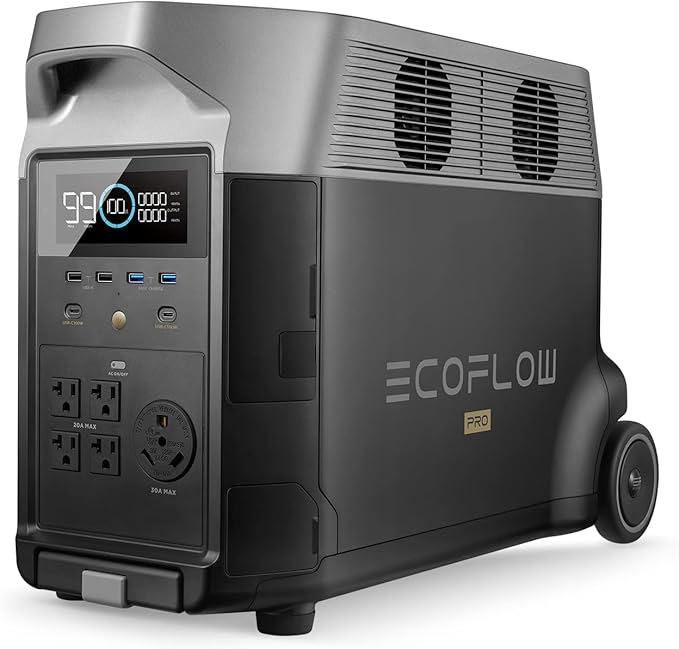
The EF ECOFLOW DELTA Pro remains an interesting option for people who want a large portable power station for air conditioning, RV use, emergency backup, and off-grid applications.
The original DELTA Pro provides 3,600Wh of battery capacity and 3,600W of AC output, with up to 7,200W of surge capability. It also supports up to 1,600W of solar input and uses an LFP battery.
For an air conditioner, the biggest advantage is the combination of a large battery and strong inverter.
However, buyers should understand that the DELTA Pro 3 is now the newer generation. EcoFlow’s current DELTA Pro 3 increases capacity to 4,096Wh and provides 4,000W of continuous output with an 8,000W surge rating. It also accepts up to 2,600W of solar input and supports 120/240V output.
That means shoppers should check exactly which DELTA Pro version the Amazon listing currently offers before purchasing.
Key Specifications
| Feature | EF ECOFLOW DELTA Pro |
|---|---|
| Battery capacity | 3,600Wh |
| Battery chemistry | LiFePO4 |
| AC output | 3,600W |
| Surge output | Up to 7,200W |
| Solar input | Up to 1,600W |
| Expandable | Yes |
| Weight | About 99 lb |
| Best use | RVs, backup power, larger AC loads |
Why I Like It for AC Use
The DELTA Pro has substantially more inverter headroom than smaller portable power stations. That’s important when an air conditioner’s compressor starts.
The 3,600Wh battery also gives you considerably more usable energy than typical 1,000Wh-class units.
The downside is weight. At roughly 99 pounds, this isn’t something most people will want to carry around like a small camping power station.
Best for: RV air conditioners, larger window units, emergency backup, and users who prioritize battery capacity over portability.
2. EF ECOFLOW DELTA 2 Max – Best Balance of Size and Capacity
Check Amazon Price Click Here!
The EF ECOFLOW DELTA 2 Max is one of the more practical choices for people who want enough power for air conditioning without stepping all the way up to a 4,000W-class system.
It has a 2,048Wh LFP battery and 2,400W of AC output, with up to 4,800W of surge capability. The U.S. version supports up to 1,000W of solar input.
The battery can also be expanded, which is useful if your primary goal is longer AC runtime during outages.
Key Specifications
| Feature | EF ECOFLOW DELTA 2 Max |
|---|---|
| Battery capacity | 2,048Wh |
| Battery chemistry | LiFePO4 |
| AC output | 2,400W |
| Surge output | Up to 4,800W |
| Solar input | Up to 1,000W |
| Expandable | Yes |
| Weight | About 50 lb |
| Best use | Window AC, RV, home backup |
Why It Makes Sense for an Air Conditioner
The DELTA 2 Max sits in a useful middle ground.
A 2,400W inverter gives you more room for compressor startup than many compact power stations, while 2,048Wh is enough for several hours of operation with a relatively efficient AC.
It also has enough solar input to make daytime operation much more practical than using a small panel with a large air conditioner.
For example, if your AC averages 800W while running, the battery-only runtime will not be four hours just because the battery is rated at 2,048Wh. After accounting for inverter losses and other system consumption, actual runtime will be lower.
Still, this is a strong size-to-capacity combination for many users.
Best for: 8,000–12,000 BTU window ACs, RV cooling, emergency cooling, and buyers who want a reasonably portable system.
3. OUKITEL P2001 Plus + 400W Solar Generator Kit – Best Value-Oriented Pick
Check Amazon Price Click Here!
The OUKITEL P2001 Plus deserves attention because its current specifications are stronger than the original article suggested.
The P2001 Plus provides 2,048Wh of LiFePO4 battery capacity and 2,400W of pure sine wave AC output, with a 4,800W surge rating.
The current specification also lists up to 500W of solar input, rather than the 1,200W figure previously shown in the article.
Key Specifications
| Feature | OUKITEL P2001 Plus |
|---|---|
| Capacity | 2,048Wh |
| Battery chemistry | LiFePO4 |
| Continuous output | 2,400W |
| Surge output | 4,800W |
| Solar input | Up to 500W |
| AC charging | Up to 1,800W |
| Solar + AC input | Up to 2,300W |
| Weight | About 48.5 lb |
| Wi-Fi/Bluetooth | Yes |
| Best use | AC backup, RV, home emergency power |
The P2001 Plus can charge from AC at up to 1,800W and supports adjustable charging levels. OUKITEL also lists a 500W maximum solar input and a pure sine wave inverter.
Why It’s Interesting for AC Use
The 2,400W inverter gives this unit enough output for many smaller and medium-sized air conditioners, provided the AC’s startup requirements are within the power station’s limits.
The 2,048Wh battery is also large enough to make it much more useful than a 500–1,000Wh power station for emergency cooling.
One limitation is the 500W solar input. That’s useful, but it’s not as much solar charging capacity as some newer high-end systems offer.
Best for: 5,000–10,000 BTU window ACs, RV users, emergency cooling, and buyers looking for a large-capacity power station without moving into the heaviest systems.
Best AC Soft-Start Devices
A soft-start device is not a solar generator. Instead, it is an accessory installed with the air conditioner to reduce the compressor’s startup demand.
This distinction matters.
A soft starter doesn’t add battery capacity. It simply makes it easier for the inverter to handle the compressor’s startup event.
4. MICRO-AIR EasyStart FLEX 398 – Best Premium Soft Starter
Check Amazon Price Click Here!
The MICRO-AIR EasyStart FLEX is a different type of product from the solar generators above, but it can be extremely useful when an air conditioner has a startup surge that causes a power station to overload.
The current EasyStart Flex is designed for residential air conditioners and heat pumps up to 6 tons or 72,000 BTUs, with Micro-Air advertising up to a 75% reduction in startup current.
It supports 100–250VAC systems and uses adaptive learning technology to optimize compressor startup.
Key Specifications
| Feature | MICRO-AIR EasyStart FLEX |
|---|---|
| Application | Residential AC and heat pumps |
| Supported systems | Up to 6 tons / 72,000 BTU |
| Voltage | 100–250VAC |
| Startup reduction | Up to 75% |
| Enclosure | Weather-resistant design |
| Installation | DIY or professional |
| Best use | Reducing compressor startup demand |
Is It Necessary?
Not always.
If your solar generator easily starts your AC without overloading, a soft starter may not be necessary.
But if your generator can handle the AC’s running wattage but shuts down whenever the compressor starts, reducing startup current can make the difference.
Installation should be performed according to the manufacturer’s instructions. If you’re not comfortable working around AC electrical wiring, use a qualified HVAC technician or electrician.
Best for: Larger residential AC systems, generator-constrained installations, and compressors with difficult startup loads.
5. SoftStart Home – Another Option for Residential AC
Check Amazon Price Click Here!
SoftStart Home is another soft-start solution designed to reduce the startup power demand of air conditioners and heat pumps.
The manufacturer states that it can reduce startup power demand by up to 70%. Its specifications support both 110V and 220V single-phase applications, depending on the specific system.
Key Specifications
| Feature | SoftStart Home |
|---|---|
| Application | Air conditioners and heat pumps |
| Voltage | 110V / 220V |
| Startup reduction | Up to 70% |
| Maximum continuous current | 42A |
| Installation | DIY or professional |
| Best use | Reducing AC startup demand |
Like the Micro-Air system, this should be viewed as an accessory that helps a generator handle the AC compressor rather than as a replacement for a properly sized inverter.
Best for: Home central AC systems and other compressor-based HVAC equipment where startup current is the limiting factor.
Solar Generators for Air Conditioners: Comparison Table
| Model | Capacity | Continuous AC Output | Surge | Solar Input | Best For |
|---|---|---|---|---|---|
| EF ECOFLOW DELTA Pro | 3,600Wh | 3,600W | 7,200W | 1,600W | Large AC/RV backup |
| EF ECOFLOW DELTA 2 Max | 2,048Wh | 2,400W | 4,800W | 1,000W | Medium AC/home backup |
| OUKITEL P2001 Plus | 2,048Wh | 2,400W | 4,800W | 500W | Value-oriented AC backup |
| MICRO-AIR EasyStart FLEX | N/A | N/A | N/A | N/A | Reducing AC startup surge |
| SoftStart Home | N/A | N/A | N/A | N/A | Reducing HVAC startup demand |
How Long Can a Solar Generator Run an Air Conditioner?
This is where many solar-generator articles become misleading.
Battery capacity is measured in watt-hours (Wh), while an air conditioner’s electrical consumption is measured in watts (W).
A simple estimate is:
Runtime = Battery Capacity × Usable Efficiency ÷ AC Running Watts
For example, let’s assume a 2,048Wh power station and approximately 85% usable efficiency after conversion losses.
That gives approximately:
2,048Wh × 0.85 = 1,741Wh of practical AC energy
If your air conditioner averages 500W:
1,741 ÷ 500 = about 3.5 hours
At 800W:
1,741 ÷ 800 = about 2.2 hours
At 1,000W:
1,741 ÷ 1,000 = about 1.7 hours
At 1,200W:
1,741 ÷ 1,200 = about 1.45 hours
These are estimates, not guarantees.
An air conditioner may cycle on and off rather than drawing its maximum running wattage continuously. Ambient temperature, thermostat settings, insulation, humidity, compressor efficiency, and the specific AC model can all change the result.
How Many Solar Panels Do You Need?
Battery capacity determines how much stored energy you have.
Solar input determines how quickly you can replace that energy during daylight.
For example, if your AC consumes approximately 800W while running, a single 400W solar panel cannot completely offset that consumption under real-world conditions.
The panel may produce substantially less than its rated 400W because of:
- Cloud cover
- Panel angle
- Heat
- Shading
- Time of day
- Dust
- Cable losses
- Controller losses
This is why larger solar generators can be more useful for extended daytime AC operation.
A system that accepts 1,000W or more of solar input gives you much more flexibility than one limited to 200–400W.
Do You Need a Soft Starter for an Air Conditioner?
Not necessarily.
A soft starter becomes particularly useful when the AC’s compressor startup surge is too high for the solar generator’s inverter.
Consider this situation:
Your AC consumes 800W once running, but its compressor briefly requires substantially more power to start.
A 2,000W solar generator might handle the 800W running load easily but shut down during compressor startup.
A properly installed soft starter can reduce that startup demand and make the AC easier for the inverter to start.
However, a soft starter does not reduce the AC’s normal energy consumption enough to turn a small battery into a large one.
If your AC consumes 800W while running, the battery still has to provide roughly that amount of power during operation.
Best Solar Generator Size by Air Conditioner Type
5,000 BTU Window AC
A small window unit is one of the easiest air conditioners to pair with a solar generator.
A 1,000Wh-class power station may work for short emergency cooling periods, assuming the inverter can handle startup.
For longer operation, a 2,000Wh system is much more practical.
8,000 BTU Window AC
This is still a realistic target for a 2,000W-class power station.
Look for at least 1,500–2,000Wh of battery capacity if you want useful runtime.
10,000–12,000 BTU Window AC
For these larger units, I’d prefer a power station with at least 2,400W of continuous inverter output and plenty of surge headroom.
A 2,000Wh battery can work, but don’t expect all-day operation without solar input or additional batteries.
RV Air Conditioner
RV rooftop AC units can be more demanding because they typically use compressor-based cooling and may have a significant startup surge.
This is where a soft-start device can be particularly valuable.
A 2,400–4,000W-class power station is a much safer starting point than a small 1,000W portable unit.
Mini-Split
Mini-splits can be an excellent match for battery power, particularly modern inverter-driven systems.
Their variable-speed compressors can reduce startup stress and may use considerably less power once the room reaches the target temperature.
However, you still need to verify the voltage and electrical requirements of the specific mini-split.
Central Air Conditioning
Central AC is a completely different challenge.
A typical residential central system can require several thousand watts and may operate at 240V.
For this application, don’t assume that a portable 2,000Wh power station is sufficient.
Large systems such as the EcoFlow DELTA Pro 3 provide 120/240V output, 4,000W continuous output and 8,000W surge capability, making them far more appropriate for larger HVAC loads than compact portable stations.
What to Look for When Buying a Solar Generator for AC
1. Continuous Wattage
This is the amount of power the inverter can deliver continuously.
If your AC consumes 1,000W, buying a 1,000W inverter leaves virtually no margin.
I prefer having additional capacity above the expected running load.
2. Surge Wattage
This is especially important for compressor-based air conditioners.
Check the AC’s electrical specifications whenever possible rather than relying on generic BTU-to-watt estimates.
3. Battery Capacity
For AC use, I’d generally favor 2,000Wh or more when practical.
A 500Wh or 1,000Wh battery may be useful for short cooling sessions, but it will drain quickly when an air conditioner is consuming several hundred watts.
4. Solar Input
Higher solar input becomes increasingly important if you want to run the AC for many hours.
A system capable of accepting 1,000W of solar power has a major advantage over one limited to 200W or 400W.
5. Battery Chemistry
LiFePO4 batteries are now common in quality portable power stations because they offer good cycle life and thermal stability.
The DELTA Pro, DELTA 2 Max and OUKITEL P2001 Plus all use LFP battery chemistry.
6. Expandability
If you’re buying a solar generator for emergency home backup, consider whether you can add extra batteries later.
This can be more economical than replacing the entire system when your energy requirements increase.
7. 120V or 240V Output
Most portable window AC units operate from 120V.
Large central HVAC systems may require 240V.
Always verify the voltage before buying.
Solar Generator vs. Gas Generator for Air Conditioning
A solar generator has several advantages during an outage.
It produces no exhaust while operating, is quiet, and can be used indoors when operated according to the manufacturer’s instructions.
A gas generator, however, can continue producing electricity as long as you have fuel.
That’s the fundamental difference.
A battery power station gives you a finite amount of stored energy. Solar panels can replenish it during daylight, but cloudy weather can significantly reduce production.
For a long outage, a larger battery bank, substantial solar array, or another charging source may be necessary.
How to Get Longer AC Runtime During a Blackout
You don’t always need a larger generator.
Sometimes reducing the AC’s workload is more effective.
Keep doors and windows closed, block direct sunlight, improve insulation around the cooled room, and cool only the rooms that matter.
A smaller window AC cooling one occupied bedroom can consume far less energy than trying to maintain the entire house at the same temperature.
You can also raise the thermostat slightly and use fans to improve comfort without dramatically increasing electrical consumption.
These simple changes can make a significant difference when every watt-hour matters.
Safety Tips for Running an AC From a Solar Generator
Never assume that a power station can safely power your home’s electrical circuits simply because it has AC outlets.
If you want to connect a portable power station to household wiring, use an appropriate transfer switch, inlet, or manufacturer-approved system installed according to electrical code.
Never backfeed a home through a standard wall outlet.
Also:
- Check the AC’s voltage and amperage.
- Check both running and startup requirements.
- Avoid undersized extension cords.
- Keep portable equipment dry unless specifically rated for wet conditions.
- Follow the solar generator manufacturer’s operating instructions.
- Don’t exceed the inverter’s continuous rating.
- Don’t assume a soft starter eliminates all electrical limitations.
- Use professional installation for permanent HVAC wiring if you’re not qualified.
Frequently Asked Questions
Can a solar generator run an air conditioner?
Yes. Many modern solar generators can run small and medium-sized air conditioners. The critical factors are the AC’s running wattage, startup surge, the generator’s inverter output, and battery capacity.
What size solar generator do I need for a 10,000 BTU AC?
A 2,000W-class inverter can be a reasonable starting point, but a 2,400W or larger system provides more headroom. Around 2,000Wh of battery capacity is also a good target if you want meaningful runtime rather than a short emergency cooling session.
Can a 2,000W solar generator run an AC?
It can run many smaller AC units, but the startup surge is just as important as the running wattage. A 2,000W inverter may operate a 500–800W AC but still struggle with a compressor that has a high startup demand.
How long will a 2,000Wh solar generator run an air conditioner?
It depends on the AC’s actual power consumption. As a rough example, a 2,000Wh battery may provide around 1.5–2 hours of runtime for an AC averaging approximately 1,000W after accounting for conversion losses. A lower-power 500W AC could run for several hours.
Will a soft starter make a small solar generator run a large AC?
It can help with startup, but it doesn’t solve every problem. A soft starter reduces compressor startup demand; it does not dramatically reduce the AC’s continuous power consumption or increase battery capacity.
Can solar panels run an air conditioner directly?
A solar generator can combine solar charging with battery power to operate an AC. Direct solar operation without sufficient battery storage requires a system specifically designed for that purpose. Solar production also changes throughout the day, so battery storage provides an important buffer.
Is 2,000Wh enough for an air conditioner?
It can be enough for several hours with a relatively efficient AC, but it isn’t enough for all-day cooling in most situations without solar charging. If you need overnight or extended outage operation, consider a larger or expandable battery system.
What is the best solar generator for an RV air conditioner?
For an RV AC, prioritize a strong inverter, sufficient surge capacity, and at least around 2,000Wh of battery storage. The EcoFlow DELTA Pro and similar 2,400–4,000W-class systems are better suited to demanding RV cooling than small portable power stations.
Can a solar generator run central air conditioning?
Some large 120/240V systems can power central AC, but this is significantly more demanding than running a window unit. You’ll need to match the generator to the HVAC system’s voltage, running current and startup requirements. Professional electrical installation may also be necessary.
Final Verdict: What’s the Best Solar Generator for an Air Conditioner in 2026?
The best solar generator for an air conditioner depends on the AC, not simply the battery brand or wattage printed on the box.
For larger AC loads and maximum headroom, the EF ECOFLOW DELTA Pro remains a powerful option, although buyers should also compare it with the newer DELTA Pro 3 before purchasing.
For many RV owners and homeowners who want a balance between capacity, output and portability, the EF ECOFLOW DELTA 2 Max is one of the most practical options in this group.
The OUKITEL P2001 Plus is another compelling choice if you want 2,048Wh of LFP storage and a 2,400W inverter without moving into the largest power stations.
For difficult compressor startups, the MICRO-AIR EasyStart FLEX and SoftStart Home can be valuable additions. They are not replacements for a properly sized solar generator, but reducing startup demand can make an existing power station much more capable of handling an air conditioner.
Most importantly, don’t buy based on BTUs alone.
Check the AC’s actual electrical specifications, determine its running wattage, consider startup requirements, and calculate how many watt-hours you’ll need for the number of hours you actually want to stay cool.
For short emergency cooling, a 1,000–2,000Wh power station may be enough. For longer outages, RV air conditioning, or serious home backup, stepping up to a 2,000–4,000Wh expandable system with strong solar input is usually the smarter long-term investment.
The right combination of inverter capacity, battery storage, solar input and—when necessary—a soft-start device can turn a portable power station into a surprisingly capable air-conditioning backup system in 2026.