As an Amazon Associate I earn from qualifying purchases.
Reliable electricity is no longer just a convenience on a modern boat. Navigation electronics, bilge pumps, refrigeration, lighting, battery chargers, communications equipment, and onboard appliances all depend on having the right power system.
The best marine power solution depends on how you use your boat. A fishing boat that spends most of the day underway has different requirements than a sailboat that anchors overnight or a cruiser that spends several days at a marina.
In 2026, boat owners have more options than simply installing a fuel-powered generator. Shore power, marine generators, battery banks, inverters, solar and wind charging systems can all play a role in a reliable onboard electrical system.
This guide looks at several useful marine power products, explains where they fit into a boat’s electrical setup, and shows what to consider before buying.
Marine Power Solutions for Boats in 2026
| Product | Best Use | Link |
|---|---|---|
| VEVOR 500W Wind Turbine Generator | Supplemental off-grid battery charging | Amazon Link |
| Attwood 8806LP2 6-Gallon Fuel Tank | Portable fuel storage for compatible outboards | Amazon Link |
| Scepter 08669 12-Gallon Marine Fuel Tank | Higher-capacity portable fuel storage | Amazon Link |
| PAULINN Shore Power Inlet Plug | Dockside AC connection | Amazon Link |
| Magicalmai Inductive Hour Meter | Tracking engine operating hours | Amazon Link |
These products serve different purposes, so they should not be viewed as interchangeable. A wind turbine can supplement battery charging, a shore power inlet provides access to marina electricity, fuel tanks support compatible gasoline-powered equipment, and an hour meter helps with engine maintenance.
How Marine Power Systems Work on a Boat
Before choosing equipment, it helps to understand the two basic types of electricity found on many recreational boats.
DC Power
Most smaller onboard systems use DC electricity supplied by batteries. Depending on the boat, this can include:
- Navigation electronics
- Bilge pumps
- Cabin and navigation lights
- VHF radios
- Fish finders
- GPS equipment
- USB charging ports
- Some refrigerators and other low-voltage equipment
Many recreational boats use a 12V DC electrical system, while larger vessels may use 24V or higher-voltage DC systems.
AC Power
AC electricity is used for higher-power equipment and household-style appliances. Depending on the boat, AC power may come from:
- Marina shore power
- An onboard marine generator
- An inverter connected to the battery bank
- A portable generator used in an appropriate setup
The important point is that your boat’s electrical system needs to be designed around the equipment you actually intend to run.
For example, adding a large inverter does not automatically create more energy. The batteries still need enough capacity, and the charging system must be capable of replacing the energy that has been consumed.
Choosing Between a Marine Generator, Shore Power, Batteries, and Wind
There is no single best marine power source for every boat.
Shore Power
Shore power is particularly useful for boats that spend substantial time at a marina. It can supply AC power while docked and can also run battery chargers and other onboard equipment.
Its biggest limitation is obvious: it is unavailable once you leave the dock.
Marine Generator
A permanently installed marine generator is designed to provide AC electricity while the boat is away from shore power. This can be useful for larger loads such as air conditioning, refrigeration, water heating, and other equipment.
A purpose-built marine generator is different from an ordinary household portable generator. Marine installations have additional considerations involving ventilation, exhaust, cooling, fuel systems, electrical bonding, ignition protection, and installation location.
Battery and Inverter System
A battery bank combined with an inverter can provide quiet AC power without running a generator. This is particularly useful for electronics, small appliances, charging devices, and other moderate loads.
Modern lithium battery systems can provide substantial usable energy, but they still need proper charging equipment, protection, cabling, and installation.
Wind and Solar Charging
Renewable charging can reduce dependence on shore power or engine-based charging. Wind turbines can be particularly useful for sailboats and boats that spend extended periods in windy locations.
However, renewable generation is weather-dependent. It should generally be viewed as part of a larger energy system rather than as a guaranteed replacement for a generator.
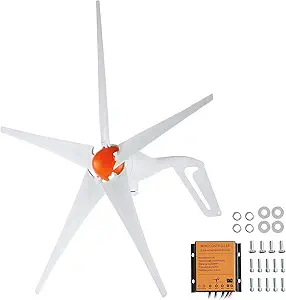
VEVOR 500W Wind Turbine Generator – Supplemental Marine Wind Power
Check Amazon Price Click Here!
Type: 12V Wind Turbine Generator
Rated Power: 500W
Blades: Product variants include 3- and 5-blade versions
Controller: MPPT controller included
If you spend significant time away from shore power, a small wind turbine can be an interesting way to supplement your boat’s battery charging system.
The VEVOR 500W Wind Turbine Generator is a 12V wind turbine kit designed for applications that include boats, RVs, farms, and other off-grid uses. The current product specifications list a 500W rated output and a startup wind speed of approximately 2.5 m/s.
The important word here is supplemental.
A 500W rating does not mean the turbine will continuously produce 500W. Actual output depends heavily on wind speed and installation conditions. It is therefore better suited to charging or supporting a battery system than treating it as a standalone replacement for a conventional marine generator.
Key Features
- 500W rated output
- 12V system
- MPPT controller included
- Approximately 2.5 m/s startup wind speed
- Three- or five-blade versions depending on the selected model
- Approximately 47-inch rotor diameter
- Corrosion-resistant and weather-resistant construction
- Designed for applications including boats and RVs
What Makes It Useful on a Boat?
The biggest advantage is the ability to generate electricity without burning fuel while adequate wind is available.
For a sailboat, liveaboard, or off-grid cruising setup, a wind turbine can help maintain the battery bank when the boat is sitting at anchor or moored away from shore power.
The turbine should be installed where it has sufficient airflow and where the mounting system is appropriate for the vessel. The tower or mounting structure is also an important part of the installation and should not be overlooked.
Best for: Sailboats, off-grid cruising, and boat owners looking for supplemental battery charging from wind.
Attwood 8806LP2 6-Gallon Fuel Tank – Portable Fuel Storage
Check Amazon Price Click Here!
Type: Portable Marine Fuel Tank
Capacity: 6 gallons
Model: 8806LP2
Not every marine power system needs a large built-in fuel tank. Smaller outboard-powered boats may benefit from a portable marine fuel tank that is easy to transport and connect to a compatible fuel system.
The Attwood 8806LP2 is a 6-gallon marine fuel tank designed for compatible outboard applications. Its multilayer construction uses HDPE and EVOH materials designed to reduce fuel permeation.
One advantage of a low-permeation marine fuel tank is reduced fuel vapor permeation compared with older tank designs.
Key Features
- 6-gallon fuel capacity
- Multilayer HDPE/EVOH construction
- Low-permeation design
- Designed for marine use
- Compatible with appropriate fuel fittings and fuel systems
- Compact size for smaller boats
Who Should Consider It?
This type of fuel tank makes the most sense for boat owners who need portable gasoline storage for a compatible outboard rather than a permanent below-deck fuel system.
Always confirm the tank, fuel line, connector, and engine are compatible before using them together.
Fuel storage should also follow the manufacturer’s instructions and applicable boating safety requirements.
Best for: Smaller boats and compatible outboard engines where portable fuel storage is practical.
Scepter 08669 12-Gallon Marine Fuel Tank – More Portable Fuel Capacity
Check Amazon Price Click Here!
Type: Portable Marine Fuel Tank
Capacity: 12 gallons
Model: 08669
If six gallons is not enough for your typical trips, the Scepter 08669 provides twice the capacity in a low-profile portable design.
Scepter lists this model as a 12-gallon rectangular portable marine tank. It features a two-way vented cap, fuel sight gauge, UV-stabilized construction, and low-permeation materials.
The tank measures approximately 24.5 inches long by 18.1 inches wide by 11.5 inches high, so checking available storage space before purchasing is important.
Key Features
- 12-gallon capacity
- Low-profile rectangular design
- Two-way vented cap
- Fuel sight gauge
- UV-stabilized HDPE construction
- Rust- and corrosion-resistant material
- Low-permeation design
- Designed for marine applications
6 Gallons vs. 12 Gallons
The choice between the Attwood and Scepter is primarily about capacity, physical size, and compatibility.
A smaller 6-gallon tank can be easier to transport and store. A 12-gallon tank can reduce the frequency of refueling, but it also takes up more space and adds more weight when full.
Don’t choose a tank based on capacity alone. Make sure its fittings and fuel system are appropriate for your outboard and installation.
Best for: Boaters who need more portable fuel capacity for compatible outboard applications.
PAULINN Shore Power Inlet Plug – Connect Your Boat to Marina Power
Check Amazon Price Click Here!
Type: Marine Shore Power Inlet
Rated System: 30A/125V configuration
For boats that regularly return to a marina, shore power can be one of the most convenient sources of onboard electricity.
Instead of running a generator while docked, the boat can connect to the marina’s electrical pedestal through the appropriate shore power cord and boat-side inlet.
The PAULINN Shore Power Inlet Plug is designed for this type of dockside connection.
Before buying any shore power inlet, however, verify the exact amperage, voltage, connector style, wiring configuration, and dimensions required by your boat.
Key Features to Look For
- 30A/125V configuration where compatible
- Locking marine-style connection
- Weather-resistant cover or gasket
- Corrosion-resistant components
- Boat-side installation design
- Compatibility with the existing shore power system
Why Shore Power Matters
A shore power connection can supply electricity while the boat is docked without requiring the engine or generator to run.
Depending on the boat’s electrical system, shore power may support:
- Battery chargers
- Refrigeration
- Air conditioning
- Cabin outlets
- Lighting
- Water heaters
- Other AC loads
The exact available loads depend on the boat’s wiring, breaker panel, shore power capacity, and electrical design.
Shore Power Safety
This is an area where quality and correct installation matter.
Loose, damaged, corroded, or overheated connections can create serious electrical and fire hazards. Never assume that a connector is compatible simply because it physically fits.
If you’re replacing or installing a shore power inlet, follow the manufacturer’s instructions and use a qualified marine electrician when the work is beyond your experience.
Best for: Boats that regularly use marina or dockside electrical service.
Magicalmai Inductive Hour Meter – Keep Track of Engine Hours
Check Amazon Price Click Here!
Type: Inductive Engine Hour Meter
Installation: Inductive pickup from an ignition/spark-plug wire
An hour meter does not generate electricity, but it can still be an important part of maintaining a boat’s power-producing equipment.
The Magicalmai Inductive Hour Meter records engine operating time using an inductive signal rather than requiring a conventional electrical connection to the engine.
For boat owners who rely on an outboard or gasoline engine for regular charging, propulsion, or other onboard needs, knowing total operating hours makes maintenance planning easier.
Why Engine Hours Matter
Many maintenance tasks are based partly on operating hours.
Depending on the engine and manufacturer recommendations, service intervals may involve:
- Engine oil
- Oil filters
- Spark plugs
- Fuel-system inspection
- Cooling-system checks
- Belt inspection
- General engine inspection
An hour meter provides a simple way to keep track of that usage.
Installation Considerations
Because this type of meter is typically installed using an inductive pickup around the ignition wire, installation is generally less invasive than wiring directly into the engine’s electrical system.
However, installation should still follow the meter’s instructions and the engine manufacturer’s recommendations.
Also remember that an hour meter is a maintenance tool. It does not replace the manufacturer’s service schedule or inspection requirements.
Best for: Boat owners who want a simple way to monitor engine operating time and maintenance intervals.
How to Build a Reliable Marine Power System in 2026
Buying individual marine power products is only part of the solution. The equipment needs to work together as a system.
A practical boat power setup may include several of the following:
1. Battery Bank
The battery bank stores energy for later use.
The size should be based on your actual daily electrical consumption rather than simply choosing the largest battery that fits.
2. Charging Sources
Charging may come from:
- Engine alternator
- Shore power charger
- Solar panels
- Wind turbine
- Generator
- DC-to-DC charger
Using more than one charging source can improve flexibility.
3. Inverter or Inverter/Charger
An inverter converts DC battery power into AC electricity for compatible household-style loads.
An inverter/charger can combine inverter and battery-charging functions in one system.
4. AC and DC Distribution
The electrical system needs appropriate breakers, fuses, disconnects, wiring, and distribution equipment.
Don’t size these components based solely on the wattage printed on a generator or inverter. The entire system needs to be designed around the expected current and electrical loads.
5. Monitoring
Battery monitors, voltage monitoring, engine hour meters, and other instrumentation can help you understand how much energy the boat is using and when maintenance is required.
How Much Power Does Your Boat Need?
One of the most common mistakes is buying a generator or inverter before calculating the actual load.
Start by making a list of the equipment you want to operate.
For example:
| Equipment | Typical Power Consideration |
|---|---|
| Navigation electronics | Usually relatively low |
| VHF radio | Low to moderate |
| LED lighting | Low |
| Refrigerator | Moderate, with compressor startup demand |
| Battery charger | Moderate to high |
| Microwave | High |
| Water heater | High |
| Air conditioner | High |
| Electric cooking equipment | High |
The exact wattage varies by model, so use the specifications for your actual equipment.
Also consider startup or surge power. Motors and compressors can briefly require considerably more power when starting than they use during normal operation.
This is especially important when sizing an inverter or generator.
Portable Generator vs. Marine Generator
These terms are sometimes used interchangeably, but they shouldn’t be.
A portable generator may be useful for certain applications when operated in an appropriate location and configuration. A permanently installed marine generator, however, is designed specifically for integration into a boat.
Marine generator installations can involve:
- Exhaust systems
- Cooling systems
- Ventilation
- Fuel systems
- Electrical bonding
- Ignition protection
- Sound and vibration control
- Engine-room installation requirements
Never assume that a standard portable generator is suitable for installation inside a boat’s engine compartment or other enclosed space.
Carbon monoxide is another major concern. Combustion engines must be operated in a way that prevents exhaust from entering occupied areas.
What About Solar and Wind Power?
Renewable energy can be extremely useful for boats that spend extended periods away from shore power.
Solar panels are particularly attractive because they have no moving parts and can produce power during daylight.
Wind turbines can complement solar because they can produce energy at times when solar production is unavailable, particularly at night or during cloudy weather when sufficient wind is present.
For that reason, some off-grid boats use a combination of:
Solar + Wind + Batteries + Alternator + Shore Power + Generator
The goal isn’t necessarily to eliminate every other power source. Instead, multiple sources can reduce dependence on any single one.
Marine Power Safety Tips
Electrical and fuel systems require more care on a boat than they do in many household applications.
Keep these basic precautions in mind:
- Never overload an AC circuit.
- Inspect shore power cords and connectors regularly.
- Replace damaged or overheated electrical components.
- Keep fuel containers secured and properly stored.
- Follow the manufacturer’s instructions for fuel tanks and connectors.
- Never operate combustion engines where exhaust can accumulate.
- Take carbon monoxide seriously on any boat with combustion equipment.
- Use appropriate fuses and circuit protection.
- Don’t make electrical modifications beyond your knowledge level.
- Use a qualified marine electrician for complicated AC or DC system work.
- Keep battery terminals and connections clean and properly secured.
- Follow the service schedule for engines and generators.
A reliable marine power system is not simply about buying a higher-wattage generator. Safe installation, correct wiring, proper ventilation, appropriate fuel storage, and regular maintenance are equally important.
Which Marine Power Solution Is Right for You?
The right setup depends on how and where you use your boat.
For Marina-Based Boaters
If your boat spends most of its time at a dock, shore power may be the most practical primary AC power source.
A properly installed shore power inlet, cord, protection system, and battery charger can provide convenient dockside electricity.
For Offshore and Extended Cruising
A combination of battery storage, charging sources, inverter capacity, and a marine generator may make more sense.
This provides multiple ways to maintain power when shore power is unavailable.
For Sailboats and Off-Grid Cruising
A combination of solar, wind, batteries, and engine charging can reduce generator runtime and fuel consumption.
The VEVOR 500W wind turbine can be considered as one supplemental charging component when wind conditions and installation requirements make sense.
For Smaller Outboard Boats
Portable marine fuel tanks can be more relevant than a large generator system.
The Attwood 6-gallon and Scepter 12-gallon tanks provide different capacity options for compatible outboard applications.
For Maintenance-Focused Boat Owners
An inexpensive inductive hour meter can make it easier to keep track of engine operating time and service intervals.
Final Thoughts: Choosing Marine Power Equipment in 2026
The best marine power solution isn’t necessarily the product with the highest wattage or the largest battery.
Start with how you actually use your boat.
If you spend most of your time at a marina, shore power may handle much of your electrical demand. If you regularly anchor away from shore, battery storage, inverter capacity, renewable charging, or a marine generator become more important.
For smaller outboard boats, reliable fuel storage can be just as important as electrical equipment. And regardless of the power system you use, keeping track of engine hours and following the manufacturer’s maintenance schedule can help prevent avoidable problems.
The products covered here serve different roles:
- VEVOR 500W Wind Turbine: Supplemental wind-based battery charging.
- Attwood 8806LP2: Compact 6-gallon portable marine fuel storage.
- Scepter 08669: Higher-capacity 12-gallon portable fuel storage.
- PAULINN Shore Power Inlet: Dockside electrical connection for compatible systems.
- Magicalmai Hour Meter: Simple engine-hour tracking for maintenance.
The most reliable approach is to think of your boat’s electrical system as a complete network rather than a collection of individual products. Calculate your loads, understand your charging sources, verify compatibility, and prioritize safe marine installation.
That approach will help you build a power system that is better suited to your boat, your cruising style, and the demands you expect to place on it throughout the 2026 boating season.