As an Amazon Associate I earn from qualifying purchases.

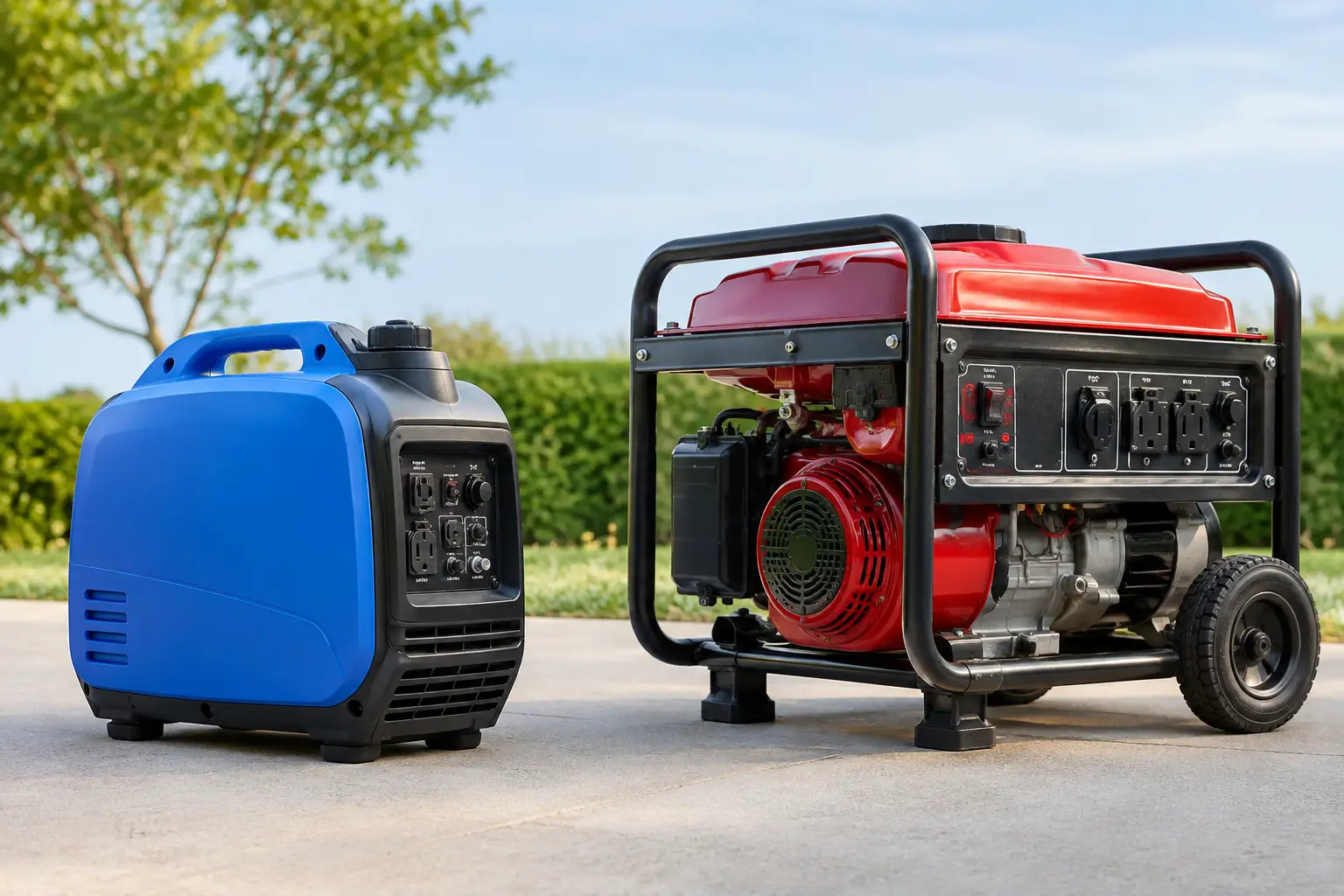
Choosing a reliable generator for a travel trailer is about more than buying the highest wattage you can afford. You need enough running power for your appliances, enough starting power for demanding equipment such as a rooftop air conditioner, and a design that is quiet and portable enough for camping.
For many 30-amp travel trailers, an RV-ready inverter generator in the 3,000- to 4,500-watt class can be a practical range when air conditioning is part of the load. Smaller generators can make more sense for boondocking without AC, where you may only need power for lights, electronics, a refrigerator, and battery charging.
Inverter generators are particularly well suited to camping because they produce stable electricity for sensitive electronics and can reduce engine speed when demand is low. Some models also offer dual-fuel operation, allowing you to use gasoline or propane depending on availability.
Below, we compare five generators covering different power and portability requirements so you can choose the right option for your travel trailer rather than simply buying the biggest generator.
Quick Comparison: Generators for Travel Trailers
| Generator | Starting / Running Watts | Fuel | Noise | RV Outlet | Best For |
|---|---|---|---|---|---|
| WEN DF680iX | 6,800 / 5,100 W gas | Gas/Propane | 64 dBA | TT-30R | High-power trailers |
| Champion 4500W | 4,500 / 3,500 W | Gas | 61 dBA | TT-30R | 30A trailers with AC |
| Champion 4000W | 4,000 / 3,000 W | Gas | 64 dBA | TT-30R | Lighter RV setups |
| Westinghouse iGen2550 | 2,550 / 1,900 W | Gas | 52 dBA | TT-30R | Quiet, light-duty camping |
| MaXpeedingrods 3500W | 3,500 / 3,200 W gas | Gas/Propane* | 62 dBA | 30A RV outlet | Compact dual-fuel use |
*Specifications can vary by the exact MaXpeedingrods version and fuel configuration.
1. WEN DF680iX 6800-Watt Dual Fuel Inverter Generator
Check Amazon Price Click Here!
The WEN DF680iX is the highest-output generator in this comparison and makes the most sense when your travel trailer needs more than the typical 3,000- to 4,500-watt inverter can provide.
It produces 6,800 starting watts and 5,100 running watts on gasoline, while propane output is rated at 6,000 starting watts and 4,500 running watts. That gives RV owners substantial headroom for an air conditioner plus other appliances operating at the same time.
The 224cc dual-fuel engine uses a 2.9-gallon gasoline tank and offers electric starting. WEN also includes a TT-30R RV outlet along with 120/240V capability, making this more versatile than a generator designed strictly around basic camping loads.
Key Specifications
- Starting watts: 6,800 W gasoline / 6,000 W propane
- Running watts: 5,100 W gasoline / 4,500 W propane
- Engine: 224cc OHV
- Fuel: Gasoline and propane
- Fuel tank: 2.9 gallons
- Noise: About 64 dBA at quarter load
- Weight: 94.8 lb
- Start: Electric and recoil
- RV outlet: 120V TT-30R
- Safety: CO Watchdog, low-oil shutdown and overload protection
- Parallel capability: Yes, with the appropriate WEN system
Why Choose the WEN DF680iX?
Its biggest advantage is power. If you have a larger travel trailer, multiple high-draw appliances, or simply want more operating headroom, 5,100 running watts on gasoline gives you considerably more capacity than the smaller models in this list.
The tradeoff is portability. At almost 95 pounds, this is not the generator you want to carry around like a lightweight camping inverter. It is better suited to RV owners who have enough storage and are comfortable using wheels and the integrated handle for transportation.
The 64 dBA noise rating is reasonable for a generator in this power class, but it is not the quietest choice here.
Best for: Travel trailers that need substantial power and owners who want gasoline/propane flexibility.
Keep in mind: Its size and weight are excessive if you only need to charge electronics and run small appliances.
2. Champion 4500-Watt RV Ready Inverter Generator
Check Amazon Price Click Here!
For many 30-amp travel trailers, the Champion 4500W offers a more balanced combination of power, RV compatibility and portability than a much larger generator.
It produces 4,500 starting watts and 3,500 running watts, which places it in a useful range for trailers equipped with a typical rooftop air conditioner. Champion specifically markets this model for RVs, camping and tailgating.
The built-in TT-30R 30-amp RV outlet allows a compatible RV power cord to connect directly without relying on a separate adapter. It also produces clean power with less than 3% THD and includes Champion’s CO Shield automatic carbon-monoxide shutdown system.
Key Specifications
- Starting watts: 4,500 W
- Running watts: 3,500 W
- Engine: 212cc Champion OHV
- Fuel: Gasoline
- Fuel tank: 2.3 gallons
- Runtime: Up to 14 hours at 25% load
- Noise: 61 dBA at 23 feet
- RV outlet: 120V 30A TT-30R
- THD: Less than 3%
- Start: EZ Start Dial
- Safety: CO Shield and low-oil shutdown
- Parallel capability: Yes
Why Choose the Champion 4500W?
The real advantage is that it sits close to the sweet spot for many 30-amp travel trailers. You get enough running capacity for typical RV loads without moving all the way into the nearly 100-pound class.
Its 61 dBA published noise rating is also reasonable for campground use, although actual noise will vary with load and operating conditions. Champion measures the published 61 dBA rating at 23 feet.
Economy Mode can reduce engine speed when electrical demand falls, helping reduce fuel consumption and operating noise.
Best for: 30-amp travel trailers where air conditioning and normal RV appliances need to run from one generator.
Keep in mind: It is substantially heavier than the smallest inverter generators, so it is more of a transport-with-wheels unit than a carry-by-hand camping generator.
3. Champion 4000-Watt RV Ready Inverter Generator
Check Amazon Price Click Here!
The Champion 4000W is an interesting option for RV owners who want an RV-ready generator but want to keep weight below 50 pounds.
It produces 4,000 starting watts and 3,000 running watts from its 149cc engine. Champion lists the generator at less than 49 pounds, making it significantly easier to move than many larger RV generators.
The generator includes a TT-30R RV outlet, a 120V household outlet and parallel connections. It also uses inverter technology to provide clean power with less than 3% THD.
Key Specifications
- Starting watts: 4,000 W
- Running watts: 3,000 W
- Engine: 149cc Champion OHV
- Fuel: Gasoline
- Fuel tank: 1.54 gallons
- Runtime: Up to 10 hours at 25% load
- Noise: 64 dBA at 23 feet
- Weight: Less than 49 lb
- RV outlet: 120V 25A TT-30R
- THD: Less than 3%
- Start: Recoil
- Safety: CO Shield and low-oil shutdown
- Parallel capability: Yes
Why Choose the Champion 4000W?
Portability is the biggest reason to consider it.
At less than 49 pounds, it is much easier to move in and out of a truck, garage or travel trailer storage area than a 90-pound-plus generator.
The 3,000 running watts also give it considerably more practical capacity than compact 2,000-watt generators.
However, don’t assume that 4,000 starting watts means it will automatically handle every RV air conditioner. Compressor startup requirements vary, and other appliances running simultaneously reduce the available power.
Best for: Smaller travel trailers and campers where portability matters almost as much as power.
Keep in mind: The 64 dBA rating is not as quiet as the Westinghouse 2550W.
4. Westinghouse iGen2550 Inverter Generator
Check Amazon Price Click Here!
The Westinghouse iGen2550 takes a completely different approach from the WEN and larger Champion models. Instead of maximizing output, it emphasizes low weight, low noise and efficient operation.
It produces 2,550 peak watts and 1,900 running watts and weighs roughly 43–46 pounds depending on the current version and listing. Westinghouse rates the generator as low as 52 dBA, making it one of the quieter options in this comparison.
It also includes a 120V TT-30R outlet, which makes it RV-ready despite its relatively modest output.
Key Specifications
- Peak watts: 2,550 W
- Running watts: 1,900 W
- Engine: 80cc OHV
- Fuel: Gasoline
- Fuel tank: 1.1 gallons
- Runtime: Up to 11–12 hours at 25% load, depending on version
- Noise: As low as 52 dBA
- Weight: About 43–46 lb
- RV outlet: 120V TT-30R
- THD: Less than or equal to 3%
- Start: Recoil
- Parallel capability: Yes
- Safety: Low-oil shutdown and overload protection
Why Choose the Westinghouse iGen2550?
This is the generator to consider when your camping priorities are portability and quiet operation rather than running every RV appliance simultaneously.
It can be a good fit for lights, charging devices, electronics and other modest loads. Its 1,900 running watts, however, put it in a different category from the 3,000- to 5,100-watt generators above.
That distinction is important. A TT-30R outlet does not magically turn a 1,900-watt generator into a full-capacity 30-amp power source.
If your main goal is running a rooftop air conditioner, check the AC’s starting requirements carefully before choosing this model.
Best for: Quiet camping, lightweight travel and RV owners who don’t need to operate high-draw appliances simultaneously.
Keep in mind: 1,900 running watts can be limiting for travel trailers with demanding rooftop AC systems.
5. MaXpeedingrods 3500-Watt Inverter Generator
Check Amazon Price Click Here!
The MaXpeedingrods 3500W inverter generator targets RV owners who want a compact generator with useful output and, depending on the version purchased, dual-fuel flexibility.
The current dual-fuel specification lists 3,500 peak and 3,200 running watts on gasoline, with 3,100 peak and 2,800 running watts on LPG. The unit uses a 145cc OHV engine and includes a 30-amp RV outlet.
Published specifications also list Eco Mode, CO protection, overload protection and parallel capability.
Key Specifications
- Gasoline: 3,500 peak / 3,200 running watts
- LPG: 3,100 peak / 2,800 running watts
- Engine: 145cc OHV
- Fuel: Gasoline/propane on dual-fuel version
- Noise: About 62 dBA
- Weight: About 55 lb for the dual-fuel configuration
- Runtime: Up to about 11 hours at 25% load on gasoline
- RV outlet: 120V 30A
- Start: Electric/recoil depending on configuration
- Features: Eco Mode, CO protection, overload protection and parallel capability
Why Choose the MaXpeedingrods 3500W?
Its combination of output, size and fuel flexibility makes it an option for RV owners who want something between a lightweight 2,000-watt-class generator and a much heavier 4,500-watt unit.
The manufacturer lists a 62 dB noise level at 23 feet for its dual-fuel configuration and up to 24 hours of runtime at 25% load on LPG.
Because MaXpeedingrods sells several 3500W configurations, check the exact model and fuel version before purchasing. Specifications such as weight, starting system and running output can differ between gasoline-only and dual-fuel versions.
Best for: Campers looking for a middle ground between portability, RV output and dual-fuel flexibility.
Keep in mind: Verify the exact configuration before buying because the 3500W product family includes different versions.
How Much Generator Power Does a Travel Trailer Need?
There isn’t one wattage that works for every travel trailer.
The right generator depends on what you plan to run at the same time.
A trailer using only lights, a refrigerator, battery chargers, a TV and small electronics can often work with a much smaller inverter generator than a trailer running a rooftop air conditioner.
The air conditioner is usually the load that changes the calculation.
A rooftop AC compressor can require substantially more power during startup than its normal running consumption. That’s why you should look at both the generator’s running watts and starting watts rather than focusing only on the larger number printed on the generator.
For Basic Camping Without AC
If you are primarily charging phones, powering lights, running electronics and handling modest loads, a generator around the 1,800- to 2,000-running-watt range may be sufficient.
The Westinghouse iGen2550 fits this type of use particularly well because of its low weight and 52 dBA noise rating.
For a 30-A Travel Trailer With AC
A generator producing around 3,000 to 3,500 running watts gives you considerably more flexibility.
The Champion 4000W provides 3,000 running watts, while the Champion 4500W provides 3,500 running watts.
For many travel trailers, this is a practical range to investigate first.
For Larger Loads
If you want substantial reserve capacity for an air conditioner plus other high-draw appliances, the WEN DF680iX provides 5,100 running watts on gasoline and 4,500 running watts on propane.
The additional capacity comes with a significant increase in size and weight, so there is little reason to carry a 95-pound generator if your actual electrical needs are modest.
What to Look for in a Travel Trailer Generator
1. Running Watts
Running watts are the continuous power the generator can supply.
This is the number you should pay close attention to when estimating whether the generator can handle your normal RV load.
2. Starting Watts
Starting watts are the temporary surge capacity available when equipment with a motor or compressor starts.
Air conditioners, refrigerators, pumps and other motor-driven equipment may require extra starting power.
3. A Built-In TT-30R Outlet
A TT-30R outlet is particularly convenient for a 30-amp travel trailer because it is designed for RV connections.
The Champion 4500W, Champion 4000W, Westinghouse iGen2550 and WEN DF680iX all provide an RV-ready connection.
4. Inverter Technology
Inverter generators are popular for camping because they can adjust engine speed according to electrical demand and produce stable electrical output.
For example, Champion’s Economy Mode automatically adjusts engine speed as the load changes, while the Westinghouse iGen2550 uses variable engine speed for efficiency and quieter operation.
5. Noise
Noise matters at a campground.
Don’t compare dBA numbers without checking the manufacturer’s measurement conditions. A generator’s noise can change depending on load, distance and operating mode.
For reference, the models in this comparison range from approximately 52 dBA for the Westinghouse iGen2550 to about 64 dBA for the WEN DF680iX and Champion 4000W.
6. Weight
Portability becomes increasingly important when you are moving the generator between storage and the campsite.
A generator weighing less than 50 pounds is much easier to handle manually than a unit approaching 100 pounds.
This is one reason the Champion 4000W and Westinghouse iGen2550 can make sense even though they produce considerably less power than the WEN DF680iX.
7. Fuel Type
Gasoline remains convenient because it is widely available, while propane can be attractive for storage and fuel flexibility.
A dual-fuel generator such as the WEN DF680iX lets you choose between gasoline and propane, although output changes depending on the fuel being used.
8. CO Protection
Carbon monoxide is a serious hazard with portable generators.
A CO shutdown system can automatically stop the generator when dangerous carbon-monoxide levels are detected, but it does not replace safe generator placement.
Always operate a portable generator outdoors and follow the manufacturer’s required clearance from your trailer, buildings, doors, windows and ventilation openings.
30-Amp vs. 50-Amp Travel Trailers
Before buying a generator, check your RV’s electrical service.
A typical 30-amp RV connection is designed around a single 120V supply, while 50-amp RV electrical systems are designed for substantially greater overall capacity.
A generator with a TT-30R outlet is therefore a natural match for many 30-amp travel trailers, but that does not mean it can reproduce the full electrical capacity of a 50-amp shore-power connection.
If you own a 50-amp trailer, you should pay particular attention to the generator’s voltage, outlet configuration, maximum running watts and the specific connection method recommended by your RV and generator manufacturers.
Gasoline or Propane for RV Camping?
Dual-fuel generators provide an advantage when you don’t want to rely exclusively on gasoline.
Gasoline commonly provides the higher wattage rating, while propane provides an alternative fuel source that can be convenient for RV owners who already carry propane for cooking or other equipment.
The WEN DF680iX is a good example: its gasoline rating is 5,100 running watts, compared with 4,500 running watts on propane.
The MaXpeedingrods dual-fuel model also reduces output somewhat when switching from gasoline to LPG.
When comparing generators, therefore, don’t look only at the headline wattage. Check the running and starting output for the specific fuel you intend to use.
Are Inverter Generators Good for Travel Trailers?
Yes. Inverter generators are particularly well suited to RV and camping applications because they combine relatively compact designs with stable electrical output and variable engine operation.
They’re especially useful when your power demand changes throughout the day.
For example, a generator may need significantly less output while you’re charging phones and running a few lights than when the microwave or air conditioner is operating.
That ability to reduce engine speed can help lower noise and fuel consumption during lighter loads.
Generator Safety for Travel Trailer Camping
Never operate a gasoline or propane generator inside your travel trailer, inside a garage, under the trailer, or in another enclosed or partially enclosed area.
Keep exhaust away from doors, windows and ventilation openings, and follow the clearance requirements in the owner’s manual.
A carbon-monoxide shutdown feature is useful, but it should be treated as an additional safety system rather than a replacement for proper generator placement.
Before every trip, inspect the generator, fuel lines, electrical connections and extension or RV power cord for damage.
Also check campground rules before operating a generator. Some campgrounds impose specific generator hours or noise restrictions.
Which Generator Is Right for Your Travel Trailer?
The right choice depends on how you actually camp.
For maximum power: The WEN DF680iX provides 5,100 running watts on gasoline and 4,500 on propane, making it appropriate when you want substantial reserve capacity. Its major drawback is its nearly 95-pound weight.
For a typical 30-amp travel trailer: The Champion 4500W offers 3,500 running watts, a built-in TT-30R outlet, 61 dBA operation and a useful combination of RV-oriented features.
For a lighter RV generator: The Champion 4000W provides 3,000 running watts while staying below 49 pounds, making it attractive when portability is a priority.
For quiet, lightweight camping: The Westinghouse iGen2550 stands out with 1,900 running watts and a noise rating as low as 52 dBA. It is better suited to lighter electrical loads than running multiple high-demand RV appliances.
For a middle-ground dual-fuel option: The MaXpeedingrods 3500W offers a useful combination of RV compatibility, inverter technology and gasoline/propane flexibility, depending on the specific version.
The most important step is to size the generator around your actual travel trailer loads. A smaller generator that comfortably handles your needs is often easier to transport and quieter at the campsite, while a larger model provides more headroom when air conditioning and multiple appliances need to run together.