As an Amazon Associate I earn from qualifying purchases.
Choosing the right generator cord is about more than finding one that fits the outlet. The wrong wire gauge, an incompatible connector, or an excessive cord length can cause voltage drop, overheating, and unreliable power when you need your generator most.
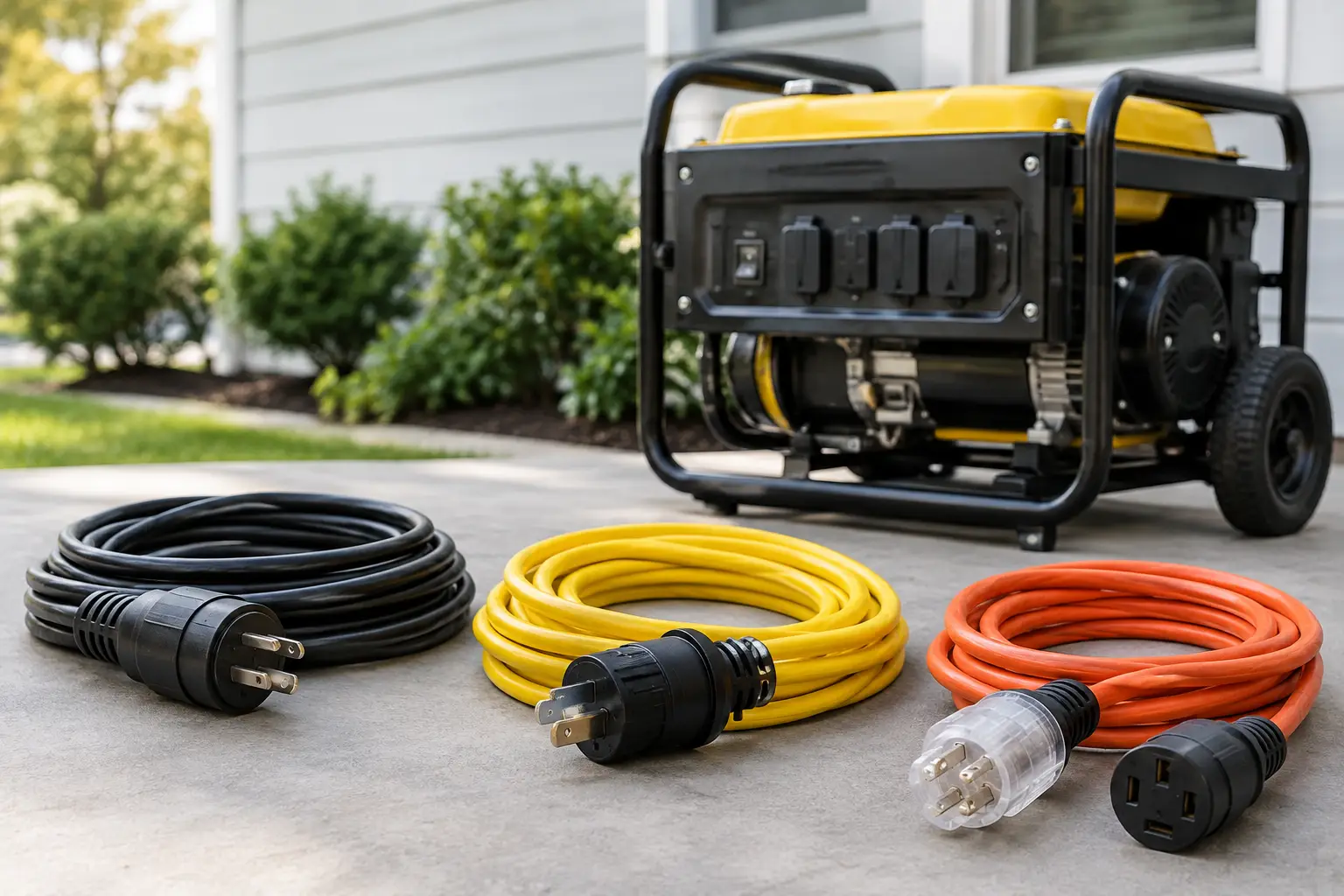
This generator cord comparison explains the differences between 15-amp, 20-amp, 30-amp, and 50-amp cords, including wire gauge, connector types, outdoor ratings, and practical cord lengths. Whether you are powering household appliances, connecting a portable generator to a transfer switch, running an RV, or operating tools at a jobsite, the goal is to find a cord that matches your electrical equipment and the load you intend to run.
For most homeowners, a heavy-duty 12-gauge extension cord works well for individual appliances connected to standard 120-volt outlets. A 30-amp home backup connection typically requires a 10-gauge, four-conductor L14-30 cord, while a 50-amp setup requires a properly rated 50-amp cord with the correct connectors and conductor sizes.
The important thing is to check your generator’s actual outlet specifications rather than choosing a cord based on advertised generator wattage alone.
Start With the Generator Connection You Need
Before comparing wire gauge or cord length, identify the outlet on your generator and the connection on the equipment you want to power.
A generator cord must have compatible connectors at both ends. The voltage, amperage, number of conductors, and connector configuration must also match the electrical system.
Here are some common connections found on portable generators in the United States.
| Generator outlet | Voltage | Typical application | |—|—|—| | NEMA 5-15 | 120V, 15A | Household appliances and smaller loads | | NEMA 5-20 | 120V, 20A | Higher-capacity household outlets | | NEMA L5-30 | 120V, 30A | RV connections and 120V equipment | | NEMA L14-30 | 120/240V, 30A | Home backup inlet boxes and transfer switches | | NEMA 14-50 | 120/240V, 50A | Larger generators and 50A power connections |
These are common configurations, not a complete list of generator receptacles. Always verify the exact outlet designation printed on your generator.
For example, a generator with an L14-30 outlet needs a compatible four-prong connection when feeding a 120/240-volt inlet. A standard three-prong household extension cord cannot replace that connection.
The same principle applies to 50-amp systems. A 50-amp cord does not increase the generator’s available output, and an adapter cannot turn a 30-amp outlet into a genuine 50-amp supply.
The generator outlet, cord, inlet box, transfer equipment, and connected loads must all be compatible.
Generator Cord Comparison by Amperage
The easiest way to narrow down your options is to compare cords by their electrical rating and intended application.
| Cord rating | Common wire configuration | Typical application | |—|—|—| | 15A | 14 AWG or heavier, depending on length and rating | Small appliances and light-duty loads | | 20A | 12 AWG or heavier, depending on length and rating | Refrigerators, tools, and household equipment | | 30A | 10/4 AWG copper for common L14-30 cords | Home backup and 30A RV connections | | 50A | Commonly 6/3 plus 8/1 AWG on some designs | Larger home backup and 50A RV connections |
These are common reference configurations, not substitutes for the cord manufacturer’s specifications. Always check the actual amperage rating, conductor construction, temperature rating, and product listing.
| 12-Gauge Extension Cord | 30-Amp Generator Cord | 50-Amp Generator Cord |
|---|---|---|
|
Heavy-Duty Outdoor Cord
12 AWG outdoor extension cord for compatible household appliances and 120V generator outlets. Check Price on Amazon → |
Champion 100395
25-foot, 30-amp generator power cord with L14-30P to L14-30R connectors. Check Price on Amazon → |
50-Amp Generator Cord
Heavy-duty 50-amp generator cord. Check connector configuration and electrical ratings before purchasing. Check Price on Amazon → |
As an Amazon Associate, I earn from qualifying purchases.
15- and 20-Amp Extension Cords
Standard 120-volt extension cords are useful when connecting individual appliances directly to a portable generator.
A heavy-duty 12-gauge extension cord is a practical choice for many household applications, including refrigerators, sump pumps, lighting, battery chargers, and power tools.
For shorter runs and lower electrical loads, a properly rated 14-gauge cord may also be suitable. However, it is important to check its amperage rating and length before connecting demanding equipment.
For example, a refrigerator may operate at a relatively modest wattage once running, but its compressor can require additional power during startup. A sump pump or air compressor can have similar starting requirements.
A 12-gauge cord generally provides more capacity and less resistance than a comparable 14-gauge cord.
If you are planning a longer extension run or operating equipment close to its electrical limits, consider a heavier-gauge cord and follow the appliance and generator manufacturers’ recommendations.
30-Amp Generator Cords
A 30-amp generator cord is one of the most common choices for portable home backup systems.
Many generators designed for this application have a NEMA L14-30 outlet. This four-prong locking connection provides two hot conductors, one neutral, and one equipment grounding conductor.
A typical L14-30 generator cord uses four 10-gauge copper conductors and is rated for 30 amps at 125/250 volts.
This configuration is commonly used to connect a portable generator to a compatible generator inlet box and transfer switch.
A quality 30-amp generator cord should have the correct L14-30 connector configuration, an appropriate outdoor-rated jacket, and clearly marked electrical specifications.
For many home backup installations, a 25-foot or 30-foot cord is convenient. However, the actual length depends on where the generator must operate and where the inlet box is installed.
Do not assume every 30-amp generator cord is interchangeable. An L5-30 connection is a 120-volt, three-prong configuration, while an L14-30 connection provides 120/240-volt service through four conductors.
Both are rated for 30 amps, but they serve different electrical applications.
50-Amp Generator Cords
A 50-amp generator cord is designed for equipment with a compatible 50-amp electrical connection.
These cords are commonly used with larger portable generators, home backup systems, and RVs equipped with 50-amp service.
Unlike a typical 30-amp L14-30 cord, a 50-amp cord must be selected according to the specific connector configuration and conductor specifications of the equipment.
Many 50-amp, 120/240-volt cord designs use 6 AWG current-carrying conductors with a smaller grounding conductor, but the exact construction varies by product.
Some generator-to-inlet cords use a NEMA 14-50 plug on one end and a compatible locking generator connector on the other. Other configurations are designed specifically for RV shore-power applications.
Check both connector ends before purchasing.
A 25-foot 50-amp generator cord can be a practical option when the generator and inlet are relatively close together. Longer versions are available when the installation requires additional distance.
For most homeowners, choosing between 30 and 50 amps should depend on the electrical system they actually have, not simply on the possibility of buying a larger generator later.
A 30-amp generator, 30-amp inlet box, and compatible transfer equipment generally make a straightforward system. A 50-amp installation requires equipment designed for that higher capacity.
Wire Gauge and Cord Length Matter Together
Wire gauge describes the thickness of the electrical conductors inside a cord.
The American Wire Gauge (AWG) system works in reverse: a smaller number means a thicker conductor.
For example:
- 10 AWG wire is thicker than 12 AWG.
- 12 AWG wire is thicker than 14 AWG.
- 6 AWG wire is thicker than 10 AWG.
Thicker conductors generally have less electrical resistance, which helps reduce voltage drop when power travels over longer distances.
This matters because a cord that performs well over 25 feet may not deliver the same voltage at 100 feet under the same electrical load.
As cord length increases, electrical resistance increases. The result can be lower voltage at the equipment, reduced motor performance, and additional heating if the cord is undersized or overloaded.
Generator Extension Cord Gauge and Length Comparison
The following table provides practical starting points for common 120-volt extension-cord applications.
| Electrical load | 25 feet | 50 feet | 100 feet | |—|—|—|—| | Up to 10A | 16 AWG or heavier | 14 AWG or heavier | 12 AWG or heavier | | Up to 15A | 14 AWG or heavier | 12 AWG or heavier | 10 AWG or heavier | | Up to 20A | 12 AWG or heavier | 10 AWG or heavier | 10 AWG or heavier |
These are conservative selection guidelines, not universal ampacity ratings. The actual allowable load depends on the cord’s listing, construction, operating conditions, and manufacturer specifications. Motor startup loads and voltage-drop requirements may also require a heavier cord.
For dedicated 30-amp and 50-amp generator connections, use cords specifically manufactured and rated for those applications rather than trying to substitute ordinary household extension cords.
How Long Should a Generator Cord Be?
The best generator cord is usually the shortest practical length that allows the generator to operate in a safe location.
However, there is an important consideration for home backup systems: the generator must be positioned far enough away from the house to reduce carbon monoxide exposure.
The U.S. Consumer Product Safety Commission recommends operating portable generators outdoors at least 20 feet away from homes, with the exhaust directed away from doors, windows, and vents.
That means a 25-foot cord may not provide enough usable distance in every installation. The route, obstacles, generator position, and inlet location all matter.
A 30-foot, 40-foot, or 50-foot cord may be more practical depending on the property.
Avoid purchasing an unnecessarily long cord, though. Extra length increases resistance, adds weight, and can make storage more difficult.
For a longer run, consider a heavier conductor size when required to maintain acceptable voltage.
Outdoor Ratings Are Not a Minor Detail
Generator cords are often used outside during power outages, construction projects, RV trips, and camping.
They may encounter moisture, dirt, sunlight, cold temperatures, and repeated movement.
For that reason, choose a cord specifically rated for its intended outdoor application.
One common marking is SJTW. This designation identifies a junior-service thermoplastic cord with an outdoor-use rating.
Other common jacket designations include STW and SJOOW. Their construction and service characteristics differ, so do not assume they are interchangeable.
When comparing products, look for:
- Clearly marked voltage and amperage ratings.
- Appropriate conductor gauge and number of conductors.
- A jacket rated for the intended outdoor conditions.
- Proper strain relief at the plug connections.
- Solidly fitted connectors without loose blades.
- A recognized safety certification, such as UL or ETL, where applicable.
- Temperature ratings suitable for the climate in which the cord will be used.
Cold-weather flexibility can also make a difference. Some inexpensive cords become stiff in low temperatures, making them harder to route and store.
A flexible jacket is particularly useful for RV owners and homeowners who may need to reposition their generator during an outage.
Remember that an outdoor-rated cord is not automatically safe to use with wet connectors. Follow the manufacturer’s instructions and keep electrical connections protected from water.
If the insulation is cracked, the plug is damaged, or copper conductors are exposed, replace the cord instead of attempting a temporary repair.
Do Not Confuse a Generator Cord With an Adapter
Generator cords and adapters serve different purposes.
A generator cord carries electrical power between two compatible connections. An adapter changes the physical connector configuration to accommodate a particular application, provided the electrical characteristics remain compatible.
For example, an RV owner may use an appropriately rated adapter to connect a 30-amp RV power cord to a compatible generator receptacle.
However, an adapter cannot:
- Increase the generator’s available amperage.
- Turn a 120-volt source into a genuine 120/240-volt source.
- Increase the capacity of an undersized cord.
- Make incompatible electrical systems safe.
- Replace a properly installed transfer switch.
If you need a specific connection, check the ratings and wiring configuration before buying an adapter.
Our guide to 30-amp 3-prong to 4-prong generator adapters explains an important distinction between these connector configurations.
Avoid connecting multiple adapters, household power strips, and extension cords together to create a makeshift generator distribution system.
Every additional connection creates another potential failure point.
For home backup, never connect a portable generator to a household wall outlet to energize the home’s wiring. This practice is called backfeeding and can cause electrocution, equipment damage, and serious injuries to utility workers.
Use a properly installed transfer switch or approved interlock system and a compatible generator inlet box. Have the installation completed by a qualified electrician.
Match the Generator Cord to Your Specific Application
Not every generator owner needs the same type of cord.
A homeowner powering a few appliances directly from a small inverter generator has different requirements from someone connecting a large portable generator to a home’s electrical panel.
Home Backup Power
If you are powering selected household appliances directly from a generator, heavy-duty 12-gauge extension cords may be suitable for individual 120-volt loads, provided their ratings match the appliances.
For a home backup system connected through an inlet box, the cord must match the generator outlet and the inlet configuration.
A common arrangement uses a 30-amp L14-30 connection with a four-conductor, 10-gauge cord.
Larger systems may require a properly rated 50-amp connection.
Before purchasing, verify the generator outlet, inlet box, transfer equipment, and electrical load requirements.
RV and Camping Applications
RV owners should first determine whether their vehicle has 30-amp or 50-amp electrical service.
A 30-amp RV connection normally supplies 120 volts through one hot conductor, neutral, and ground.
A 50-amp RV connection typically supplies 120/240 volts through two hot conductors, neutral, and ground.
These systems are not electrically identical, even though some adapters may allow specific combinations of plugs and receptacles.
Check the RV’s power requirements and the generator’s available outlets before selecting a cord.
For camping, cord flexibility, outdoor durability, connector protection, and sufficient length are also important considerations.
Jobsite and Workshop Applications
On a construction site or in a workshop, generator cords must handle repeated movement and demanding equipment.
Circular saws, compressors, and other motor-driven tools can draw substantially more current during startup than during normal operation.
A contractor should consider the combined load, starting requirements, cord length, and voltage-drop limitations before choosing an extension cord.
For multiple tools, separate properly rated cords or a purpose-built generator distribution system may be more appropriate than one long cord connected to an overloaded splitter.
Well Pumps and Other Motor Loads
Well pumps require additional attention because their startup requirements can be significantly higher than their running wattage.
Before choosing a generator cord, check the pump’s electrical specifications, starting current, controller requirements, and the distance between the generator and pump.
A cord that works for lighting or a refrigerator may not be suitable for a well pump.
The generator must also have sufficient starting and running capacity for the motor.
A Generator Cord Safety Checklist Before Every Use
Before connecting your generator, take a few minutes to inspect the cord and its connectors.
Use this checklist:
- Inspect the entire cord for cuts, cracks, crushed sections, or exposed wires.
- Confirm that the voltage and amperage ratings match the intended application.
- Check that the wire gauge is appropriate for the load and distance.
- Make sure the plugs and receptacles are clean and undamaged.
- Confirm that locking connectors are fully engaged.
- Keep electrical connections protected from standing water.
- Avoid running cords through areas where vehicles, doors, or heavy objects can damage them.
- Uncoil the cord before use and follow the manufacturer’s instructions.
- Never overload the cord with additional appliances or equipment.
- Keep generator operation outdoors and at least 20 feet from the house, with exhaust directed away from openings.
If a plug becomes unusually hot, the cord insulation feels excessively warm, lights dim significantly, or a breaker repeatedly trips, stop using the setup.
Disconnect the load safely and investigate the cause before using the equipment again.
A hot connector can indicate a loose connection, damaged contacts, excessive current, or another electrical problem.
Never ignore these warning signs.
Frequently Asked Questions About Generator Cords
What gauge extension cord is best for a generator?
For many household applications, a 12-gauge outdoor-rated extension cord is a good starting point for 15- and 20-amp loads. Dedicated 30-amp generator connections commonly use 10-gauge four-conductor cords. A 50-amp generator cord requires a heavier, properly rated conductor configuration.
The correct choice also depends on cord length and the equipment being powered.
Can I use a regular extension cord with a portable generator?
Yes, if the extension cord is specifically rated for outdoor use and its voltage, amperage, wire gauge, and length are appropriate for the connected appliance.
A lightweight indoor household cord is not a suitable replacement for a heavy-duty generator extension cord.
Is a 10-gauge generator cord better than a 12-gauge cord?
A 10-gauge cord has thicker conductors and generally offers less electrical resistance than a comparable 12-gauge cord.
However, that does not automatically make it the right choice for every application. The cord must still have compatible connectors and an appropriate electrical rating.
Can I use a 30-amp generator cord with a 50-amp generator?
Only if the connection and electrical design specifically permit that arrangement and the entire circuit is properly protected and rated for the cord’s capacity.
A 30-amp cord does not provide 50-amp capacity. Never assume that an adapter makes an undersized connection suitable for a higher-amperage circuit.
Is a 25-foot generator cord long enough?
It depends on the generator’s location and the distance to the inlet or equipment.
For home backup, 25 feet may work in some installations, but a longer cord may be necessary to position the generator at least 20 feet from the house as recommended by the CPSC.
Does a longer generator cord reduce power?
A longer cord increases electrical resistance and can increase voltage drop, especially when the wire gauge is too small for the load.
Using an appropriately sized conductor helps reduce this problem.
Are locking generator cords better?
Locking connectors help prevent accidental disconnection during operation. They are particularly useful for generator-to-inlet connections and other applications where a secure connection is important.
However, a locking connector does not compensate for an incorrect voltage rating, undersized wire, or incompatible equipment.
Final Thoughts: Choose the Right Generator Cord Before You Need It
The best generator cord is not necessarily the most expensive, the thickest, or the longest one available.
It is the cord that matches your generator’s electrical outlet, the equipment you want to power, the expected amperage, and the distance between connections.
For smaller household appliances, a properly rated 12-gauge extension cord is often a practical choice. For a common 30-amp home backup connection, look for a four-conductor 10-gauge L14-30 cord. For a 50-amp system, choose a cord specifically designed and rated for the corresponding 50-amp connection.
Pay attention to outdoor ratings, connector quality, conductor specifications, and the safety requirements of your installation.
A generator is only as useful as the electrical connection between the machine and the equipment it powers. Choosing the correct cord before an outage can help prevent unnecessary problems when dependable backup electricity matters most.