As an Amazon Associate I earn from qualifying purchases.
A blackout in an apartment changes the question from “How much generator do I need?” to “What can I run without creating a safety problem?” For most renters, the best portable generators for apartments are not gasoline, propane, or dual-fuel generators at all. They are portable battery power stations that can operate quietly indoors with no exhaust.
That distinction matters. A conventional portable generator burns fuel and produces carbon monoxide, a colorless, odorless gas that can become deadly in enclosed or partially enclosed spaces. An open window, hallway, balcony, parking garage, fire escape, or rooftop does not automatically make generator operation safe or permitted. Apartment leases, local fire rules, and building management policies often prohibit fuel storage and generator use on the property as well.
A battery power station is the practical apartment alternative. It stores electricity in a lithium battery, delivers AC power through standard outlets, and can be recharged from a wall outlet, car outlet, or compatible solar panel. It will not replace a whole-home backup system, but it can keep phones, lights, a laptop, internet equipment, and select medical or comfort devices operating during an outage.
Why fuel-powered generators do not fit apartment living
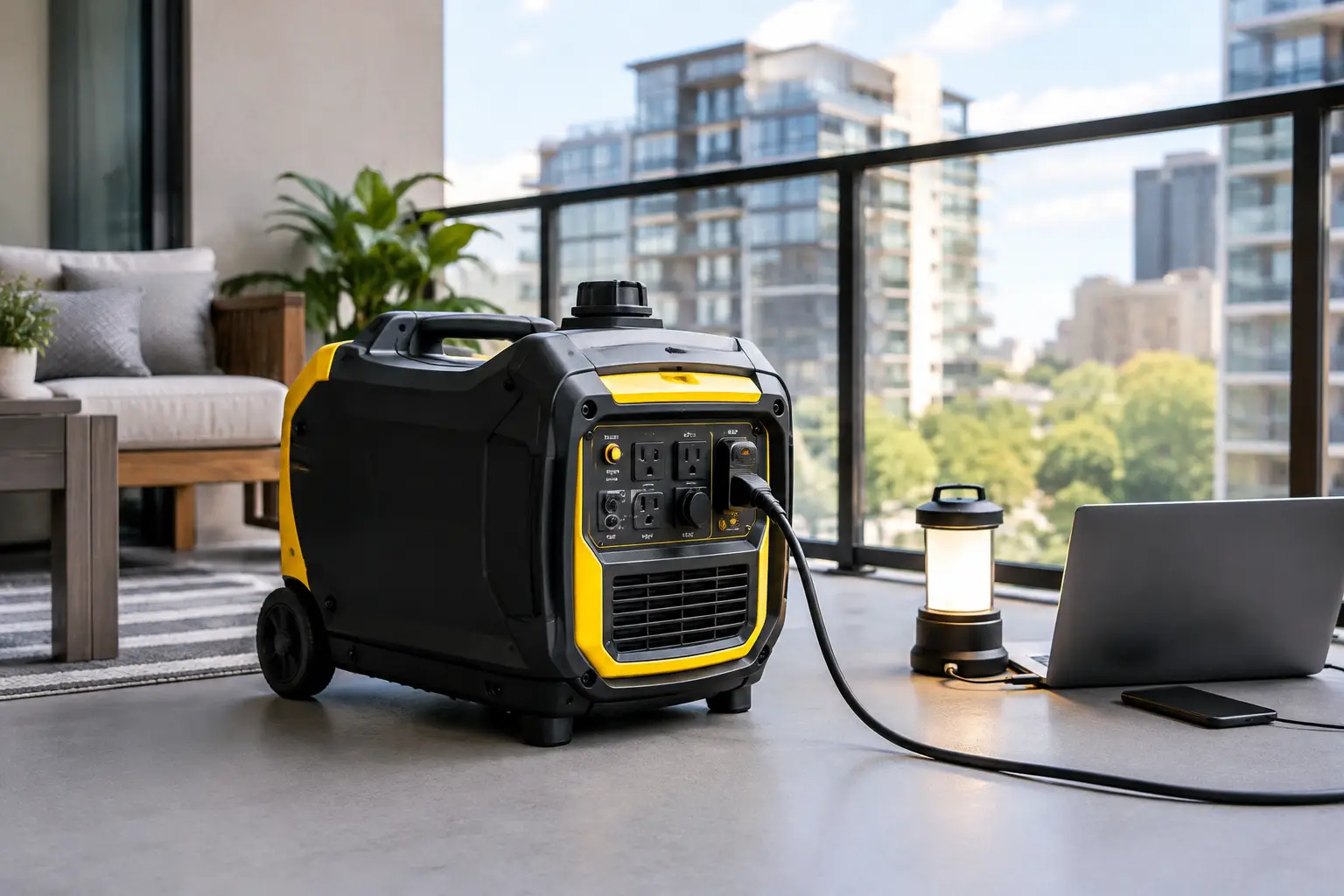
Portable inverter generators such as the Honda EU2200i, Yamaha EF2200iS, and Champion 2500-watt dual-fuel inverter are excellent tools for campsites, detached homes, RVs, and outdoor work areas. They are not indoor appliances. Every fuel-burning generator needs to run outdoors, far from doors, windows, vents, and other openings, with the manufacturer’s required clearances.
That is difficult to achieve at an apartment building. A balcony may be outdoors, but exhaust can drift into your unit or a neighbor’s window. Noise and vibration can also violate lease rules, even with a quieter inverter model. Running a cord through a doorway or window adds weather exposure and trip hazards, while placing a generator in a garage, breezeway, laundry room, or covered patio is unsafe.
Do not try to make a fuel generator apartment-safe with longer extension cords, exhaust hoses, or makeshift enclosures. Carbon monoxide alarms are essential in every home, but they are not permission to operate a generator too close to living areas.
| Power Station | Best For | Amazon USA |
|---|---|---|
| Anker SOLIX C1000 | Compact apartment backup | Check Price on Amazon → |
| EcoFlow DELTA 2 | Expandable emergency power | Check Price on Amazon → |
| BLUETTI AC180 | Higher-output backup | Check Price on Amazon → |
The best portable generator alternatives for apartments
For apartment backup, prioritize a battery power station with a lithium iron phosphate, or LiFePO4, battery. This chemistry generally offers a long cycle life and good durability for occasional emergency use. The right size depends on the devices you actually need to keep running.
Best compact choice: Anker SOLIX C1000
The Anker SOLIX C1000 is a strong fit for renters who want meaningful backup power without dedicating much closet space to it. Its approximately 1,000Wh battery capacity is enough for phones, rechargeable lights, a laptop, a modem and router, and a small fan for many hours, depending on total load. Its high AC output also gives it more flexibility than a small power bank.
This is a sensible choice for a one-bedroom apartment where the priority is communications, lighting, and basic comfort. It is still too small for long-term operation of high-draw appliances such as space heaters, toaster ovens, hair dryers, or most window air conditioners.
Best balance of capacity and expandability: EcoFlow DELTA 2
The EcoFlow DELTA 2 is another practical apartment-ready power station in the roughly 1kWh class. It is well suited to a home-office setup during a utility interruption because it can support a laptop, monitor, modem, router, phone chargers, and LED lamps without the noise or fumes of a conventional generator.
Its value is flexibility. For renters who expect to move into a house later, expandable battery options can make the system more useful over time. Before buying, check the current package carefully. Expansion batteries, solar panels, and charging cables are not always included in the base unit.
Best for higher-output appliances: BLUETTI AC180
The BLUETTI AC180 is worth considering when you need more AC output for appliances with higher startup demand. That can be useful for a refrigerator during a short outage, provided you calculate its actual power use and allow for compressor startup. A larger power station can also run kitchen electronics briefly, but using resistance-heating appliances will drain any battery quickly.
Capacity remains the limiting factor. A unit in this class can be very useful for a refrigerator, but it is not a substitute for permanent backup power. If cold food is your main concern, use a plug-in watt meter before an outage to learn how many watt-hours your refrigerator consumes over a full day.
Best simple emergency backup: Jackery Explorer 1000 v2
The Jackery Explorer 1000 v2 appeals to buyers who want a straightforward emergency power setup with familiar controls. It is a practical option for charging personal electronics, running lighting, maintaining internet access, and powering a CPAP machine when the device’s manufacturer permits battery operation.
For CPAP users, verify the machine’s wattage and whether a DC adapter is available. Using direct DC power can reduce conversion losses compared with running the machine through an AC outlet. If uninterrupted medical power is essential, speak with the equipment provider and build in more runtime than your estimate suggests.
Size the battery by watt-hours, not outlet count
A power station with many outlets is not necessarily the better backup unit. Two numbers matter more: watt-hours and continuous AC output. Watt-hours tell you how much stored energy is available. Watts tell you how much equipment the unit can power at one time.
Start by separating essentials from conveniences. In a typical apartment outage, essentials may include a phone, LED lamps, a modem and router, laptop, fan, and a medical device. A compact setup might draw 100 to 200 watts. A 1,000Wh power station will not provide a full 1,000Wh at its outlets because energy is lost during conversion, but it can often cover that kind of load overnight or longer.
Avoid planning around appliances that turn electricity into heat. Space heaters, electric kettles, coffee makers, hot plates, hair dryers, and portable air conditioners can use 1,000 to 1,800 watts or more. Even when a power station can technically run one, the battery may be depleted quickly.
Refrigerators are more complicated. Their running watts can be modest, but compressors have a startup surge. Check both the refrigerator label and the power station’s surge rating. Use a heavy-duty, appropriately rated extension cord only when necessary, and do not overload a power strip.
Apartment backup setup and charging plan
Store the power station indoors in a dry, accessible area with space around its vents. Keep it off a damp floor and away from direct heat. Unlike a fuel generator, it does not need outdoor placement, but it still needs airflow while charging or powering a substantial load.
Keep a short, labeled kit with the cables you are likely to need: USB-C charging cables, a grounded extension cord, a quality surge protector if appropriate, and a small LED lamp. This is also a good time to identify the power requirements of your modem, router, and laptop chargers. During an outage is the wrong moment to search for adapters.
Solar charging can extend runtime, but it is not automatic emergency power. Apartment windows reduce output, building shade can be significant, and many leases restrict panels on balconies or common areas. A folding panel may be useful if you have a permitted, sunny outdoor space, but wall charging should remain your primary plan.
Never connect a portable power station or generator directly to an apartment electrical panel, dryer outlet, or wall receptacle. That practice can backfeed power into building wiring, endanger utility workers, and damage equipment. For renters, plug essential devices directly into the battery station instead.
What to ask before you buy
Check your lease and ask property management about emergency-power restrictions, especially if you are considering solar panels, outdoor equipment, or fuel storage. Confirm the return policy, warranty terms, battery chemistry, recharge time, weight, and app features only after you have identified the capacity you need.
Also think beyond the power station. Fresh batteries in flashlights, working smoke and carbon monoxide alarms, a stocked first-aid kit, and a way to keep phones charged may do more for apartment preparedness than chasing the largest unit you can fit in a closet.
The right apartment backup system is the one you can safely store, confidently operate, and keep charged before the lights go out. Start with the devices that protect communication, comfort, and health, then choose enough battery capacity to support them without relying on a fuel-burning generator where it does not belong.