As an Amazon Associate I earn from qualifying purchases.
A good portable power station can make a big difference when you’re camping without hookups, working away from the grid, traveling in an RV, or preparing for a power outage. The challenge is figuring out which specifications actually matter.
For this guide, we’re focusing on 1000W-class solar power stations with enough battery capacity to handle everyday electronics, small appliances, camping equipment, and selected emergency loads.
One important distinction: 1000W refers to the inverter’s output capability, while watt-hours (Wh) describe how much energy the battery stores. A 1000W power station with an 800Wh battery won’t provide the same runtime as a 1000W model with a 1,000Wh battery.
The market has also changed considerably since 2025. Newer power stations now emphasize LiFePO4 batteries, faster AC charging, higher inverter output, better solar input, app controls, and more useful information about actual energy delivery.
Below are five models from the original lineup, followed by the specifications and buying factors that matter most in 2026.
Quick Comparison: 1000W Solar Power Stations for 2026
| Power Station | Battery Capacity | Rated AC Output | Battery Type | Best For |
|---|---|---|---|---|
| GRECELL T-1000 | 999Wh | 1000W | NCM Li-ion | Camping and basic backup |
| Jackery Explorer 1000 v2 | 1070Wh | 1500W | LiFePO4 | Higher output and longer-term use |
| Barphygo 1000W | 1024Wh | 1000W | LiFePO4 | Budget-oriented buyers |
| EBL Voyager 1000 | 999Wh | 1000W | NCM Li-ion | Portable electronics |
| BALDR 1000W | 808Wh | 1000W | Lithium | Lightweight backup and camping |
A quick note about the wattage
Don’t assume that a 1000W power station can run every appliance rated below 1000W indefinitely.
The 1000W figure is the maximum continuous AC output, not the amount of energy stored in the battery. Runtime depends on the appliance’s actual wattage, battery capacity, inverter efficiency, and other losses.
For example, a 100W device could theoretically consume around 100Wh in one hour. In real use, however, you should expect less usable energy than the battery’s advertised capacity because of conversion losses and the way the power station manages its battery.
1. GRECELL T-1000 999Wh Portable Power Station
Check Amazon Price: Click Here
Overview
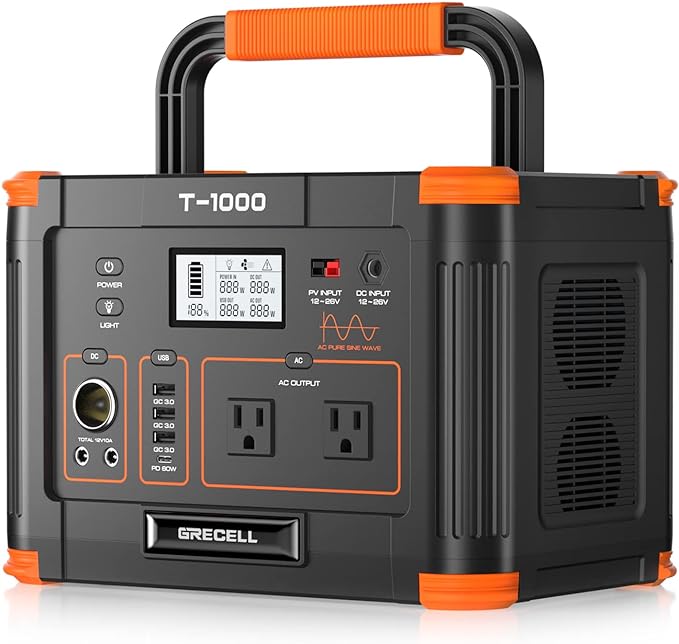
The GRECELL T-1000 remains an interesting option for buyers who want a roughly 1,000Wh portable power station without moving into a much larger and heavier unit.
The biggest correction to the original article concerns the battery chemistry. The current GRECELL specifications identify the T-1000 as using an NCM lithium-ion battery, not LiFePO4. The manufacturer lists a 999Wh capacity, 1000W AC output, 2000W peak output, built-in MPPT, wireless charging, USB-C, USB-A, DC outputs, and a car outlet.
That distinction matters if you’re comparing battery longevity with newer LiFePO4 models.
Key Specifications
| Feature | GRECELL T-1000 |
|---|---|
| Battery Capacity | 999Wh |
| Battery Chemistry | NCM Li-ion |
| Rated AC Output | 1000W |
| Peak Output | 2000W |
| AC Input | Up to 155W |
| Solar Input | 12–26V, up to 8–8.5A |
| USB-C | Up to 60W |
| USB-A | Up to 18W |
| Wireless Charging | 10W |
| Car Output | 12V/10A |
| Weight | About 17.9 lbs |
| MPPT | Yes |
GRECELL also lists AC, solar, and vehicle charging as recharge options, with pass-through charging supported.
What I Like
- Nearly 1,000Wh of battery capacity.
- 1000W pure-sine-wave AC output.
- 2000W peak capability.
- Built-in MPPT solar charging.
- Relatively low weight for its capacity.
- Wireless phone charging.
- Useful combination of AC, USB, DC, and car outputs.
What to Keep in Mind
The NCM battery is the main consideration when comparing the GRECELL with newer LiFePO4 power stations.
It’s also important not to confuse the 1000W inverter with solar charging speed. The current GRECELL specification lists only 155W maximum input power, so this isn’t a high-input solar charging powerhouse.
Best For
The GRECELL T-1000 makes the most sense for camping, road trips, electronics, small appliances, and occasional emergency backup where portability is more important than extremely fast solar recharge.
2. Jackery Solar Generator 1000 v2
Check Amazon Price: Click Here
Overview
The Jackery Explorer 1000 v2 is one of the most significant upgrades in this class because it goes beyond the traditional 1000W specification.
Instead of a 1000W inverter, the Explorer 1000 v2 provides 1500W of continuous AC output and up to 3000W of surge power. Its 1070Wh LiFePO4 battery is rated for 4000 cycles to at least 70% capacity.
That makes it particularly interesting for buyers who originally started their search with “1000W power station” but want additional headroom for appliances with higher startup or operating demands.
Key Specifications
| Feature | Jackery Explorer 1000 v2 |
|---|---|
| Battery Capacity | 1070Wh |
| Battery Chemistry | LiFePO4 |
| Rated AC Output | 1500W |
| Surge Output | 3000W |
| AC Charging | About 1.7 hours |
| Solar Input | Up to 400W |
| Weight | About 23.8 lbs |
| AC Outlets | 3 |
| USB-C | 30W + 100W |
| USB-A | 18W |
| Car Port | 12V/10A |
| Cycle Life | 4000 cycles to 70%+ |
| Warranty | 3+2 years |
Jackery’s current specifications list a maximum solar input of 400W, 1500W total AC output, a 1070Wh battery, and approximately 23.8 pounds of weight.
Why It Stands Out
The extra inverter capacity is one of the biggest advantages.
A 1000W-class station can handle many common devices, but 1500W gives you more flexibility. It can also reduce the chance that an appliance gets too close to the inverter’s maximum output.
The LiFePO4 battery is another major advantage for frequent users. Jackery rates it for 4000 cycles to 70% or more of its original capacity.
What to Keep in Mind
The Explorer 1000 v2 isn’t the lightest station in this comparison. At around 23.8 pounds, it’s still portable, but you will notice the weight if you’re carrying it long distances.
Also, 1070Wh is still a relatively small battery for whole-home backup. It’s better suited to essential loads than to running an entire house.
Best For
The Jackery Explorer 1000 v2 is a strong fit for campers, RV users, remote workers, emergency preparedness, and anyone who wants more inverter headroom than a traditional 1000W power station.
3. Barphygo 1000W Portable Power Station
Check Amazon Price: Click Here
Overview
Barphygo targets buyers who want approximately 1kWh of storage and 1000W of AC output without paying for a premium-brand power station.
Available documentation for the Barphygo 1000W models identifies a 1024Wh LiFePO4 battery and 1000W AC output. Some versions are also sold as solar-generator kits with a foldable solar panel.
Because Barphygo has several similar listings and model numbers, buyers should check the exact Amazon listing before ordering, especially when comparing the included solar panel and charging specifications.
Key Specifications
| Feature | Barphygo 1000W |
|---|---|
| Battery Capacity | 1024Wh |
| Battery Chemistry | LiFePO4 |
| Rated AC Output | 1000W |
| USB-C | Up to 100W |
| USB-A | Up to 18W |
| DC Output | 12V/10A |
| Charging | AC, car, solar |
| Battery Management | BMS |
| Weight | Around 28.8 lbs on documented models |
| Lighting | Flashlight, strobe and SOS |
Documentation for one Barphygo 1000W model lists 1024Wh, LiFePO4 chemistry, 1000W pure-sine-wave output, a 100W USB-C port, and solar charging support.
What I Like
- 1024Wh capacity.
- LiFePO4 battery on documented models.
- 1000W AC inverter.
- 100W USB-C output.
- Multiple DC and car outputs.
- Solar charging capability.
- Integrated emergency lighting.
What to Keep in Mind
The Barphygo is considerably heavier than some competing stations. Documentation for the model reviewed lists approximately 28.8 pounds.
That makes it less attractive if you’ll frequently carry the unit over long distances.
The other issue is consistency between different Barphygo listings. Before buying, verify the exact model number, battery chemistry, included panel, solar input, and warranty associated with the listing you’re purchasing.
Best For
Barphygo is worth considering if your priority is getting around 1kWh of LiFePO4 storage and 1000W of output at a lower-cost end of the market.
4. EBL Voyager 1000 Portable Power Station
Check Amazon Price: Click Here
Overview
The EBL Voyager 1000 is another compact 1000W-class power station with a 999Wh battery.
Its feature set includes a wireless charging pad, USB-C output, USB-A QC 3.0, AC output, DC outputs, a car outlet, and solar charging through its built-in MPPT controller. EBL lists the battery chemistry as NCM lithium, with a 1000W rated output and 2000W peak output.
Key Specifications
| Feature | EBL Voyager 1000 |
|---|---|
| Battery Capacity | 999Wh |
| Battery Chemistry | NCM Lithium |
| Rated AC Output | 1000W |
| Peak Output | 2000W |
| Maximum Input | 155W |
| USB-C | Up to 60W |
| USB-A QC | Up to 18W |
| Wireless Charging | 10W |
| Solar Input | 12–26V, up to 8A |
| Pure Sine Wave | Yes |
| Weight | About 18.7 lbs net |
| MPPT | Yes |
EBL’s current specifications list a net weight of approximately 8.5kg, or about 18.7 pounds, and a 999Wh NCM lithium battery.
What I Like
- Relatively light for a 999Wh power station.
- 1000W pure-sine-wave output.
- 2000W peak.
- Wireless charging.
- USB-C support.
- Built-in MPPT.
- AC, solar, and car charging.
- Pass-through charging support.
What to Keep in Mind
The biggest limitation is the relatively low maximum charging input.
EBL lists a maximum input of about 155W. That means the Voyager 1000 isn’t designed to compete with newer power stations that can accept much larger solar arrays or recharge extremely quickly from AC.
Its NCM battery also makes it less interesting for someone specifically shopping for a modern LiFePO4 power station for frequent daily cycling.
Best For
The EBL Voyager 1000 is a practical choice for camping, electronics, weekend trips, and occasional emergency use where low weight and a large selection of outputs matter.
5. BALDR 1000W Portable Power Station
Check Amazon Price: Click Here
Overview
The BALDR 1000W portable power station takes a slightly different approach.
It has a 1000W pure-sine-wave inverter but only 808Wh of battery capacity, making it smaller than the approximately 1,000Wh models above. BALDR lists a 2000W surge rating, MPPT solar charging, USB-C PD 60W, USB-A QC 18W, ECO mode, and pass-through charging.
Key Specifications
| Feature | BALDR 1000W |
|---|---|
| Battery Capacity | 808Wh |
| Rated AC Output | 1000W |
| Surge Output | 2000W |
| Battery Type | Lithium |
| USB-C | 60W PD |
| USB-A | 18W QC |
| Charging | AC, solar, car |
| MPPT | Yes |
| Weight | 18.5 lbs |
| Pure Sine Wave | Yes |
| ECO Mode | Yes |
| Pass-Through Charging | Yes |
BALDR currently lists the 1000W/808Wh model at 18.5 pounds and describes it as having a 1000W pure-sine-wave inverter, 2000W surge capability, MPPT solar charging, and a 60W USB-C PD port.
What I Like
- Lightweight at 18.5 pounds.
- 1000W inverter.
- Pure-sine-wave AC output.
- MPPT solar charging.
- 60W USB-C PD.
- ECO mode.
- Pass-through charging.
- Compact design.
What to Keep in Mind
The biggest compromise is capacity.
At 808Wh, it stores roughly 20% less energy than a 1,024Wh station. That doesn’t make it bad, but it does mean shorter runtime when powering the same device.
For example, if two power stations have similar inverter efficiency and one has 808Wh while the other has roughly 1,024Wh, the larger battery should provide meaningfully longer runtime under the same load.
BALDR’s official product page currently also shows this particular model as sold out, so availability should be checked before making a purchase decision.
Best For
BALDR makes more sense for buyers who prioritize portability and don’t need the longest possible runtime from a single charge.
How Much Can a 1000W Solar Power Station Actually Run?
This is where many power-station buying guides become misleading.
A 1000W inverter does not mean you have 1000Wh of stored energy.
Think about the two numbers this way:
- Watts (W) = how much power a device needs right now.
- Watt-hours (Wh) = how much energy the battery can store.
A 1000W power station can potentially run a 500W appliance because 500W is below its continuous output rating.
But that doesn’t mean it will run the appliance for two hours.
A simplified estimate is:
Runtime ≈ Battery Capacity × 0.85 ÷ Appliance Wattage
The 0.85 factor is only a rough example for accounting for conversion losses. Actual results vary by station, load, temperature, battery condition, and operating mode.
Example Runtime Estimates
| Device | Approx. Power Draw | Approx. Runtime From 1000Wh |
|---|---|---|
| Wi-Fi router | 10W | Up to 85 hours |
| LED lights | 20W | Up to 42 hours |
| Laptop | 60W | Up to 14 hours |
| Small TV | 100W | Up to 8.5 hours |
| CPAP | 40W | Up to 21 hours |
| Mini fridge | 60–100W average* | Several hours to more than a day |
| Coffee maker | 800–1200W | Usually less than 1 hour |
| Microwave | 1000–1500W | Short periods only |
*Refrigerators and other compressor appliances cycle on and off, so their actual energy consumption varies significantly.
These figures are estimates rather than guaranteed runtimes.
What Can You Run With a 1000W Power Station?
A 1000W-class power station is generally well suited to lower-power electronics and selected household or camping appliances.
Good Uses
- Phones and tablets
- Laptops
- Cameras
- Wi-Fi routers
- LED lights
- Fans
- Small TVs
- CPAP machines when properly configured
- Small portable refrigerators
- Camping electronics
- Routers and networking equipment
- Small chargers
- Some small kitchen appliances
Appliances That Require More Care
Coffee makers, microwaves, hair dryers, hot plates, kettles, toasters, and heating appliances can consume close to or more than 1000W.
Always check the appliance’s actual running wattage and startup requirements before connecting it.
An appliance rated at 900W may work with a 1000W power station, but you have very little headroom for additional loads.
What to Look For in a 1000W Solar Power Station
1. Battery Capacity
For this category, I’d generally look for at least 800Wh, with approximately 1,000Wh or more being more attractive for extended use.
The difference between 808Wh and 1,070Wh can be significant when you’re running equipment for several hours.
Don’t choose based solely on the inverter wattage.
A 1000W/800Wh station and a 1000W/1,000Wh station can provide very different real-world runtimes.
2. Battery Chemistry
Battery chemistry has become much more important in the 2026 market.
LiFePO4, also called LFP, is now common in newer portable power stations because it is designed for substantially more charge cycles than many older NCM lithium-ion systems.
That doesn’t automatically make every LiFePO4 station better for every buyer, but it is an important consideration if you expect to charge and discharge the battery frequently.
The difference is especially obvious in this comparison: Jackery’s Explorer 1000 v2 uses LiFePO4 and is rated for 4000 cycles to 70%+ capacity, while the current GRECELL T-1000 and EBL Voyager 1000 specifications identify NCM lithium batteries.
3. Continuous Output vs. Surge Output
Always look at both numbers.
Continuous output tells you what the inverter can provide during normal operation.
Surge output refers to the additional short-term power available for devices that need extra power when starting.
Motors and compressors are common examples.
For instance, a refrigerator may consume relatively little electricity once running but require considerably more power when its compressor starts.
4. Solar Charging Input
This is one of the most overlooked specifications in “solar generator” articles.
A station can have a 1000W inverter while accepting only a relatively small amount of solar power.
For example, the current GRECELL T-1000 and EBL Voyager 1000 specifications list maximum input around 155W, whereas the Jackery Explorer 1000 v2 supports up to 400W of solar input.
If you’re buying specifically for off-grid solar use, solar input can be just as important as inverter output.
5. Recharge Time
Fast AC charging is convenient when you need to prepare the station quickly before an outage or camping trip.
Solar charging is different because the actual time depends on:
- Solar panel wattage
- Sun intensity
- Panel orientation
- Temperature
- Clouds and shade
- Solar input limits
- Battery state of charge
Never assume a 200W solar panel will produce 200W continuously throughout the day.
6. Weight
Around 18–24 pounds is still manageable for many people, but a station weighing close to 30 pounds becomes noticeably less convenient to carry.
Compare weight against battery capacity rather than looking at weight alone.
A heavier station may still make sense if it provides significantly more usable energy.
7. Ports
At minimum, look for:
- AC outlets
- USB-C
- USB-A
- 12V DC
- Car outlet
USB-C Power Delivery is particularly useful because modern laptops, tablets, phones, and other electronics can often charge directly without using the AC inverter.
8. Pure Sine Wave Output
For a general-purpose portable power station, pure-sine-wave AC output is preferable because it more closely resembles the electricity supplied by a household outlet.
The models in this comparison that publish pure-sine-wave output should still be used according to their manuals and the requirements of the connected equipment.
1000W vs. 1500W vs. 2000W: Which Size Makes Sense?
The name of this category can be misleading.
You may start by searching for a “1000W solar generator” and discover that newer products around the same battery capacity now offer 1500W or even 2000W of inverter output.
That’s why the Jackery Explorer 1000 v2 is relevant even though its inverter is rated at 1500W. Its 1070Wh battery puts it squarely in the same general 1kWh-class market.
The same trend appears across the market. Current 2026 comparisons place models such as the EcoFlow DELTA 2 and Anker SOLIX C1000 Gen 2 alongside the Jackery in this capacity class, with some newer stations offering substantially more inverter power than the older 1000W designs.
So when shopping, don’t filter your search so narrowly that you automatically exclude a 1500W or 2000W model with approximately 1,000Wh of storage.
Are 1000W Solar Generators Good for Home Backup?
Yes, but with realistic expectations.
A 1000Wh-class portable power station can be extremely useful during a short outage, especially for keeping essential electronics operating.
It can potentially power:
- Wi-Fi equipment
- Phones
- Laptops
- Lights
- Small fans
- Medical equipment such as a CPAP when compatible
- A small refrigerator for limited periods
However, it is not a replacement for a whole-home standby generator.
Central air conditioning, electric water heaters, electric ranges, clothes dryers, well pumps, and other high-demand appliances can exceed the capacity of a 1000W-class station.
For whole-home backup, you’ll generally need a much larger battery system, a higher-output inverter, or a conventional standby generator.
Can You Use a 1000W Power Station While Charging With Solar?
Many portable power stations support some form of pass-through charging, but you should check the specific manufacturer’s instructions before relying on it for a particular application.
GRECELL and EBL both document pass-through charging on their current product information.
However, pass-through charging doesn’t mean the station is creating unlimited power.
If your connected equipment is consuming 100W while your solar panel is supplying only 60W, the battery can still lose charge.
Safety Tips for Solar Power Stations
Portable power stations are much easier to use than fuel-powered generators, but they still need proper handling.
Keep the station dry
Unless the manufacturer specifically gives the unit an appropriate water-resistance rating, keep the power station protected from rain and standing water.
Don’t overload the inverter
Add up the wattage of connected AC appliances before turning them on.
Leave ventilation space
Don’t cover the cooling vents or place the unit where heat cannot escape.
Use compatible solar panels
Check voltage, current, connector type, and the station’s maximum solar input before connecting a panel.
Store the battery correctly
For long-term storage, follow the manufacturer’s recommended charge level and temperature range rather than simply leaving the station plugged in indefinitely.
Be careful with medical equipment
A portable power station can be useful during an outage, but people who depend on electrically powered medical equipment should have a backup plan that meets the equipment manufacturer’s requirements.
Which 1000W Solar Power Station Should You Choose?
The right choice depends more on how you plan to use the power station than on the 1000W label itself.
GRECELL T-1000
A practical option if you want a relatively lightweight 999Wh station with plenty of connection options. Its NCM battery and relatively modest charging input are the main things to consider.
Jackery Explorer 1000 v2
A particularly interesting option for buyers who want more inverter headroom, a 1070Wh LiFePO4 battery, and a higher cycle rating. Its 1500W output also gives it an advantage over traditional 1000W designs.
Barphygo 1000W
Worth considering for shoppers looking for a 1024Wh LiFePO4-based station at the budget end of the market. Verify the exact model and included accessories before buying because Barphygo has multiple similar listings.
EBL Voyager 1000
A compact 999Wh option with useful USB and wireless charging features. Its NCM battery and approximately 155W maximum input make it more appropriate for basic portable power than aggressive off-grid solar charging.
BALDR 1000W
An interesting lightweight alternative for users who don’t need 1,000Wh of storage. Its 808Wh capacity and 18.5-pound weight make portability its strongest selling point.
Final Thoughts
The best 1000W solar power station isn’t necessarily the one with the biggest number printed on the box.
For 2026, I would pay particular attention to battery capacity, battery chemistry, continuous inverter output, surge capability, solar input, recharge speed, weight, and usable energy.
The market has moved beyond simply comparing “1000W” labels. A modern 1kWh-class station can have a 1000W, 1500W, or even 2000W inverter, while solar charging speeds can vary dramatically between models.
The Jackery Explorer 1000 v2 is a good example of this shift: it combines a 1070Wh LiFePO4 battery with a 1500W inverter and 400W maximum solar input.
Meanwhile, the GRECELL and EBL models show why battery chemistry and charging input should be checked rather than assumed from the product name. Both current specifications identify NCM lithium batteries and approximately 155W maximum input.
If your main goal is camping, remote work, emergency electronics, or occasional off-grid use, a power station in this capacity range can be a very useful middle ground between a small battery pack and a large home backup system.
Before buying, check the exact model listing, current specifications, included solar panel, warranty, and current availability. Those details can change, especially with Amazon listings and older portable power station models.