As an Amazon Associate I earn from qualifying purchases.
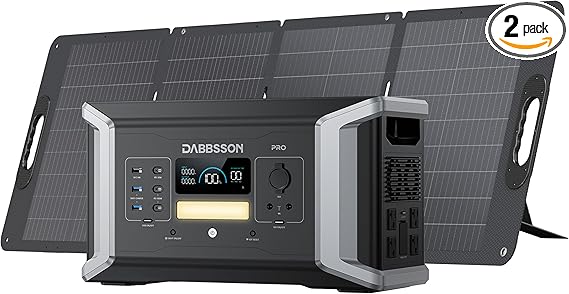
If you want a portable power station that can handle more than phones and small electronics, a 2000W solar generator is a practical place to start. This power class can run many everyday appliances, support camping and RV equipment, and provide valuable backup power during a blackout.
But there is an important detail that is easy to miss: 2,000 watts and 2,000 watt-hours are not the same thing.
Watts tell you how much power the inverter can deliver at one time. Watt-hours tell you how much energy the battery stores. A 2,000W power station with a 1,024Wh battery can deliver plenty of power to a high-wattage appliance, but it will not run that appliance for as long as a 2,048Wh battery.
For this 2026 guide, I looked at the current specifications of the models in this list and focused on output power, battery capacity, solar charging, portability, battery chemistry, expansion options, and practical use.
One more clarification: the term solar generator is commonly used for a portable power station paired with solar panels. The battery power station itself does not generate electricity; it stores energy and converts it into usable AC power.
Best 2000W Solar Generators at a Glance
| Model | Battery Capacity | Continuous AC Output | Surge Output | Solar Input | Best For |
|---|---|---|---|---|---|
| Dabbsson DBS1000 Pro | 1,024Wh | 2,000W | 4,000W | Up to 1,200W | Fast solar charging and portability |
| OUPES Mega 1 | 1,024Wh | 2,000W | 4,500W | Up to 800W | Camping and expandable backup |
| Jackery Explorer 2000 v2 | 2,042Wh | 2,200W | 4,400W | Up to 400W | Home backup and camping |
| AFERIY Haven2400 P210 | 2,048Wh | 2,400W | Varies by configuration | Up to 500W | Higher-output backup |
| BLUETTI AC70 | 768Wh | 1,000W | 1,500W | Up to 500W | Lightweight camping and smaller loads |
Important: The BLUETTI AC70 is included as a compact alternative because it was part of the original product list, but it is not a true 2,000W continuous-output power station. If your priority is specifically a 2,000W inverter, focus on the first four options.
1. Dabbsson DBS1000 Pro
Check Amazon Price Click Here!
The Dabbsson DBS1000 Pro is one of the more interesting options in this group because it combines a relatively compact 1,024Wh battery with a true 2,000W AC inverter.
It uses a semi-solid-state LiFePO4 battery and is rated for 4,500 cycles to 80% capacity. The station also supports up to 1,200W of solar input, which is considerably more useful than the 500W solar input listed in the original version of this article.
For camping, emergency preparedness, and short-duration home backup, that combination makes the DBS1000 Pro worth considering.
Key Specifications
| Feature | Details |
|---|---|
| Battery Capacity | 1,024Wh |
| Battery Chemistry | Semi-solid-state LiFePO4 |
| Continuous AC Output | 2,000W |
| Surge Output | 4,000W |
| Power Boost | Up to 3,000W |
| Solar Input | Up to 1,200W |
| AC Input | Up to 1,200W |
| AC Outlets | 4 |
| USB-C | Up to 100W |
| Weight | About 34.4 lbs |
| Cycle Life | 4,500 cycles to 80% |
| Warranty | 5 years |
Pros
- True 2,000W continuous AC output
- Up to 1,200W solar input
- Long rated battery cycle life
- Relatively portable for its output class
- Expandable battery system
- Multiple USB-C and AC outputs
Cons
- 1,024Wh capacity is smaller than the 2,000Wh-class models
- Solar panels are not necessarily included
- Less suitable for long-duration high-power loads without expansion
Best For
The Dabbsson DBS1000 Pro is a good fit for campers, van owners, emergency-preparedness kits, and buyers who value fast solar charging.
If you expect to run a refrigerator or other appliance for many hours, however, pay close attention to battery capacity rather than looking only at the 2,000W inverter rating.
2. OUPES Mega 1
Check Amazon Price Click Here!
The OUPES Mega 1 is another genuine 2,000W-class portable power station. One important correction from the original article is that the base Mega 1 has a 1,024Wh battery, not 2,048Wh.
That distinction matters.
The Mega 1 provides 2,000W of continuous AC output and up to 4,500W of surge power. It can also accept up to 800W from solar panels and supports battery expansion to as much as 5.12kWh with compatible additional batteries.
That makes it more flexible than its base 1,024Wh capacity might suggest.
Key Specifications
| Feature | Details |
|---|---|
| Battery Capacity | 1,024Wh |
| Battery Chemistry | LiFePO4 |
| Continuous AC Output | 2,000W |
| Surge Output | 4,500W |
| Solar Input | Up to 800W |
| AC Fast Charging | Up to 1,400W |
| AC + Solar Input | Up to 2,200W |
| Expansion Capacity | Up to 5.12kWh |
| AC Outlets | 4 |
| USB-C | 2 × 100W |
| Weight | About 27.8 lbs |
| Cycle Life | 3,500+ cycles to 80% |
Pros
- True 2,000W continuous output
- 4,500W surge capability
- Lightweight for this power class
- Up to 800W solar input
- Expandable battery capacity
- Wi-Fi and Bluetooth connectivity
- Strong option for camping and emergency backup
Cons
- Base battery capacity is only 1,024Wh
- Larger loads will drain the battery relatively quickly
- Expansion batteries add weight and cost
Best For
The OUPES Mega 1 makes the most sense for camping, RV use, emergency backup, and buyers who want the option to expand the battery later.
It is also worth considering if portability matters. At roughly 28 pounds, it is significantly easier to move than many 2,000Wh-class power stations.
3. Jackery Explorer 2000 v2
Check Amazon Price Click Here!
The Jackery Explorer 2000 v2 is one of the strongest choices in this group for buyers who want a large battery without moving into an extremely heavy power station.
Despite the “2000” name, its actual specifications are slightly above the 2,000W target: it has a 2,200W continuous AC output and 4,400W surge capacity.
It also has a 2,042Wh LiFePO4 battery, giving it roughly twice the stored energy of the 1,024Wh Dabbsson and OUPES base models.
That difference can be more important than a few hundred watts of inverter capacity when your goal is longer emergency runtime.
Key Specifications
| Feature | Details |
|---|---|
| Battery Capacity | 2,042Wh |
| Battery Chemistry | LiFePO4 |
| Continuous AC Output | 2,200W |
| Surge Output | 4,400W |
| AC Outlets | 3 |
| Solar Input | Up to 400W |
| AC Charging | About 1.75 hours |
| USB-C | Up to 100W |
| USB-A | Up to 18W |
| Weight | About 39.5 lbs |
| Cycle Life | 4,000 cycles to 70%+ capacity |
| Warranty | 3 years + 2 years extension |
The Explorer 2000 v2 also supports UPS functionality, with Jackery specifying an automatic transfer time of approximately 20 milliseconds. It should not, however, be treated as a zero-interruption UPS for equipment that requires true online UPS protection.
Pros
- Large 2,042Wh battery
- 2,200W continuous output
- 4,400W surge capacity
- LiFePO4 battery chemistry
- Relatively light for a 2kWh-class unit
- Fast AC charging
- Good option for home emergency backup
- Useful for camping and RV applications
Cons
- Solar input is limited compared with some newer competitors
- No built-in expansion battery system on the standard unit
- Heavier than 1,000Wh-class stations
Best For
The Jackery Explorer 2000 v2 is particularly well suited to home emergency backup, RV use, camping, refrigerators, electronics, and other essential loads.
If your main priority is battery runtime rather than the lightest possible package, the 2,042Wh capacity gives it a significant advantage over 1,024Wh models.
4. AFERIY Haven2400 P210
Check Amazon Price Click Here!
The AFERIY P210 has also evolved since the original version of this article was written. AFERIY now identifies it as the Haven2400 P210, with a 2,048Wh LiFePO4 battery and a 2,400W pure sine wave inverter.
That means it is better described as a 2,000W-class or above-2,000W portable power station, rather than an exact 2,000W model.
The extra inverter headroom can be useful for appliances and tools with higher startup requirements. It also has up to 500W of solar input and supports multiple charging methods.
Key Specifications
| Feature | Details |
|---|---|
| Battery Capacity | 2,048Wh |
| Battery Chemistry | LiFePO4 |
| Continuous AC Output | 2,400W |
| Solar Input | Up to 500W |
| AC Charging | About 2 hours, depending on configuration |
| Battery Expansion | Not the same expansion platform as smaller AFERIY models |
| App Control | Yes, on applicable configuration |
| Outputs | Multiple AC, USB and DC outputs |
| Pure Sine Wave | Yes |
Pros
- 2,400W continuous output
- 2,048Wh battery capacity
- LiFePO4 battery
- Up to 500W solar input
- App control
- Designed for home backup and outdoor use
- More inverter headroom than a 2,000W unit
Cons
- Heavier than compact 1,000Wh stations
- Not the best choice if portability is the main concern
- 500W solar input is modest compared with some newer high-input models
Best For
The AFERIY P210 is a good choice for home backup, RVs, off-grid use, camping, and appliances that benefit from additional inverter headroom.
If you frequently use equipment close to the 2,000W limit, having a 2,400W inverter gives you more breathing room than a station rated exactly at 2,000W.
5. BLUETTI AC70: A Compact Alternative, Not a True 2000W Model
Check Amazon Price Click Here!
The BLUETTI AC70 deserves a place in the original product lineup, but it needs to be categorized correctly.
It is not a 2,000W continuous-output solar generator.
The AC70 has a 768Wh LiFePO4 battery and a 1,000W continuous AC output, with a 1,500W surge rating. BLUETTI’s Power Lifting feature can allow certain resistive loads to operate at higher wattage, but that does not make the AC70 a 2,000W continuous inverter.
What it does offer is excellent portability.
At about 22.5 pounds, it is much easier to carry than a 2,000Wh-class power station. It also supports up to 500W of solar input and fast AC charging.
Key Specifications
| Feature | Details |
|---|---|
| Battery Capacity | 768Wh |
| Battery Chemistry | LiFePO4 |
| Continuous AC Output | 1,000W |
| Surge Output | 1,500W |
| Solar Input | Up to 500W |
| AC Charging | Up to 950W |
| USB-C | 2 × 100W |
| AC Outlets | 2 |
| Weight | About 22.5 lbs |
| Cycle Life | 3,000+ cycles to 80% |
| Warranty | 5 years |
Pros
- Very portable
- 22.5-pound weight
- LiFePO4 battery
- Up to 500W solar input
- Fast AC charging
- USB-C ports up to 100W
- Excellent for camping and travel
Cons
- Only 1,000W continuous AC output
- 768Wh capacity is much smaller than 2,000Wh-class stations
- Not the right choice for sustained 2,000W loads
Best For
Choose the BLUETTI AC70 if your priority is portability, camping, travel, electronics, and smaller appliances rather than maximum 2,000W output.
If you specifically need a 2,000W inverter, move up to one of the four models above.
2000W vs. 2000Wh: What Should You Actually Look At?
This is one of the most important things to understand before buying a solar generator.
Watts (W) measure power.
Watt-hours (Wh) measure stored energy.
For example, the OUPES Mega 1 provides 2,000W of continuous output but has a 1,024Wh battery. The Jackery Explorer 2000 v2 provides 2,200W of output and has a 2,042Wh battery.
The Jackery therefore has approximately twice the stored energy, even though its inverter is only slightly more powerful.
A simplified runtime calculation looks like this:
Runtime ≈ Battery Capacity × Efficiency ÷ Appliance Wattage
Actual runtime varies because of inverter losses, battery-management systems, temperature, load changes, and the power station’s operating characteristics.
For example, a 100W device connected to a 2,000Wh-class station will generally run much longer than a 1,500W appliance.
This is why you should never choose a power station based only on the wattage number printed in its name.
What Can a 2000W Solar Generator Run?
A 2,000W-class power station can handle many common appliances, but you need to check both running wattage and startup requirements.
Depending on the specific appliance, a unit in this class can potentially power:
- Refrigerators
- TVs
- Laptops and desktop computers
- Wi-Fi routers
- Lights
- CPAP machines
- Coffee makers
- Microwaves
- Small kitchen appliances
- Fans
- Battery chargers
- Some power tools
- Small pumps
The important word is potentially.
A refrigerator might have a relatively low running consumption but require a much higher startup surge. The same applies to compressors, pumps, saws, grinders, and other motor-driven equipment.
You should compare the appliance’s starting and running wattage with the power station’s continuous and surge ratings before connecting it.
Can a 2000W Solar Generator Power a Whole House?
Usually, no.
A 2,000W-class portable power station is better thought of as an essential-load backup system, not a whole-house generator.
It may keep a refrigerator, lights, internet equipment, phones, laptops, and selected small appliances running.
It generally is not designed to power an entire home containing large electric loads such as:
- Central air conditioning
- Electric water heaters
- Electric dryers
- Electric ranges
- Large well pumps
- Whole-house heating systems
- Multiple high-wattage appliances simultaneously
For whole-home backup, you generally need a much larger battery system, higher inverter capacity, and an appropriately installed transfer or backup-power system.
What to Look for in a 2000W Solar Generator
1. Continuous Output
Always check the continuous AC output, not just the model name.
A product called a “2000” power station may not actually provide 2,000W continuously.
The BLUETTI AC70 is a good example: its name and Power Lifting feature can create confusion, but its standard AC output is 1,000W.
2. Surge Capacity
Surge power matters when starting motors and compressors.
A refrigerator, pump, or power tool may draw considerably more power for a short period when starting.
A higher surge rating can provide additional headroom, but the appliance must still be compatible with the manufacturer’s specifications.
3. Battery Capacity
If you want longer runtime, look at Wh, not just W.
A 2,048Wh station will generally provide substantially more stored energy than a 1,024Wh station under comparable conditions.
4. Solar Input
Solar input determines how quickly you can replenish the battery using solar panels.
For emergency use, a station with a higher solar-input ceiling can be valuable because it allows a larger compatible panel array.
However, maximum input is not the same as guaranteed charging speed. Weather, panel orientation, temperature, shading, and the actual output of the panels all affect charging.
5. Battery Chemistry
LiFePO4 batteries are now common in this class of portable power station.
They generally offer long cycle life and good thermal characteristics compared with older lithium-ion chemistries.
Still, cycle-life numbers should be compared carefully because manufacturers may define end-of-life differently.
6. UPS/EPS Function
If you plan to use the power station with a computer, router, networking equipment, or other sensitive electronics, check its UPS/EPS switching specification.
Do not assume that every portable power station provides a true zero-interruption UPS.
7. Weight
A 2,000Wh battery is considerably more portable than a large home battery system, but it is still heavy.
If you expect to carry the station frequently, a 1,000Wh-class model such as the OUPES Mega 1 or Dabbsson DBS1000 Pro may make more sense.
If the station will mostly stay in one location during an outage, a 2,000Wh-class model can provide substantially more runtime.
8. Expandability
If you are preparing for multi-day outages, expansion can be more valuable than buying the largest inverter.
The OUPES Mega 1, for example, can be expanded substantially beyond its base 1,024Wh capacity with compatible batteries.
Which 2000W Solar Generator Should You Choose?
The best choice depends on what you actually need.
For a true 2,000W portable power station with fast solar charging: the Dabbsson DBS1000 Pro is worth a close look, especially if portability and solar input are priorities.
For a lightweight and expandable 2,000W option: the OUPES Mega 1 is an attractive choice, particularly for camping and emergency preparedness.
For longer battery runtime: the Jackery Explorer 2000 v2 stands out with its 2,042Wh battery and 2,200W continuous output.
For extra inverter headroom: the AFERIY Haven2400 P210 provides 2,400W of continuous output with a 2,048Wh battery.
For lightweight camping: the BLUETTI AC70 is easier to carry, but remember that it is a 1,000W-class station rather than a true 2,000W model.
Final Thoughts
The best 2000W solar generator for you depends on more than the number printed on the box.
Start with the continuous AC output to determine what you can run. Then look at battery capacity in watt-hours to determine how long you can run it. After that, compare solar input, charging speed, surge capability, weight, battery chemistry, UPS functionality, and expansion options.
For emergency preparedness, a 2,000W-class power station can be a practical way to keep essential electronics and selected appliances operating during a blackout. For camping and RV use, the same equipment can provide quiet, fuel-free electricity without the exhaust and maintenance associated with a conventional gas generator.
Just remember that a 2,000W power station is not automatically a whole-home backup system. The right model is the one whose output, battery capacity, charging options, and portability match the loads you actually expect to use.
Before purchasing, check the latest Amazon listing and manufacturer specifications because prices, bundles, included solar panels, and product configurations can change over time.