As an Amazon Associate I earn from qualifying purchases.

A 240-volt portable generator can do much more than keep a few lights and refrigerators running during a power outage. When properly sized, a 120/240V generator can also supply larger loads such as well pumps, electric water heaters, air-conditioning equipment, workshop tools, and other appliances that require 240 volts.
The important part is choosing a generator based on its running wattage, surge capacity, outlet configuration, fuel type, and intended use. A generator rated at 11,000 peak watts, for example, does not continuously produce 11,000 watts.
For 2026, the five models below cover several different needs, from a relatively compact inverter generator for RV and backup use to larger dual-fuel machines designed for demanding home loads.
Best 240-Volt Portable Generators at a Glance
| Generator | Gas Running / Peak | Propane Running / Peak | 120/240V | Inverter | Best For |
|---|---|---|---|---|---|
| WEN DF475T | 3,800 / 4,750W | 3,500 / 4,350W | Yes | No | Budget home backup and RV use |
| WEN DF680iX | 5,100 / 6,800W | 4,500 / 6,000W | Yes | Yes | RVs, electronics and flexible backup |
| WEN DF1100T | 8,300 / 11,000W | 7,500 / 9,500W | Yes | No | Heavy-duty home backup |
| Westinghouse WGen9500DF | 9,500 / 12,500W | 8,500 / 11,200W | Yes | No | Large home backup |
| Westinghouse iGen11000DFc | 9,000 / 11,000W | 8,100 / 10,000W | Yes | Yes | High-output inverter backup |
The specifications above are based on manufacturer information rather than temporary Amazon pricing. Generator prices and availability can change, so it makes more sense to check the current listing before buying.
What Is a 240-Volt Portable Generator?
A 240-volt portable generator is designed to provide both 120-volt and 240-volt AC power. This makes it different from many smaller portable generators that provide 120V only.
The advantage becomes important when you need to power equipment that requires 240V. Depending on the equipment and your home’s electrical system, examples can include certain well pumps, larger air-conditioning systems, electric water heaters, air compressors, welders, and workshop machinery.
However, seeing “120/240V” on a generator does not mean that the generator can power every appliance in your home simultaneously.
You still need to calculate the total running load and account for the higher starting demand of motors and compressors.
For home backup, the generator also needs to be connected through an appropriate transfer switch or interlock arrangement. Never connect a portable generator to a home’s electrical system by plugging it into a household outlet. Improper backfeeding can energize utility lines and create a serious hazard.
1. WEN DF475T
Check the WEN DF475T on Amazon
The WEN DF475T is the smaller and more affordable option in this comparison. It makes sense for buyers who need 120/240V capability without moving up to a much larger 8,000- or 9,000-watt generator.
The important correction here is the actual power rating. On gasoline, the DF475T produces 3,800 running watts and 4,750 surge watts. On propane, it produces 3,500 running watts and 4,350 surge watts.
It uses a 224cc four-stroke OHV engine and has a 4-gallon fuel tank. WEN lists up to 11 hours of runtime at half load on gasoline.
The generator can switch between 120V and 240V operation and includes a 120/240V L14-30R twist-lock outlet. It also has two 120V GFCI outlets and electric start.
Why consider the WEN DF475T?
- 120/240V output
- Dual-fuel gasoline/propane operation
- Electric start
- 3,800 running watts on gasoline
- 4,750 peak watts on gasoline
- L14-30R 120/240V outlet
- GFCI-protected 120V outlets
- Four-gallon gasoline tank
- Wheel and handle kit
Best for
The DF475T is a practical choice for basic home backup, smaller RV setups, power tools, refrigerators, sump pumps and other moderate loads.
It is not the right choice if you expect to run several high-demand appliances at the same time.
2. WEN DF680iX
Check the WEN DF680iX on Amazon
The WEN DF680iX is one of the more interesting generators here because it combines 120/240V capability with inverter technology.
On gasoline, it provides 5,100 running watts and 6,800 surge watts. On propane, it provides 4,500 running watts and 6,000 surge watts. Its 224cc engine is paired with a 2.9-gallon fuel tank.
The inverter design is especially useful if you expect to run sensitive electronics. WEN specifies total harmonic distortion below 1.2% at full load, while also providing a CO shutdown sensor.
It also includes fuel shutoff, electric start, a 120/240V L14-30R outlet, a TT-30R RV receptacle, 120V outlets, USB ports and a voltage selector.
One unusual feature is its bonded-neutral 240V configuration for low-power Level 2 EV charging. That does not mean it is a universal EV charging solution; the vehicle, charger and generator setup must all be compatible, and the manufacturer’s instructions should be followed.
Why consider the WEN DF680iX?
- Inverter generator technology
- 120/240V output
- Dual-fuel operation
- 5,100 running watts on gasoline
- 6,800 peak watts on gasoline
- TT-30R RV outlet
- L14-30R 120/240V outlet
- CO Watchdog shutdown protection
- Fuel shutoff
- Electric and recoil start
- Parallel capability with compatible WEN equipment
Best for
The DF680iX is particularly appealing for RV owners, electronics, emergency backup and buyers who want 240V capability without moving to a very large conventional generator.
Its inverter design also gives it an advantage when clean electrical output is a priority.
3. WEN DF1100T
Check the WEN DF1100T on Amazon
If you need substantially more power than the DF475T or DF680iX, the WEN DF1100T moves into serious home-backup territory.
Its correct gasoline rating is 8,300 running watts and 11,000 surge watts. On propane, it produces 7,500 running watts and 9,500 surge watts. The generator uses a 457cc four-stroke OHV engine and supports both 120V and 240V operation.
WEN lists a 6.6-gallon fuel tank and up to 8.5 hours of runtime at half load on gasoline.
The control panel includes four 120V GFCI outlets, a 120V 30A twist-lock outlet and a 120/240V 50A NEMA 14-50R outlet. That 50A connection gives this generator considerably more flexibility for larger backup installations.
Why consider the WEN DF1100T?
- 8,300 running watts on gasoline
- 11,000 peak watts on gasoline
- 7,500 running watts on propane
- 9,500 peak watts on propane
- 120/240V output
- 50A NEMA 14-50R outlet
- 457cc engine
- Electric start
- Dual-fuel operation
- Wheel kit
- Suitable for transfer-switch applications
Best for
The DF1100T is better suited to larger homes, demanding workshop equipment, well pumps, larger appliances and emergency backup systems where a smaller generator would quickly run out of capacity.
It is also worth considering if you specifically need a 50A generator connection.
4. Westinghouse WGen9500DF
Check the Westinghouse WGen9500DF on Amazon
The Westinghouse WGen9500DF is the highest-output conventional generator in this comparison.
The model name is important: it is not simply a “12,500DF.” The generator is called the WGen9500DF, while 12,500 watts is its gasoline peak output.
On gasoline, the generator delivers 9,500 running watts and 12,500 peak watts. On propane, it produces 8,500 running watts and 11,200 peak watts.
It uses a 457cc four-stroke OHV engine and a 6.6-gallon fuel tank. Westinghouse lists up to 12 hours of runtime at 25% load and up to 8 hours at 50% load on gasoline.
The control panel includes both a 120/240V L14-30R twist-lock outlet and a 120/240V 14-50R outlet. It is designed to work with appropriate transfer-switch systems and includes electric, remote and recoil starting.
One important correction from the original article: the current manufacturer specifications list no carbon monoxide sensor for the WGen9500DF. Buyers should not assume that every Westinghouse generator has the same CO protection system.
Why consider the WGen9500DF?
- 9,500 running watts on gasoline
- 12,500 peak watts
- 8,500 running watts on propane
- 11,200 peak watts on propane
- 120/240V output
- 30A L14-30R outlet
- 50A 14-50R outlet
- Remote and electric start
- 457cc engine
- GFCI outlets
- Transfer-switch ready
- Large 6.6-gallon fuel tank
Best for
The WGen9500DF is aimed at large-home backup, demanding appliances, workshops and users who need substantial 120/240V capacity.
For a home backup installation, however, the generator’s maximum output should always be compared with the loads you actually intend to operate.
5. Westinghouse iGen11000DFc Inverter Generator
Check the Westinghouse iGen11000DFc on Amazon
The Westinghouse iGen11000DFc combines high output with inverter technology, making it the most specialized generator in this group.
On gasoline, it produces 9,000 running watts and 11,000 peak watts. On propane, the figures are 8,100 running watts and 10,000 peak watts. Westinghouse specifies total harmonic distortion of 3% or less.
It has a 457cc engine, a 7.92-gallon fuel tank and a manufacturer-listed runtime of up to 17 hours at 25% load on gasoline.
The control panel includes a 120/240V 14-50R outlet and a 120/240V L14-30R outlet, along with 120V GFCI outlets. It also includes electric, remote and recoil starting, a digital display, economy mode and CO sensor protection.
Why consider the iGen11000DFc?
- 9,000 running watts on gasoline
- 11,000 peak watts on gasoline
- 8,100 running watts on propane
- 10,000 peak watts on propane
- Inverter technology
- ≤3% THD
- 120/240V operation
- 50A 14-50R outlet
- 30A L14-30R outlet
- Remote start
- CO sensor with automatic shutdown
- Economy mode
- 7.92-gallon fuel tank
- Parallel capable
Best for
This model is a strong fit for buyers who want high-output home backup with inverter technology and who are willing to pay more for the combination of power, cleaner electrical output and additional features.
It is also more attractive than a traditional open-frame generator if you expect to power a mixture of major appliances and sensitive electronics.
240V Portable Generator vs. 120V Generator
The biggest reason to buy a 240V generator is not simply “more voltage.”
It is flexibility.
A 120/240V generator can provide power to both 120V and 240V equipment when connected and configured correctly. This can be particularly important for homes with equipment that cannot operate from a standard 120V receptacle.
Examples can include:
- Well pumps
- Certain air-conditioning systems
- Electric water heaters
- Large air compressors
- Welders
- Some table saws and other workshop machinery
- Other 240V appliances
The actual requirements vary by appliance, so check the equipment nameplate before assuming a generator can operate it.
How Many Watts Do You Need?
This is one of the most important questions when buying a 240-volt portable generator.
Start with the appliances you actually need during an outage.
For each item, determine:
- Running watts
- Starting or surge watts
- Whether it operates at 120V or 240V
- Whether several motors could start at the same time
Motors, compressors and pumps can require substantially more power when starting than they use once running.
For example, a generator may have enough running capacity for a refrigerator and sump pump but still trip its overload protection if both motors start simultaneously while several other appliances are operating.
This is why a generator’s running wattage is generally more important for long-term load planning than its peak wattage.
Inverter vs. Conventional 240V Generator
Both types can be useful, but they serve somewhat different priorities.
Conventional generator
Traditional portable generators are usually attractive when your primary concern is maximum output for the money.
They can be excellent for:
- Home backup
- Construction sites
- Workshops
- Large appliances
- Pumps
- Heavy-duty tools
Inverter generator
An inverter generator typically costs more, but it can provide cleaner electrical output and may offer better efficiency at lighter loads.
That can make inverter technology particularly attractive for:
- Computers
- Televisions
- Battery chargers
- Modern electronics
- RV equipment
- Mixed loads
The WEN DF680iX and Westinghouse iGen11000DFc are the inverter options in this comparison.
Dual-Fuel vs. Gasoline-Only
All five generators in this comparison use gasoline and propane.
Dual-fuel capability can be valuable during an extended outage because it gives you another fuel option.
Gasoline is often convenient when you need maximum output from the generator, while propane can be attractive for longer-term storage because properly stored propane does not degrade in the same way gasoline can.
The important thing is to compare the output on both fuels. Propane generally produces less power than gasoline on these models.
For example, the WEN DF1100T produces 8,300 running watts on gasoline but 7,500 running watts on propane.
Do You Need a 240V Generator for an RV?
Not necessarily.
Many RV appliances operate on 120V, so simply buying a 240V generator does not automatically make it a better RV generator.
The more important questions are:
- Does the generator have the correct RV receptacle?
- Does it provide enough running watts?
- Does it provide enough starting capacity for the RV’s air conditioner?
- Is it an inverter generator if clean power is important?
- Is the generator’s noise level acceptable for your camping environment?
The WEN DF680iX is particularly interesting for RV users because it includes a TT-30R RV receptacle in addition to its 120/240V L14-30R outlet.
Connecting a 240V Generator to Your Home
A portable generator should never be connected to household wiring by using a homemade cable or by plugging it into a normal wall outlet.
For a home backup installation, the generator connection needs an appropriate isolation method, such as a properly installed manual transfer switch or compatible panel interlock, depending on the equipment and local electrical requirements. The purpose is to prevent utility power and generator power from being connected in an unsafe way at the same time.
Because generator installations involve electrical hazards and local code requirements, a qualified electrician should handle the installation.
Also remember that a 240V generator does not mean you can simply turn on every breaker in the house. Your generator still has a finite wattage and amperage capacity.
Important Safety Tips for 240V Portable Generators
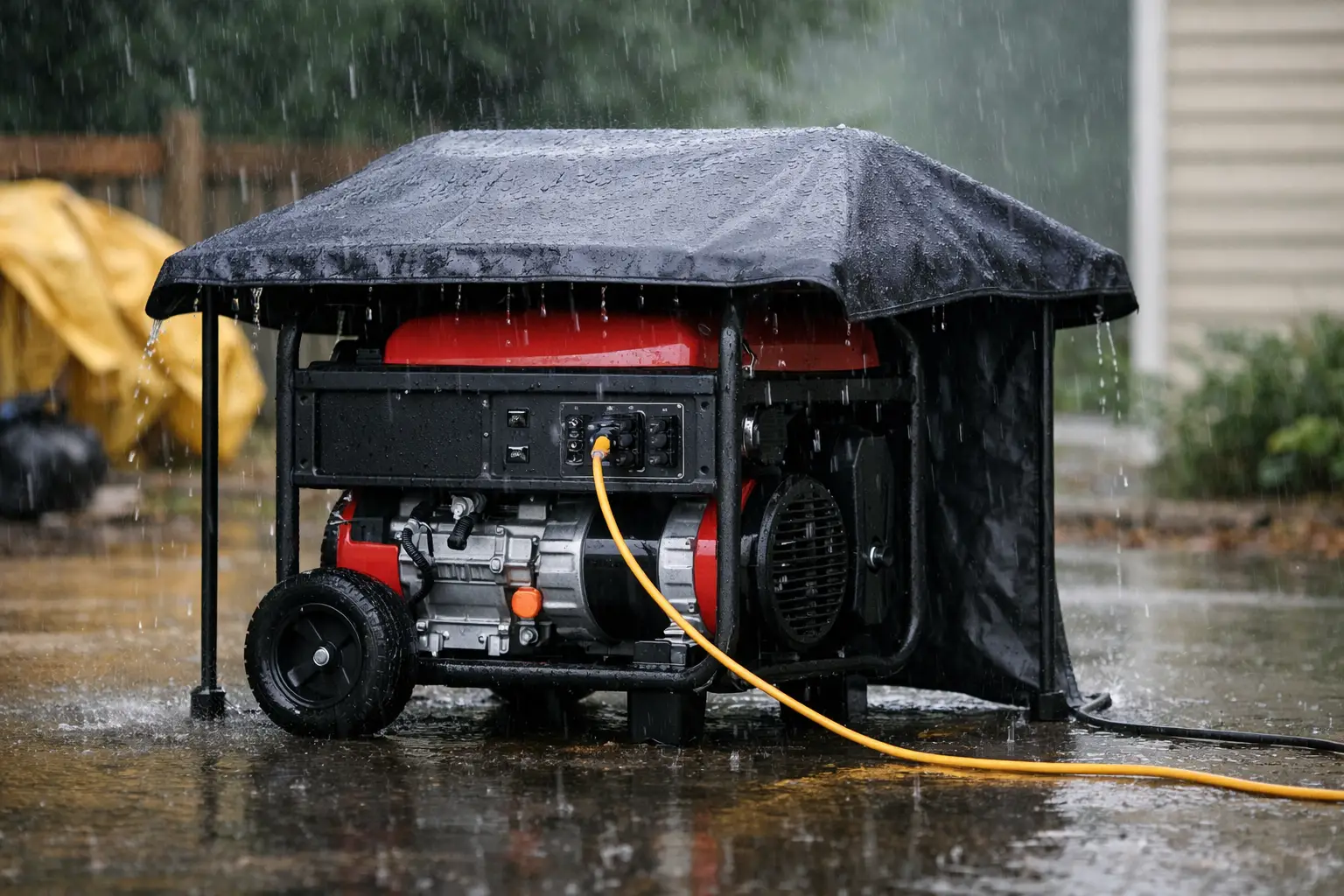
A portable generator should always be operated outdoors and away from doors, windows and other openings where exhaust could enter the building.
Carbon monoxide is odorless and can become dangerous quickly. Never operate a gasoline or propane generator inside a home, garage, basement or other enclosed area.
Before buying, also check:
- CO protection
- GFCI protection
- Overload protection
- Fuel shutoff features
- Grounding configuration
- Outlet configuration
- Transfer-switch compatibility
- Manufacturer operating instructions
Do not assume that two generators with similar wattage have identical electrical configurations.
For example, the WEN DF680iX uses a bonded-neutral 240V configuration, while the Westinghouse WGen9500DF also lists a bonded-neutral grounding system. Installation requirements can therefore depend on the exact generator and transfer equipment being used.
Which 240V Portable Generator Should You Buy?
The best choice depends on how much power you actually need.
Choose the WEN DF475T if:
You want an affordable dual-fuel generator with 120/240V capability for moderate loads and don’t need more than roughly 3,800 running watts on gasoline.
Choose the WEN DF680iX if:
You want a more compact inverter generator with 240V capability, RV connectivity, dual-fuel operation and cleaner electrical output.
Choose the WEN DF1100T if:
You need considerably more power for home backup, tools, pumps or other heavy loads and want a 50A 120/240V connection.
Choose the Westinghouse WGen9500DF if:
Your priority is high conventional-generator output for larger home backup loads, with 9,500 running watts on gasoline and 12,500 peak watts.
Choose the Westinghouse iGen11000DFc if:
You want high output but also want inverter technology, ≤3% THD, 120/240V operation and additional features such as remote start and CO protection.
Frequently Asked Questions
What is the best wattage for a 240V portable generator?
There is no single wattage that works for every home. Smaller units around 4,000 running watts can handle essential loads, while generators producing 8,000 to 9,500 running watts provide much more flexibility for larger homes. Calculate your actual running and starting loads before choosing a generator.
Can a portable generator run a 240V appliance?
Yes, if the generator provides 240V output and has enough running and starting capacity for the appliance. You also need the correct receptacle and connection method. Always check the appliance’s voltage and wattage requirements before connecting it.
Is 240V better than 120V for a portable generator?
240V is not automatically better. It is more versatile when you need to operate 240V equipment or supply both legs of a home’s electrical system through an appropriate transfer setup. If all your equipment is 120V, a 120V generator may be sufficient.
Can I connect a 240V generator directly to my house?
A portable generator should not be connected to a home’s wiring through a household outlet. A proper transfer switch or compatible interlock system is required to isolate generator power from utility power. Have the installation performed according to applicable electrical codes.
Are inverter generators better for sensitive electronics?
Inverter generators are often a good choice when clean electrical output is important. The WEN DF680iX, for example, uses inverter technology and specifies low total harmonic distortion. The Westinghouse iGen11000DFc also uses inverter technology with THD of 3% or less.
Can a 240V generator power an RV?
It depends on the RV and the generator’s outlets. Many RV systems use 120V, so a generator needs the correct RV receptacle and enough capacity for the RV’s air conditioner and other loads. The WEN DF680iX includes a TT-30R RV outlet, making its configuration particularly useful for many RV applications.
Is dual fuel worth it on a portable generator?
Dual fuel can be useful because you can operate the generator on gasoline or propane. It also gives you flexibility during extended outages when one fuel source may be easier to obtain than another. Keep in mind that propane output is usually lower than gasoline output.
Final Thoughts
The right 240-volt portable generator is not necessarily the one with the biggest peak-watt number.
For moderate loads, the WEN DF475T provides 120/240V capability without moving into the largest generator class. The WEN DF680iX adds inverter technology and an RV-friendly configuration for buyers who want cleaner power and more flexibility.
For substantially heavier loads, the WEN DF1100T and Westinghouse WGen9500DF provide much higher running capacity. The WGen9500DF reaches 9,500 running watts on gasoline and 12,500 peak watts.
If you want high output combined with inverter technology, the Westinghouse iGen11000DFc offers 9,000 running watts on gasoline, 120/240V output and THD of 3% or less.
Before buying, focus on the numbers that actually matter: running watts, starting watts, 120/240V capability, outlet type, fuel options, runtime, safety features and the loads you need to operate.
That approach will help you choose a generator that fits your actual home, RV or jobsite instead of simply buying the generator with the largest number on the box.