As an Amazon Associate I earn from qualifying purchases.
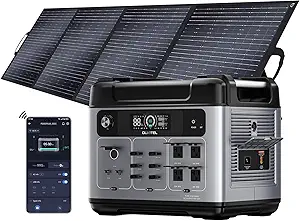
If you’re searching for a 5000 watt solar generator, there’s an important detail to understand before buying: not every power station marketed around the 5,000-watt class can actually deliver 5,000 watts continuously.
Some models reach 5,000 watts only as a short surge rating, while newer high-output power stations now offer 6,000W or more of continuous AC output. At the same time, battery capacity is measured in watt-hours (Wh), which determines how long your equipment can run.
That distinction matters if you’re planning to use a solar generator for home backup, RV power, an off-grid cabin, emergency preparedness, or demanding tools and appliances.
For 2026, the market has moved well beyond the older 2,000W portable power station category. Large systems now combine high inverter output, LiFePO4 batteries, 120V/240V operation, expandable storage, and much higher solar-input limits.
This guide explains what to look for in a 5000 watt solar generator, compares the products from the original article, and explains when a 2,400W-class station such as the OUKITEL P2001 Plus still makes sense.
What Is a 5000 Watt Solar Generator?
A 5000 watt solar generator is generally a battery-based power system capable of supplying approximately 5,000 watts of AC power or more.
The term can be confusing because manufacturers and retailers sometimes use “5000 watt” to describe a peak output rather than continuous rated power.
For example, the OUKITEL P2001 Plus is rated at 2,400W continuous output with a 4,800W surge rating. That makes it a powerful 2,400W-class power station, but it should not be described as a true 5,000W continuous generator.
By comparison, newer high-output systems such as the Anker SOLIX F3800 provide 6,000W of AC output, while the Jackery Explorer 5000 Plus is rated at 7,200W and supports 120V/240V operation.
Watts vs. Watt-Hours
This is one of the most important things to understand before buying.
Watts (W) measure how much power your equipment requires at a particular moment.
Watt-hours (Wh) measure how much energy the battery stores.
For example, a 5,000W inverter does not automatically mean the battery will run a 5,000W load for one hour.
A 5,000W load would require roughly 5,000Wh of usable energy for one hour, before accounting for inverter losses and other system inefficiencies.
That’s why a high-output solar generator should be evaluated using both its AC output rating and battery capacity.
2026 5000-Watt-Class Solar Generator Comparison
| Model | Continuous AC Output | Battery Capacity | Solar Input | Voltage | Best Use |
|---|---|---|---|---|---|
| Anker SOLIX F3800 | 6,000W | 3,840Wh | Up to 2,400W | 120V/240V | High-power home and RV backup |
| Jackery Explorer 5000 Plus | 7,200W | 5,040Wh | Up to 4,000W | 120V/240V | Extended home backup |
| OUKITEL P2001 Plus | 2,400W | 2,048Wh | Up to 500W | 120V | Portable backup and RV use |
| EcoFlow DELTA 2 | 1,800W | 1,024Wh | Up to 500W | 120V | Portable and expandable backup |
| OSCAL 2400W class | Around 2,400W depending on listing | Around 2,048Wh depending on listing | Varies | 120V | Budget-oriented portable backup |
The first two models represent the current high-output category much more accurately than the older products in the original article.
The OUKITEL and EcoFlow models are still useful products, but they should be positioned as lower-output alternatives rather than true 5,000W solar generators.
1. Anker SOLIX F3800 — A True 5000W-Class Solar Generator
The Anker SOLIX F3800 is one of the clearest examples of how the high-output portable power station market has changed.
It provides 6,000W of AC output, a 3,840Wh LiFePO4 battery, and support for 120V/240V power. Solar input can reach 2,400W, making it much more suitable for users with substantial electrical loads.
The system can also be expanded with additional batteries when more energy storage is required.
Key Specifications
- 6,000W AC output
- 3,840Wh battery capacity
- LiFePO4 battery chemistry
- Up to 2,400W solar input
- 120V/240V capability
- Up to 26.9kWh capacity with expansion batteries
- 9,000W surge output
- App monitoring and control
- RV and EV charging capabilities
Why It Matters
The biggest advantage is that the F3800 isn’t relying on a temporary boost mode to reach the 5,000W class.
Its 6,000W rated output gives it considerably more headroom for demanding appliances, tools, RV equipment, and home backup loads.
It is also much better suited to appliances that require substantial startup power.
Best For
The Anker SOLIX F3800 makes the most sense for users who want a high-output solar generator for home backup, RV use, workshops, or off-grid applications and need more than a conventional 2,000W power station can provide.
2. Jackery Explorer 5000 Plus — High-Capacity 120V/240V Backup
The Jackery Explorer 5000 Plus takes the concept even further with a 5,040Wh LiFePO4 battery and 7,200W maximum AC output.
It supports both 120V and 240V operation, which is especially important for homeowners looking to power larger appliances or selected household circuits.
Solar input can reach 4,000W when using the appropriate high-voltage solar configuration.
Key Specifications
- 5,040Wh battery capacity
- 7,200W AC output
- 14,400W surge rating
- LiFePO4 battery
- 120V/240V operation
- Up to 4,000W solar input
- Expandable battery system
- 5-year warranty
- Approximately 134.5 lb
Why It Stands Out
The Explorer 5000 Plus is substantially larger and heavier than the portable stations in the original article.
That’s intentional.
A 5,040Wh battery combined with a 7,200W inverter is designed for substantially more demanding backup applications than a lightweight camping power station.
The 120V/240V capability is particularly important when your appliances or electrical circuits require split-phase power.
Best For
This type of system is better suited to home backup, extended outages, larger RV applications, and users who need both high output and substantial battery storage.
It is not the choice for someone looking for a lightweight weekend camping battery.
3. OUKITEL P2001 Plus — Powerful 2400W Alternative
The OUKITEL P2001 Plus remains relevant, but it needs to be described accurately.
Its rated output is 2,400W, while its surge output is 4,800W. The battery capacity is 2,048Wh, and the unit uses LiFePO4 battery chemistry.
It also accepts up to 500W of solar input and supports AC plus solar charging.
Key Specifications
- 2,400W continuous AC output
- 4,800W surge output
- 2,048Wh capacity
- LiFePO4 battery
- Up to 500W solar input
- Pure sine wave inverter
- 4 AC outlets
- 100W USB-C output
- App control
- EPS function
- Approximately 48.5 lb
Charging Performance
According to OUKITEL’s current specifications, the P2001 Plus can charge from 0% to 80% in approximately one hour using its maximum AC charging rate.
With maximum solar input, the manufacturer lists approximately 2.75 hours for a 0–80% solar charge.
Combining AC and solar charging can reduce the 0–80% charging time further.
Is It Really a 5000W Solar Generator?
No.
This is an important correction from the original article.
The P2001 Plus is a 2,400W power station with a 4,800W surge rating. It is therefore better described as a high-capacity 2,400W solar generator or a 5,000W-class surge power station.
That distinction helps buyers avoid purchasing a unit that cannot continuously support a 5,000W electrical load.
Who Should Buy It?
The P2001 Plus is a strong option if your actual load is below 2,400W and you want a substantially more affordable and portable system than a 6,000W or 7,200W home-backup unit.
It can be particularly useful for refrigerators, electronics, lights, smaller tools, camping equipment, and selected household appliances.
4. EcoFlow DELTA 2 — Compact and Expandable
The EcoFlow DELTA 2 is another product that should not be marketed as a 5,000W generator.
Its rated AC output is 1,800W, with a 2,700W surge rating. It has a 1,024Wh LiFePO4 battery and accepts up to 500W of solar input.
The advantage is portability and EcoFlow’s expandable ecosystem rather than extreme inverter output.
Key Specifications
- 1,024Wh battery
- 1,800W continuous AC output
- 2,700W surge
- Up to 500W solar input
- LiFePO4 battery
- 100W USB-C ports
- Wi-Fi and Bluetooth
- Expandable battery capability
- Approximately 27 lb
Why Consider It?
At around 27 pounds, the DELTA 2 is dramatically easier to move than the large 5,000W-class systems.
It’s therefore better for camping, emergency electronics, refrigerators, communication equipment, laptops, small appliances, and portable backup.
Its 1,800W output also makes it easier to operate from typical household electrical circuits.
Best For
Choose this type of power station when portability, smart monitoring, and expandable storage matter more than maximum inverter output.
5. OSCAL 2400W Solar Generator
The OSCAL product included in the original article requires more caution.
The original article presented estimated specifications, including an estimated 5,000W surge rating. That is not a strong enough basis for a product comparison.
For an Amazon listing that can change between configurations, the safest approach is to verify the exact model number, battery capacity, inverter rating, solar-input specification, included panels, and warranty before purchasing.
If the listing is still the 2,400W-class configuration, it belongs in the same general category as the OUKITEL P2001 Plus rather than the true 5,000W-plus category.
What to Verify Before Buying
Check the Amazon listing for:
- Continuous AC output
- Surge output
- Battery capacity in Wh
- LiFePO4 chemistry
- Maximum solar input
- Included solar panels
- AC charging speed
- Number and type of AC outlets
- Warranty
- Current seller
- Exact model number
This is especially important because solar-generator bundles can change while retaining similar product names.
What Can a 5000W Solar Generator Run?
A true 5,000W-class power station can handle a much broader combination of appliances than a 1,000W or 2,000W portable battery.
Potential loads include:
- Refrigerators
- Freezers
- Microwaves
- Coffee makers
- Power tools
- Shop equipment
- Sump pumps
- Well pumps, depending on startup requirements
- Air conditioners, depending on the model
- RV appliances
- Computers and networking equipment
- Lighting
- Televisions
- Chargers
- Selected heating appliances
However, you should never determine compatibility using wattage alone.
Motors and compressors can require substantially more power during startup.
A refrigerator that uses 200W while running might temporarily require considerably more power when the compressor starts.
The same applies to pumps, air conditioners, power tools, and other motor-driven equipment.
How Long Will a 5000W Solar Generator Run?
Runtime depends primarily on battery capacity and actual load.
A simplified calculation is:
Runtime ≈ Battery Capacity (Wh) × 0.85 ÷ Load (W)
The 0.85 figure is only a general estimate for system losses. Real-world results vary.
For example, a 5,000Wh battery powering a continuous 1,000W load might provide roughly:
5,000 × 0.85 ÷ 1,000 = 4.25 hours
At a 500W load:
5,000 × 0.85 ÷ 500 = 8.5 hours
At 5,000W:
5,000 × 0.85 ÷ 5,000 = 0.85 hours
That’s why a high-wattage inverter does not automatically mean long runtime.
For extended off-grid living, battery capacity can be just as important as inverter output.
5000W Solar Generator vs. Gas Generator
A solar generator and a conventional fuel generator serve different purposes.
A solar generator operates from stored battery energy and can be recharged using solar panels or the electrical grid.
Advantages include:
- No gasoline storage
- No exhaust emissions during operation
- Quiet operation
- Indoor-friendly battery-based operation when used according to the manufacturer’s instructions
- Solar recharge capability
- Low routine maintenance
Traditional gas generators have a major advantage when you need continuous power for long periods and can keep adding fuel.
For extended outages, a battery system with sufficient solar input and expandable storage can provide a different approach to energy independence.
How Much Solar Input Do You Need?
Solar input is another specification that is frequently misunderstood.
A power station rated for 2,400W of solar input does not automatically produce 2,400W throughout the day.
Actual solar production depends on:
- Panel wattage
- Sun angle
- Weather
- Temperature
- Shading
- Panel orientation
- Wiring
- Solar controller limits
A large battery with a very small solar array can take many hours to recharge.
Conversely, a high solar-input system can replenish a large battery much faster under good conditions.
For serious off-grid use, look at the relationship between battery capacity, inverter output, and maximum solar input, rather than focusing on only one number.
120V vs. 240V: Why It Matters
This is one of the biggest differences between the older products in the original article and modern high-output systems.
Many normal household devices operate at 120V.
Some larger appliances, however, use 240V.
Examples can include certain:
- Electric dryers
- Water heaters
- Well pumps
- Central air-conditioning equipment
- Workshop machinery
A power station with 120V/240V capability can therefore serve applications that a conventional 120V portable power station cannot.
Before purchasing, identify the voltage and starting requirements of the equipment you actually want to run.
Can You Use a Solar Generator for Whole-Home Backup?
A high-output portable power station can provide substantial emergency power, but connecting it directly to household wiring requires the proper equipment and installation.
Do not backfeed a home’s electrical system through a standard wall outlet.
For circuits connected to a home’s electrical panel, use a properly installed transfer switch, inlet, or other manufacturer-approved solution installed according to local electrical requirements.
For basic emergency use, many homeowners simply connect individual appliances directly to the power station.
That can be much simpler when whole-home integration isn’t necessary.
What to Look for in a 5000 Watt Solar Generator
Before buying, compare these specifications.
1. Continuous Output
This is one of the most important numbers.
Don’t confuse peak or surge output with the continuous rating.
2. Battery Capacity
Look for Wh rather than only watts.
A higher Wh rating generally provides more stored energy.
3. Battery Chemistry
LiFePO4 batteries have become standard among many modern high-capacity power stations because of their cycle life and durability.
4. Solar Input
Higher solar-input capability can significantly reduce recharge time when adequate panels are available.
5. 120V/240V Capability
If you need to power larger appliances or certain home circuits, this can be critical.
6. Expandable Battery Storage
Expansion can be more practical than purchasing an entirely new system when your energy requirements increase.
7. Surge Capacity
Check the surge rating if you’re running motors, compressors, pumps, or other equipment with high startup demand.
8. Weight and Mobility
A genuine 5,000W-plus power station can be very heavy.
Wheels and telescoping handles can make a major difference.
9. UPS/EPS Function
If you need backup for computers, networking equipment, refrigerators, or other sensitive loads, check the manufacturer’s transfer-time specification.
Which Type of Solar Generator Should You Buy?
The right choice depends on your actual electrical load.
For 5,000W-plus continuous power
Look at current high-output systems such as the Anker SOLIX F3800 or Jackery Explorer 5000 Plus.
These are designed for a completely different level of power than compact 2,000W-class stations.
For a powerful but more portable system
The OUKITEL P2001 Plus makes more sense if your actual load remains below 2,400W.
Its 2,048Wh battery and 500W solar input provide a useful balance between capacity and portability.
For lightweight backup
The EcoFlow DELTA 2 is better suited to users who prioritize portability and expandable storage rather than extreme output.
For budget-oriented shopping
An OSCAL 2400W-class listing may be worth considering if the current Amazon configuration offers the capacity and output you need, but verify the exact specifications before ordering.
Frequently Asked Questions
Is a 5000W solar generator enough to power a house?
It can power many household essentials, but it may not power an entire home simultaneously. The actual limit depends on the inverter’s continuous output, battery capacity, appliance startup loads, and whether the system supports 120V/240V operation.
What is the difference between a 5000W and 5000Wh solar generator?
5,000W describes power output, while 5,000Wh describes stored energy. A 5,000W inverter can theoretically handle a 5,000W load, while a 5,000Wh battery describes how much energy the battery stores.
Can a 2400W power station be called a 5000W solar generator?
Not as a continuous-output rating. A 2,400W unit may have a surge rating approaching 5,000W, but that does not mean it can continuously supply 5,000W.
Is LiFePO4 better for a solar generator?
LiFePO4 is widely used in modern solar generators because it offers long cycle life and good durability. It has become a common choice for larger portable power stations.
Can solar generators run refrigerators?
Yes. Many can run refrigerators, but compressor startup requirements must be considered. Check both the refrigerator’s running wattage and its startup demand.
Can a 5000W solar generator run an air conditioner?
Potentially, but the answer depends on the air conditioner’s running and startup requirements. A 120V/240V system with adequate surge capacity may be better suited to larger air-conditioning equipment.
How many solar panels do I need for a 5000W solar generator?
There is no single answer. The number depends on the power rating of each panel and the maximum solar-input specification of the power station. Always stay within the manufacturer’s voltage, current, and wattage limits.
Final Verdict
The biggest mistake when shopping for a 5000 watt solar generator is focusing only on the number printed in the product title.
For 2026, buyers should look at the entire system: continuous AC output, surge capacity, battery storage, solar input, battery chemistry, voltage, expansion capability, and intended load.
For genuinely high-power backup, modern systems such as the Anker SOLIX F3800 and Jackery Explorer 5000 Plus are much closer to what most buyers mean when they search for a 5,000W solar generator.
The OUKITEL P2001 Plus remains a useful alternative when 2,400W of continuous output is enough and portability matters more than maximum power.
The EcoFlow DELTA 2 is an even more compact option for lighter loads.
The important thing is to match the power station to the equipment you actually need to run. A correctly sized 2,400W system can be a better purchase than an unnecessarily large 6,000W or 7,200W unit, while demanding home-backup loads may justify moving into the true 5,000W-plus category.
Before purchasing, check the current Amazon listing for the exact configuration, included solar panels, price, seller, warranty, and specifications because bundled solar-generator packages can change over time.