As an Amazon Associate I earn from qualifying purchases.
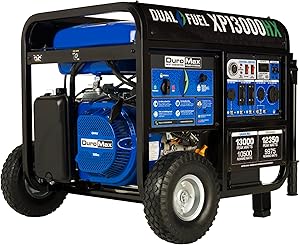
When a major power outage hits, a 13,000-watt generator can provide enough portable power to keep many of the most important systems in a home operating. Depending on the model and fuel being used, generators in this class can handle refrigerators, freezers, sump pumps, well pumps, lighting, HVAC equipment, kitchen appliances, and other high-demand loads.
But there is an important distinction that many generator buying guides overlook: 13,000 peak watts is not the same as 13,000 running watts.
Most generators in this category produce somewhere around 10,000 to 10,500 running watts and reach approximately 13,000 to 13,500 starting or peak watts on gasoline. That extra starting capacity is useful for appliances with electric motors, but it does not mean you can operate every large appliance in your home at the same time.
For 2026, the market includes several strong dual-fuel and tri-fuel options from DuroMax, DuroStar, and Westinghouse. Newer models from brands such as Champion and other manufacturers also compete in or near this power range, so it is worth looking beyond the headline wattage.
Below are five models that are especially relevant if you are shopping for a 13,000-watt-class generator for home backup, emergency power, an RV, or heavy-duty portable power.
13,000-Watt Generator Comparison
| Model | Gasoline Output | Propane Output | Natural Gas | Fuel Type | Remote Start | Approx. Weight |
|---|---|---|---|---|---|---|
| DuroMax XP13000HX | 13,000 peak / 10,500 running | 12,500 peak / 10,000 running | No | Dual Fuel | No | 240 lb dry |
| DuroMax XP13000EH | 13,000 peak / 10,500 running | 12,350 peak / 9,975 running | No | Dual Fuel | Yes | 234 lb dry |
| DuroStar DS13000MX | 13,000 peak / 10,500 running | 12,500 peak / 10,000 running | No | Dual Fuel | Yes | 209 lb |
| Westinghouse 13500W Tri-Fuel | 13,500 peak / 10,500 running | 12,500 peak / 9,500 running | 10,000 peak / 8,500 running | Tri-Fuel | Yes | 230 lb |
| Westinghouse 13500W Dual Fuel | 13,500 peak / 10,500 running | 12,500 peak / 9,500 running | No | Dual Fuel | Yes | 230 lb |
Specifications can vary by fuel and production revision. Always verify the current manufacturer specifications and owner’s manual before purchase or installation.
What Does a 13,000-Watt Generator Actually Power?
The biggest mistake when shopping for a generator is assuming that the advertised peak wattage represents the amount of power the generator can continuously supply.
For example, the DuroMax XP13000HX is rated at 13,000 peak watts and 10,500 running watts on gasoline. On propane, its output drops to 12,500 peak watts and 10,000 running watts.
That difference matters when several appliances are operating simultaneously.
A generator in this class can potentially support combinations such as:
- Refrigerator and freezer
- Sump pump
- Well pump
- Furnace blower
- Central air conditioning
- Microwave
- Lighting
- Television and networking equipment
- Garage door opener
- Selected kitchen appliances
- Power tools
- Some electric water heating loads
However, you should calculate the running watts and starting watts of the appliances you intend to operate.
Large motors and compressors can briefly require substantially more power when they start. Central air conditioners, well pumps, sump pumps, refrigerators, and compressors are common examples.
A 13,000-watt peak generator is therefore better thought of as a high-capacity portable home-backup generator, rather than a guarantee that every electrical load in a house can run simultaneously.
1. DuroMax XP13000HX Dual Fuel
Check Amazon Price Click Here!
The DuroMax XP13000HX is one of the most capable dual-fuel options in this group and is designed specifically around high-demand home backup.
Its 500cc engine produces 13,000 peak watts and 10,500 running watts on gasoline. When operating on propane, output is rated at 12,500 peak watts and 10,000 running watts.
One important correction from older versions of this article is the starting system. The current DuroMax specification lists push-button electric start and recoil start, but no remote start.
DuroMax XP13000HX Specifications
- Gasoline: 13,000 peak / 10,500 running watts
- Propane: 12,500 peak / 10,000 running watts
- Fuel: Gasoline and propane
- Engine: 500cc 4-stroke OHV
- Starting: Push-button electric and recoil
- Remote start: No
- Gasoline runtime: Up to 8.5 hours at 50% load
- Fuel tank: 8.3 gallons
- Voltage: 120/240V
- THD: Less than 5%
- Weight: 240 lb dry
- Noise: Approximately 74 dB
- Warranty: 5 years
The current model also includes CO Sensor Shutdown, GFCI outlets, automatic voltage regulation, a digital voltmeter and hour meter, copper windings, and a 50-amp receptacle.
Why Consider the XP13000HX?
The combination of high output, dual-fuel capability, copper windings, and CO shutdown makes it particularly interesting for homeowners who expect to use a generator during extended outages.
The generator is also specified at less than 5% THD, which is a useful consideration when comparing conventional open-frame generators.
Best For
- High-demand home backup
- Homeowners who want dual-fuel capability
- Users who value CO shutdown
- Buyers who want a longer warranty
- Heavy-duty portable power
2. DuroMax XP13000EH Dual Fuel
Check Amazon Price Click Here!
The DuroMax XP13000EH remains a strong option if you want the same basic 13,000-watt class of output with dual-fuel operation.
The current DuroMax specifications list 10,500 running watts and 13,000 peak watts on gasoline, with 9,975 running watts and 12,350 peak watts on propane.
Another important correction is the starting system. Contrary to the older description, the current specification lists remote start, along with electric and recoil starting.
DuroMax XP13000EH Specifications
- Gasoline: 13,000 peak / 10,500 running watts
- Propane: 12,350 peak / 9,975 running watts
- Fuel: Gasoline and propane
- Engine: 500cc 4-stroke OHV
- Starting: Electric, recoil and remote
- Gasoline runtime: Approximately 8 hours at 50% load
- Propane runtime: Approximately 6 hours at 50% load
- Fuel tank: 8.3 gallons
- Voltage: 120/240V
- Weight: 234 lb dry
- Noise: Approximately 74 dB
- Warranty: 3 years
It includes GFCI outlets, a 50-amp receptacle, automatic low-oil shutdown, a digital display, copper windings, RV-ready capability and home-backup capability.
Why Consider the XP13000EH?
The XP13000EH makes sense for buyers who want a large conventional generator without moving into a much larger 14,000- or 15,000-watt class.
The remote start is particularly useful during storms because you can start the generator without standing directly beside the machine.
Best For
- Whole-home essential-load backup
- Buyers who want remote start
- Gasoline and propane flexibility
- RV and heavy-duty portable applications
- Homeowners who need 120/240V output
3. DuroStar DS13000MX Dual Fuel
Check Amazon Price Click Here!
The DuroStar DS13000MX is closely related to the DuroMax models but is positioned as a more affordable option within the same 13,000-watt class.
The current model produces 13,000 peak watts and 10,500 running watts on gasoline. On propane, the current specification lists 12,500 peak watts and 10,000 running watts.
The current version also includes CO Alert and remote control capability, which is another important correction from the older article.
DuroStar DS13000MX Specifications
- Gasoline: 13,000 peak / 10,500 running watts
- Propane: 12,500 peak / 10,000 running watts
- Fuel: Gasoline and propane
- Engine: 500cc 4-stroke OHV
- Starting: Electric, recoil and remote control
- Gasoline runtime: Up to 8.5 hours at 50% load
- Propane runtime: Up to 6.5 hours at 50% load
- Fuel tank: 8.3 gallons
- Voltage: 120/240V
- Weight: Approximately 209 lb
- CO protection: CO Alert automatic shutdown
- Warranty: 3 years
DuroStar also lists a 50-amp transfer-switch-ready connection and home-backup capability.
Why Consider the DS13000MX?
Its biggest advantage is the combination of substantial output and a relatively low weight for this power category.
At roughly 209 pounds, it is considerably easier to move than some of the larger generators in this class.
The inclusion of remote control and CO Alert also makes the current DS13000MX substantially more attractive than the version described in many older buying guides.
Best For
- Budget-conscious homeowners
- High-output emergency backup
- Buyers who want remote start
- Dual-fuel operation
- Users who want a lighter option in this power class
4. Westinghouse 13500 Peak Watt Tri-Fuel Generator
Check Amazon Price Click Here!
The Westinghouse WGen10500TFc is marketed as a 13,500-peak-watt generator, making it slightly larger than the traditional 13,000-peak-watt models.
The important detail is that its running output is 10,500 watts on gasoline, not 12,000 watts as stated in the older version of this article. Its output is:
- Gasoline: 13,500 peak / 10,500 running watts
- Propane: 12,500 peak / 9,500 running watts
- Natural gas: 10,000 peak / 8,500 running watts
Westinghouse WGen10500TFc Specifications
- Fuel: Gasoline, propane and natural gas
- Gasoline: 13,500 peak / 10,500 running watts
- Propane: 12,500 peak / 9,500 running watts
- Natural gas: 10,000 peak / 8,500 running watts
- Engine: 500cc 4-stroke OHV
- Starting: Electric, remote and recoil
- Gasoline runtime: Up to 19 hours at 25% load
- Gasoline runtime: About 9.5 hours at 50% load
- Fuel tank: 9.5 gallons
- Weight: 230 lb dry
- Noise: Approximately 74 dBA
- CO sensor: Yes
- Warranty: 3-year residential limited warranty
The WGen10500TFc includes two GFCI 120V duplex outlets, an L14-30R transfer-switch-ready outlet, a 14-50R receptacle, USB ports, a digital display and remote start.
Why Tri-Fuel Matters
The biggest reason to choose this model over a dual-fuel generator is natural gas.
During a long power outage, gasoline availability can become a problem. Propane can be stored for emergencies, but natural gas can provide another fuel source when a suitable household connection is available.
Natural gas also changes the logistics of a multi-day outage because you do not have to repeatedly refill a gasoline tank.
Natural gas does, however, produce less power on this generator than gasoline.
One Important Consideration: THD
Westinghouse specifies total harmonic distortion of up to ≤23% for this model.
For ordinary emergency loads, that does not automatically make the generator unsuitable. However, if your home has equipment that is particularly sensitive to generator power, such as certain medical equipment, UPS systems or other sensitive electronics, check the equipment manufacturer’s requirements before choosing a conventional open-frame generator.
Best For
- Long-duration outages
- Homes with access to natural gas
- Buyers who want three fuel options
- Homeowners who want remote start
- Users who value long gasoline runtime
5. Westinghouse 13500 Peak Watt Dual Fuel Generator
Check Amazon Price Click Here!
The Westinghouse WGen10500DFc provides the same general 13,500-peak-watt class as the tri-fuel model but uses gasoline and propane instead of natural gas.
It produces:
- Gasoline: 13,500 peak / 10,500 running watts
- Propane: 12,500 peak / 9,500 running watts
Westinghouse WGen10500DFc Specifications
- Fuel: Gasoline and propane
- Gasoline: 13,500 peak / 10,500 running watts
- Propane: 12,500 peak / 9,500 running watts
- Engine: 500cc 4-stroke OHV
- Starting: Electric, remote and recoil
- Gasoline runtime: Up to 19 hours at 25% load
- Gasoline runtime: About 9.5 hours at 50% load
- Propane runtime: About 7 hours at 50% load
- Fuel tank: 9.5 gallons
- Weight: Approximately 230 lb
- Noise: Approximately 74 dBA
- CO sensor: Yes
- Warranty: 3 years residential
The generator includes GFCI household outlets, a 30A transfer-switch-ready outlet, a 50A receptacle, remote start, digital monitoring and automatic low-oil shutdown.
Why Choose the Dual-Fuel Westinghouse?
If your home does not have a practical natural gas connection, the tri-fuel model may not offer enough additional value to justify choosing it.
The dual-fuel version gives you two readily available fuel options while retaining the high-output platform, remote start and long gasoline runtime.
Best For
- Home backup without natural gas
- Long outages
- Users who prefer gasoline and propane
- Buyers wanting remote start
- Larger homes with multiple essential circuits
13,000-Watt Generator Feature Comparison
| Feature | DuroMax XP13000HX | DuroMax XP13000EH | DuroStar DS13000MX | Westinghouse WGen10500TFc | Westinghouse WGen10500DFc |
|---|---|---|---|---|---|
| Peak gasoline output | 13,000W | 13,000W | 13,000W | 13,500W | 13,500W |
| Running gasoline output | 10,500W | 10,500W | 10,500W | 10,500W | 10,500W |
| Propane | Yes | Yes | Yes | Yes | Yes |
| Natural gas | No | No | No | Yes | No |
| Remote start | No | Yes | Yes | Yes | Yes |
| CO shutdown/sensor | Yes | Yes | Yes | Yes | Yes |
| 120/240V | Yes | Yes | Yes | Yes | Yes |
| 50A connection | Yes | Yes | Yes | Yes | Yes |
| GFCI | Yes | Yes | Yes | Yes | Yes |
| Inverter generator | No | No | No | No | No |
How to Choose the Right 13,000-Watt Generator
The right model depends less on the number printed on the box and more on how you intend to use it.
1. Calculate Your Running Wattage
Start by listing the appliances you want to operate during an outage.
For example:
| Appliance | Typical Running Load |
|---|---|
| Refrigerator | 100–800W |
| Freezer | 100–700W |
| Sump pump | 800–1,500W |
| Well pump | 700–1,500W+ |
| Furnace blower | 400–800W |
| Microwave | 1,000–1,500W |
| Central AC | Highly variable |
| Electric range | 1,500–3,500W+ |
| Electric water heater | 3,000–5,000W+ |
These are only planning ranges. The actual electrical requirements should be taken from the nameplate or manufacturer’s documentation for your equipment.
The important point is that running watts and starting watts are different.
A refrigerator may use relatively little electricity once operating but require a substantially larger surge when its compressor starts.
2. Gasoline vs. Propane vs. Natural Gas
Gasoline
Gasoline generally provides the highest output on these generators and is easy to use when fuel is readily available.
The downside is storage. Gasoline degrades over time and should be stored and managed correctly.
Propane
Propane is convenient for emergency preparedness because properly stored propane has a long storage life.
It also provides a second fuel source if gasoline becomes unavailable.
The tradeoff is that generators generally produce less power on propane than gasoline.
Natural Gas
Natural gas is especially useful during extended outages because the fuel is supplied through the utility rather than stored in a portable tank.
The downside is that natural gas usually provides less power than gasoline, and the generator must be properly connected to the home’s gas supply.
Never improvise a natural-gas connection. Follow the generator manufacturer’s requirements and applicable local codes.
3. Do You Need Remote Start?
Remote start is a convenience feature that becomes more valuable during severe weather.
With remote start, you can start a compatible generator without standing beside the machine.
Among the models covered here, the current configurations include:
- XP13000HX: No remote start
- XP13000EH: Remote start
- DS13000MX: Remote control
- Westinghouse WGen10500TFc: Remote start
- Westinghouse WGen10500DFc: Remote start
Always check the exact model number before ordering because manufacturers can update configurations over time.
4. Do You Need a Transfer Switch or Interlock?
If your goal is to use a portable generator to power circuits through your home’s electrical panel, you need a proper connection method.
A generator should not be connected to a household outlet with a homemade or improvised cable. That can create dangerous backfeeding conditions.
A properly installed transfer switch isolates the utility supply from generator power.
An approved interlock kit can provide another method of managing the connection, depending on your electrical panel and local requirements.
The manufacturer specifically describes the XP13000HX as home-backup ready and recommends a transfer switch or interlock for whole-home backup.
For permanent electrical connections, use a qualified electrician and follow local electrical codes.
5. Think About Starting Loads
A generator with 10,500 running watts can still trip its overload protection if several large motors start simultaneously.
This is especially important if your home has:
- Central air conditioning
- Well pump
- Sump pump
- Electric water heater
- Electric dryer
- Electric range
- Large compressors
A load-management strategy can make a major difference.
For example, you may run the central AC while temporarily avoiding the electric dryer and water heater.
This is often more practical than trying to size a portable generator large enough to operate every major electrical load simultaneously.
6. Consider Noise
Large open-frame generators are not quiet appliances.
The DuroMax and Westinghouse models discussed here are around the mid-70 dB range according to their published specifications.
That is considerably louder than a small inverter generator.
If the generator will be used during overnight outages, placement matters. Keep it as far from occupied areas as practical while still following the manufacturer’s installation and safety requirements.
Never sacrifice safe placement to reduce noise.
Generator Safety: The 20-Foot Rule Matters
Carbon monoxide is one of the biggest hazards associated with portable generators.
The CDC recommends operating portable generators outdoors at least 20 feet away from doors, windows and vents.
The CPSC likewise recommends keeping portable generators at least 20 feet from homes and buildings, with exhaust directed away from the structure.
Never operate a gasoline or propane generator:
- Inside a house
- Inside a garage
- Inside a basement
- Inside a shed
- In another enclosed structure
- Near doors, windows or ventilation openings
A CO shutdown system is an important safety feature, but it is not a substitute for correct generator placement.
The CDC also recommends having a battery-powered or battery-backup carbon monoxide detector in the home.
Never refuel a hot or running generator. Shut it down and allow it to cool before adding fuel.
Are 13,000-Watt Generators Good for Whole-Home Backup?
They can be, but the phrase whole-home backup needs some clarification.
A portable generator in this class can be connected to a home’s electrical system through an appropriate transfer switch or interlock and can supply multiple circuits.
However, that does not mean every electrical appliance can run at the same time.
A home with:
- Central AC
- Electric water heater
- Electric dryer
- Electric range
- Well pump
- Multiple refrigerators
- Freezer
- Pool equipment
may exceed the generator’s continuous output if several large loads operate simultaneously.
For that type of home, load management is essential.
If you want automatic operation and enough capacity to run virtually everything without manually managing loads, a permanently installed standby generator may be a better solution.
A portable generator is usually more attractive when you want high emergency capacity without the installation cost of a permanently installed standby system.
Which 13,000-Watt Generator Makes the Most Sense?
DuroMax XP13000HX
The XP13000HX stands out for its 5-year warranty, copper windings, CO shutdown and sub-5% THD specification. It is a strong choice if you want a rugged dual-fuel generator and do not need remote starting.
DuroMax XP13000EH
The XP13000EH is worth considering if remote start is important. It provides the same general 13,000-watt gasoline peak class and dual-fuel capability while adding remote-start functionality.
DuroStar DS13000MX
The DS13000MX is especially interesting if you want high output, dual-fuel operation, CO Alert and remote control while keeping the generator’s weight relatively low for this category.
Westinghouse WGen10500TFc
The WGen10500TFc is the better fit when natural gas is important. It offers gasoline, propane and natural gas in one generator, plus remote start and a long gasoline runtime.
Westinghouse WGen10500DFc
The WGen10500DFc makes more sense if you want the Westinghouse platform but do not need natural gas. It combines gasoline and propane with remote start, CO sensing and a 9.5-gallon fuel tank.
Final Verdict: 13,000-Watt Generators for 2026
A 13,000-watt generator is a serious step up from the smaller portable generators commonly used for basic emergency loads.
For many homes, this power class can support refrigerators, freezers, pumps, lighting, HVAC equipment and other essential circuits during an outage. The key is understanding that the generator’s running wattage is what determines how much continuous electrical load it can support.
For a dual-fuel setup, the DuroMax XP13000HX, DuroMax XP13000EH, and DuroStar DS13000MX provide different combinations of safety features, starting options, warranty coverage and portability.
If natural gas is important for long outages, the Westinghouse WGen10500TFc adds a third fuel source and can provide substantial flexibility when gasoline or propane supplies become inconvenient.
The Westinghouse WGen10500DFc is the simpler choice if gasoline and propane are enough for your emergency plan.
Before buying, calculate your home’s actual electrical loads, pay attention to motor-starting requirements, verify the generator’s output on your preferred fuel, and plan the transfer-switch or interlock installation in advance.
Most importantly, treat generator safety as part of the purchase decision. A high-output portable generator is only useful if it is installed, positioned and operated correctly. Keep it outdoors, maintain at least 20 feet of separation from the home, direct exhaust away from openings, and follow the owner’s manual every time you use it.
For 2026, the biggest improvement over older 13,000-watt buying guides is not simply having more generator choices. It is understanding the difference between peak watts and running watts, choosing the right fuel configuration, and matching the generator to the actual electrical demands of your home.