As an Amazon Associate I earn from qualifying purchases.
When the power goes out, having a generator that can run on more than one fuel can make a big difference. The best dual-fuel portable generators give you the option to use gasoline or propane, making it easier to adapt when fuel availability, storage, or runtime becomes a concern.
But not every dual-fuel generator is designed for the same job. A large conventional generator may be the better choice for home backup and high-wattage loads, while a compact inverter generator can be a better fit for an RV, camping, or sensitive electronics.
For this 2026 guide, I compared five dual-fuel models across power output, fuel flexibility, runtime, noise, portability, outlets, safety features, and overall use case.
Best Dual-Fuel Portable Generators for 2026
| Generator | Best For | Gas Running / Peak | Propane Running / Peak | Type |
|---|---|---|---|---|
| Westinghouse WGen9500DFc | Best Overall / Home Backup | 9,500 / 12,500 W | 8,500 / 11,200 W | Conventional |
| WEN DF680iX | Best Dual-Fuel Inverter | 5,100 / 6,800 W | 4,500 / 6,000 W | Inverter |
| DuroMax XP13000HX | Best High-Output | 10,500 / 13,000 W | 10,000 / 12,500 W | Conventional |
| WEN DF1100X | Best Value High-Output | 8,300 / 11,000 W | 7,500 / 9,500 W | Conventional |
| Westinghouse iGen4000DFc | Best Compact & Quiet | 3,300 / 4,000 W | 2,970 / 3,600 W | Inverter |
1. Westinghouse WGen9500DFc — Best Overall Dual-Fuel Generator
Check Amazon Price Click Here!
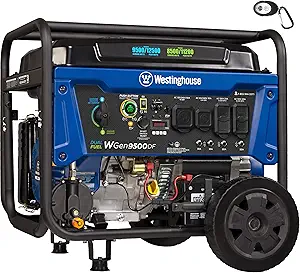
If your priority is dependable home backup with plenty of power, the Westinghouse WGen9500DFc is one of the strongest options in this group.
It produces up to 9,500 running watts and 12,500 peak watts on gasoline, while propane provides 8,500 running watts and 11,200 peak watts. The generator uses a 6.6-gallon gasoline tank and can run for up to 12 hours at 25% load on gasoline. Westinghouse also rates propane runtime at up to 7 hours with a 20-pound tank.
The WGen9500DFc is designed around home backup rather than quiet camping. It has 120/240V output, a 50A receptacle, an L14-30R transfer-switch-ready outlet, GFCI protection, electric start, remote start, and a recoil backup.
Westinghouse WGen9500DFc Specifications
| Feature | Specification |
|---|---|
| Gasoline Running Watts | 9,500 W |
| Gasoline Peak Watts | 12,500 W |
| Propane Running Watts | 8,500 W |
| Propane Peak Watts | 11,200 W |
| Fuel Tank | 6.6 gallons |
| Gas Runtime @ 25% Load | Up to 12 hours |
| Propane Runtime | Up to 7 hours with 20-lb tank |
| Engine | 457cc 4-stroke OHV |
| Starting | Electric, remote, recoil |
| Voltage | 120/240V |
| Noise | 74 dBA |
| Weight | 212.1 lb |
| CO Protection | Automatic CO shutdown |
| Transfer Switch Ready | Yes |
| RV Ready | Yes |
| Warranty | 3-year limited residential |
Why I Like It
The biggest advantage is the combination of high output and fuel flexibility. If gasoline becomes difficult to obtain during a prolonged outage, propane gives you another way to keep essential circuits running.
The remote start is also useful when the generator is sitting outside in poor weather. However, this is a large, heavy machine at more than 200 pounds, so portability is relative. The wheels and handles help, but this is not the generator you want to carry across a campsite.
One important consideration is power quality. The WGen9500DFc is a conventional generator, not an inverter model, and Westinghouse specifies total harmonic distortion of up to 23%. If clean power for sensitive electronics is a priority, one of the inverter models below makes more sense.
Best for: home backup, refrigerators, sump pumps, well pumps, larger appliances, tools, and other high-demand loads.
2. WEN DF680iX — Best Dual-Fuel Inverter Generator
Check Amazon Price Click Here!
The WEN DF680iX is the most interesting choice here if you want dual-fuel capability without giving up the advantages of inverter technology.
It produces 6,800 peak watts and 5,100 rated watts on gasoline, or 6,000 peak watts and 4,500 rated watts on propane. Its 224cc engine is paired with a 2.9-gallon fuel tank, and WEN rates gasoline runtime at up to 6.1 hours at half load and propane runtime at up to 9 hours at half load with a 20-pound LPG tank.
WEN DF680iX Specifications
| Feature | Specification |
|---|---|
| Gasoline Running Watts | 5,100 W |
| Gasoline Peak Watts | 6,800 W |
| Propane Running Watts | 4,500 W |
| Propane Peak Watts | 6,000 W |
| Fuel Tank | 2.9 gallons |
| Gas Runtime @ 50% Load | Up to 6.1 hours |
| Propane Runtime @ 50% Load | Up to 9 hours with 20-lb tank |
| Engine | 224cc 4-stroke OHV |
| Starting | Electric + recoil |
| Voltage | 120/240V configuration |
| Noise | Approximately 64 dBA |
| Weight | 94.8 lb |
| CO Protection | WEN Watchdog automatic shutdown |
| RV Outlet | TT-30R |
| Transfer-Switch Ready | Yes |
| Parallel Capable | Yes |
| Warranty | 3-year limited |
Why It Stands Out
The biggest reason to choose this model is cleaner inverter power. WEN states that the DF680iX limits total harmonic distortion to under 0.3% at no load and under 1.2% at full load. That makes it a much better candidate than a conventional generator when you’re concerned about powering electronics such as laptops, monitors, tablets, and other sensitive equipment.
It is also RV-ready with a TT-30R outlet and includes a 120/240V L14-30R receptacle.
Another unusual feature is its bonded-neutral 240V configuration, which WEN says can support low-power Level 2 charging for compatible battery and hybrid electric vehicles.
Best for: RVs, home-office backup, electronics, moderate home backup, and buyers who want cleaner inverter power.
3. DuroMax XP13000HX — Best High-Output Dual-Fuel Generator
Check Amazon Price Click Here!
If maximum portable output is your priority, the DuroMax XP13000HX moves into another class.
The current manufacturer specifications list 13,000 peak watts and 10,500 running watts on gasoline, while propane produces 12,500 peak watts and 10,000 running watts. It uses a 500cc engine and an 8.3-gallon gasoline tank.
DuroMax XP13000HX Specifications
| Feature | Specification |
|---|---|
| Gasoline Running Watts | 10,500 W |
| Gasoline Peak Watts | 13,000 W |
| Propane Running Watts | 10,000 W |
| Propane Peak Watts | 12,500 W |
| Fuel Tank | 8.3 gallons |
| Gas Runtime @ 25% Load | Up to 17 hours |
| Gas Runtime @ 50% Load | Up to 8.5 hours |
| Propane Runtime @ 25% Load | Up to 13 hours |
| Propane Runtime @ 50% Load | Up to 6.5 hours |
| Engine | 500cc 4-stroke OHV |
| Starting | Electric + recoil |
| Voltage | 120/240V |
| Noise | 74 dBA |
| Weight | 246 lb |
| CO Protection | Automatic CO shutdown |
| RV Ready | Yes |
| Home Backup Ready | Yes |
| THD | <5% |
| Warranty | 5-year |
The XP13000HX includes four 120V 5-20R outlets, an L5-30R, an L14-30R, and a 14-50R outlet. It is also equipped with GFCI protection, a digital voltmeter, an hour meter, automatic low-oil shutdown, and a CO sensor shutdown system.
What to Know Before Buying
The output is impressive, but so is the size. At 246 pounds, this is firmly in the heavy-duty category.
It also isn’t an inverter generator. Its specified THD is below 5%, which is considerably different from the WEN DF680iX’s inverter output.
For homeowners who need substantial 120/240V capacity, a large RV, a job site, or demanding backup loads, that tradeoff may be worthwhile.
Best for: high-demand home backup, large appliances, job sites, RVs requiring substantial power, and buyers who prioritize output over compactness.
4. WEN DF1100X — Best Value High-Output Option
Check Amazon Price Click Here!
The WEN DF1100X offers a useful middle ground between the 6,800-watt inverter above and the larger 13,000-watt DuroMax.
It produces 11,000 surge watts and 8,300 running watts on gasoline, or 9,500 surge watts and 7,500 running watts on propane. WEN pairs the generator with a 457cc four-stroke OHV engine and a 6.6-gallon gasoline tank.
WEN DF1100X Specifications
| Feature | Specification |
|---|---|
| Gasoline Running Watts | 8,300 W |
| Gasoline Peak Watts | 11,000 W |
| Propane Running Watts | 7,500 W |
| Propane Peak Watts | 9,500 W |
| Fuel Tank | 6.6 gallons |
| Gas Runtime @ 50% Load | Up to 8.5 hours |
| Engine | 457cc 4-stroke OHV |
| Starting | Electric + recoil |
| Voltage | 120/240V |
| Weight | 213.8 lb |
| CO Protection | WEN Watchdog |
| Transfer Switch Ready | Yes |
| RV Ready | Not the primary design focus |
| Warranty | 2-year |
The control panel includes four 120V GFCI 5-20R receptacles, a 120V L5-30R twist-lock receptacle, a 120V/240V 14-50R outlet, and a 12V DC outlet.
Why Consider It?
The DF1100X makes sense for shoppers who want serious home-backup capability without moving all the way up to the DuroMax’s 13,000-watt class.
Its 14-50R outlet and transfer-switch-ready design are particularly useful when you’re planning a properly installed home backup connection.
The main downside is weight. At more than 200 pounds, this is another generator that should be treated as a stationary or semi-portable backup machine rather than something you’ll frequently carry around.
Best for: home backup, power outages, tools, refrigerators, sump pumps, and buyers looking for strong output at a lower power class than the DuroMax.
5. Westinghouse iGen4000DFc — Best Compact and Quiet Dual-Fuel Generator
Check Amazon Price Click Here!
If your idea of a portable generator involves an RV, campsite, tailgate, or occasional emergency use, the Westinghouse iGen4000DFc is much easier to live with than the 200-plus-pound models above.
This inverter generator produces 4,000 peak watts and 3,300 running watts on gasoline, with 3,600 peak watts and 2,970 running watts on propane. It weighs just 62.8 pounds and has a 1.69-gallon gasoline tank.
Westinghouse iGen4000DFc Specifications
| Feature | Specification |
|---|---|
| Gasoline Running Watts | 3,300 W |
| Gasoline Peak Watts | 4,000 W |
| Propane Running Watts | 2,970 W |
| Propane Peak Watts | 3,600 W |
| Fuel Tank | 1.69 gallons |
| Gas Runtime @ 25% Load | Up to 7 hours |
| Propane Runtime @ 25% Load | Up to 17 hours |
| Engine | 141cc 4-stroke OHV |
| Starting | Electric, remote, recoil |
| Voltage | 120V |
| Noise | 52 dBA |
| Weight | 62.8 lb |
| CO Protection | Automatic CO shutdown |
| RV Outlet | TT-30R |
| Parallel Capable | Yes |
| Transfer Switch Ready | No |
| THD | ≤3% |
| Warranty | 3-year limited |
The iGen4000DFc includes an RV-ready TT-30R outlet, two USB ports, a digital data center, economy mode, overload protection, automatic low-oil shutdown, and CO shutdown.
Why It Makes Sense for Smaller Loads
At 52 dBA, this is dramatically quieter than the 74 dBA open-frame generators in this lineup.
It is also small enough to move without a two-person lift. That makes it a much better fit for recreational use and smaller backup loads.
However, it is not a replacement for a 10,000- or 13,000-watt generator. If you’re trying to operate a central air-conditioning system, electric range, well pump, or multiple large appliances at once, you’ll likely need considerably more capacity.
Best for: RVs, camping, tailgating, electronics, small emergency loads, and buyers who prioritize low noise and portability.
Dual-Fuel Generator Comparison for 2026
| Model | Best For | Gas Running | Propane Running | Inverter | Noise | Weight |
|---|---|---|---|---|---|---|
| Westinghouse WGen9500DFc | Home backup | 9,500 W | 8,500 W | No | 74 dBA | 212.1 lb |
| WEN DF680iX | Clean/quiet power | 5,100 W | 4,500 W | Yes | ~64 dBA | 94.8 lb |
| DuroMax XP13000HX | Maximum output | 10,500 W | 10,000 W | No | 74 dBA | 246 lb |
| WEN DF1100X | Value home backup | 8,300 W | 7,500 W | No | — | 213.8 lb |
| Westinghouse iGen4000DFc | RV & portability | 3,300 W | 2,970 W | Yes | 52 dBA | 62.8 lb |
How to Choose the Best Dual-Fuel Portable Generator
1. Calculate Your Running and Starting Watts
Don’t choose a generator based only on the biggest wattage number in the product title.
Running watts tell you how much continuous power the generator can supply. Starting or surge watts provide additional short-term capacity for appliances with electric motors.
Refrigerators, sump pumps, well pumps, air conditioners, compressors, and some power tools can require significantly more power when starting.
Make a list of the appliances you actually want to operate at the same time and add their running wattage. Then account for the largest starting surge.
2. Decide Whether You Need an Inverter
An inverter generator is generally the better choice when portability, quieter operation, fuel efficiency, and cleaner electrical output are important.
The WEN DF680iX and Westinghouse iGen4000DFc are the inverter choices in this comparison.
Traditional open-frame generators are usually more attractive when maximum wattage and home-backup capability matter more than noise and weight.
3. Compare Gasoline and Propane Output Separately
Don’t assume a generator produces the same power on both fuels.
Dual-fuel models typically produce less power on propane than gasoline. For example, the WGen9500DFc produces 9,500 running watts on gasoline versus 8,500 on propane, while the DuroMax XP13000HX produces 10,500 versus 10,000 running watts.
Check both numbers before deciding whether a model can handle your intended loads.
4. Consider Runtime at the Same Load
Runtime figures are only useful when you know the test conditions.
A generator running at 25% load will generally operate much longer than the same generator running at 50% or 75% load.
That’s why you shouldn’t compare “12 hours” from one generator directly with “8 hours” from another without checking the load percentage and fuel being used.
5. Think About Noise
Noise becomes especially important for camping, RV use, neighborhoods, and nighttime operation.
The difference between 52 dBA and 74 dBA is substantial in practical use. That’s one reason the Westinghouse iGen4000DFc is a better recreational choice, while the larger Westinghouse and DuroMax models make more sense when power output comes first.
6. Check the Outlets You Actually Need
For home backup, look for 120/240V capability and an appropriate transfer-switch-ready connection.
For RV use, a TT-30R outlet may be much more important than having a large 50A receptacle.
For high-power loads, check whether the generator includes an L14-30R or 14-50R connection.
Don’t buy based solely on the number of outlets. Make sure the specific receptacle matches your equipment and intended installation.
Can a Dual-Fuel Generator Power a House?
Yes, but the correct setup depends on the generator’s output, the home’s electrical system, and which circuits you want to operate.
A generator such as the Westinghouse WGen9500DFc or DuroMax XP13000HX can provide substantial 120/240V power for home backup, but that does not automatically mean it can power every appliance in the house simultaneously.
For a permanent connection to household wiring, use a properly rated transfer switch installed by a qualified electrician. Never attempt to backfeed a house through a standard wall outlet.
A transfer-switch-ready generator makes this type of installation easier, but the electrical installation still needs to comply with applicable local requirements.
Dual-Fuel Generator Safety: What You Need to Know
Dual-fuel technology does not eliminate the hazards associated with combustion engines.
Every gasoline- or propane-powered portable generator produces carbon monoxide. The CDC recommends operating a portable generator outdoors at least 20 feet away from doors, windows, and vents, and never inside a house, basement, garage, or other enclosed space.
The exhaust should also be directed away from the building.
A built-in CO sensor or automatic shutdown is a valuable safety feature, but it is not permission to operate the generator indoors. The WGen9500DFc, WEN DF680iX, WEN DF1100X, and DuroMax XP13000HX all include CO-related protection features, but they still need to be operated outdoors according to the manufacturer’s instructions.
Keep gasoline stored in an appropriate approved container and allow a hot generator to cool before refueling. NFPA also recommends keeping portable generators away from doors, windows, and vents and using a properly installed transfer switch when connecting to household wiring.
Gasoline vs. Propane for a Portable Generator
Gasoline
Gasoline generally gives a dual-fuel generator its higher rated output and is widely available.
The downside is storage. Gasoline requires proper storage and maintenance, particularly if you expect to keep it available for emergency use.
Propane
Propane is attractive for emergency preparedness because it can be stored in suitable containers for long periods without the same fuel-stability concerns associated with gasoline.
It also gives you another fuel source if gasoline is unavailable during a prolonged outage.
The tradeoff is that most dual-fuel generators produce somewhat less power when operating on propane.
For emergency preparedness, having both fuels available can be more useful than relying on only one.
Which Dual-Fuel Generator Should You Buy?
Best Overall: Westinghouse WGen9500DFc
Choose the Westinghouse WGen9500DFc if your priority is high-capacity home backup with remote start, 120/240V output, transfer-switch readiness, and dual-fuel flexibility.
Best Inverter: WEN DF680iX
Choose the WEN DF680iX if you want the advantages of inverter technology, cleaner power, RV capability, and a more manageable size.
Best High-Output: DuroMax XP13000HX
Choose the DuroMax XP13000HX if you need as much portable output as possible and don’t mind a generator weighing around 246 pounds.
Best Value High-Output: WEN DF1100X
Choose the WEN DF1100X if you want substantial 120/240V backup capacity without stepping all the way up to the DuroMax.
Best Compact and Quiet: Westinghouse iGen4000DFc
Choose the Westinghouse iGen4000DFc if portability, low noise, RV use, and smaller emergency loads matter more than maximum wattage.
Frequently Asked Questions
Are dual-fuel generators worth it?
Yes. A dual-fuel generator gives you the flexibility to operate on gasoline or propane. That can be particularly useful during extended power outages when one fuel may be easier to obtain than the other. The main tradeoff is that propane usually produces somewhat less power than gasoline.
Is a dual-fuel inverter generator better?
It depends on how you plan to use it. An inverter generator is usually preferable for quieter operation, portability, fuel efficiency, and cleaner electrical output. A conventional generator can be the better choice when you need substantially more wattage for home backup.
Can a dual-fuel generator run a refrigerator and other appliances?
Yes, provided its running and starting wattage capacity is sufficient. You should calculate the combined running load and account for the starting surge of motor-driven appliances before deciding which generator size you need.
Is propane better than gasoline for generator storage?
Propane can be more convenient for long-term emergency preparedness because it does not have the same gasoline-storage concerns. However, gasoline can provide higher output on many dual-fuel generators. Keeping both fuels available provides the greatest flexibility.
Are dual-fuel generators safe for electronics?
Not automatically. Conventional generators can have considerably higher THD than inverter generators. If sensitive electronics are important, an inverter model such as the WEN DF680iX may be a better choice because WEN specifies less than 1.2% THD at full load.
Can I connect a portable generator directly to my home’s electrical panel?
A portable generator should not be connected to household wiring through an improvised backfeed connection. If you want to power selected household circuits, have a properly rated transfer switch installed by a qualified electrician and follow local electrical requirements. NFPA specifically recommends a qualified electrician for this type of connection.
How far away should a portable generator be from my house?
The CDC recommends operating portable generators outdoors at least 20 feet from doors, windows, and vents. Never operate one inside a house, garage, basement, or other enclosed area.
Final Verdict: Best Dual-Fuel Portable Generators for 2026
The best dual-fuel portable generator depends on what you actually need to power.
For most homeowners who want substantial emergency backup capacity, the Westinghouse WGen9500DFc is the strongest all-around choice in this lineup.
For cleaner inverter power and RV-friendly portability, the WEN DF680iX is a better fit.
For maximum output, the DuroMax XP13000HX stands out with 10,500 running watts on gasoline and 13,000 peak watts.
The WEN DF1100X is a practical middle-ground option for buyers who want serious 120/240V backup capability, while the Westinghouse iGen4000DFc is the clear choice when quiet operation and portability matter more than raw power.
Before buying, focus on five things: running watts, starting watts, fuel runtime, outlet configuration, and how you plan to connect and use the generator.
Most importantly, treat carbon monoxide safety as non-negotiable. A portable generator belongs outdoors, at least 20 feet from doors, windows, and vents, with the exhaust directed away from the building.