As an Amazon Associate I earn from qualifying purchases.
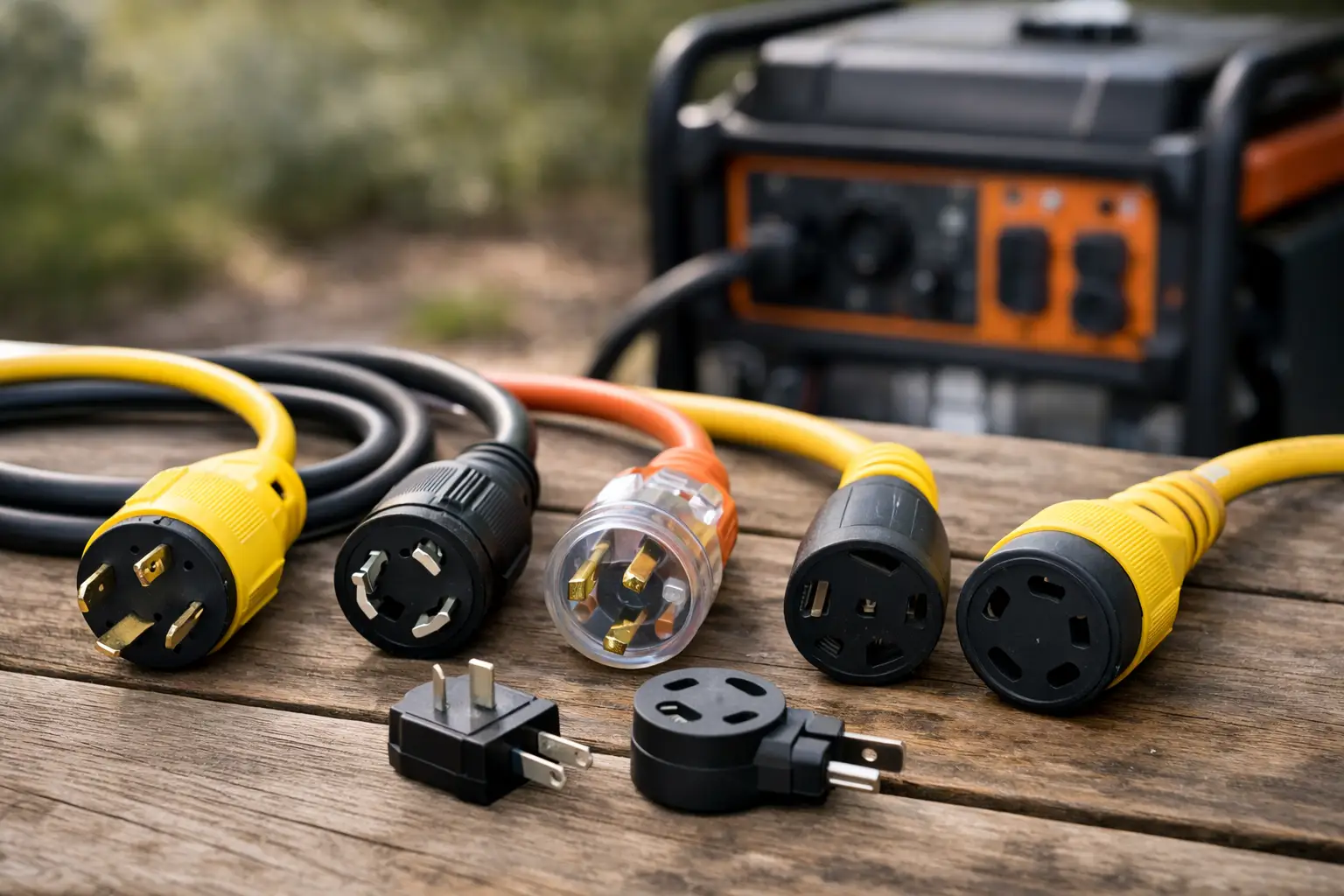
A reliable 50 amp generator cord can make a big difference when you’re moving high-power electricity from a portable generator to an RV, power inlet, transfer equipment, or another properly rated connection point.
Unlike lighter 15A or 30A extension cords, a 50A generator cord is designed for substantially higher electrical loads. The most common heavy-duty configurations in this category use 6/3 + 8/1 AWG copper conductors, a NEMA 14-50P male plug, and a locking SS2-50R female connector.
The right cord, however, isn’t simply the longest or highest-rated option you can find. You need to match the amperage, voltage, connector type, wire gauge, cord length, generator outlet, and intended application.
For 2026, these are several 50 amp generator cord options worth considering, including shorter cords for close installations, longer cables for keeping a generator farther from occupied areas, and an inlet-box kit for compatible home backup setups.
Important: A 50 amp cord does not automatically make a generator capable of producing 50 amps or 12,500 watts. Your generator, receptacle, wiring, inlet, and other equipment must all be properly rated for the intended load.
Quick Comparison: 50 Amp Generator Cords
| Product | Length | Connector | Conductor | Best For |
|---|---|---|---|---|
| PlugSaf 50 Amp Generator Cord | 25 ft | 14-50P to SS2-50R | 6/3 + 8/1 | General-purpose 50A connections |
| PlugSaf 50 Amp Generator Cord | 10 ft | 14-50P to SS2-50R | 6/3 + 8/1 | Short-distance setups |
| CircleCord 50 Amp Generator Cord | 50 ft | 14-50P to SS2-50R | 6/3 + 8/1 | Longer generator-to-inlet runs |
| CircleCord 50 Amp Generator Cord | 75 ft | 14-50P to SS2-50R | 6/3 + 8/1 | Maximum reach |
| CircleCord 50 Amp Generator Cord | 15 ft | 14-50P to SS2-50R | 6/3 + 8/1 | Compact installations |
| VEVOR 50 Amp Cord + Inlet Box Kit | 25 ft | 14-50P to SS2-50R | 6/3 + 8/1 | Compatible home inlet installations |
| Mophorn 50 Amp Generator Cord | 75 ft | 14-50P to SS2-50R | 6/3 + 8/1 | Long outdoor runs |
The 6/3 + 8/1 configuration is common in this category. Current products from VEVOR, CircleCord and other manufacturers continue to use this conductor configuration for 50A generator/RV applications.
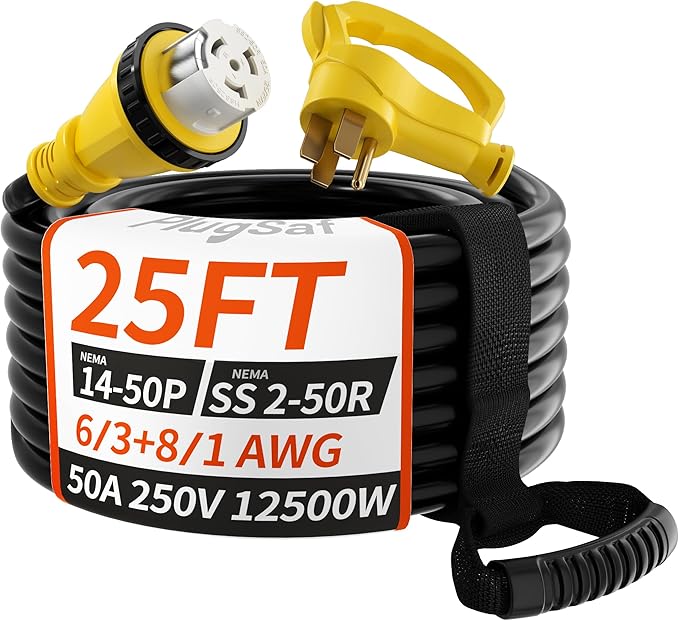
PlugSaf 50 Amp Generator Cord – 25 ft
Check Amazon Price Click Here!
Specifications
- Length: 25 ft
- Connector: NEMA 14-50P male to SS2-50R twist-lock female
- Wire: 6/3 + 8/1 AWG STW
- Rated current: 50A
- Maximum power at 250V: 12,500W
- Construction: Heavy-duty copper conductors
- Features: Ergonomic grip and cord storage strap
- Application: Generator, RV and compatible power-inlet connections
Why Consider It?
The 25-foot length is a practical middle ground for many generator setups. It provides considerably more flexibility than a 10-foot cable without becoming as cumbersome as a 50- or 75-foot cord.
The NEMA 14-50P to SS2-50R configuration is particularly important here. The male 14-50 plug connects to a compatible 50A generator receptacle, while the SS2-50R twist-lock end is intended for a compatible inlet or connection point.
The locking connection can be useful outdoors because it helps prevent the cord from being accidentally pulled loose.
For many homeowners and RV users, 25 feet is enough to position a portable generator at a safer distance from occupied areas while keeping the cable manageable.
PlugSaf 50 Amp Generator Cord – 10 ft
Check Amazon Price Click Here!
Specifications
- Length: 10 ft
- Connector: NEMA 14-50P to SS2-50R
- Wire: 6/3 + 8/1 AWG STW
- Rating: 50A
- Maximum power at 250V: 12,500W
- Jacket: Heavy-duty, outdoor-oriented construction
- Features: Grip-style handles and compact length
Why Consider It?
If your generator and connection point are relatively close together, a 10-foot cord can be easier to handle and store than a much longer cable.
Shorter does not automatically mean better, but using only the length you actually need can help keep the setup neater and reduce unnecessary cable to coil and store.
This option makes the most sense when you already have adequate clearance between the generator and the connection point and don’t need a long run.
CircleCord 50 Amp Generator Cord – 50 ft
Check Amazon Price Click Here!
Specifications
- Length: 50 ft
- Connector: NEMA 14-50P male to SS2-50R twist-lock female
- Wire: 6/3 + 8/1 AWG STW
- Maximum power at 250V: 12,500W
- Maximum power at 125V: 6,250W
- Certification: UL listed according to the manufacturer’s product information
- Construction: Heavy-duty copper conductors
- Application: Generator, RV and compatible outdoor power connections
Why Consider It?
A 50-foot cord gives you considerably more placement flexibility than a short 10- or 15-foot cable.
That can be especially useful when a portable generator needs to be positioned away from a house, RV, windows, doors or other occupied areas.
CircleCord currently lists its 50A generator/RV cord family in multiple lengths, including 10, 15, 25, 50, 75 and 100 feet, using the 14-50P-to-SS2-50R configuration.
The tradeoff is weight and storage. A 50A cable with 6/3 + 8/1 conductors is substantially heavier and less flexible than an ordinary household extension cord.
CircleCord 50 Amp Generator Cord – 75 ft
Check Amazon Price Click Here!
Specifications
- Length: 75 ft
- Connector: NEMA 14-50P to SS2-50R twist-lock
- Wire: 6/3 + 8/1 AWG STW
- Maximum power at 250V: 12,500W
- Maximum power at 125V: 6,250W
- Certification: UL listed according to the manufacturer’s product information
- Design: Heavy-duty outdoor cord
- Features: Locking connector and ergonomic handling features
Why Consider It?
A 75-foot generator cord is primarily about placement flexibility.
For emergency backup power, a longer cord can allow you to keep a portable generator farther from the house while still reaching the appropriate connection point.
The downside is that 75 feet of heavy-gauge cable is bulky. It also shouldn’t be purchased simply because “longer is better.”
Before buying a 75-foot cord, measure the actual distance you need and consider where the cable will be routed. Avoid creating sharp bends, pinch points, vehicle traffic hazards or areas where the cord could be damaged.
CircleCord 50 Amp Generator Cord – 15 ft
Check Amazon Price Click Here!
Specifications
- Length: 15 ft
- Connector: NEMA 14-50P to SS2-50R
- Wire: 6/3 + 8/1 AWG STW
- Maximum power at 250V: 12,500W
- Maximum power at 125V: 6,250W
- Certification: UL listed according to the manufacturer’s product information
- Design: Heavy-duty generator/RV cord
Why Consider It?
The 15-foot version sits between the compact 10-foot and longer 25-foot options.
It’s a useful choice when the generator and connection point aren’t far apart but you still need more reach than a very short cord provides.
Because 50A cables are heavy, avoiding unnecessary length can also make setup, coiling and storage easier.
VEVOR 50 Amp Generator Extension Cord and Power Inlet Box Kit – 25 ft
Check Amazon Price Click Here!
Specifications
- Length: 25 ft
- Connector: NEMA 14-50P to SS2-50R
- Wire: 6/3 + 8/1 AWG STW
- Rating: 50A
- Voltage: 125/250V depending on the connected system
- Kit includes: Generator cord and power inlet box
- Certification: ETL listed according to the manufacturer’s information
- Features: Twist-lock connection, weather-oriented enclosure and storage accessories
Why Consider It?
This option is different from a standard cord because it includes a power inlet box.
The current VEVOR version uses a 25-foot 6/3 + 8/1 STW cord with a NEMA 14-50P male plug and SS2-50R twist-lock female connection. The manufacturer describes the inlet box as having an SS2-50P connection and an ETL-certified design.
This can be useful for a properly designed portable-generator-to-home connection, but the inlet box should not be confused with a complete transfer-switch installation.
A typical residential backup-power system may require an appropriately rated inlet, transfer switch or listed interlock arrangement, suitable wiring, overcurrent protection and compliance with local electrical requirements.
If you’re connecting a generator to a home’s electrical system, have the permanent wiring and connection equipment installed or verified by a qualified electrician.
Mophorn 75 ft 50 Amp Generator Extension Cord
Check Amazon Price Click Here!
Specifications
- Length: 75 ft
- Connector: NEMA 14-50P to SS2-50R twist-lock
- Conductor configuration: 6/3 + 8/1 AWG
- Voltage: 125/250V
- Current: 50A
- Maximum power at 250V: 12,500W
- Application: Generator, RV and outdoor power connections
- Features: Heavy-duty construction and storage strap
Why Consider It?
The biggest advantage here is simple: 75 feet of reach.
That can be useful when your generator needs to be positioned considerably farther from the connection point. The product design uses the same general 14-50P-to-SS2-50R configuration found on many 50A generator cords.
One point deserves attention, though: certification claims should be checked against the exact current product listing rather than assumed from an older listing or a similarly named product. Product families and sellers can change over time.
For that reason, verify the current Amazon listing, markings on the cord and manufacturer documentation before treating a particular certification claim as a purchasing requirement.
What Does a 50 Amp Generator Cord Actually Do?
A 50 amp generator cord is designed to transfer electricity from a compatible high-amperage generator receptacle to a compatible connection point.
A common configuration is:
NEMA 14-50P → SS2-50R
The NEMA 14-50P is the male plug. The SS2-50R is the locking female connector.
The twist-lock design is useful because the connection is mechanically secured rather than relying solely on friction.
Some generator cords instead use a 14-50P to 14-50R configuration. That is a different type of cord and should not be substituted for an SS2-50R cord when your generator inlet requires a locking connection.
Always match the connectors to the actual receptacles on your generator and inlet.
How Much Power Can a 50 Amp Generator Cord Handle?
This is one of the most misunderstood parts of shopping for a 50A generator cord.
If a system is operating at 250 volts and 50 amps, the theoretical maximum is:
50A × 250V = 12,500 watts
At 125 volts:
50A × 125V = 6,250 watts
That’s why you’ll commonly see 50A cords advertised as 12,500W at 250V and 6,250W at 125V.
The cord rating does not mean that your generator will automatically deliver 12,500 watts.
Your generator’s actual output rating is the limiting factor.
For example, connecting a 50A cord to a generator that produces less than 12,500 watts does not increase the generator’s capacity.
The cord is simply capable of carrying the electrical load within its rating.
Why 6/3 + 8/1 AWG Is Common on 50 Amp Generator Cords
The designation 6/3 + 8/1 AWG describes the conductor configuration.
In simple terms, it means the cable contains:
- Three 6 AWG conductors
- One 8 AWG conductor
This is a common construction for heavy-duty 50A generator and RV cords.
The larger 6 AWG conductors are designed to carry the main current, while the smaller conductor is used for the grounding function in the cord configuration.
Current products in this category continue to use 6/3 + 8/1 STW construction, including VEVOR and CircleCord models.
How Long Should a 50 Amp Generator Cord Be?
The best length is usually the shortest cord that safely reaches the connection point.
That doesn’t mean you should buy a cord so short that the generator has to sit next to a building.
Instead, measure the route from the generator to the intended connection point and leave enough slack for normal positioning without creating excessive loops.
10–15 ft
Good for:
- Close generator-to-inlet connections
- RV setups where the receptacles are nearby
- Easier storage
- Less cable to manage
25 ft
A good general-purpose length for many installations.
It provides useful flexibility without becoming excessively difficult to handle.
50 ft
Better when you need more distance between the generator and connection point.
75 ft
Best reserved for situations where the additional distance is genuinely necessary.
A 75-foot 50A cord is heavy, bulky and expensive compared with a shorter cord.
Does a Longer Generator Cord Cause Voltage Drop?
Yes, electrical resistance increases with conductor length, so longer runs can experience more voltage drop under load.
However, it’s inaccurate to say that a 50- or 75-foot cord automatically causes a significant loss of usable power.
The actual voltage drop depends on several factors, including:
- Conductor size
- Cord length
- Current flowing through the cable
- Temperature
- Connection quality
- Load characteristics
A properly sized 50A cord can be used for longer runs, but if you’re planning an unusually long high-current installation, voltage-drop calculations are worth considering.
Do not compensate for a long run by using an undersized cord.
50 Amp Generator Cord vs. 30 Amp Generator Cord
A 50A cord isn’t automatically better for every generator.
Choose a 50A cord when:
- Your generator has a compatible 50A outlet
- Your inlet or connection equipment is rated for 50A
- Your electrical system is designed for the intended load
- You need higher available capacity
A 30A cord may be more appropriate when your generator has only a 30A output or when your expected electrical load is relatively modest.
Using a much larger cord doesn’t create additional generator capacity.
The generator, receptacle, circuit and connected equipment all have to be compatible.
What Should You Look for in a Heavy-Duty 50 Amp Generator Cord?
1. Correct Connector Type
Check the generator outlet first.
If the generator has a NEMA 14-50 receptacle and your inlet requires an SS2-50R connection, a 14-50P to SS2-50R cord is the appropriate configuration.
Never assume that every 50A connector is interchangeable.
2. Proper Wire Gauge
For the products covered here, 6/3 + 8/1 AWG is a common heavy-duty configuration.
The larger conductors are one reason these cords are substantially heavier than ordinary extension cords.
3. Outdoor-Rated Construction
Generator cords are frequently used outdoors.
Look for an appropriate heavy-duty jacket and construction designed for the environment in which the cord will actually be used.
Weather resistance is useful, but it does not mean a cord should be left permanently exposed to weather without following the manufacturer’s instructions.
4. Recognized Certification
UL and ETL markings can provide useful evidence that a product has been evaluated to applicable safety standards.
However, verify the exact product and listing, not simply the brand name.
Certification claims can differ between product versions, lengths and sellers.
5. Twist-Lock Connection
A twist-lock connector can help prevent accidental separation.
That’s particularly useful when a generator is operating outdoors and the cord may be exposed to movement, wind or incidental contact.
6. Strain Relief and Grip Handles
A 50A cord is heavy.
A molded grip or ergonomic handle can make a noticeable difference when connecting or disconnecting the cable.
Good strain relief at the plug ends also helps protect the cable from repeated bending.
Can You Use a 50 Amp Generator Cord in the Rain?
Only if the specific cord and connection equipment are rated for the intended outdoor conditions, and even then, the entire setup needs to be protected appropriately.
The fact that a cord has a weather-resistant jacket does not mean the generator itself can be operated in rain without protection.
Keep generator equipment dry and follow the generator manufacturer’s outdoor operating instructions.
Also inspect the plugs and connectors before every use. If a connector is cracked, damaged, loose or showing signs of overheating, don’t continue using it.
Can You Bury a 50 Amp Generator Extension Cord?
No.
A portable generator cord should not simply be buried underground.
Portable cords are not automatically rated for direct burial, and burying one can create serious electrical and safety problems.
If you need permanent underground wiring, use a wiring method and cable specifically approved for that installation and have the work completed according to applicable electrical requirements.
A portable generator cord is intended for temporary use, not as a substitute for permanent electrical wiring.
Can a 50 Amp Generator Cord Connect Directly to a House?
A cord by itself does not make a direct house connection safe.
For a portable generator to supply a home’s electrical system, the installation generally needs appropriately rated equipment such as a power inlet, transfer switch or listed interlock arrangement, proper wiring and overcurrent protection.
The exact configuration depends on the generator and home’s electrical system.
Never backfeed a house through a dryer, range or other improvised receptacle.
For a permanent generator connection, use equipment designed for that purpose and follow local electrical requirements.
Why Generator Cord Length Matters During an Outage
During an outage, cord length isn’t only about convenience.
A portable generator produces carbon monoxide in its exhaust, so generator placement is a critical safety issue.
A longer cord can sometimes make it easier to place the generator farther from the home while still reaching the appropriate inlet.
However, do not use a longer cord as a substitute for following the generator manufacturer’s required clearance distances.
The generator’s owner manual should always take priority for placement.
Frequently Asked Questions
Do I need a 50 amp generator cord for a 12,500-watt generator?
If the generator is designed to deliver its output through a compatible 50A receptacle, a properly rated 50A cord may be appropriate. However, the correct cord depends on the generator’s actual outlet configuration and the connection equipment you are using.
Is a 50 amp generator cord the same as an RV 50 amp cord?
Not always. Many use similar 6/3 + 8/1 construction and 50A service, but the connector configuration can be different. A generator cord with a 14-50P-to-SS2-50R configuration should not be assumed to be interchangeable with every RV extension cord.
Is 25 feet better than 50 feet?
Not necessarily. A 25-foot cord is easier to handle and store, while a 50-foot cord gives you more placement flexibility. Choose the shortest length that safely reaches your connection point.
Does a 75-foot cord reduce generator power?
A longer cable can increase voltage drop under load because of increased conductor resistance. The actual effect depends on conductor size, current and other conditions. A properly sized heavy-duty cable is designed to minimize these losses within its intended application.
Can I use a 50 amp cord with a 30 amp generator?
Only if the connection is specifically designed and approved for that combination. Do not assume that a larger-rated cord can solve an incompatible generator outlet. The generator’s receptacle and manufacturer’s instructions should determine the correct connection.
What does SS2-50R mean?
SS2-50R identifies a type of 50A twist-lock female receptacle commonly used with generator and RV power connections. It is designed to mate with a compatible male connector and lock into place.
Is 12,500 watts the same as 50 amps?
No. Watts depend on both voltage and current.
At 250V:
50A × 250V = 12,500W
At 125V:
50A × 125V = 6,250W
That’s why voltage matters when comparing generator and cord specifications.
Can I connect a 50 amp generator cord to a transfer switch?
Potentially, if the transfer equipment and cord use compatible connectors and ratings. The entire system must be designed for the generator’s output and installed correctly. Follow the transfer-switch manufacturer’s instructions and applicable electrical requirements.
Which 50 Amp Generator Cord Should You Choose?
The best option depends mostly on distance and connector compatibility.
For a general-purpose 25-foot setup
The PlugSaf 25 ft is a practical option if your generator and connection point require the 14-50P-to-SS2-50R configuration.
For a short connection
The PlugSaf 10 ft or CircleCord 15 ft makes more sense when the generator and connection point are relatively close.
For a longer run
The CircleCord 50 ft provides considerably more reach while retaining the heavy-duty 6/3 + 8/1 configuration.
For maximum reach
The CircleCord 75 ft is worth considering when 50 feet isn’t enough and the additional length is genuinely necessary.
For a generator-to-home inlet setup
The VEVOR 25 ft cord and inlet-box kit is the more specialized option because it combines the cord with a compatible power inlet box. The current VEVOR product uses a 14-50P-to-SS2-50R cable and an SS2-50P inlet connection.
For a 75-foot budget-oriented setup
The Mophorn 75 ft provides the reach needed for long-distance applications, but verify the current product listing and certification information before purchasing.
Final Thoughts
A good 50 amp generator cord should be selected based on more than its advertised wattage.
Start with the connector configuration, then confirm the generator’s output, cord gauge, length, certification, outdoor suitability and intended connection point.
For many applications, 25 feet is a useful starting point because it provides a good balance between reach and manageability. A 10- or 15-foot cord can be better when the connection is close, while 50- and 75-foot cables make sense when additional generator placement distance is necessary.
Most importantly, don’t treat a heavy-duty cord as a substitute for proper electrical installation. A 50A cord can safely transfer substantial electrical power only when the generator, connectors, inlet, wiring and connected equipment are all appropriately rated.
For 2026, the strongest buying approach is simple: match the connector, choose the shortest practical length, use the correct heavy-duty conductor size, verify the certification of the exact product, and follow the generator manufacturer’s safety requirements.