As an Amazon Associate I earn from qualifying purchases.
If you rely on a portable generator for RV camping, emergency backup, or outdoor power, choosing the right 30 amp generator gear is about more than buying the biggest generator you can find.
A 30-amp RV electrical connection is rated for 120 volts and up to 30 amps, which works out to a theoretical maximum of 3,600 watts. But that does not mean every generator with a 30-amp outlet can actually produce 3,600 watts continuously.
That distinction matters.
A compact inverter generator can have a 30A RV outlet while producing considerably less than 3,600 running watts. The Westinghouse 2,550-watt models below are a good example: they provide a TT-30R RV receptacle, but their gasoline running output is 1,900 watts.
The right setup therefore depends on what you actually need to power, especially if you want to run an RV air conditioner.
Below are five useful pieces of 30 amp generator gear for 2026, followed by a practical guide to matching the generator, cord, and inlet correctly.
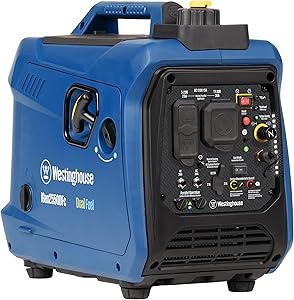
1. Westinghouse 2550 Peak Watt Inverter Generator
Check Amazon Price Click Here!
The Westinghouse iGen2550c is a compact gasoline inverter generator designed for camping, tailgating, and basic portable backup power.
It produces 2,550 peak watts and 1,900 running watts on gasoline. More importantly for RV owners, it includes a dedicated 120V TT-30R 30-amp RV outlet, along with a standard 120V duplex outlet and two USB ports. Westinghouse rates it at 52 dBA and up to 11 hours of runtime at 25% load.
Key Specifications
| Feature | Specification |
|---|---|
| Peak Output | 2,550W |
| Running Output | 1,900W |
| Engine | 80cc OHV 4-stroke |
| Fuel | Gasoline |
| Noise | As low as 52 dBA |
| Fuel Tank | 1.1 gallons |
| Runtime | Up to 11 hours at 25% load |
| RV Outlet | 120V TT-30R, 30A |
| Standard Outlet | 120V 5-20R duplex |
| USB | 2 USB ports |
| THD | ≤3% |
| Parallel Capable | Yes |
| CO Sensor | Yes |
| Low-Oil Shutdown | Yes |
| Warranty | 3-year residential limited warranty |
| Weight | About 40 lb dry |
Why It Makes Sense for Smaller RV Loads
The biggest advantage here is portability. At roughly 40 pounds dry, this is much easier to move than a large open-frame generator.
Its inverter design also produces low-THD power suitable for common electronics such as laptops, phones, televisions, and chargers.
However, there is an important limitation: the TT-30R outlet does not turn the generator into a 3,600-watt power source.
The generator’s gasoline running output is 1,900 watts, or about 15 amps at 120 volts. That means you need to manage your RV’s electrical load carefully.
It can be a good choice for smaller loads and some RV air-conditioning setups, but you should not assume that every RV air conditioner will start reliably from a 1,900-watt generator. Compressor startup demand can be substantially higher than the unit’s normal running consumption.
If running your RV air conditioner is a primary requirement, a larger generator in the roughly 3,500-4,500-watt class may provide considerably more headroom.
2. Westinghouse 2550 Peak Watt Dual Fuel Inverter Generator
Check Amazon Price Click Here!
The Westinghouse 2550-watt dual-fuel inverter generator adds propane capability to the compact generator format.
Like the gasoline version, it offers 2,550 peak watts and 1,900 running watts when operating on gasoline, along with a 120V TT-30R RV outlet. Current specifications also list lower output when operating on propane, so buyers should not assume that gasoline and propane provide identical performance.
Key Benefits of Dual Fuel
Gasoline gives you maximum flexibility for portable power, while propane offers a convenient alternative fuel that can be attractive for emergency preparedness and longer-term storage.
Propane is also useful when gasoline is unavailable or when you prefer to keep less gasoline stored for emergency use.
The important thing is to consider dual fuel as a fuel-choice advantage, not as an automatic increase in generator capacity.
Who Should Consider It?
This model makes sense for RV owners who:
- Want a lightweight inverter generator.
- Like having gasoline and propane as fuel options.
- Need clean inverter power for electronics.
- Want a built-in TT-30R RV connection.
- Prefer a compact generator that one person can move.
Again, the 1,900-watt gasoline running output means this is not equivalent to a full 3,600-watt 30-amp RV power source.
If your RV has a large air conditioner, microwave, electric water heater, refrigerator, and other appliances running simultaneously, you will need to manage those loads or consider a higher-output generator.
3. Champion 30-Amp RV Generator Power Cord
Check Amazon Price Click Here!
A quality 30 amp RV generator cord is one of the most important accessories to have when connecting a compatible generator directly to a 30-amp RV.
The key is to match the connectors.
A typical 30-amp RV connection uses a TT-30 configuration, while many portable generators and home generator inlet systems use other connector types such as L5-30 or L14-30.
Champion currently sells dedicated 30-amp RV generator power cords, including its 30-amp RV cord in the company’s extension-cord lineup.
What to Check Before Buying
Look at both ends of your existing RV power connection and the generator receptacle before ordering.
You want to verify:
- The RV is a 30-amp model.
- The generator has the correct 30A receptacle.
- The cord connectors match both ends.
- The cord is rated for outdoor use.
- The cord has an adequate conductor size for its length and load.
Do not assume that every product advertised as a 30 amp generator cord will connect directly to your RV.
A 30A L14-30 cord and a 30A TT-30 RV cord are not interchangeable just because both are rated at 30 amps.
4. RVINGPRO 30-Amp Generator Cord and Inlet Box Kit
Check Amazon Price Click Here!
The RVINGPRO 30 amp generator cord and inlet box kit is a different type of accessory from a basic RV shore-power cord.
The product associated with this link is a 25-foot, 10/4 generator cord with NEMA L14-30P to L14-30R connections and a pre-drilled outdoor generator inlet box. The kit is ETL listed and designed around generator-to-inlet connections.
What Is It Used For?
This type of kit is more appropriate for a home generator inlet installation than for simply plugging a generator into an RV.
A typical arrangement looks like this:
Portable generator → L14-30 generator cord → outdoor inlet box → properly installed wiring → transfer switch/interlock → selected home circuits
The inlet box provides a weather-resistant connection point outside the home.
It should not be treated as a plug-and-play replacement for a transfer switch or interlock.
Important Installation Note
Connecting a portable generator to a home’s electrical system requires the correct equipment and installation method.
Never backfeed a home through a standard wall outlet.
A transfer switch or properly installed interlock system is used to prevent dangerous backfeeding into utility lines. If you are installing an inlet box, have the electrical work completed according to applicable local electrical requirements by a qualified electrician.
This makes the RVINGPRO kit particularly useful for homeowners who want a cleaner generator connection point for emergency backup power.
5. PlugSaf 50-Foot 30-Amp Generator Extension Cord
Check Amazon Price Click Here!
The PlugSaf 50-foot 30-amp generator cord is designed around a completely different connection style from the standard TT-30 RV cord.
It uses NEMA L14-30P to L14-30R, four conductors, 10-gauge construction, and a 30-amp rating. The product is listed for 125/250V applications and up to 7,500 watts depending on the configuration and voltage.
Why Choose a 50-Foot Cord?
The main advantage is reach.
A portable generator needs to be positioned in a safe outdoor location away from doors, windows, vents, and occupied spaces because of carbon monoxide emissions. A longer cord can make it easier to place the generator farther away from the home while still reaching a properly installed inlet.
However, longer is not automatically better.
A 50-foot cord is heavier and bulkier than a short cord, and you should always use a cord with the correct rating for the generator and connected equipment.
This PlugSaf model is best viewed as a generator-to-inlet/transfer-switch cord, not as a universal 30A RV cord.
30 Amp Generator Gear: Understanding the Connections
One of the easiest ways to buy the wrong accessory is to focus only on the words “30 amp.”
There are several different 30-amp configurations.
TT-30
TT-30 is the familiar three-prong 120V connection used by many 30-amp RVs.
A compatible generator may have a dedicated TT-30R RV outlet.
This is what makes a generator “RV ready” in the conventional sense.
L14-30
L14-30 is a four-prong locking connection commonly used with portable generators, transfer switches, and home generator inlet systems.
The PlugSaf and RVINGPRO products above use this type of connection.
L5-30
L5-30 is another 30-amp locking connector commonly found on generators and generator cords.
It is different from both TT-30 and L14-30.
The important lesson is simple:
30 amps does not automatically mean the same plug.
Always match the connector configuration, voltage, conductor arrangement, and intended application.
How Many Watts Does a 30-Amp RV Need?
A 30-amp, 120V RV electrical system has a theoretical maximum of:
120V × 30A = 3,600 watts
But you should not plan to operate continuously at the absolute maximum.
Your generator also needs enough capacity for startup loads.
For example, an RV might use:
| RV Load | Approximate Consideration |
|---|---|
| LED lighting | Low |
| Television | Low |
| Phone chargers | Very low |
| Refrigerator | Moderate |
| Microwave | High |
| Coffee maker | Moderate to high |
| Electric water heater | High |
| RV air conditioner | High startup demand |
| Electric space heater | Very high |
The actual wattage varies by appliance, so check the labels and manuals for your specific RV equipment.
This is why a 2,000-watt-class generator and a 4,000-watt-class generator can behave very differently even though both may have a 30A-style connection.
Can a 30-Amp Generator Run an RV Air Conditioner?
Sometimes, but the answer depends on the generator’s actual running and starting capacity and the specific air conditioner.
A small 1,900-watt inverter generator may struggle with an RV air conditioner, especially when the compressor starts.
A larger generator with more running watts provides additional headroom.
The easiest way to improve the odds is to calculate the actual loads instead of relying on the “30A” label.
If air conditioning is your priority, look closely at:
- Generator running watts
- Generator peak/startup watts
- Air-conditioner startup demand
- Other appliances operating at the same time
- Whether your A/C has a soft-start system
- Ambient temperature and altitude
A generator with a 30A TT-30 outlet is not necessarily capable of supplying the full 30 amps continuously.
Inverter Generator vs. Conventional Generator for RV Use
For many RV owners, an inverter generator is the better fit.
Inverter generators generally offer:
- Cleaner electrical output
- Lower operating noise
- Better fuel efficiency at lighter loads
- More compact designs
- Better suitability for sensitive electronics
The Westinghouse 2550 models are good examples of compact inverter generators, with a stated ≤3% THD and noise level around 52 dBA.
A conventional open-frame generator can make sense when maximum output and lower purchase cost matter more than quiet operation and portability.
For campground use, however, noise can be an important consideration.
Gasoline vs. Dual Fuel
There is no single best fuel choice for every RV owner.
Gasoline
Choose gasoline if you want:
- Maximum availability
- Simple operation
- The highest output from many dual-fuel generators
- Familiar fueling and refueling
Propane
Propane can be attractive if you want:
- Longer-term fuel storage
- An alternative to gasoline
- A cleaner-burning fuel option
- More flexibility during emergencies
Dual Fuel
A dual-fuel generator gives you both options.
That flexibility can be especially useful during a prolonged outage or remote camping trip.
Just remember that the generator’s wattage can change depending on the fuel being used. Always check the manufacturer’s specifications rather than assuming the gasoline rating also applies to propane.
How to Choose the Right 30 Amp Generator Gear
Before buying anything, answer these five questions.
1. Are you powering an RV or a house?
For an RV, you will typically be looking for compatible TT-30 equipment.
For home backup, you may need an L14-30 cord, outdoor inlet box, transfer switch, or interlock.
2. How much power do you actually need?
Add the running watts of the appliances you expect to use and account for startup loads.
3. Do you need to run the RV air conditioner?
If yes, don’t automatically choose the smallest generator simply because it has a 30A outlet.
4. What connector does your generator use?
Check the generator control panel.
Look specifically for:
- TT-30R
- L5-30
- L14-30
- Standard 120V receptacles
5. How far away will the generator be?
Choose enough cord length to place the generator safely without unnecessary excess cable.
Safety Tips for 30 Amp Generator Use
Generator safety should come before convenience.
Always operate a gasoline or propane generator outdoors and away from doors, windows, vents, and other openings.
Carbon monoxide is colorless and odorless and can accumulate in enclosed or partially enclosed areas.
Also:
- Never run a portable generator inside an RV, garage, basement, shed, or enclosed porch.
- Keep the generator away from combustible materials.
- Keep electrical connections dry.
- Inspect cords before every use.
- Replace damaged cords rather than repairing them with improvised methods.
- Do not overload the generator.
- Keep cords away from hot exhaust.
- Do not connect a generator to a home’s wiring through a regular wall outlet.
- Use a properly installed transfer switch or interlock for home backup.
- Follow the generator manufacturer’s operating and maintenance instructions.
A longer generator cord can help with safe placement, but it does not make an unsafe generator location safe by itself.
Best 30 Amp Generator Gear for Different Needs
| Need | Best Choice From This List | Why |
|---|---|---|
| Lightweight gasoline generator | Westinghouse 2550 | Compact and portable |
| Gasoline + propane flexibility | Westinghouse 2550 Dual Fuel | Two fuel options |
| Direct 30A RV connection | Compatible Champion RV cord | Designed around RV power connections |
| Home generator inlet | RVINGPRO kit | Includes inlet box and generator cord |
| Long generator-to-inlet run | PlugSaf 50-foot cord | Extra reach with L14-30 connections |
Final Thoughts
The best 30 amp generator gear in 2026 is not necessarily the gear with the highest amp or wattage number on the package.
The first step is identifying what you are powering and which connector you actually need.
For lightweight RV camping, the Westinghouse 2550-watt inverter generators are appealing because they combine portability, quiet operation, inverter technology, and a TT-30R RV outlet. Their limitation is equally important: 1,900 running watts is well below the theoretical 3,600-watt capacity of a 30-amp RV connection.
For homeowners preparing for outages, the RVINGPRO inlet box kit and PlugSaf L14-30 cord serve a different purpose. They are better suited to a properly installed generator inlet and home backup arrangement rather than being treated as universal RV cords.
The Champion RV cord is the more appropriate direction when you need a compatible direct connection between a generator’s RV-ready outlet and a 30-amp RV.
In short, match the generator’s real output to your loads, match the cord to the connector, and choose enough cord length to operate the generator safely outdoors.
That approach will give you a much more reliable portable power setup than simply buying the first product labeled “30 amp.”