As an Amazon Associate I earn from qualifying purchases.
A generator can have plenty of available wattage and still fail to power what you need if the cord is wrong. Understanding
generator power cord types helps you match the generator outlet, the appliance or inlet connection, and the expected electrical load without creating a heat, overload, or compatibility problem.
For most buyers, the decision comes down to three questions: What outlet does the generator provide? How many amps and volts does the equipment require? How far must power travel? Answer those first, then choose a cord with the right plug configuration, wire gauge, and weather rating.
Generator Power Cord Types by Connection
Generator cords are often described by their plug ends, but the connection style matters just as much as the cord itself. A standard household extension cord is appropriate for some jobs. A generator inlet cord or a heavy-duty locking cord is needed for others.
Standard 120V extension cords
A 120-volt extension cord is the familiar option with a standard household-style plug and receptacle. It connects directly to a generator’s 5-15R or 5-20R outlet and is useful for individual loads such as lights, a refrigerator, a sump pump, battery chargers, fans, or small power tools.
These cords are simple, affordable, and widely useful during an outage or at a campsite. Their limitation is capacity. A standard 15-amp cord is not the right choice for a large RV air conditioner, a high-output welder, or a whole-home transfer switch connection. Never assume a household-looking cord can safely carry every 120V load.
Locking generator cords
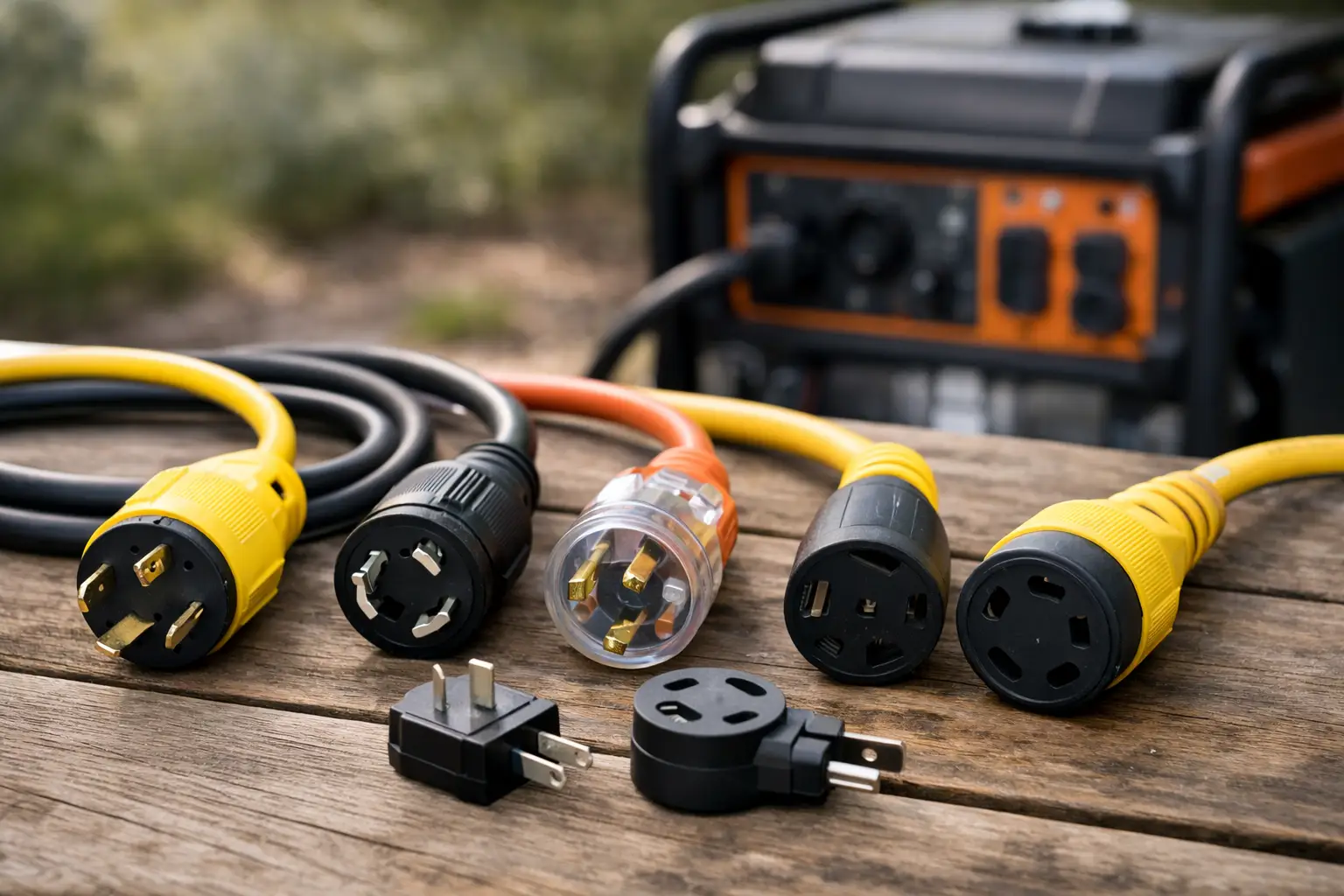
Locking cords use twist-lock connectors that turn and secure into place. Common generator configurations include L5-30 for 120V, L14-30 for 120/240V, and
L14-50 for larger 120/240V connections. The number generally indicates the amperage rating: 30 for 30 amps and 50 for 50 amps.
The locking design is especially useful outdoors, on jobsites, and anywhere vibration or foot traffic could loosen a plug. A 30-amp L5-30 cord may be a strong fit for a larger 120V RV or a distribution box, while an L14-30 cord is a frequent choice for portable-generator home backup setups. The plugs are not interchangeable just because they look similar. The voltage, neutral, ground, and blade arrangement must match.
Generator inlet cords for home backup
An inlet cord connects a portable generator to a power inlet box installed outside the house. From there, power is routed through approved equipment such as a manual transfer switch or an interlock kit. This is the correct approach when you want selected household circuits – such as a refrigerator, furnace blower, well pump, lights, or internet equipment – powered during an outage.
These cords usually have a male locking connector on one end for the inlet box and a female locking connector on the generator end. A 30-amp, 120/240V L14-30 generator inlet cord is common because many portable generators provide that outlet. Larger systems may use a 50-amp inlet and cord.
Do not use a double-male “suicide cord” to backfeed a panel through a dryer outlet or wall receptacle. It can energize utility lines, endanger lineworkers, damage equipment, and create a serious fire risk. Proper transfer equipment is not an optional accessory.
RV generator cords and adapters
RV connections add another layer because RV shore-power standards commonly use TT-30 for 30-amp, 120V service and 14-50 for 50-amp, 120/240V service. A 30-amp RV is limited to 120V power, while a 50-amp RV service provides two 120V legs and substantially more available capacity.
Many inverter generators, including popular models from Honda, Champion, and Westinghouse, offer an RV-ready TT-30 outlet or can be paired with an appropriate adapter. An adapter changes the plug shape, not the generator’s output capability. Connecting a 30-amp generator outlet to a 50-amp RV inlet does not give the RV 50 amps of usable power. You must still manage high-demand appliances, particularly air conditioners, microwaves, water heaters, and electric space heaters.
240V generator cords
Some equipment needs
240V power, including certain well pumps, shop tools, air compressors, and electric heaters. A generator with a 120/240V outlet can serve these loads through an appropriately rated four-wire cord, often using an L14-30 or L14-50 configuration.
Before purchasing, verify whether the load truly needs 240V and whether it needs a neutral. A pure 240V tool may use two hot wires and a ground, while a home backup connection generally needs hot wires, a neutral, and a ground. This is why plug type and wiring configuration matter more than a cord’s overall appearance.
Choosing Wire Gauge and Cord Length
The plug ends may fit perfectly, but undersized wire can still cause voltage drop and overheating. Generator cords are usually labeled with American Wire Gauge, or AWG. Lower numbers mean thicker wire and greater current-carrying ability.
For short runs and lighter loads, a 14-gauge cord may be acceptable. A 12-gauge cord is a more dependable general-purpose choice for 15-amp tools and appliances. For a 30-amp generator connection, 10-gauge copper wire is commonly required. A
50-amp connection generally calls for 6-gauge copper wire, although the exact requirement depends on cable construction, length, and applicable electrical codes.
Length changes the equation. A 25-foot cord has less voltage drop than a 100-foot cord of the same gauge. If the generator must sit farther from the house to keep exhaust safely away from doors, windows, and vents, plan for the longer run by using a heavier-gauge cord. A long, thin cord can make a motor struggle to start, cause lights to dim, and generate excess heat at the plug or cable.
For outdoor generator use, look for cords marked for exterior service, often with a jacket rated for wet locations and sunlight exposure. Flexible cold-weather jackets are worth considering for winter outage preparedness. A stiff, cracked cord is harder to deploy and less safe to use.
Match Cord Capacity to the Actual Load
A cord rating is a limit, not a target. A 30-amp cord should not be treated as a reason to run a continuous 30-amp load for hours. Motors draw extra power when starting, and generator output can be affected by altitude, heat, fuel condition, and maintenance.
Start by checking the appliance label for running watts or amps. For 120V equipment, watts equal volts multiplied by amps. A refrigerator drawing 6 amps uses roughly 720 running watts, though its compressor can need more power for a brief startup period. Add the loads you expect to run at the same time, then compare that number with both the generator’s running-watt rating and the outlet or cord rating.
This is also where a power distribution box can help. Rather than running several cords from one generator outlet, a properly rated distribution box can provide multiple protected receptacles. It is useful for jobsite tools, event equipment, and organized emergency setups, but its input rating must match the generator outlet.
Safety Checks Before Every Use
Inspect the cord before starting the generator. Look for cuts, crushed sections, loose blades, melted plastic, corrosion, or a plug that no longer grips firmly. Replace damaged cords rather than wrapping them in tape and hoping for the best.
Keep all connections off wet ground, protect them from rain, and route cords where they will not be pinched by doors or driven over. Fully uncoil the cord when carrying substantial loads. A cord left tightly coiled can trap heat.
Run the generator outdoors only, well away from the home, RV, tent, and enclosed work areas. Carbon monoxide is the more immediate danger in many generator incidents, but safe cord management is part of the same preparedness plan. A generator that is correctly positioned but connected with an undersized or incompatible cord is still not a safe setup.
The best cord is not necessarily the longest, heaviest, or most expensive model. It is the one that precisely matches your generator outlet, intended equipment, distance, and environment. Once you identify those four details, choosing the right cord becomes far less confusing – and your backup-power plan becomes much more dependable when you need it.