As an Amazon Associate I earn from qualifying purchases.

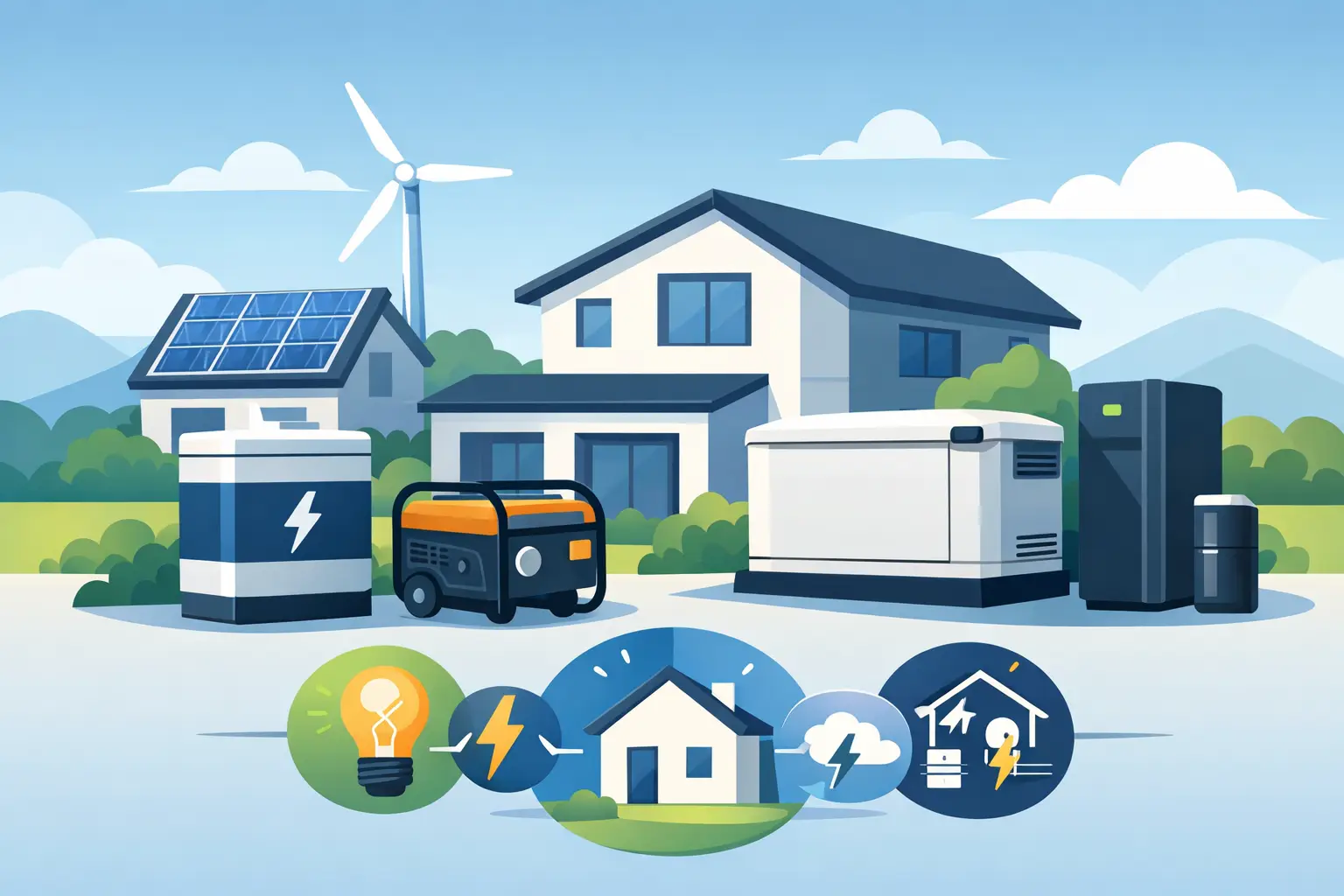
Power outages can leave a home without heating or cooling, refrigeration, internet access, lighting, and other essential systems. A properly sized backup power system can reduce those disruptions, but not every generator works the same way. Standby generators are permanently installed and can start automatically, while portable generators generally require more hands-on setup. Battery-based systems offer another option for homeowners who want quiet, emissions-free backup power indoors.
In this guide, we compare several popular whole-home generators, portable backup generators, energy-management equipment, and whole-house surge protection options available to U.S. homeowners. The goal is to help you understand what each type of system can realistically power and which features matter before you buy.
2026 Whole-Home Generators & Backup Power Systems
| Product | Type | Main Use |
|---|---|---|
| Generac Guardian 14kW | Standby generator | Automatic home backup |
| DuroMax XP13000EH | Portable dual-fuel generator | High-output emergency backup |
| DuroMax XP15000HX | Portable dual-fuel generator | Higher-output home backup |
| EcoFlow Smart Home Panel 2 | Energy-management panel | Battery, solar, and generator integration |
| Bad Wolf Whole-House Surge Protector | Surge protection | Electrical surge and transient protection |
These products represent different approaches to home backup power. The list includes a permanently installed standby generator, high-output portable generators, a smart electrical-management system, and whole-house surge protection.
The right choice depends on your home’s electrical demand, how much automation you want, the available fuel sources, installation requirements, and how much of your home you want to keep running during an outage.
2026 Whole-Home Generator & Backup System Reviews
Generac Guardian 14kW Home Standby Generator
The Generac Guardian 14kW is a permanently installed standby generator designed for automatic home backup. The current model provides 14,000 watts of running power and can operate on either natural gas or liquid propane. It also includes Mobile Link remote monitoring, allowing homeowners to check generator status and maintenance information from a phone, tablet, or computer.
One of the main advantages of a standby system is automation. Once properly installed with the appropriate transfer equipment, the generator can detect a utility outage and automatically transfer the home’s supported electrical loads to generator power. When utility power is restored, the system transfers the loads back to the grid.
The Guardian 14kW uses Generac’s G-Force 800 engine and an aluminum enclosure. It also includes Quiet-Test functionality and True Power technology designed to provide power with less than 5 percent total harmonic distortion.
The important point is that a 14kW generator should not automatically be assumed to power every appliance in every home at the same time. Actual coverage depends on the home’s electrical demand, transfer equipment, and load-management configuration.
Best suited for: Homeowners who want permanent installation and automatic backup without manually starting a portable generator.
DuroMax XP13000EH Dual Fuel Portable Generator
The DuroMax XP13000EH is a high-output portable dual-fuel generator rated at 13,000 peak watts and 10,500 running watts on gasoline. On propane, it produces 12,350 peak watts and 9,975 running watts.
The ability to switch between gasoline and propane gives homeowners more fuel flexibility during an extended outage. Gasoline provides the higher rated output, while propane can be useful for longer-term emergency fuel storage.
The generator uses a 500cc OHV engine and provides 120/240V output. It also includes electric and recoil starting, a 50-amp home-backup connection, and a wheeled frame designed to make moving the large generator easier.
The XP13000EH can be used for home backup when connected through an appropriately installed transfer switch or other approved connection method. Whether it can support an entire home depends on the home’s electrical demand, the generator’s running capacity, and how loads are managed.
Keep in mind that a portable generator is not equivalent to an automatic standby system. It requires proper outdoor placement, fuel management, and more hands-on operation.
Best suited for: Homeowners who need substantial portable backup power and want the flexibility of gasoline and propane.
DuroMax XP15000HX 15,000-Watt Dual Fuel Portable Generator
The DuroMax XP15000HX is a high-output dual-fuel portable generator that provides 15,000 peak watts and 12,000 running watts on gasoline. On propane, it is rated at 14,250 peak watts and 11,400 running watts.
That output gives the XP15000HX more running capacity than the XP13000EH, making it worth considering for homes with larger electrical loads. However, the generator’s actual ability to power appliances simultaneously still depends on the home’s total demand.
The unit supports both gasoline and propane and includes electric start, recoil start, and remote start. It also provides 120/240V output and a 50-amp outlet designed for home-backup applications.
Another useful feature is the carbon-monoxide sensor with automatic shutdown. This is an additional safety feature, not a substitute for proper generator placement. Fuel-powered generators must be operated outdoors and according to the manufacturer’s clearance and ventilation requirements.
The XP15000HX also includes GFCI protection, automatic low-oil shutdown, an hour meter, a digital volt meter, and a metal frame with wheels.
Best suited for: Homeowners who want a high-output portable generator with dual-fuel capability and remote starting.
EcoFlow Smart Home Panel 2 Backup Solution
The EcoFlow Smart Home Panel 2 takes a different approach to backup power. It is not a generator or battery by itself; it is a smart electrical panel designed to connect compatible home circuits with EcoFlow backup power systems.
The system can integrate with compatible EcoFlow batteries, solar equipment, and gas generators. It provides automatic power transfer, circuit-level energy management, and remote monitoring through the EcoFlow ecosystem.
For homeowners considering a battery-based backup system instead of a traditional engine generator, the Smart Home Panel 2 can serve as the electrical-management component that connects the backup equipment to selected household circuits.
The system supports 120/240V electrical service and can manage up to 12 loads. EcoFlow also specifies a maximum gas-generator input of 12kW and an automatic switchover designed to occur in approximately 20 milliseconds.
One advantage of this approach is that the Smart Home Panel 2 can be part of a broader energy system involving battery storage and solar generation. That makes it different from a conventional fuel-powered standby generator.
Best suited for: Homeowners building a battery-based, solar-integrated, or multi-source backup power system.
Bad Wolf Whole-House Surge Protector
The Bad Wolf Whole-House Surge Protector is designed to provide an additional layer of electrical protection for a home’s wiring and connected equipment.
The current SP240V225KA model is rated for 225kA surge-current capacity and is designed for 120/240V split-phase systems. The manufacturer identifies protection against lightning-related surges, utility switching transients, motor-generated surges, and other electrical disturbances, including EMP-related surge events.
It is important to understand what a surge protector does and does not do. It does not generate electricity and cannot replace a generator or battery system. Instead, it is intended to reduce the effects of certain electrical surges reaching equipment connected to the home’s electrical system.
The device is a hardwired whole-house product and should be installed according to its instructions and applicable electrical requirements.
Best suited for: Homeowners who want to add whole-house surge protection as part of a broader backup-power and electrical-protection strategy.
What to Consider Before Choosing a Whole-Home Generator
1. Calculate Your Actual Power Requirements
Generator size should be based on the appliances and systems you actually want to operate, not on a generic wattage target.
Start by identifying the equipment you want to keep running during an outage. This may include refrigerators, freezers, furnaces, air conditioners, sump pumps, well pumps, lighting, internet equipment, medical equipment, and other essential loads.
Add the running wattage of your planned loads and account for the higher starting demand of motor-driven equipment. Air conditioners, refrigerators, pumps, and other motors can require additional power when they start.
A licensed electrician or qualified generator professional can perform a load calculation to determine the appropriate generator size and transfer equipment for your home.
2. Compare Fuel Options
Portable generators commonly use gasoline, propane, or both. Gasoline can provide strong output but requires appropriate storage and fuel management. Propane has a long storage life and can be useful for emergency preparedness.
Standby generators commonly use natural gas or liquid propane, depending on the model and local installation requirements.
If you choose a dual-fuel generator, compare the running wattage and runtime for each fuel rather than looking only at the advertised peak wattage.
3. Decide Between Standby and Portable Backup
A standby generator is permanently installed and can automatically transfer supported household circuits to generator power during an outage.
Portable generators generally provide more flexibility and can be moved or stored when not needed, but they require outdoor placement, fuel management, startup procedures, and an appropriate transfer-switch or connection setup when powering household circuits.
If convenience and automatic operation are your priorities, a standby system may make more sense. If portability and lower initial equipment cost matter more, a portable generator may be worth considering.
4. Look at the Features You Will Actually Use
Remote monitoring can make it easier to check generator status and maintenance alerts.
Load management can help a smaller generator handle selected high-demand appliances without exceeding its capacity.
CO detection is an important safety feature on compatible portable generators, but it never replaces proper outdoor operation and safe placement.
Other useful features can include electric start, remote start, automatic low-oil shutdown, GFCI protection, fuel gauges, hour meters, and 120/240V output.
5. Consider Whole-House Surge Protection
A generator solves a power-availability problem; a surge protector addresses a different problem.
Whole-house surge protection can help reduce the risk from certain electrical surges and transients reaching equipment connected to the home’s electrical system.
It should be treated as a complementary protection layer rather than a replacement for proper generator installation or other electrical safeguards.
Generator Safety: What Homeowners Need to Know
Fuel-powered generators produce carbon monoxide, an odorless and potentially deadly gas.
Never operate a gasoline or propane generator inside a home, garage, basement, crawlspace, shed, or other enclosed or partially enclosed area.
A portable generator should be positioned outdoors and away from doors, windows, and other openings according to the manufacturer’s instructions. Carbon-monoxide detection on the generator is an additional safety feature, but it does not make indoor operation safe.
Never attempt to connect a portable generator to a home’s electrical system by plugging it into a standard household outlet. An improperly connected generator can backfeed electricity into utility lines and create a serious hazard.
If you want a portable generator to power household circuits, use an appropriately installed transfer switch or another approved connection method and follow local electrical requirements.
Standby Generator vs. Portable Generator vs. Battery Backup
Choosing the right technology becomes easier when you compare the three main approaches.
| Feature | Standby Generator | Portable Generator | Battery Backup |
|---|---|---|---|
| Automatic operation | Yes, when properly installed | Usually no | Yes, with compatible system |
| Fuel required | Natural gas or propane | Gasoline, propane, or both | Electricity/solar charging |
| Exhaust emissions | Yes | Yes | None during operation |
| Indoor operation | No | No | Depending on system, potentially yes |
| Installation | Professional installation normally required | Minimal to moderate | Electrical installation may be required |
| Portability | No | Yes | Varies |
| Long outage capability | Strong with fuel supply | Strong with fuel supply | Depends on battery capacity and recharge options |
| Noise | Engine noise | Engine noise | Very quiet |
| Solar integration | Model dependent | Model dependent | Strong option for compatible systems |
There is no single backup technology that fits every home. A standby generator focuses on automatic fuel-powered backup, a portable generator emphasizes flexibility and output, while a battery system can provide quiet backup and integrate with solar generation.
Buying a Generator Online: What to Check Before Ordering
Before purchasing a generator online, verify the exact model number, running wattage, peak wattage, fuel type, voltage, emissions certification, transfer-switch compatibility, warranty, and installation requirements.
For large standby systems, also confirm whether the listed price includes the transfer switch and professional installation.
For portable generators, check the generator’s weight, fuel capacity, outlet configuration, noise level, and whether the model is approved for use in your state.
It is also important to distinguish between running watts and peak watts. Running watts describe the continuous output the generator is designed to provide, while peak or starting watts represent the additional short-term capacity available for starting certain loads.
Product availability, pricing, shipping, and retailer policies can change, so check the current listing before placing an order.
Frequently Asked Questions
What size generator do I need for a whole house?
The required size depends on the home’s electrical load, including HVAC equipment, water heaters, pumps, refrigerators, cooking appliances, and other high-demand devices. A professional load calculation is the safest way to determine the appropriate generator size.
Is a portable generator enough to power a whole house?
A sufficiently powerful portable generator can supply multiple household circuits when connected through an appropriately installed transfer switch or approved connection equipment. Whether it can power the entire house depends on its running wattage and the home’s electrical demand.
Is a standby generator better than a portable generator?
They serve different purposes. Standby generators offer permanent installation and automatic operation, while portable generators generally provide more flexibility and can be moved or stored when not needed. The appropriate option depends on the home’s power requirements, budget, installation options, and desired level of convenience.
Can I run a generator inside my garage?
No. Fuel-powered generators should not be operated inside a garage, basement, home, or other enclosed or partially enclosed area because of carbon monoxide and exhaust hazards. Follow the generator manufacturer’s placement and clearance requirements.
Do I need a transfer switch for a portable generator?
If you want to connect a portable generator to your home’s electrical wiring, the system needs an appropriate transfer-switch or other approved connection method installed according to applicable electrical requirements. Never connect a generator directly to a household wall outlet.
Are battery backup systems a replacement for gas generators?
For some homes and use cases, yes, but it depends on the required power and duration. Battery systems can provide quiet, emissions-free operation and may integrate with solar panels, but their available power and runtime depend on inverter output, battery capacity, recharge capability, and the loads being powered.
Final Thoughts
Choosing a whole-home backup system starts with understanding how much power your household actually needs and how you want the system to operate.
A permanently installed standby generator can provide automatic backup for supported circuits, while a large portable generator can offer substantial output with more hands-on operation. Battery-based systems provide another option for homeowners who prioritize quiet operation, solar integration, and energy storage.
The Generac Guardian 14kW represents the traditional standby-generator approach, while the DuroMax XP13000EH and XP15000HX provide high-output portable alternatives with dual-fuel capability. The EcoFlow Smart Home Panel 2 is designed for a different type of backup architecture centered around batteries, solar, and compatible generators. Whole-house surge protection can then add another layer of electrical protection.
Before buying, focus on actual load requirements, transfer equipment, fuel availability, installation requirements, safety, and long-term maintenance.
A generator is only as useful as the system around it, so proper sizing and installation should come before maximum wattage.