As an Amazon Associate I earn from qualifying purchases.
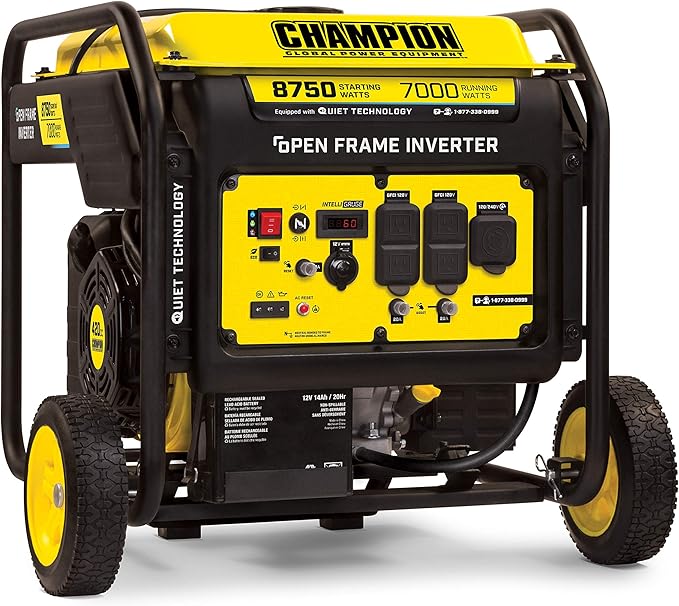
A 7,000-watt generator can be a practical middle ground for homeowners who need more capacity than a small portable generator can provide without moving all the way into a large standby system. These generators can handle combinations of refrigerators, sump pumps, freezers, lights, power tools, and other essential loads, depending on the model and the total wattage required.
One important detail is easy to overlook: a generator advertised as “7,000 watts” may produce 7,000 starting watts but considerably fewer running watts. That distinction matters when you are choosing a generator for home backup. In this guide, I separate those numbers so you can see what each model can realistically deliver.
The 7,000-watt class now includes several very different types of portable generators. Some are conventional gasoline models designed around maximum continuous output, while others use inverter technology for cleaner power and lower operating noise. Dual-fuel models add propane as an alternative to gasoline, and some premium inverter generators add electric or remote starting, CO shutdown protection, digital monitoring, and 120/240V output.
Because these features vary considerably, the right choice depends on whether your priority is continuous power, quieter operation, fuel flexibility, electronics-friendly output, or home backup capability.
Best 7000-Watt-Class Generators and Backup Power Options for 2026
| Generator | Power Output | Fuel | Generator Type | Best For |
|---|---|---|---|---|
| Champion 8750-Watt Inverter | 8,750 starting / 7,000 running | Gasoline | Open-frame inverter | Maximum continuous power |
| DuroMax XP7000iH | 7,000 starting / 5,500 running | Gasoline/Propane | Digital inverter | Dual-fuel home backup |
| Honda EU7000iS | 7,000 max / 5,500 rated | Gasoline | Enclosed inverter | Quiet operation |
| Champion 7000W Generator | 8,750 starting / 7,000 running | Gasoline | Conventional portable | Home backup and job sites |
| GRECELL 4000W S5 | 4,000 continuous / 7,000 peak | Battery/Solar | Portable power station | Silent backup and indoor use |
Generator Breakdown: Power, Performance, and Practicality
Champion Power Equipment 8750-Watt Inverter Generator
If your main priority is getting a true 7,000 watts of continuous output, the Champion 8750-watt inverter is a more direct match for this category. The model produces 8,750 starting watts and 7,000 running watts at 120/240V.
Unlike the DuroMax XP7000iH, which is rated at 5,500 running watts, this Champion model is designed around a 7,000-watt continuous output. That makes the distinction important for buyers planning to run several larger appliances or tools at the same time.
The open-frame inverter design provides cleaner electrical output than a conventional generator while retaining the capacity needed for demanding loads. Electric and recoil starting are available, and the generator uses a 420cc-class engine with a substantial frame and wheel kit.
For a homeowner, contractor, or RV owner who needs 120/240V power and wants to stay around the 7,000-running-watt range, this type of generator makes more sense than choosing a model simply because its name contains “7000.”
DuroMax XP7000iH Dual Fuel Portable Inverter Generator
The DuroMax XP7000iH is one of the more interesting options in this category because it combines inverter technology with gasoline and propane capability. It produces 7,000 peak watts and 5,500 running watts on gasoline. On propane, its output is 6,650 peak watts and 5,225 running watts.
One important clarification: the XP7000iH is a 7,000-watt peak-output generator, not a 7,000-watt continuous-output generator. Buyers who specifically need 7,000 continuous watts should look at a higher-output model instead.
The dual-fuel design gives you the ability to choose between gasoline and propane depending on availability and storage preferences. Propane can also be useful for emergency preparedness because it can be stored for longer periods than gasoline when handled correctly.
The XP7000iH includes electric start, recoil backup, and remote start. It also provides 120/240V output, a digital display, GFCI protection, CO sensor shutdown, and parallel capability.
DuroMax lists the generator at less than 3% total harmonic distortion, with a 3-gallon gasoline tank and a noise rating of 62 dB at 25% load. The unit weighs approximately 147 pounds and includes wheels and a handle kit.
For homeowners who want an inverter generator with dual-fuel flexibility and do not actually require 7,000 continuous watts, the XP7000iH is worth considering.
Honda EU7000iS Inverter Generator
The Honda EU7000iS is another important model to consider when shopping in the 7,000-watt class. However, just like the DuroMax, its 7,000-watt figure represents maximum output rather than continuous rated output.
Honda lists the EU7000iS at 7,000 watts maximum and 5,500 watts rated at 120/240V. It uses a 389cc Honda GX390 EFI engine and a 5.1-gallon fuel tank.
One of its major advantages is its enclosed inverter design. Honda lists noise at 58 dB(A) at rated load and 52 dB(A) at one-quarter load. The generator also includes electric and recoil starting, CO-MINDER carbon monoxide detection, electronic circuit breakers, and Honda’s My Generator app with Bluetooth connectivity.
Fuel injection is another notable feature because it eliminates the conventional carburetor choke arrangement and can help with starting and fuel management.
At more than 260 pounds dry, the EU7000iS is considerably heavier than some smaller portable generators, so portability should be considered carefully. Its combination of inverter output, 120/240V capability, low noise, and premium construction makes it more appropriate for buyers who place a high value on those features.
Champion 7000W Portable Generator
For buyers who care more about continuous output than inverter technology, a conventional 7,000-running-watt generator can be a better fit.
Champion’s 7000W generator produces 8,750 starting watts and 7,000 running watts. It uses a 389cc OHV engine and has a gasoline-only configuration.
The unit includes CO Shield automatic carbon monoxide shutdown, GFCI-protected household outlets, a 120/240V 30A locking outlet, electric monitoring through the Intelligauge system, and a wheel kit.
Champion lists up to 11 hours of runtime at 50% load with its 7.7-gallon gasoline tank. The manufacturer also lists a 74 dBA noise rating from 23 feet.
This type of generator is better suited to users who need substantial continuous output for home backup, tools, or job-site equipment and are less concerned about having an enclosed inverter design.
GRECELL 4000W S5 Portable Power Station
The GRECELL S5 belongs in this guide as a battery-powered alternative rather than as a direct replacement for a 7,000-running-watt gasoline generator.
It provides 4,000 watts of continuous AC output and up to 7,000 watts of peak power, with a 5,040Wh LiFePO4 battery.
That distinction matters. A battery power station does not provide the same long-duration refueling capability as a gasoline generator, but it has several advantages for specific situations: no engine exhaust, much lower noise, and the ability to provide power without running an engine.
The S5 can accept AC charging, vehicle charging, and solar input, with up to 2,100W of photovoltaic input. It also has a UPS function with a stated switchover time of 20 milliseconds or less.
For indoor backup, electronics, temporary power, or situations where engine noise and exhaust are unacceptable, a large battery power station can be a useful alternative. It should not, however, be described as a conventional 7,000-watt generator.
How to Choose a 7000-Watt Generator in 2026
1. Calculate Running and Starting Watts
Before buying a generator, make a list of the appliances and equipment you want to operate at the same time. Look at both their running wattage and their starting or surge requirements.
Motors used in refrigerators, sump pumps, furnaces, air conditioners, compressors, and power tools can briefly require substantially more power when they start. A generator that has enough running watts but not enough surge capacity may struggle when several motor-driven appliances start together.
For example, a generator rated at 7,000 running watts and 8,750 starting watts is not equivalent to a generator rated at 7,000 starting watts and 5,500 running watts.
Always use the manufacturer’s rated output when planning your load.
2. Choose the Right Fuel Type
Gasoline: Gasoline is widely available and is the most common fuel for portable generators. It is convenient for short-term or occasional use, although proper storage is important.
Propane: Propane can be stored for longer periods and gives dual-fuel generator owners another fuel option during an outage. However, propane output can be lower than gasoline output on the same generator.
Dual fuel: Dual-fuel generators allow you to use gasoline or propane. This can be useful when fuel availability changes during an emergency.
Battery power stations: These use stored electricity rather than an internal-combustion engine. They are quiet and produce no exhaust at the point of use, but their runtime depends on battery capacity and load.
Keep in mind that a dual-fuel generator usually produces slightly less output on propane than on gasoline. Always check the model’s specifications instead of assuming the two fuels provide identical wattage.
3. Consider the Starting System
Modern portable generators commonly use one or more of these starting methods:
- Electric start: Uses a battery and push-button or switch operation.
- Remote start: Allows the generator to be started from a distance on compatible models.
- Recoil start: Provides a manual backup if the battery is discharged.
A remote start is convenient, but it does not eliminate the need to place and operate the generator safely outdoors.
4. Check the Noise Level
Noise can be a major difference between a conventional open-frame generator, an open-frame inverter, and an enclosed inverter generator.
Check the manufacturer’s dB(A) rating and, more importantly, the distance at which that measurement was taken.
For example, Honda lists the EU7000iS at 58 dB(A) at rated load and 52 dB(A) at one-quarter load, while the Champion 7000W conventional generator is listed at 74 dBA from 23 feet.
These figures illustrate why generator design matters as much as wattage when noise is a concern.
5. Pay Attention to Portability
Portability becomes more important as generator size and weight increase.
Check:
- Dry weight
- Wheel size
- Handle design
- Overall dimensions
- Whether the wheels are included
- Whether two people are required to move the unit safely
For example, the Honda EU7000iS weighs 263.2 pounds dry, while the DuroMax XP7000iH is approximately 147 pounds. That is a substantial difference when the generator needs to be moved or stored.
6. Look for Useful Features
Depending on the model, useful features can include:
- CO shutdown
- Digital voltage and frequency displays
- Hour meters
- Fuel gauges
- Remote starting
- Bluetooth or app connectivity
- Low-oil shutdown
- GFCI protection
- 120/240V capability
- Parallel capability
Not every generator needs every feature. Focus on the ones that actually fit your intended use.
Generator Safety: What You Need to Know
A portable generator must always be operated outdoors.
Never run a gasoline or propane generator inside a home, garage, basement, shed, crawlspace, or other enclosed or partially enclosed area. Carbon monoxide from generator exhaust can build up quickly and can be fatal.
Keep the generator away from doors, windows, and vents, and follow the clearance requirements in the owner’s manual. A carbon monoxide shutdown system adds an important layer of protection, but it does not make indoor operation safe.
If you want to connect a portable generator to household circuits, use the appropriate transfer equipment installed according to local electrical requirements. Never connect a portable generator directly to a wall outlet in an attempt to energize the home’s wiring.
Also check the generator’s grounding, GFCI, extension-cord, fuel-storage, and maintenance requirements before operating it. The owner’s manual should always take priority over generic recommendations.
What to Check Before Buying a Generator Online
Generator prices, availability, shipping, and seller information can change frequently, so check the current product listing before placing an order.
Pay particular attention to the exact model number because generators with similar names can have different wattage ratings, fuel options, outlets, or regulatory certifications.
Also check whether the model is available in your state, whether the listing is sold by the manufacturer or an authorized seller, what warranty is included, and whether replacement parts and service are available.
For home backup, confirm that the generator provides the voltage and connection options required by your equipment. A 120/240V generator may be necessary for certain larger loads, while a 120V-only model may be sufficient for smaller applications.
Frequently Asked Questions
Is a 7,000-watt generator enough to power a house?
It can power many essential household circuits, but it depends on the home’s electrical loads. Refrigerators, freezers, sump pumps, lights, electronics, and some heating or cooling equipment may be supported when their combined running and starting requirements stay within the generator’s limits.
What is the difference between 7,000 starting watts and 7,000 running watts?
Starting watts are the short-term surge capacity available when equipment with motors starts. Running watts are the continuous output the generator can provide. A generator advertised as 7,000 starting watts may have considerably less continuous capacity, so always check both numbers.
Can a 7,000-watt generator run a central air conditioner?
It depends on the air conditioner’s starting and running requirements. Some systems can exceed the generator’s capacity when the compressor starts. Check the HVAC equipment’s specifications and compare its starting requirements with the generator’s available surge capacity before connecting it.
Is an inverter generator better for home backup?
An inverter generator can provide cleaner electrical output and may operate more quietly than a conventional generator, but the right choice depends on the application. For home backup, compare continuous wattage, surge capacity, 120/240V capability, fuel type, noise, runtime, and connection options.
Can a portable generator be connected directly to a house?
Do not connect a portable generator to a household wall outlet. A proper transfer switch or other approved connection method should be installed according to applicable electrical requirements. Have this work handled by a qualified professional when required.
Are dual-fuel generators worth considering?
Dual-fuel models can provide flexibility because gasoline and propane can be used as available. However, output and runtime can differ between fuels. Check the manufacturer’s specifications for both gasoline and propane before choosing a model.
How far should a generator be from the house?
Follow the current owner’s manual and applicable local requirements. The generator must be positioned outdoors and away from doors, windows, and vents so exhaust cannot enter the building. Carbon monoxide safety should take priority over convenience.
Final Thoughts: Choosing the Right 7000-Watt Generator in 2026
A 7,000-watt-class generator can provide a useful combination of capacity, portability, and flexibility for home backup, RV use, outdoor projects, and job-site power.
The key is to look beyond the number printed in the product name.
Pay close attention to running watts versus starting watts. A model such as the Champion 8750 provides 7,000 running watts, while the DuroMax XP7000iH and Honda EU7000iS provide 5,500 rated watts despite having 7,000-watt maximum output ratings.
Fuel flexibility, inverter technology, noise, 120/240V capability, CO protection, runtime, weight, and starting options can all affect which generator makes sense for your particular application.
For shoppers comparing generators in 2026, the best approach is to calculate the loads you actually need to run, compare the manufacturer’s continuous and surge ratings, and then choose the generator that provides an appropriate margin rather than buying solely based on its advertised peak wattage.