As an Amazon Associate I earn from qualifying purchases.
A good solar generator does not have to cost hundreds or even thousands of dollars. In 2026, affordable portable power stations offer more useful capacity, better battery technology, and faster charging than many budget models from just a few years ago.
For camping, road trips, emergency charging, RV use, or short power outages, a compact solar generator can keep phones, laptops, lights, cameras, fans, and other essential electronics running without gasoline, engine noise, or exhaust fumes.
However, not every inexpensive power station is designed for the same job. A small 88Wh unit may be perfect for charging phones and lights, while a 576Wh model can handle considerably larger loads for longer periods.
For this guide, the focus is on affordable models that balance battery capacity, AC output, portability, charging options, and practical off-grid use.
Best Affordable Solar Generators for 2026
| Solar Generator | Capacity | AC Output | Best For | Portability |
|---|---|---|---|---|
| MARBERO 237Wh | 237Wh | 300W | Camping and emergency essentials | Excellent |
| Apowking 146Wh | 146Wh | 100W | Phones, cameras and small electronics | Excellent |
| Apowking 220Wh | 220Wh | 300W | Camping and basic backup power | Very Good |
| MARBERO 88.8Wh | 88.8Wh | 80W | Ultralight emergency kits | Excellent |
| DaranEner 576Wh | 576Wh | 600W | Longer backup and RV use | Good |
The biggest thing to remember is that watt-hours (Wh) measure stored energy, while watts (W) describe how much power the station can deliver at one time. A larger Wh rating generally means more runtime, while a higher W rating determines whether the power station can run a particular device.
MARBERO 237Wh Solar Generator – Best Balance of Portability and Capacity
Check Amazon Price Click Here!
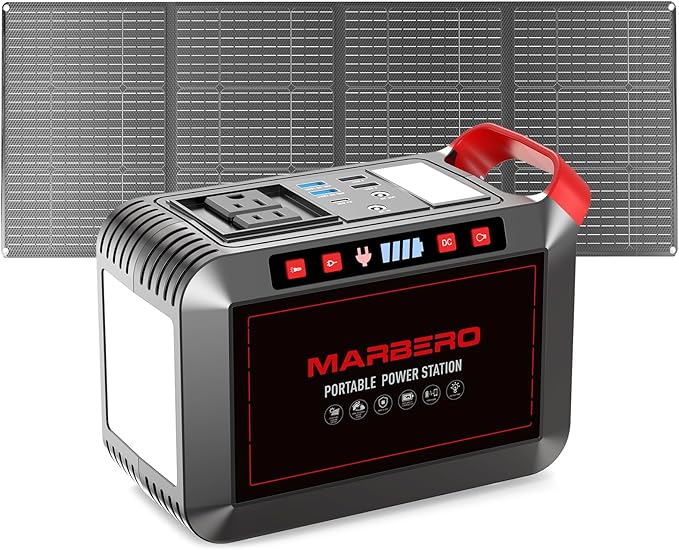
The MARBERO 237Wh portable power station is one of the more practical choices in this group for people who want something compact without dropping all the way down to a very small battery.
The current M823 version has a 237Wh battery and a 300W pure sine wave inverter, with up to 375W peak output. It also weighs about 4.6 pounds, making it considerably easier to carry than larger 500Wh-plus power stations.
Its output selection is one of its strongest points. The unit includes AC outlets, USB-A ports, USB-C, and DC output, so it can handle common camping and emergency devices such as phones, tablets, laptops, cameras, lights, and other small electronics.
The 237Wh capacity is large enough for more than basic phone charging, but it is still important to stay within the 300W continuous output limit. High-wattage heating appliances such as electric kettles, hot plates, and space heaters are not appropriate for a power station in this class.
The solar version comes with a 60W solar panel, while the power station can also be recharged from an AC outlet or a vehicle.
Why choose the MARBERO 237Wh?
- 237Wh battery capacity
- 300W pure sine wave AC output
- 375W peak output
- Multiple AC, USB and DC outputs
- Compact 4.6-pound design
- 60W solar-panel bundle available
- Useful for camping and emergency charging
- Built-in LED lighting and SOS functionality
Best for
This model makes the most sense for campers, travelers, and homeowners who want a relatively small emergency power station for electronics and other low-power devices.
It is not a replacement for a large home backup battery, but that is not what it is designed to be.
Apowking 146Wh Solar Generator – Best for Lightweight Emergency Charging
Check Amazon Price Click Here!
If portability is more important than battery capacity, the Apowking 146Wh is worth considering.
The unit uses a 146Wh lithium-ion battery and a 100W continuous AC inverter with 200W peak output. At approximately 3.3 pounds, it is small enough to keep in a vehicle, emergency kit, backpack, or camping setup.
This is the type of power station that works best when your primary goal is keeping smaller electronics charged. Smartphones, cameras, tablets, LED lights, and other low-power devices are much more appropriate than appliances that require hundreds of watts.
The 100W continuous rating is particularly important. Although the unit can briefly reach 200W peak output, that does not mean it can continuously run a 200W appliance.
The Apowking 146Wh version is also available in configurations that include a 40W solar panel, making it possible to recharge the battery away from an electrical outlet.
Why choose the Apowking 146Wh?
- 146Wh battery
- 100W continuous AC output
- 200W peak output
- Approximately 3.3 pounds
- Compact design for travel
- USB, AC and DC outputs
- Solar-compatible configurations available
- Useful for small electronics and emergency charging
Best for
This is a good fit for someone who wants a lightweight backup battery rather than a larger camping power station.
It is especially practical for short trips, vehicle emergency kits, photography equipment, and keeping communication devices charged during an outage.
Apowking 220Wh Solar Generator – More Output Without a Large Footprint
Check Amazon Price Click Here!
The Apowking 220Wh is a step up from the 146Wh model when you need both additional battery capacity and a stronger AC output.
It features a 220Wh lithium-ion battery with 300W rated output and 600W peak output. The AC outlets use pure sine wave power, making the unit suitable for many sensitive electronic devices within its rated output limit.
The power station also provides USB and DC outputs, allowing multiple smaller devices to be charged at the same time.
A version of the solar-generator bundle includes a 40W monocrystalline solar panel. The manufacturer also lists AC and 12V vehicle charging as additional ways to recharge the station.
The 220Wh capacity gives you more flexibility than the 146Wh model, but it is still a relatively small battery. You should think of it as a power source for essential electronics rather than a solution for high-demand appliances.
For example, phones, tablets, laptops, cameras, LED lights, and small fans are much more appropriate than microwaves, electric heaters, induction cookers, or other large appliances. Apowking itself advises that these compact units are intended for low-power devices.
Why choose the Apowking 220Wh?
- 220Wh battery capacity
- 300W continuous output
- 600W peak output
- Pure sine wave AC power
- Multiple AC, USB and DC outputs
- 40W solar-panel bundle available
- AC and vehicle charging options
- Compact design for camping and emergency use
Best for
Choose this model if you want a small power station with more output capability than the Apowking 146Wh but do not want to carry a 500Wh or larger unit.
It can be particularly useful for camping, road trips, small RV setups, and emergency electronics.
MARBERO 88.8Wh Solar Generator – Best Ultra-Portable Option
Check Amazon Price Click Here!
For users who want the smallest and lightest option possible, the MARBERO 88.8Wh power station takes a different approach.
Its 88.8Wh battery weighs approximately 2.3 pounds, and the current version provides 80W of rated AC output with up to 120W peak output. It also includes USB-A, USB-C, DC, and AC connections.
That makes it especially convenient for emergency kits and short camping trips where carrying weight matters.
A version of this model includes a 25W foldable solar panel. MARBERO also lists the ability to charge several smaller devices at the same time, although the low 80W continuous output means this is clearly intended for light-duty applications.
This is not the power station to choose for a refrigerator, large appliance, or power tool. Its strength is simplicity and portability.
Why choose the MARBERO 88.8Wh?
- 88.8Wh battery
- 80W rated AC output
- 120W peak output
- Approximately 2.3 pounds
- USB-A and USB-C charging
- AC and DC outputs
- 25W foldable solar panel included in the solar bundle
- Extremely compact for emergency storage
Best for
This model works particularly well for hikers, campers, travelers, and anyone assembling a lightweight emergency kit.
If your main priorities are keeping phones, lights, tablets, and other small electronics running, its compact size can be more valuable than having a much larger battery.
DaranEner 576Wh Solar Generator – Best for Longer Backup Needs
Check Amazon Price Click Here!
The DaranEner 576Wh power station is substantially more capable than the smaller models in this guide.
The current NEO600 configuration uses a 576Wh LiFePO4 battery and a 600W continuous pure sine wave inverter with 1,200W surge output. It also includes USB-C Power Delivery, including a port capable of up to 100W.
The larger battery makes this model more suitable for users who need several hours of backup rather than simply charging a phone or tablet.
It can be useful for laptops, lights, fans, CPAP equipment, small electronics, and other devices that remain below the station’s output limits. Actual runtime will depend heavily on the wattage of the device, inverter losses, battery condition, and other factors.
One major advantage is the use of LiFePO4 battery chemistry. Compared with older lithium-ion power stations, LiFePO4 models are generally favored for their longer cycle life and improved thermal stability.
The DaranEner NEO600 documentation lists a 576Wh LiFePO4 battery, 600W AC output, 1,200W surge capacity, and up to 150W solar input. A version with a 100W solar panel is also available.
Why choose the DaranEner 576Wh?
- 576Wh battery
- LiFePO4 battery chemistry
- 600W continuous AC output
- 1,200W surge output
- Pure sine wave AC power
- USB-C PD up to 100W
- Solar charging capability
- Suitable for longer camping and emergency use
- Larger capacity than the other models in this comparison
Best for
The DaranEner is the better fit for users who need more runtime and higher output but still want something considerably smaller than a full-size home backup power station.
It is particularly useful for RV trips, extended camping, emergency backup, and situations where several small devices need to remain powered for longer periods.
How to Choose an Affordable Solar Generator in 2026
Buying the cheapest solar generator is not necessarily the best way to save money. The important question is whether the power station has enough capacity and output for the devices you actually plan to use.
1. Check the watt-hour capacity
Wh tells you how much energy the battery stores.
For example, a 576Wh station has considerably more stored energy than an 88.8Wh unit.
As a rough illustration, a device drawing 50W continuously would theoretically use 250Wh in five hours. Real-world runtime will be lower because power stations have conversion losses and the usable battery capacity is not identical to the advertised capacity.
That is why Wh is one of the most useful numbers to compare.
2. Check continuous AC output
If your device requires 250W, buying a station rated for only 100W will not solve the problem.
Always compare the device’s running wattage with the power station’s continuous output rating.
Do not rely only on the peak or surge number. Surge output is designed for short periods when certain devices require extra power during startup.
3. Consider battery chemistry
Battery chemistry has become a major difference between older budget power stations and newer models.
Many current portable power stations under $500 use LiFePO4 batteries, with several 2026 models offering capacities from roughly 200Wh to more than 1,000Wh.
LiFePO4 is attractive for users who expect to recharge their power station frequently because these batteries generally offer a much longer cycle life than older lithium-ion chemistries.
However, battery chemistry is only one factor. Capacity, output, charging speed, weight, warranty, and price still matter.
4. Look at solar input, not just the words “solar generator”
A portable power station can support solar charging without including a solar panel.
This distinction matters.
For example, a 220Wh power station paired with a 40W panel is a very different setup from a 576Wh power station paired with a 100W or 150W solar input.
Solar charging speed also varies according to sunlight, panel orientation, temperature, shading, and the station’s maximum solar-input rating.
5. Think about weight
A larger battery generally means more weight.
If you are carrying the unit into a campsite, hiking area, or remote location, an 88Wh or 146Wh station may be more convenient than a 1,000Wh model.
On the other hand, if the power station will remain in an RV, vehicle, or home, additional capacity may be worth the extra weight.
6. Count the ports you actually need
Look beyond the number of ports.
USB-C Power Delivery can be particularly useful if you want to charge a modern laptop directly without using an AC adapter.
AC outlets are necessary for conventional plugs, while USB-A and USB-C can be more efficient for smaller electronics because they avoid some of the losses associated with converting battery power to AC and then back to DC.
What Can an Affordable Solar Generator Actually Power?
The answer depends on both battery capacity and inverter output.
Small electronics
Most of the models in this guide can handle devices such as:
- Smartphones
- Tablets
- Cameras
- LED lights
- Small fans
- Laptop chargers
- Portable electronics
- Small networking equipment
Medium-power devices
Larger models such as the DaranEner 576Wh can be more useful for:
- CPAP machines
- Larger fans
- Multiple lights
- Laptops and monitors
- Small camping appliances
- Other devices within the station’s wattage limits
High-power appliances
Budget portable power stations are generally not the right solution for:
- Space heaters
- Electric water heaters
- Large induction cooktops
- Full-size electric ovens
- High-powered air conditioners
- Large power tools exceeding the inverter rating
Always check the appliance’s actual wattage before connecting it.
Solar Generator vs. Gas Generator
A portable solar generator and a conventional gas generator serve different purposes.
A solar generator is essentially a rechargeable battery power station paired with a method of producing electricity, usually solar panels. It operates quietly and does not produce exhaust fumes during use.
A gasoline generator can produce much more continuous power and can be refueled quickly, but it requires fuel, produces exhaust, and should only be operated outdoors according to the manufacturer’s safety instructions.
For phones, laptops, lights, small appliances, camping, and short emergency outages, a portable power station can be very convenient.
For running multiple high-demand appliances for extended periods, a fuel-powered generator or a much larger battery system may be more appropriate.
Are Affordable Solar Generators Good for Power Outages?
Yes, but expectations matter.
A small power station can be extremely useful during a short outage because it can keep communication devices, lights, laptops, Wi-Fi equipment, and other essentials running.
However, a 100Wh or 200Wh battery should not be expected to power an entire house.
If your goal is to keep a refrigerator, medical equipment, sump pump, or several household appliances running for many hours, you will generally need substantially more battery capacity and inverter output.
This is where the larger 500Wh-plus class becomes more practical.
Safety Tips for Using a Solar Generator
Portable power stations are easier to use than fuel-burning generators, but they still need to be handled properly.
- Stay within the manufacturer’s continuous wattage rating.
- Do not exceed the recommended surge rating.
- Use compatible solar panels and charging cables.
- Keep ventilation openings clear.
- Protect the power station from excessive heat and moisture unless it is specifically rated for those conditions.
- Inspect cables and connectors for damage.
- Follow the manufacturer’s charging and storage instructions.
- Do not attempt to modify the battery or internal electronics.
- Keep the unit away from conditions that can cause overheating.
- For medical equipment such as CPAP machines, calculate expected runtime before relying on the power station during an outage.
Final Thoughts: Which Affordable Solar Generator Makes Sense for You?
The best affordable solar generator depends on how you plan to use it rather than simply choosing the model with the largest number on the box.
The MARBERO 88.8Wh is designed around portability and light-duty charging. The Apowking 146Wh adds some extra capacity while remaining easy to carry.
The Apowking 220Wh offers a useful middle ground with a 300W inverter, while the MARBERO 237Wh provides similar capacity with a strong combination of portability and multiple output options.
For users who need substantially more stored energy and output, the DaranEner 576Wh is the more capable option of the five, particularly for longer camping trips, RV use, and emergency backup.
One important point for 2026 buyers is that the affordable power-station market has moved forward considerably. Current sub-$500 models can offer LiFePO4 batteries, 500–1,000Wh capacities, faster charging, and significantly higher AC output than many older budget models.
That means you should not judge a solar generator solely by its price. Compare Wh capacity, continuous watts, battery chemistry, solar input, weight, charging speed, and the devices you actually need to power.
For a small emergency kit, a compact 88Wh–237Wh model can be enough. For longer off-grid use or more demanding backup needs, stepping up to a 500Wh-plus LiFePO4 power station can make a much bigger difference.