As an Amazon Associate I earn from qualifying purchases.
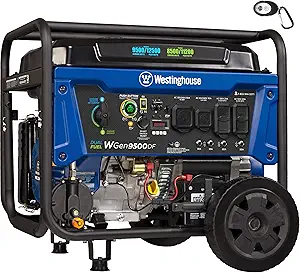
When you need serious backup power without moving into the price and complexity of a permanent standby system, a large portable generator can make a lot of sense. The Westinghouse WGen9500DF is one of the more powerful dual-fuel options in this category, delivering up to 9,500 running watts and 12,500 peak watts on gasoline, or 8,500 running watts and 11,200 peak watts on propane.
That combination makes the WGen9500DF worth considering for home power outages, RV use, workshops, and other situations where a smaller 3,000- or 5,000-watt generator simply isn’t enough. It also includes remote electric start, a 50-amp outlet, a 30-amp transfer-switch-ready outlet, and a 6.6-gallon gasoline tank.
But there are a few things you should know before buying it. This is a large, open-frame generator, it weighs more than 200 pounds, and its published runtime depends heavily on how much power you’re using. It also does not include a carbon monoxide sensor; that feature belongs to the newer WGen9500DFc version.
Check Amazon Price: Click Here
Westinghouse WGen9500DF Specifications
| Feature | Specification |
|---|---|
| Model | Westinghouse WGen9500DF |
| Fuel Type | Gasoline / Propane |
| Gasoline Running Power | 9,500 watts |
| Gasoline Peak Power | 12,500 watts |
| Propane Running Power | 8,500 watts |
| Propane Peak Power | 11,200 watts |
| Engine | 457cc 4-Stroke OHV |
| Fuel Tank | 6.6 gallons |
| Gasoline Runtime | Up to 12 hours at 25% load |
| Gasoline Runtime at 50% Load | Up to 8 hours |
| Propane Runtime at 50% Load | Up to 7 hours |
| Start System | Remote, Electric, Recoil |
| Voltage | 120/240V |
| Frequency | 60Hz |
| Outlets | 2 × 120V 5-20R, 1 × 120/240V L14-30R, 1 × 120/240V 14-50R |
| Display | VFT digital display |
| Low-Oil Shutdown | Yes |
| Overload Protection | Yes |
| GFCI Protection | Yes |
| RV Ready | Yes |
| Transfer Switch Ready | Yes |
| Noise Rating | As low as 74 dBA |
| Dry Weight | Approximately 211 lb |
| Warranty | 3-year limited residential warranty |
| CO Sensor | No |
| CARB Compliant | No |
Westinghouse lists the WGen9500DF at 9,500 running watts and 12,500 peak watts on gasoline, with slightly lower output when operating on propane. The manufacturer also lists 12 hours of gasoline runtime at 25% load, 8 hours at 50% load, and approximately 7 hours at 50% load on a 20-pound propane tank.
How Much Power Does the WGen9500DF Produce?
Power output is one of the biggest reasons to consider the WGen9500DF.
On gasoline, the generator provides 9,500 running watts and 12,500 peak watts. On propane, output drops to 8,500 running watts and 11,200 peak watts. That reduction is normal with dual-fuel generators because gasoline and propane do not provide the same energy output under the same conditions.
The distinction between running and peak watts is important.
Running watts are the amount of power the generator can continuously provide. Peak watts are available temporarily to handle startup surges from appliances and equipment with electric motors.
For example, a refrigerator, well pump, air conditioner, sump pump, or power tool may require considerably more power for a brief moment when its motor starts. The 12,500-watt gasoline peak rating gives the WGen9500DF some extra headroom for those startup demands.
However, 12,500 watts does not mean you can continuously operate a 12,500-watt load. For extended operation, the total running load needs to remain within the generator’s rated output.
Dual-Fuel Operation Is One of Its Biggest Advantages
One of the strongest reasons to choose the WGen9500DF over a gasoline-only generator is its ability to operate on gasoline or propane.
Gasoline provides the higher output, making it the better choice when you need maximum available power. Propane gives you another fuel option when gasoline is difficult to obtain or when you want a fuel that can be stored for longer periods without the same concerns associated with aging gasoline.
Westinghouse also designed the fuel system so you can switch between gasoline and propane without shutting down the generator, which can be particularly useful during a prolonged outage.
For emergency preparedness, having two fuel options can be more practical than depending entirely on gasoline.
That said, propane isn’t a magic solution for unlimited runtime. A standard 20-pound propane cylinder provides considerably less runtime than a large gasoline tank, and the generator produces less power on propane.
Runtime: Don’t Confuse 25% Load With 50% Load
This is one area where the original version of this review needed an important correction.
The WGen9500DF can run for up to 12 hours on its 6.6-gallon gasoline tank at 25% load. That does not mean it will run for 12 hours while producing half of its rated output. Westinghouse lists approximately 8 hours at 50% gasoline load. On propane, the manufacturer lists approximately 7 hours at 50% load with a 20-pound tank.
Actual runtime will vary depending on the electrical load, fuel quality, temperature, altitude, and operating conditions.
This is important if you’re planning for a long outage. A generator running a refrigerator, lights, internet equipment, and a few other essential appliances will consume considerably less fuel than one running air conditioning, electric heating, pumps, cooking appliances, and other high-demand equipment simultaneously.
Remote Start Makes Emergency Use Easier
The WGen9500DF includes three starting methods:
- Remote key fob
- Push-button electric start
- Recoil start
The remote start is particularly convenient during bad weather. Instead of walking outside every time you need to start the generator, you can use the key fob from a distance.
The electric start provides another convenient option, while the recoil starter serves as a backup if the battery isn’t available.
The generator includes a battery and battery float charger, along with the equipment needed to get the starting system ready.
Outlet Selection for Home and RV Use
The WGen9500DF offers a useful combination of outlets for different applications.
It includes:
- Two 120V 5-20R GFCI household outlets
- One 120/240V L14-30R twist-lock outlet
- One 120/240V 14-50R outlet
The 14-50R outlet is particularly useful for RV owners with compatible 50-amp connections. The L14-30R outlet can also be used for appropriate transfer-switch or generator-inlet configurations.
This gives the WGen9500DF more flexibility than a generator equipped only with standard household outlets.
For home backup, however, you should not connect a portable generator directly to a household electrical panel without the proper equipment. A properly installed transfer switch or approved interlock system and generator inlet are needed to safely connect generator power to household circuits.
Is the WGen9500DF Good for RV Use?
The answer depends on your RV’s electrical system and what you want to run.
The 50-amp 14-50R outlet makes the WGen9500DF RV-ready, and its high output gives it enough capacity for demanding RV loads.
That can be useful when running equipment such as:
- RV air conditioning
- Refrigerator
- Microwave
- Lights
- Battery charger
- Television and electronics
- Other household-style appliances
The important limitation is that the generator is much larger and heavier than the portable inverter generators commonly used for camping.
At approximately 211 pounds dry, the WGen9500DF isn’t something most people will want to move frequently. Its wheel kit helps when moving it across relatively flat surfaces, but loading it into a truck or trailer is a different matter.
If your priority is maximum RV power, its output is attractive. If your priority is easy transportation and quiet campground operation, a smaller inverter generator may make more sense.
How Loud Is the WGen9500DF?
The WGen9500DF is not a quiet generator.
Westinghouse lists an operating noise level as low as 74 dBA, but real-world noise depends on load and testing conditions. Independent hands-on testing by Bob Vila measured approximately 89–90 dBA from about 6 feet away during its testing.
That difference is worth understanding before purchasing.
The WGen9500DF is an open-frame conventional generator, not a quiet inverter generator enclosed in a sound-dampening housing.
For home emergency use, this may not be a major concern. During a power outage, having substantial available power can be more important than low noise.
For recreational camping, however, the noise can be a significant disadvantage, particularly in areas with strict campground noise rules.
Weight and Portability
At around 211 pounds dry, the WGen9500DF is a heavy portable generator.
Westinghouse includes wheels and a handle system to make it easier to move around the property, but “portable” doesn’t mean lightweight.
This generator is best thought of as something you position in a suitable location and keep there until you need to move it.
The weight also matters if you’re planning to transport it regularly. Loading a 200-plus-pound generator into a pickup truck is a job for at least two capable adults and appropriate equipment.
VFT Display Helps Monitor the Generator
The WGen9500DF includes a VFT digital display that provides information about:
- Voltage
- Frequency
- Lifetime operating hours
The display is useful for monitoring the generator while it’s operating and keeping track of accumulated running time for maintenance.
The lifetime-hours reading is particularly helpful because generator maintenance is based partly on operating hours rather than simply calendar time.
Safety Features: What the WGen9500DF Has and Doesn’t Have
The generator includes several useful safety features, including:
- Automatic low-oil shutdown
- Overload protection
- GFCI outlets
- Covered outlets
- Voltage regulation
- Bonded-neutral grounding configuration
However, there is an important distinction regarding carbon monoxide protection.
The WGen9500DF does not have a carbon monoxide sensor. Westinghouse lists the separate WGen9500DFc as the version equipped with a CO sensor and automatic shutdown.
That difference should not be overlooked when comparing models.
Regardless of whether a generator has a CO sensor, it must always be operated outdoors and well away from doors, windows, vents, and other openings. Carbon monoxide can accumulate rapidly in enclosed or partially enclosed areas. The manufacturer’s manual specifically warns against operating the generator indoors or in enclosed spaces.
A CO sensor should be considered an additional safety feature, not permission to operate a generator closer to a building than recommended.
Can It Power a Whole House?
The WGen9500DF can provide enough output for many essential household circuits, but the phrase “whole-house generator” needs some qualification.
A 9,500-watt portable generator can potentially support a substantial number of household loads, particularly when appliances are managed carefully.
For example, you might be able to operate combinations of:
- Refrigerator
- Freezer
- Sump pump
- Well pump
- Lights
- Internet equipment
- Television
- Microwave
- Selected kitchen appliances
- Window air conditioner
- Some central air-conditioning systems, depending on their startup requirements
The actual combination depends on the wattage of your equipment and the starting requirements of motors and compressors.
A central air conditioner is especially important. Don’t assume that 9,500 running watts automatically means the generator will start every central AC system. Large compressors can have significant startup demands.
A soft-start device may help some HVAC systems reduce startup requirements, but compatibility should be verified with the HVAC manufacturer or a qualified electrician.
Transfer Switch and Home Backup Setup
The WGen9500DF is designed to work with appropriate transfer-switch configurations, which makes it more useful for emergency home backup than a generator intended strictly for plugging in extension cords.
The L14-30R and 14-50R outlets provide connection options for suitable generator inlet and transfer equipment.
However, installation should be handled correctly.
Never connect a portable generator to a home’s electrical panel using an improvised connection or a standard outlet. Improper connections can create backfeed hazards and put utility workers and occupants at risk.
If you want to use the WGen9500DF as a home backup generator, have the required inlet, transfer switch, or approved interlock equipment installed according to local electrical requirements.
Maintenance Requirements
A high-output portable generator needs regular maintenance, particularly if it may sit unused for months between outages.
Westinghouse specifies SAE 10W-30 engine oil and an oil capacity of approximately 1.1 quarts. The owner’s manual should be followed for the exact maintenance schedule and procedures.
Good maintenance habits include:
- Check the engine oil before operation
- Change the oil according to the manufacturer’s maintenance schedule
- Inspect and maintain the air filter
- Check the spark plug as specified in the manual
- Keep the generator clean and dry
- Maintain the electric-start battery
- Use appropriate fuel and fuel stabilizer when storing gasoline
- Avoid using E15 or E85 fuel
- Exercise the generator periodically according to the manufacturer’s recommendations
Fuel storage is particularly important with carbureted generators. If you plan to leave the generator unused for extended periods, follow Westinghouse’s storage procedure rather than simply filling the tank and forgetting about it.
What Comes With the WGen9500DF?
Westinghouse includes several items intended to make setup easier.
Depending on the package and current retail configuration, the generator includes items such as:
- Engine oil
- Oil funnel
- Spark plug wrench
- Remote key fob
- Propane regulator and hose
- Battery float charger
- Wheels and hardware
Westinghouse also states that its portable generators are functionally tested at the factory, so a small amount of residual oil or fuel odor can be present when the unit is first unpacked.
That isn’t necessarily a sign that the generator was previously used.
WGen9500DF Pros and Cons
Pros
- 9,500 running watts on gasoline
- 12,500 peak watts on gasoline
- Dual-fuel operation
- 8,500 running watts on propane
- 50-amp RV-ready outlet
- Transfer-switch-ready connection
- Remote electric start
- Push-button electric start
- Recoil backup
- 6.6-gallon gasoline tank
- VFT digital display
- GFCI protection
- Automatic low-oil shutdown
- 3-year limited residential warranty
- Useful for home backup, RVs, workshops, and job sites
Cons
- Heavy at roughly 211 pounds
- Open-frame design is relatively loud
- Not an inverter generator
- Gasoline runtime varies significantly with load
- 12-hour runtime is only at 25% load
- Propane produces less power than gasoline
- The standard WGen9500DF does not have a CO sensor
- Not CARB compliant according to Westinghouse’s current specifications
- Not ideal if you need something that is easy to transport frequently
WGen9500DF vs. WGen9500DFc
One of the most important distinctions to understand in 2026 is the difference between the WGen9500DF and WGen9500DFc.
The basic WGen9500DF delivers the same core gasoline and propane output ratings, while the WGen9500DFc adds a carbon monoxide sensor with automatic shutdown. Westinghouse lists the CO sensor as a feature of the DFc version.
If you’re shopping for one of these generators, check the exact model number before purchasing.
The letter “c” matters because you shouldn’t assume that every WGen9500DF listing includes the same CO protection.
Who Should Consider the Westinghouse WGen9500DF?
The WGen9500DF makes the most sense for someone who needs substantial portable power rather than a lightweight camping generator.
It is particularly suited to:
- Homeowners preparing for extended outages
- RV owners with high electrical demands
- Workshops and job sites
- Properties with well pumps or sump pumps
- Users who want gasoline and propane flexibility
- People who want remote starting
- Buyers who need a 50-amp connection
Its combination of output and dual-fuel capability is the main attraction.
Who Should Look at Something Else?
The WGen9500DF may not be the right choice if your priorities are very different.
Consider another type of generator if you need:
A quiet generator: An inverter generator is generally a better fit for situations where noise is a major concern.
Easy transportation: At more than 200 pounds, this is not a lightweight portable generator.
Built-in CO protection: Consider the WGen9500DFc instead if this feature is important to you.
California compliance: Westinghouse currently lists the WGen9500DF as not CARB compliant, so buyers in California should verify applicable requirements and consider a compliant model.
Maximum fuel efficiency at light loads: A smaller inverter generator may be more appropriate if you rarely need thousands of watts.
Final Verdict: Is the Westinghouse WGen9500DF Worth It?
The Westinghouse WGen9500DF remains a substantial dual-fuel portable generator for 2026, particularly for buyers who need high output without moving to a permanently installed standby system.
Its biggest strengths are straightforward: 9,500 running watts on gasoline, 8,500 running watts on propane, remote starting, a 50-amp outlet, dual-fuel flexibility, and a large 6.6-gallon fuel tank.
It also has some limitations that shouldn’t be hidden in a buying guide. It’s heavy, it’s relatively loud, and the advertised 12-hour gasoline runtime applies to only a 25% load. The standard WGen9500DF also lacks the CO sensor found on the WGen9500DFc.
For someone preparing for power outages, running demanding RV equipment, or powering tools at a worksite, those trade-offs may be reasonable. For someone looking for a quiet, lightweight generator for recreational use, a different category of generator may be more appropriate.
Overall, the WGen9500DF is best understood as a high-output, open-frame dual-fuel generator designed primarily around power capacity and backup versatility rather than quiet operation or easy transportation.
Check Amazon Price: Click Here