As an Amazon Associate I earn from qualifying purchases.
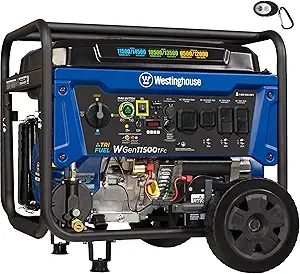
A reliable backup generator can make a major difference when a power outage lasts longer than expected. For homeowners who already have natural gas service, a tri-fuel generator can be especially practical because it can use natural gas, propane, or gasoline depending on what is available.
However, there is an important distinction to understand before buying one: a large portable tri-fuel generator is not the same thing as a permanently installed whole-house standby generator. Portable models can provide substantial power through a properly installed transfer switch or interlock, but they still require outdoor placement and manual operation. A standby generator is permanently installed and can start automatically when utility power fails.
For this guide, the focus is on large portable natural gas generators capable of residential backup, including models with enough output to support major household circuits when properly connected.
The most important specification is not the headline gasoline wattage. If you plan to use natural gas during an outage, look at the generator’s rated running watts on natural gas.
Best Natural Gas Generators for Residential Backup in 2026
| Generator | Natural Gas Running Watts | Natural Gas Peak Watts | Fuel Options | Best Use |
|---|---|---|---|---|
| Westinghouse WGen14500TFc | 11,600W | 14,400W | Gasoline, Propane, Natural Gas | Large homes and high electrical loads |
| Westinghouse 13500 Tri-Fuel | 8,500W | 10,000W | Gasoline, Propane, Natural Gas | Essential home backup |
| DuroMax XP13000HXT | 8,500W | 10,000W | Gasoline, Propane, Natural Gas | Heavy-duty backup |
| WEN TF-1450 | 8,750W | 10,500W | Gasoline, Propane, Natural Gas | Value-focused home backup |
| Westinghouse 18000 Tri-Fuel | 11,600W | 14,400W | Gasoline, Propane, Natural Gas | Very large loads |
Important: The actual amount of power your home can use depends on the generator’s output, the transfer equipment, the home’s electrical panel, and the starting requirements of appliances such as central air conditioners, well pumps, and sump pumps.
Portable Natural Gas Generator vs. a True Whole-House Standby Generator
The phrase whole-house generator can be confusing because it is often used for two different types of equipment.
A permanently installed standby generator is connected to the home’s electrical system and an automatic transfer switch. When utility power fails, the system can detect the outage and start automatically.
A large portable tri-fuel generator works differently. You normally have to position it outdoors, connect it to the appropriate electrical inlet or transfer equipment, select the fuel, and start it according to the manufacturer’s instructions.
That does not make a portable generator unsuitable for home backup. In fact, large 10,000W-plus tri-fuel models can provide substantial residential backup power while also giving homeowners the ability to use gasoline or propane if natural gas is unavailable.
The difference is convenience and installation.
If you want automatic backup while you are away from home, a permanent standby system deserves consideration. If you want high output, three fuel choices, and lower equipment costs, a portable tri-fuel generator can be a more flexible solution.
Why Natural Gas Is Useful for Home Backup
Natural gas has one obvious advantage over gasoline: you don’t have to store a large quantity of liquid fuel to keep a generator operating.
A properly connected natural gas generator can draw fuel from the home’s gas supply while the utility continues providing gas service. This can be particularly useful during longer outages when gasoline stations may be closed or difficult to reach.
Natural gas also works well with tri-fuel generators because it is only one of three available fuel options. If natural gas service becomes unavailable, the generator can be switched to propane or gasoline, provided those fuels are available and the generator is designed for them.
There is an important limitation, though. Natural gas should not be treated as an absolutely unlimited fuel source. Gas pressure, household demand, utility availability, and the generator’s required BTU supply all matter.
For example, the DuroMax XP13000HXT specifies a natural-gas pressure requirement of 6–9 inches of water column and a substantial BTU requirement at full load.
Westinghouse WGen14500TFc Tri-Fuel Generator
Check Amazon Price Click Here
The Westinghouse WGen14500TFc is one of the most powerful portable options in this group when natural gas output is the deciding factor.
Its current specifications list 14,500 running watts on gasoline, 13,000 on propane, and 11,600 on natural gas. Natural gas peak output is rated at 14,400 watts.
Key Specifications
| Feature | Specification |
|---|---|
| Gasoline | 14,500W running / 18,000W peak |
| Propane | 13,000W running / 16,000W peak |
| Natural Gas | 11,600W running / 14,400W peak |
| Engine | 713cc V-Twin OHV |
| Fuel | Gasoline, propane, natural gas |
| Voltage | 120/240V |
| Starting | Electric and remote |
| Fuel tank | 10.5 gallons |
| Transfer switch ready | Yes |
| CO sensor | Yes |
| THD | Less than 5% |
| Warranty | 3-year limited residential |
The WGen14500TFc has a 50A 120/240V outlet and a 30A L14-30R connection designed for transfer-switch or interlock applications. Westinghouse also lists GFCI outlets, remote start, automatic low-oil shutdown, a digital VFT display, and CO shutdown protection.
What I Like
- 11,600 running watts on natural gas
- 14,400 natural-gas peak watts
- 120/240V output
- Tri-fuel flexibility
- Remote and electric start
- Transfer-switch and interlock readiness
- CO shutdown system
- Less than 5% THD
- Large 713cc V-Twin engine
What to Consider
This is a very large generator. Westinghouse lists a dry weight of about 348 pounds, so moving it around the property is not something most homeowners will want to do frequently.
It is also important not to assume that 11,600 natural-gas running watts automatically means every appliance in a large home can operate simultaneously. Central air conditioning, electric water heaters, electric ranges, well pumps, and other high-demand equipment can create substantial starting and running loads.
For a larger home where natural-gas output is the priority, however, this model provides considerably more NG capacity than the smaller units in this guide.
Westinghouse 13500 Peak Watt Tri-Fuel Generator
Check Amazon Price Click Here
The Westinghouse 13500 Peak Watt Tri-Fuel Generator occupies a useful middle ground for homeowners who need substantial backup power without moving to one of the company’s larger 700cc-plus models.
The current specifications list 10,500 running watts on gasoline, 9,500 on propane, and 8,500 on natural gas, with 10,000 peak watts available when using natural gas.
Key Specifications
| Feature | Specification |
|---|---|
| Gasoline | 10,500W running / 13,500W peak |
| Propane | 9,500W running / 12,500W peak |
| Natural Gas | 8,500W running / 10,000W peak |
| Engine | 500cc 4-stroke OHV |
| Fuel | Gasoline, propane, natural gas |
| Starting | Electric, recoil and remote |
| Fuel tank | 9.5 gallons |
| Transfer switch ready | Yes |
| CO shutdown | Yes |
| Runtime | Up to 19 hours at 25% load on gasoline |
| Warranty | 3-year limited |
It includes a 120/240V 14-50R outlet and a transfer-switch-ready L14-30R connection. The generator also includes a CO sensor with automatic shutdown, a fuel gauge, and a digital hour meter.
Why It Makes Sense for Home Backup
The biggest advantage is balance.
At 8,500 running watts on natural gas, it can handle a substantial selection of essential household loads when the electrical system is properly configured.
It can be a practical choice if you want to keep a refrigerator, freezer, lights, internet equipment, sump pump, furnace blower, and selected other circuits operating without stepping up to the much larger WGen14500TFc.
The limitation is that 8,500 watts is still not the same as having unlimited electrical capacity. Load management remains important, particularly with large central air-conditioning systems.
DuroMax XP13000HXT Tri-Fuel Generator
Check Amazon Price Click Here
The DuroMax XP13000HXT is another large portable tri-fuel generator designed for demanding backup and jobsite applications.
The original article incorrectly suggested that DuroMax did not specify the natural-gas output. Current manufacturer information lists 8,500 running watts and 10,000 peak watts on natural gas.
Key Specifications
| Feature | Specification |
|---|---|
| Gasoline | 10,500W running / 13,000W peak |
| Propane | 9,500W running / 12,000W peak |
| Natural Gas | 8,500W running / 10,000W peak |
| Engine | 500cc OHV |
| Fuel | Gasoline, propane, natural gas |
| Voltage | 120/240V |
| Starting | Electric, recoil and remote |
| Natural gas pressure | 6–9 in. water column |
| Natural gas requirement | Up to 225,000 BTU at full load |
| Noise | Under 74 dB according to published specifications |
| THD | Less than 5% |
DuroMax also lists a 50A 120/240V outlet, multiple 120V outlets, CO Alert technology, low-oil shutdown, all-copper windings, and a digital command center.
What Makes It Interesting
The XP13000HXT is particularly useful for homeowners who want a generator that can serve more than one purpose.
It has enough capacity for serious residential backup, but its construction and outlet configuration also make it suitable for demanding worksite applications.
The main consideration is its natural-gas output. At 8,500 running watts, it falls into the same general NG power class as the Westinghouse 13500, despite its larger gasoline headline rating.
That is exactly why shoppers should compare fuel-specific running watts instead of comparing only the number printed in the product name.
WEN TF-1450 Tri-Fuel Generator
Check Amazon Price Click Here
The WEN TF-1450 is a newer and more relevant model for this category than the older model designation used in the original article.
WEN currently lists the generator at 11,500 running watts on gasoline, 10,300 on propane, and 8,750 on natural gas. Natural gas peak output is 10,500 watts.
Key Specifications
| Feature | Specification |
|---|---|
| Gasoline | 11,500W running / 14,500W peak |
| Propane | 10,300W running / 12,500W peak |
| Natural Gas | 8,750W running / 10,500W peak |
| Engine | 500cc 4-stroke OHV |
| Fuel | Gasoline, propane, natural gas |
| Voltage | 120/240V |
| Starting | Electric and recoil |
| Fuel tank | 8.2 gallons |
| Transfer switch ready | Yes |
| CO protection | CO Watchdog on TF1450X |
| Warranty | 3-year limited |
The WEN includes a 120/240V L14-30R and 14-50R connection, an NG quick-connect adapter, an onboard digital meter, and a wheel and handle kit. WEN notes that the natural-gas hose itself is sold separately.
Why Consider the WEN?
The TF-1450 makes sense for homeowners who want a high-output tri-fuel generator without moving into the largest and heaviest models.
Its 8,750 natural-gas running watts put it slightly above the 8,500W class represented by the Westinghouse 13500 and DuroMax XP13000HXT.
The newer TF1450X adds WEN Watchdog CO shutdown protection, which is an important safety feature for a portable generator.
Westinghouse 18000 Peak Watt Tri-Fuel Generator
Check Amazon Price Click Here
The Westinghouse 18000 Peak Watt Tri-Fuel Generator is aimed at homeowners who want very high output from a portable generator.
Its specifications are particularly interesting because the 18,000-watt figure applies to gasoline peak output. On natural gas, the generator is rated at 11,600 running watts and 14,400 peak watts.
Key Specifications
| Feature | Specification |
|---|---|
| Gasoline | 14,500W running / 18,000W peak |
| Propane | 13,000W running / 16,000W peak |
| Natural Gas | 11,600W running / 14,400W peak |
| Engine | 713cc V-Twin OHV |
| Fuel | Gasoline, propane, natural gas |
| Starting | Electric and remote |
| Fuel tank | 10.57 gallons |
| Transfer switch ready | Yes |
| CO shutdown | Yes |
| Voltage | 120/240V |
Westinghouse lists two 120V GFCI household receptacles, an L14-30R transfer-switch-ready connection, and a 14-50R 120/240V outlet. It also includes automatic low-oil and CO shutdown systems.
Who Should Consider It?
This is the type of portable generator that makes sense when your electrical load is substantially higher than what an 8,500W natural-gas generator can comfortably provide.
Its 11,600 natural-gas running output places it in the same high-output NG class as the WGen14500TFc.
The downside is size. A generator of this capacity is heavy, takes up considerable outdoor space, and requires careful planning for fuel connection, electrical integration, storage, and operation.
How Much Generator Power Does Your Home Need?
One of the biggest mistakes homeowners make is choosing a generator based solely on the peak wattage advertised on the box.
You need to look at running watts and starting watts.
Running watts represent the continuous power available while appliances are operating. Starting watts account for the temporary surge required by equipment with electric motors or compressors.
For example, a central air conditioner may require substantially more power to start than it uses once the compressor is running.
The same issue applies to:
- Well pumps
- Sump pumps
- Refrigerators
- Freezers
- Furnace blowers
- Air compressors
- Large power tools
Before buying a generator, make a list of the circuits or appliances you actually want to operate during an outage.
If your priority is basic emergency power, you may not need every circuit in the house.
If you want to operate multiple HVAC systems, kitchen appliances, pumps, and other large loads simultaneously, you may need significantly more capacity.
This is also where a professional load calculation can prevent an expensive mistake.
Why Natural Gas Generators Produce Less Power on NG
This is one of the most important details to understand when shopping for a tri-fuel generator.
A generator’s advertised gasoline output can be significantly higher than its natural-gas output.
For example:
- The Westinghouse WGen14500TFc produces 14,500 running watts on gasoline but 11,600 on natural gas.
- The WEN TF-1450 produces 11,500 running watts on gasoline but 8,750 on natural gas.
- The DuroMax XP13000HXT produces 10,500 running watts on gasoline and 8,500 on natural gas.
The reason is that the engine receives different amounts of usable energy depending on the fuel and fuel delivery conditions.
For that reason, never size a natural-gas backup system using the gasoline wattage printed in the product name.
If natural gas will be your primary fuel, use the natural-gas running wattage as the starting point for your comparison.
Transfer Switches and Home Wiring
A generator described as transfer-switch ready does not mean it can simply be plugged into a regular household outlet and power the entire house.
A properly designed connection is required between the generator and the home’s electrical system.
A transfer switch or approved interlock arrangement helps isolate the generator from utility power and prevents dangerous backfeeding. CPSC documentation explains that a suitable transfer switch is needed when using household wiring to distribute generator power to selected circuits.
Generac likewise explains that a manual transfer switch helps prevent backfeeding and allows the homeowner to select between utility and generator power.
The installation should be designed according to the generator’s specifications and applicable local electrical requirements.
Do not attempt to improvise a connection by feeding a home’s electrical panel through an ordinary receptacle.
Natural Gas Connection Requirements
Before purchasing a large tri-fuel generator, check the natural-gas supply at your property.
The generator may require a specific:
- Gas pressure
- Pipe size
- BTU capacity
- Hose or quick-connect configuration
- Connection location
The DuroMax XP13000HXT, for example, specifies 6–9 inches of water column for natural gas and lists a requirement of up to 225,000 BTU at full load.
The WEN TF-1450 includes an NG quick-connect adapter, but WEN specifically notes that the natural-gas hose is sold separately.
This is why it is worth having the gas connection evaluated before assuming a particular generator will operate at its full rated output.
Portable Generator Safety in 2026
Carbon monoxide remains one of the most important safety concerns with portable generators.
A CO sensor or automatic CO shutdown feature is useful, but it does not make indoor operation safe.
The U.S. Consumer Product Safety Commission says portable generators should be operated outdoors only and at least 20 feet away from the home, with exhaust directed away from the house.
Never operate a portable generator inside:
- A home
- Garage
- Basement
- Crawlspace
- Shed
- Enclosed porch
Opening doors or windows does not provide sufficient protection against dangerous CO accumulation.
It is also a good idea to have working carbon monoxide alarms inside the home, including outside sleeping areas and on each level.
A CO shutdown system should be considered an additional layer of protection, not a substitute for correct generator placement.
Natural Gas vs. Propane vs. Gasoline
Tri-fuel generators are attractive because they provide three fuel options, but each fuel has practical advantages and limitations.
Natural Gas
Advantages:
- Convenient when connected to an existing gas supply
- No gasoline cans to store
- Useful for extended outages
- Convenient for frequent emergency use
Limitations:
- Requires an appropriate gas connection
- Output is generally lower than gasoline
- Utility gas service can also be interrupted
Propane
Advantages:
- Long shelf life
- Easy to store compared with gasoline
- Useful backup when natural gas is unavailable
- Doesn’t require a permanent natural-gas connection
Limitations:
- Requires tanks
- Tank size affects runtime
- Large loads can consume propane quickly
Gasoline
Advantages:
- Usually provides the highest output
- Widely available under normal conditions
- Useful when other fuels are unavailable
Limitations:
- Requires fuel storage
- Gasoline degrades over time
- Refueling becomes an issue during long outages
For many homeowners, the biggest advantage of tri-fuel technology is not that one fuel is always better. It is having options when an outage affects local fuel availability.
Which Natural Gas Generator Size Makes Sense?
There is no single generator size that works for every house.
A useful way to think about these models is by natural-gas running output:
Around 8,500 watts: suitable for essential circuits and moderate household loads when carefully managed.
Around 8,750 watts: similar capacity but with a little additional headroom.
Around 11,600 watts: better suited to larger electrical loads and homeowners who want to run more major appliances simultaneously.
Remember that these are general categories rather than guarantees. Your actual electrical requirements should determine the final generator size.
What to Look for in a Natural Gas Generator
1. Natural-Gas Running Watts
This should be near the top of your checklist if natural gas is your primary fuel.
Don’t compare generators using only gasoline peak wattage.
2. 120/240V Output
A 120/240V generator provides more flexibility for residential backup applications, particularly when a transfer switch or interlock is involved.
3. Transfer-Switch Compatibility
Look for a generator with the appropriate outlet and connection options for your planned electrical installation.
4. CO Shutdown Protection
An automatic CO shutdown system adds another layer of protection and is an important feature on a portable generator.
5. Starting Method
Electric start is convenient, while remote start can be particularly useful during bad weather.
6. Fuel Flexibility
If you already have natural gas service, tri-fuel capability gives you additional options if the gas supply becomes unavailable.
7. Engine and Build Quality
Large engines, cast-iron sleeves, copper windings, cooling systems, and heavy-duty frames can matter when the generator is expected to operate for extended periods.
8. Warranty and Service
A generator is an emergency appliance. Warranty coverage and access to replacement parts or service can matter just as much as the headline wattage.
Final Thoughts
The right whole-home natural gas generator depends less on the biggest number printed on the box and more on how much power the generator can actually provide on natural gas.
The Westinghouse WGen14500TFc stands out in this group for its 11,600 running watts on natural gas and its combination of tri-fuel capability, 120/240V output, remote start, CO protection, and transfer-switch readiness.
The Westinghouse 13500 and DuroMax XP13000HXT provide around 8,500 running watts on natural gas, making them more appropriate for homeowners who want substantial essential-load backup without moving into the largest portable class.
The WEN TF-1450 offers 8,750 natural-gas running watts and a useful combination of 120/240V output, tri-fuel capability, electric start, and transfer-switch readiness.
And for homeowners who want very high portable output, the Westinghouse 18000 Tri-Fuel also reaches 11,600 running watts on natural gas.
One final point is worth emphasizing: these portable generators should not be treated as direct replacements for an automatically starting standby generator. A permanently installed standby system can offer a different level of convenience, particularly for homeowners who need automatic backup while away from the property.
For portable backup, however, a properly sized tri-fuel generator can provide substantial residential power while giving you three fuel options. Start by calculating your actual electrical load, check the natural-gas supply requirements, plan the transfer equipment, and prioritize CO safety before comparing prices.
If you are shopping for a natural gas generator in 2026, natural-gas running wattage should be one of the first specifications you compare—not an afterthought.