As an Amazon Associate I earn from qualifying purchases.
When you have a large RV, a high-output portable generator, or a home backup setup, the power cord is an important part of the system. A 50 amp generator cord needs to match the connectors, voltage, amperage, and power equipment on both ends. Choosing the wrong configuration can leave you with a cord that physically does not fit your equipment or is not appropriate for the intended application.
For 2026, there are plenty of 50 amp RV and generator power cords available, but they are not all designed for the same job. Some connect a generator to an RV or generator inlet box, while others are designed to extend an existing 50 amp RV connection.
This guide looks at five options from PlugSaf, CircleCord, YOMILINK, and POWGRN and explains what to consider before buying a 50 amp RV generator power cord.
50 Amp Generator Cords for RVs and Backup Power
| Product | Length | Configuration | Best For |
|---|---|---|---|
| PlugSaf 50 Amp Generator Cord | 25 ft | NEMA 14-50P to SS2-50R | Generator and inlet-box connections |
| CircleCord 50 Amp Generator Cord | 100 ft | NEMA 14-50P to SS2-50R | Longer-distance installations |
| YOMILINK 50 Amp RV/Generator Cord | 50 ft | NEMA 14-50P to SS2-50R | RV and generator applications |
| PlugSaf 50 Amp Generator Cord | 15 ft | NEMA 14-50P to SS2-50R | Short generator runs |
| POWGRN 50 Amp RV Extension Cord | 25 ft | NEMA 14-50P to 14-50R | Extending an existing 50 amp connection |
Always verify the connector configuration and current product specifications before ordering because manufacturers can change product versions, lengths, and certifications.
What Is a 50 Amp Generator Cord?
A 50 amp generator cord is a heavy-duty power cable designed to carry substantial electrical loads between compatible equipment. In RV applications, 50 amp service is commonly associated with a four-prong connection carrying two 120-volt hot legs, a neutral, and a ground.
When the equipment is designed for 120/240-volt split-phase service, a 50 amp connection can theoretically provide up to 12,500 watts. However, that does not mean every 50 amp generator produces 12,500 watts. The actual available power is determined by the generator and the electrical system being used.
This distinction is important when shopping for a 50 amp RV power cord. The cord’s 50 amp rating describes its electrical capacity; it does not increase the generator’s output.
50 Amp Cord vs. 30 Amp Cord
A 50 amp RV electrical connection is different from the common 30 amp RV connection.
A typical 50 amp RV connection uses four conductors and a four-prong connector, while a 30 amp RV connection generally uses a three-prong configuration. Because of these differences, you should not assume that an adapter or cord intended for a 30 amp system can safely provide the same capacity as a dedicated 50 amp connection.
Before buying a cable, check the power inlet on your RV and the receptacle on your generator.
Understanding NEMA 14-50P, 14-50R and SS2-50R
One of the easiest ways to choose the wrong cable is to shop based only on “50 amp.”
The connector configuration matters just as much.
NEMA 14-50P
The NEMA 14-50P is the male plug commonly found on one end of many 50 amp generator cords. It is designed to plug into a compatible NEMA 14-50R receptacle.
NEMA 14-50R
The NEMA 14-50R is the female receptacle configuration commonly used for 50 amp RV connections and some generator applications.
A 14-50P-to-14-50R cable is generally an extension cord. It is not the same thing as a 14-50P-to-SS2-50R generator cord.
SS2-50R
The SS2-50R is a locking-style connector commonly used with generator inlet boxes. It is designed to mate with a compatible SS2-50P inlet.
A typical generator-to-inlet-box arrangement can therefore look like this:
Generator 14-50R → 14-50P cord → SS2-50R → compatible SS2-50P inlet box
The generator, cord, inlet box, and transfer equipment must all be compatible. Matching the amperage alone is not enough.
5 50 Amp RV Generator Power Cords to Consider in 2026
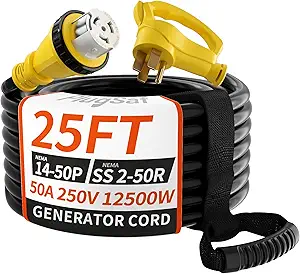
1. PlugSaf 50 Amp Generator Cord – 25 Feet
Check Amazon Price Click Here!
Model: PlugSaf 50 Amp Generator Cord
Length: 25 Feet
Plug Type: NEMA 14-50P to SS2-50R
Certification: ETL Certified as listed in the original product information
Key Features: Heavy-duty construction, locking connection, outdoor-oriented design
Overview
The PlugSaf 25FT 50 Amp Generator Cord is a practical length for installations where the generator does not need to sit far away from the RV or generator inlet box.
Its NEMA 14-50P to SS2-50R configuration makes it particularly relevant for setups using a compatible 50 amp generator inlet box. The locking connector can also help keep the connection secured once properly installed.
The 25-foot length is long enough for many residential backup-power and RV applications without creating as much excess cable as a 50- or 100-foot model.
Highlights
- 25-foot length for relatively short generator runs
- NEMA 14-50P to SS2-50R configuration
- Heavy-duty construction
- Designed for outdoor generator and RV applications
- Locking connection on the inlet-box side
- ETL certification stated for the original product
Who Should Consider It?
This model makes sense if your generator and inlet point are relatively close together and you specifically need a 50 amp generator cord with an SS2-50R connector.
Before ordering, confirm that your generator has the correct receptacle and that your inlet box accepts the SS2-50R connection.
2. CircleCord 50 Amp Generator Cord – 100 Feet
Check Amazon Price Click Here!
Model: CircleCord Heavy-Duty 50 Amp Cord
Length: 100 Feet
Plug Type: NEMA 14-50P to SS2-50R
Certification: UL Listed as stated in the original product information
Key Features: Long reach, ergonomic handling, outdoor-oriented construction
Overview
The CircleCord 100FT 50 Amp Generator Cord is intended for situations where the generator needs to be positioned considerably farther away from the RV or inlet connection.
A long cable can be useful for generator placement because portable generators should be operated outdoors and positioned according to the generator manufacturer’s instructions. However, 100 feet is considerably more cable than many RV owners actually need.
For that reason, measure your intended route before choosing this length.
Highlights
- 100-foot length for extended runs
- NEMA 14-50P to SS2-50R configuration
- Heavy-duty outdoor-oriented jacket
- Ergonomic grip design
- Long reach for generator placement
- UL listing stated in the original product information
Is a 100-Foot 50 Amp Cord Too Long?
Not necessarily, but longer is not automatically better.
A longer cord adds weight, takes more room to store, and can be less convenient to handle. The electrical characteristics of the complete setup also matter, including conductor size, load, voltage, and the generator’s output.
If you only need 25 feet, buying a 100-foot cord simply for extra reach may not be practical.
3. YOMILINK 50 Amp RV/Generator Cord – 50 Feet
Check Amazon Price Click Here!
Model: YOMILINK RV Generator Cord
Length: 50 Feet
Plug Type: NEMA 14-50P to SS2-50R
Certification: UL Listed as stated in the original product information
Key Features: 90-degree grip, flexible construction, weather-resistant design
Overview
The YOMILINK 50FT 50 Amp Cord sits between the short 15- and 25-foot options and the much longer 100-foot cable.
That makes 50 feet an interesting choice for RV owners or homeowners who need additional distance without going all the way to a 100-foot cable.
The 90-degree handle design can make the connector easier to manage, particularly when the connection point is positioned close to the ground or in a confined area.
Highlights
- 50-foot length
- NEMA 14-50P to SS2-50R configuration
- 90-degree grip design
- Flexible outdoor-oriented construction
- Locking connector
- UL listing stated in the original product information
Who Is It For?
This cable is worth considering when a 25-foot cord does not provide enough reach but a 100-foot model would be excessive.
As with every 50 amp generator cord, verify the actual connector configuration before purchase rather than relying only on the amperage rating.
4. PlugSaf 50 Amp Generator Cord – 15 Feet
Check Amazon Price Click Here!
Model: PlugSaf 15FT 50 Amp Cord
Length: 15 Feet
Plug Type: NEMA 14-50P to SS2-50R
Certification: ETL Certified as listed in the original product information
Key Features: Compact length, locking connection, outdoor-oriented construction
Overview
The PlugSaf 15FT 50 Amp Generator Cord is designed for installations where the generator and connection point are close together.
One advantage of a shorter cable is easier handling. A 15-foot cord takes up less storage space and generally has less excess cable to manage around an RV or generator setup.
The trade-off is obvious: you need to be certain that 15 feet is actually enough.
Highlights
- Compact 15-foot length
- NEMA 14-50P to SS2-50R configuration
- Locking connection
- Heavy-duty construction
- Outdoor-oriented design
- ETL certification stated in the original product information
Best Use
This is a sensible length when you already know that the generator can be positioned within a short distance of the connection point while still following the generator manufacturer’s safety requirements.
Do not choose a shorter cord simply because it is easier to store if it forces you to position the generator somewhere unsafe.
5. POWGRN 50 Amp RV Extension Cord – 25 Feet
Check Amazon Price Click Here!
Model: POWGRN 25FT 50 Amp Cord
Length: 25 Feet
Plug Type: NEMA 14-50P to 14-50R
Certification: ETL Listed as stated in the original product information
Key Features: Outdoor-oriented jacket, flexible design, insulated handle
Overview
The POWGRN 50 Amp RV Extension Cord is different from the generator cords above because it uses a NEMA 14-50P to 14-50R configuration.
That distinction matters.
This type of cable is intended to extend an existing compatible 50 amp connection. It is not the same configuration as a NEMA 14-50P-to-SS2-50R cable designed for connecting a compatible generator to an inlet box.
Highlights
- 25-foot extension length
- NEMA 14-50P to 14-50R
- ETL listing stated in the original product information
- Outdoor-oriented insulation
- Flexible construction
- Ergonomic handling
Best Use
The POWGRN option can make sense when you need additional distance between two compatible 14-50 connections.
Always check both ends of your existing equipment before purchasing an extension cord.
How to Choose the Right 50 Amp Generator Cord
The right cable is not necessarily the longest or most expensive one. Start with compatibility, then consider construction and length.
1. Check the Connector Configuration
This should be your first step.
Look at the generator’s outlet, RV inlet, or generator inlet box and identify the exact connector.
For example:
- 14-50P to 14-50R: typically an extension cord
- 14-50P to SS2-50R: commonly used for compatible generator inlet-box connections
- SS2-50P: typically found as the inlet side of a compatible inlet box
Do not purchase a cord just because both the generator and cord are labeled “50 amp.”
2. Check the Voltage
Many 50 amp generator cords and RV cords are designed for 125/250V systems.
However, the cord’s rating does not guarantee that your generator produces 125/250V or that the generator can deliver 50 amps continuously.
Check the generator’s owner’s manual and the specifications printed on its receptacle.
3. Look at Wire Gauge
Many heavy-duty 50 amp generator cords use configurations such as 6/3 AWG + 8/1 AWG.
This describes three 6-gauge conductors plus one 8-gauge conductor, typically used for the two hot conductors, neutral, and ground arrangement.
Current 50 amp generator-cord products commonly advertise this type of construction.
The important point is not simply to find the largest-looking cable. The conductor size needs to be appropriate for the cord’s rating, length, connectors, and intended application.
4. Choose the Right Cord Length
Common lengths include:
- 10 feet
- 15 feet
- 25 feet
- 50 feet
- 75 feet
- 100 feet
A 15-foot cable can be convenient when the connection is close.
A 25-foot cable is a versatile option for many installations.
A 50-foot cable provides considerably more flexibility when the generator needs to be positioned farther away.
A 75- or 100-foot cable may be useful for specific installations but can be heavier and less convenient to store.
Measure the actual distance first rather than automatically buying the longest cord available.
5. Consider Outdoor Durability
If the cord will be used outdoors, look for construction designed for outdoor applications.
Depending on the specific product, features can include:
- Water-resistant jacket
- Flame-resistant insulation
- UV resistance
- Heat resistance
- Abrasion resistance
- Heavy-duty strain relief
- Molded connectors
- Locking connections
Current products in this category commonly advertise weather-resistant jackets and heavy-duty copper conductors.
However, “weather-resistant” does not mean you should leave electrical connections exposed to standing water or use a cord in conditions prohibited by the manufacturer’s instructions.
50 Amp Generator Cord vs. 50 Amp RV Extension Cord
These terms are sometimes used interchangeably online, but they can describe different products.
A 50 amp RV extension cord with NEMA 14-50P and 14-50R connectors is intended to extend a compatible 50 amp RV connection.
A 50 amp generator cord with NEMA 14-50P and SS2-50R connectors is commonly intended for a generator-to-inlet-box arrangement.
For example:
Generator → 14-50P to SS2-50R cord → SS2-50P inlet box → transfer equipment → home
That is a different setup from:
RV pedestal → 14-50P to 14-50R extension cord → RV power cord → RV
Understanding this difference can prevent buying an expensive cable that cannot connect to your equipment.
Can You Use a 50 Amp Generator Cord With an RV?
Yes, when the connectors, electrical ratings, and generator output are compatible.
A large RV may have a 50 amp electrical service, but the generator still needs to provide the appropriate output and receptacle configuration.
Some generators have a dedicated 14-50R receptacle. Others may require a different connection arrangement.
Before connecting the RV, check:
- The generator’s rated output.
- The generator receptacle configuration.
- The RV’s power inlet.
- The cord’s voltage and amperage rating.
- The generator manufacturer’s instructions.
A 50 amp cord cannot make an undersized generator capable of powering a large RV load.
Can a 50 Amp Generator Cord Power a House?
A properly configured 50 amp generator connection can be part of a residential backup-power system, but the cord itself does not connect a portable generator directly to a home’s branch circuits.
A typical setup may include:
Portable generator → 50 amp generator cord → outdoor inlet box → transfer switch or approved interlock equipment → selected household circuits
The exact configuration depends on the home’s electrical system and the equipment being installed.
A generator should never be connected to a home’s electrical system by improvised wiring or by backfeeding through a household receptacle.
For permanent residential installations, use equipment appropriate for the electrical system and follow applicable electrical codes and the manufacturer’s installation requirements.
How Many Watts Can a 50 Amp Cord Handle?
A 50 amp, 125/250V split-phase system can theoretically provide up to 12,500 watts at 250 volts.
However, that figure should not be interpreted as the output of every 50 amp generator cord setup.
The actual available power depends on:
- Generator capacity
- Generator voltage
- Circuit-breaker rating
- Cord rating
- Connector rating
- Electrical system configuration
- Continuous load
- Startup or surge requirements
For example, a generator rated at 7,500 running watts does not suddenly become a 12,500-watt generator because it is connected with a 50 amp cable.
Think of the cord as part of the power-delivery path, not as a source of additional generator capacity.
What Length 50 Amp Cord Should You Buy?
For most buyers, the best starting point is to measure the actual distance between the two connection points.
15 Feet
Good when the generator or power source is close to the connection.
25 Feet
A practical middle ground for many RV and backup-power applications.
50 Feet
Useful when you need more flexibility in generator placement.
75 to 100 Feet
Best reserved for installations where the extra distance is genuinely necessary.
Longer cables can be heavier, more difficult to store, and more cumbersome to handle. Current products are available in lengths from short runs to 100 feet and beyond, so there is usually no reason to buy more cable than your installation requires.
Safety Tips for Using a 50 Amp Generator Cord
A heavy-duty cord still needs to be used correctly.
Inspect the Cord Before Every Use
Look for:
- Cuts
- Cracked insulation
- Exposed conductors
- Burn marks
- Damaged plugs
- Loose connectors
- Signs of overheating
Do not use a damaged cable.
Keep Connections Properly Protected
Use outdoor-rated equipment and follow the manufacturer’s instructions regarding moisture and weather exposure.
Do Not Exceed the Cord Rating
The generator, cord, connectors, and connected equipment should be appropriately rated for the intended load.
Keep Portable Generators Outdoors
Never operate a fuel-burning portable generator inside a home, garage, enclosed RV, or other enclosed space because of carbon monoxide hazards. Follow the generator manufacturer’s required clearance and placement instructions.
Avoid Improvised Connections
Do not modify plugs or create makeshift connections simply to make incompatible equipment fit.
Use Proper Transfer Equipment for a Home
If you’re connecting a generator to a home’s electrical system, use a properly installed transfer switch or other approved equipment appropriate to the installation.
Which 50 Amp Generator Cord Length Is Best?
There is no single length that works for every setup.
If your generator is only a short distance from the connection point, a 15-foot or 25-foot cord can reduce excess cable and make storage easier.
If you need more room to position the generator safely, a 50-foot cord offers additional flexibility.
A 100-foot cable can be useful for specific long-distance applications, but it should not be selected simply because it provides the maximum reach.
The most important factors are connector compatibility, electrical rating, conductor size, cord construction, and the actual distance you need to cover.
Final Thoughts on 50 Amp RV Generator Power Cords
A 50 amp RV generator power cord is more than a heavy cable with a large plug. The connector configuration, voltage, conductor size, length, and intended application all matter.
The PlugSaf 15-foot and 25-foot options can suit shorter runs, while the YOMILINK 50-foot model provides additional reach. The CircleCord 100-foot option is designed for situations requiring substantially more distance. The POWGRN model is different because its 14-50P-to-14-50R configuration is intended as an extension cord rather than the same type of generator-to-inlet-box connection.
Before buying, identify the exact connectors on your generator, RV, or inlet box. Then choose a cord with the appropriate electrical rating and enough length to complete the installation without unnecessary excess.
For a 2026 setup, paying attention to these details is more useful than simply choosing the cord with the highest amp rating or longest length.
Quick Buying Checklist
Before ordering a 50 amp generator cord, confirm:
- The plug matches your generator or power source.
- The other end matches your RV, inlet box, or existing cord.
- The voltage rating is appropriate.
- The amperage rating is appropriate.
- The conductor size is suitable for the application.
- The cord is long enough without excessive unnecessary length.
- The construction is suitable for outdoor use when required.
- Any UL or ETL certification claimed on the listing applies to the exact product and configuration.
- Your generator has enough capacity for the appliances you intend to operate.
- A home’s electrical system uses appropriate transfer equipment rather than an improvised connection.
Choosing the correct 50 amp RV power cord can make your setup easier to use and help avoid compatibility problems. The key is to match the cord to the equipment you already have rather than assuming that every 50 amp cable is interchangeable.