As an Amazon Associate I earn from qualifying purchases.
A power outage can turn into a much bigger problem when the refrigerator, sump pump, well pump, HVAC system, medical equipment, or other essential appliances depend on electricity. For homeowners who want more flexibility than a standard gasoline generator can provide, a multi-fuel generator can be a practical backup power solution.
In 2026, one of the most useful options in this category is the tri-fuel generator, which can operate on gasoline, propane, or natural gas. Having three fuel choices can make a difference during a prolonged outage because you are not dependent on a single fuel source.
Gasoline is convenient and widely available, propane can be stored for emergencies, and natural gas can provide a continuous fuel source when the utility service remains available. However, the available wattage is not necessarily the same on every fuel, so that difference matters when choosing a generator for home backup.
This guide looks at several high-output multi-fuel generators, including models from DuroMax, Westinghouse, and WEN. Rather than focusing only on peak wattage, we’ll look at running power, fuel flexibility, starting features, safety technology, runtime, and home-backup considerations.
Multi Fuel Generator Comparison for 2026
| Model | Fuel Type | Key Feature |
|---|---|---|
| DuroMax XP13000HXT | Tri-Fuel | High output and three-fuel flexibility |
| Westinghouse 14500 Peak Tri-Fuel | Tri-Fuel | High gasoline output and extended runtime |
| Westinghouse 12500 Watt Dual Fuel | Dual Fuel | Gasoline and propane flexibility |
| WEN 14500-Watt Tri-Fuel | Tri-Fuel | 120V/240V home-backup capability |
| Westinghouse 13500 Peak Dual Fuel | Dual Fuel | High output with gasoline/propane flexibility |
What Is a Multi-Fuel Generator?
A multi-fuel generator is a portable generator designed to operate with more than one type of fuel.
A dual-fuel generator typically uses gasoline and propane, while a tri-fuel generator can use gasoline, propane, and natural gas.
The biggest advantage is flexibility. If gasoline becomes difficult to obtain during a major storm, you may be able to switch to propane. If your home has an appropriate natural gas connection, a tri-fuel generator gives you another option for longer outages.
There is an important tradeoff, however: generators generally produce different amounts of power depending on the fuel being used.
For example, the DuroMax XP13000HXT produces 13,000 peak watts and 10,500 running watts on gasoline, but its published running output drops to 9,500 watts on propane and 8,500 watts on natural gas.
That is why the fuel you actually expect to use should be part of your generator-sizing decision.
Top Multi Fuel Generators for 2026
The models below cover several different needs, from high-output home backup to flexible dual-fuel operation. They are not identical, so the right choice depends on your electrical loads, preferred fuel, and installation requirements.
DuroMax XP13000HXT: High-Output Tri-Fuel Flexibility
Check Amazon Price Click Here!
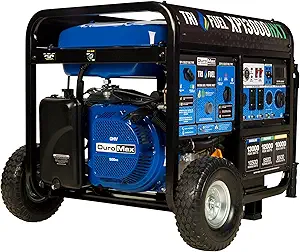
The DuroMax XP13000HXT is built for buyers who want substantial portable power combined with gasoline, propane, and natural gas capability.
One important correction from the older version of this article is the wattage description. The XP13000HXT does not provide 13,000 running watts. Its gasoline rating is 13,000 peak watts and 10,500 running watts. DuroMax lists 12,000 peak and 9,500 running watts on propane, while natural gas provides 11,000 peak and 8,500 running watts.
That distinction is important if you are planning to power several appliances at the same time.
The generator uses a 500cc four-stroke OHV engine and includes CO Alert technology. DuroMax also publishes gasoline runtime figures of up to 17 hours at 25% load, although actual runtime will vary depending on the connected load and fuel.
DuroMax XP13000HXT Specifications
| Feature | Specification |
|---|---|
| Fuel | Gasoline, propane, natural gas |
| Gasoline peak output | 13,000 watts |
| Gasoline running output | 10,500 watts |
| Propane running output | 9,500 watts |
| Natural gas running output | 8,500 watts |
| Engine | 500cc 4-stroke OHV |
| CO protection | CO Alert |
| Best suited for | High-demand home backup and jobsite use |
The XP13000HXT makes the most sense for someone who wants a large portable generator and expects to take advantage of multiple fuel sources.
It can also be connected to a properly installed home transfer equipment setup. However, a generator should never be connected directly to household wiring without the appropriate equipment and installation.
Westinghouse 14500 Peak Tri-Fuel: High Output for Extended Outages
Check Amazon Price Click Here!
The Westinghouse 14500 Peak Tri-Fuel Generator is another high-output option for homeowners who want gasoline, propane, and natural gas flexibility.
The gasoline rating is 14,500 peak watts and 11,500 running watts, putting it in a higher output class than many portable generators. Current comparisons also highlight its 550cc engine, 9.5-gallon fuel tank, remote start, and published gasoline runtime of up to 19 hours under the specified test conditions.
The 19-hour figure should not be interpreted as a guaranteed runtime under heavy loads. Generator runtime changes significantly depending on how much electricity you are drawing.
For homeowners, the combination of high running wattage and tri-fuel capability can be particularly useful during long outages.
Westinghouse 14500 Key Features
- Tri-fuel operation
- 14,500 peak watts
- 11,500 running watts on gasoline
- 550cc engine
- Remote electric start
- Large 9.5-gallon fuel tank
- 120V/240V capability
- Designed for high-demand portable backup applications
One of the biggest advantages of this type of generator is the ability to use natural gas when that utility remains available. However, users should always check the generator’s fuel-specific output before deciding which appliances can run simultaneously.
Westinghouse 12500 Watt Dual Fuel: Gasoline and Propane Flexibility
Check Amazon Price Click Here!
Not every homeowner needs a tri-fuel generator. If natural gas is not available or you simply prefer gasoline and propane, a dual-fuel generator can provide the flexibility you need without adding a third fuel option.
The Westinghouse 12500 Watt Dual Fuel model is designed around gasoline and propane operation and includes features intended for home backup use.
A digital display is useful because it provides information such as voltage, frequency, and operating hours. Remote starting can also be convenient when the generator is positioned outside during bad weather.
The important consideration is still the actual running wattage. Peak wattage can help the generator handle temporary startup demands from motors and compressors, but running wattage is the figure you should use when estimating the continuous electrical load.
Westinghouse 12500 Key Features
- Dual-fuel gasoline and propane operation
- High-output portable design
- Remote starting
- Digital monitoring
- 120V/240V capability
- Suitable for backup power applications
This model can be a practical choice for households that want propane as an alternative fuel but do not need natural gas compatibility.
WEN 14500-Watt Tri-Fuel Generator: Flexible Home Backup
Check Amazon Price Click Here!
The WEN 14500-Watt Tri-Fuel Generator is another model aimed at homeowners who want a high-output portable generator with gasoline, propane, and natural gas flexibility.
One of the important considerations with a generator in this class is the electrical connection. Current information on WEN’s TF-1450X configuration identifies a 120V/240V setup with a NEMA 14-50R outlet, making it relevant to installations using an appropriately sized generator inlet and transfer equipment.
The generator also includes carbon monoxide protection and is designed for home backup applications.
WEN 14500 Key Features
- Tri-fuel operation
- High-output gasoline performance
- Gasoline, propane, and natural gas capability
- 120V/240V output
- NEMA 14-50R connection
- CO safety technology
- Suitable for home backup applications
The main reason to consider this type of generator is flexibility. You can keep gasoline available for immediate use, store propane for emergencies, and potentially use natural gas when your home connection supports it.
As with any large portable generator, professional installation may be necessary if you want to connect it to your home’s electrical system.
Westinghouse 13500 Peak Dual Fuel: High Power Without Natural Gas
Check Amazon Price Click Here!
The Westinghouse 13500 Peak Dual Fuel Generator is aimed at buyers who want high portable output but only need gasoline and propane.
The dual-fuel design gives you two ways to operate the generator during an outage. Gasoline can provide higher output and is widely available, while propane offers longer-term storage advantages and can be kept ready for emergency use.
Current comparisons of this model class list approximately 13,500 peak watts and 10,500 running watts on gasoline, with lower output when operating on propane.
Westinghouse 13500 Key Features
- Gasoline and propane operation
- Up to 13,500 peak watts
- Approximately 10,500 running watts on gasoline
- Remote start
- Transfer-switch-ready configuration
- CO safety technology
- High-output portable design
This type of generator can make sense if your home does not have natural gas service or if you prefer to keep your emergency fuel supply limited to gasoline and propane.
How to Choose the Right Multi Fuel Generator
Buying a generator based only on its largest wattage number can lead to an expensive mistake. Before choosing a model, consider the following factors.
1. Determine Your Running Wattage
Running watts are the amount of power the generator can continuously provide.
Start by listing the appliances and systems you actually need during an outage.
For example, you might want to operate:
- Refrigerator
- Freezer
- Sump pump
- Well pump
- Furnace blower
- Selected lights
- Internet equipment
- Television
- Microwave
- Window or central air conditioning
Do not automatically assume that a 13,000- or 14,000-watt generator can run every electrical appliance in your home simultaneously.
Large electric water heaters, electric dryers, electric ranges, central air conditioners, well pumps, and other motor-driven equipment can consume substantial amounts of power.
2. Understand Starting Watts
Some appliances require additional power when their motors start.
Air conditioners, refrigerators, pumps, compressors, and other motor-driven equipment can have a starting surge that is significantly higher than their normal running consumption.
This is why generators advertise both peak watts and running watts.
When comparing models, look at both numbers rather than choosing a generator based solely on the larger peak-wattage figure.
3. Think About Which Fuel You Will Actually Use
A tri-fuel generator gives you three fuel options, but that does not mean all three provide identical performance.
Gasoline generally provides the highest output on many portable generators. Propane often produces somewhat less power, while natural gas can produce less again.
The DuroMax XP13000HXT illustrates this clearly:
- Gasoline: 10,500 running watts
- Propane: 9,500 running watts
- Natural gas: 8,500 running watts
If natural gas will be your primary emergency fuel, use the natural-gas running wattage when determining whether the generator is large enough.
4. Consider Runtime at the Load You Expect
A manufacturer may advertise a runtime of 17 or 19 hours, but that number is normally associated with a particular load level.
A generator operating at a high electrical load will consume fuel much faster than one powering only a refrigerator, lights, and a few small devices.
When comparing models, look for runtime information at a stated load percentage rather than assuming the maximum advertised runtime applies to every situation.
5. Check the Electrical Connection
For whole-home backup, the connection is just as important as the generator itself.
A large portable generator may use a 30-amp or 50-amp connection depending on the model. Some also provide 120V/240V output.
If you intend to connect the generator to your home’s electrical system, have the installation completed using the appropriate transfer equipment by a qualified professional.
Never attempt to energize household wiring by plugging a generator into a standard wall outlet.
6. Look for Carbon Monoxide Safety Features
CO shutoff technology is an important safety feature, but it should never be treated as permission to operate a portable generator indoors.
The U.S. Consumer Product Safety Commission recommends operating portable generators outside and at least 20 feet from the home, with the exhaust directed away from the house. Generators should never be operated in a garage, basement, shed, crawlspace, or other enclosed area, even when doors or windows are open.
CPSC also recommends having working carbon monoxide alarms in the home.
This is one of the most important considerations when purchasing and using any gasoline, propane, or natural gas portable generator.
Tri-Fuel vs. Dual-Fuel Generators
The choice between dual-fuel and tri-fuel depends largely on your available fuel sources.
Dual-Fuel
A dual-fuel generator typically operates on:
- Gasoline
- Propane
Advantages include simpler fuel flexibility and the ability to keep propane stored for emergencies.
Tri-Fuel
A tri-fuel generator typically operates on:
- Gasoline
- Propane
- Natural gas
The additional natural gas option can be useful for homes with an appropriate utility connection. It can also reduce dependence on stored gasoline during a prolonged outage.
The tradeoff is that natural gas usually produces less power than gasoline on the same generator, so the natural-gas wattage needs to be considered when sizing the unit.
Can a Multi Fuel Generator Power an Entire House?
A large portable generator can power many of the important systems in a home, but that does not automatically mean it can run every electrical appliance simultaneously.
Whether a generator can provide whole-home backup depends on:
- Generator running wattage
- Starting wattage requirements
- Electrical service
- Transfer equipment
- HVAC requirements
- Appliances being used
- Load-management strategy
A 13,000- to 14,500-watt generator can provide substantial backup power, but large electrical loads can quickly consume the available capacity.
For example, if you are running central air conditioning, a well pump, refrigerator, freezer, water heater, and electric range at the same time, the total demand may be considerably higher than expected.
Load management is often more practical than trying to operate everything simultaneously.
Generator Safety During a Power Outage
A generator can be extremely useful during an emergency, but it must be operated correctly.
The most important rules are straightforward.
Always operate the generator outdoors.
CPSC recommends placing a portable generator at least 20 feet from the home and positioning the exhaust away from doors, windows, vents, and other openings.
Never operate it inside a garage or enclosed structure.
Opening the garage door does not make indoor generator operation safe. Carbon monoxide can build up quickly and may become fatal before people realize there is a problem.
Keep the generator dry and follow the manufacturer’s instructions.
Wet conditions can create additional electrical hazards. CPSC recommends following the manufacturer’s instructions concerning operation during rain and other severe weather.
Maintain the generator before an emergency.
Check the oil, battery, fuel system, cables, connections, and other maintenance items according to the owner’s manual. A generator that has been sitting unused for months should not be assumed to be ready simply because it starts.
Which Type of Multi Fuel Generator Makes Sense for You?
A high-output tri-fuel generator makes sense if you want maximum fuel flexibility and have access to natural gas.
A dual-fuel generator can be sufficient if your preferred backup fuels are gasoline and propane.
For larger homes, the most important consideration is not simply the generator’s peak wattage. Look at the running wattage on your primary fuel, the starting requirements of your largest appliances, and the connection method required for your home.
For example, someone planning to use natural gas as the primary fuel should pay particular attention to the natural-gas running rating. A generator that looks extremely powerful based on its gasoline rating may provide considerably less continuous output on natural gas.
Final Thoughts
The best multi-fuel generator for your home depends on how much electricity you need, which fuels are available, and how you plan to connect and operate the generator.
The DuroMax XP13000HXT offers a combination of high output and gasoline, propane, and natural gas flexibility, with published ratings of 10,500 running watts on gasoline, 9,500 on propane, and 8,500 on natural gas.
The Westinghouse 14500 Peak Tri-Fuel is another high-output option, particularly for buyers looking for a large portable generator with tri-fuel capability, remote starting, and a large fuel tank.
The Westinghouse 12500 Dual Fuel and 13500 Dual Fuel models are worth considering when gasoline and propane are enough for your emergency-power plan, while the WEN 14500-Watt Tri-Fuel provides another high-output option for homeowners looking for gasoline, propane, and natural gas flexibility.
Before buying, calculate the running and starting wattage of the appliances you actually need, check the output available on your preferred fuel, and make sure your planned electrical connection is appropriate.
Most importantly, treat carbon monoxide safety as a non-negotiable part of generator ownership. A CO sensor or automatic shutdown feature adds protection, but it does not replace proper outdoor placement. CPSC’s current guidance remains to operate portable generators outdoors, at least 20 feet from the home, with exhaust directed away from the building.
For emergency preparedness, fuel flexibility can be valuable. But the generator that fits your needs is ultimately the one whose actual running output, fuel options, electrical connections, and safety features match the way you expect to use it during an outage.