As an Amazon Associate I earn from qualifying purchases.
A portable generator gives you a reliable source of electricity when the grid goes down, but the power coming from a generator still needs to be matched to the equipment you’re connecting to it. Voltage spikes, wiring problems, overloads, and other electrical faults can damage sensitive electronics, appliances, tools, and RV equipment.
That’s where a generator surge protector can help.
However, not every product marketed as a surge protector does the same job. A heavy-duty 120V power strip is very different from a 50-amp RV electrical management system, and a short generator splitter cord is different again. Understanding that difference is one of the most important parts of choosing the right protection for your setup.
For 2026, the products below cover several common generator-related applications, including workshop equipment, home backup setups, portable generators, and RV power connections.
Best Generator Surge Protectors for 2026
| Product | Best For | Surge Rating | Key Feature |
|---|---|---|---|
| CRST 10-Outlet Metal Surge Protector | Workshops and portable setups | 2,800J | Metal housing, 10 outlets |
| CCCEI 8-Outlet Surge Protector with USB | Workshops and multiple electronics | 2,700J | 8 outlets + USB |
| Kohree 50A RV Surge Protector | 50A RV connections | Up to 12,000J depending on version | Circuit analyzer and automatic protection |
| Yodotek Generator Cord Surge Protector | 30A portable generators | Not clearly specified as a joule rating | 4-outlet generator splitter |
| GEARGO 50A RV Surge Protector | 50A RV users | 15,000J | IP68 housing and circuit analyzer |
Why Use a Surge Protector With a Generator?
A generator provides electricity, but that does not automatically mean every connected device is protected from electrical disturbances.
A surge protector is designed primarily to help protect connected equipment from short-duration voltage surges or transient events. It should not be confused with a voltage regulator or an uninterruptible power supply.
This distinction matters because a basic surge protector does not necessarily disconnect your equipment when the voltage stays too low or too high.
For RV owners, the difference is especially important. A basic surge protector may provide surge protection and basic wiring diagnostics, while a full EMS (Electrical Management System) can monitor conditions such as high voltage, low voltage, reverse polarity, open neutral, or other wiring problems and disconnect the RV when unsafe conditions are detected. Current 2026 RV guides increasingly make this distinction a central part of their buying advice.
For a workshop or home generator setup, meanwhile, a heavy-duty power strip can be useful for distributing 120V power to several compatible devices, provided you stay within the strip’s electrical rating.
The important point is simple: choose protection based on the generator connection and the equipment you’re powering, rather than choosing only by the highest joule number.
Top Generator Surge Protection Devices
1. CRST 10-Outlet Metal Surge Protector
Buy the CRST 10-Outlet Metal Surge Protector on Amazon
The CRST 10-Outlet Metal Surge Protector is a practical choice for workshops, garages, job sites, and portable generator setups where you need multiple 120V outlets in one location.
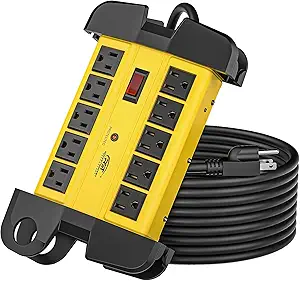
The current model provides 2,800 joules of surge protection, 10 AC outlets, a 15A/125V electrical rating, and up to 1,875 watts of connected load. It is available with either a 6-foot or 15-foot cord, depending on the version. The metal housing is designed for demanding workshop environments, and the unit is ETL listed.
One useful feature is the resettable overload protection. That gives you a way to restore operation after an overload without replacing a fuse.
The 15-foot version can also be useful when the generator or power source is positioned farther away from the work area.
Best for: Workshops, garages, contractors, and portable generator setups using standard 120V equipment.
What to know: This is a 15A/125V power strip. It is not a 30A or 50A RV EMS and should not be treated as one.
2. CCCEI 8-Outlet Surge Protector With USB
Buy the CCCEI 8-Outlet Surge Protector on Amazon
The CCCEI 8-Outlet Surge Protector is another heavy-duty option for users who need several outlets from a portable power source.
The model in this category has eight AC outlets, 2,700 joules of surge protection, a 15A/125V rating, and a USB charging port rated at 5V/2.1A. Its metal construction and wall-mountable design make it particularly suitable for workshops and garages.
The wide-spaced outlets are useful when several connected devices have bulky adapters. The built-in circuit breaker also provides overload protection.
The USB port is a convenience feature rather than a reason to exceed the strip’s electrical capacity. You still need to calculate the combined load of everything connected to it.
Best for: Workshops, garages, home backup power, and users who need both AC outlets and USB charging.
What to know: Like the CRST, this is a standard 120V/15A power strip rather than a dedicated RV electrical management system.
3. Kohree 50 Amp RV Surge Protector
Buy the Kohree 50 Amp RV Surge Protector on Amazon
RV owners have different electrical protection requirements from someone simply plugging tools into a generator.
The Kohree 50A RV Surge Protector is designed for RV power connections and includes a circuit analyzer that can help identify wiring problems before you connect the RV’s electrical system.
Kohree currently sells several versions of its 50A protector, so specifications can vary by model. One current version is listed with 12,000 joules, automatic voltage cutoff and reconnection, an LED display, and an IP65 weather-resistant design. Other Kohree 50A versions offer different surge ratings, so buyers should verify the exact model before ordering.
The device is designed around the NEMA 14-50 connection commonly used for 50A RV service. That makes it fundamentally different from a standard 120V household power strip.
The circuit analyzer is particularly useful because RV electrical problems are not limited to brief surges. Wiring faults and abnormal voltage can also create problems for expensive RV equipment.
Best for: 50A RVs, campers, and motorhomes using compatible shore-power connections.
What to know: Confirm the exact Kohree model and joule rating before purchasing because the product line includes multiple versions.
4. Yodotek Generator Cord Surge Protector
Buy the Yodotek Generator Cord Surge Protector on Amazon
The Yodotek product is different from the other products on this list because it combines a generator connection with multiple outlets in a short, heavy-duty cord assembly.
The 1.5-foot version is designed around a 30A generator connection and can handle up to 7,500 watts according to the product specifications. It uses a NEMA L14-30P input and provides four NEMA 5-20R outlets. The cable is 10-gauge and designed for demanding generator applications.
This can be convenient when you need to distribute power from a portable generator without carrying a large power strip.
However, the product should not be compared directly with a dedicated RV EMS. Its primary advantage is its generator-cord and splitter design.
Best for: Portable generators, job sites, temporary outdoor setups, and users who need several standard outlets from a 30A generator connection.
What to know: Verify the exact electrical specifications of your generator and the devices you intend to connect before use.
5. GEARGO 50 Amp RV Surge Protector
Buy the GEARGO 50 Amp RV Surge Protector on Amazon
The GEARGO 50A RV Surge Protector is one of the higher-rated options in the original product group, with a published 15,000-joule surge protection rating.
It is designed for 50A RV connections and includes a circuit analyzer capable of identifying several common wiring conditions, including open ground, open neutral, reverse polarity, reversed hot/ground, and no power. The product documentation also lists an IP68 waterproof rating and flame-retardant construction.
The circuit analyzer is one of the more useful features because it provides information about the incoming electrical connection before the RV is fully exposed to a potentially faulty power source.
Some versions also provide automatic shutoff when voltage moves outside a specified range. Because GEARGO sells more than one configuration, check the exact model and specifications associated with the listing before buying.
Best for: 50A RV owners who want high surge capacity, weather resistance, and electrical diagnostics.
What to know: A high joule rating is useful, but it should not be the only factor you consider when comparing RV electrical protection.
Surge Protector vs. EMS: What’s the Difference?
This is one of the most important things to understand before buying.
A basic surge protector primarily protects against short-duration voltage spikes. Some models also provide a basic wiring indicator.
An EMS, or Electrical Management System, goes further. Depending on the model, it can monitor incoming voltage and wiring conditions and disconnect the RV when it detects potentially damaging conditions.
| Feature | Basic Surge Protector | RV EMS |
|---|---|---|
| Surge protection | Yes | Yes |
| Wiring diagnostics | Some models | Usually |
| Low-voltage protection | Usually no | Yes, depending on model |
| High-voltage protection | Usually no | Yes, depending on model |
| Automatic shutoff | Limited/model dependent | Common |
| Reverse polarity detection | Some models | Common |
| Open neutral detection | Some models | Common |
| Typical application | Basic protection | Comprehensive RV electrical protection |
This distinction has become especially prominent in 2026 RV buying guides. Several current comparisons emphasize that sustained low or high voltage and wiring faults can be just as important to RV owners as a sudden surge.
If you are protecting a workshop with a portable generator, a heavy-duty surge strip may be all you need for compatible 120V equipment.
If you are protecting an expensive RV connected to campground power or a compatible generator, an EMS can provide a considerably broader layer of electrical monitoring.
What to Look for in a Generator Surge Protector
1. Correct Voltage and Amperage
Start with the electrical connection, not the joule rating.
A 120V/15A power strip is designed for a completely different application than a 30A generator cord or a 50A RV protector.
Never assume that a product rated for a higher amperage automatically provides better protection for your equipment.
2. Joule Rating
The joule rating indicates how much surge energy the protective components are designed to handle under specified conditions.
A higher number can provide more surge capacity, but it should not be used as the sole measure of product quality.
A 15,000-joule RV protector is not automatically the right choice for a 15A workshop circuit simply because the number is higher.
3. Wiring Diagnostics
For RV users, wiring diagnostics can be extremely useful.
Features may include detection of:
- Open ground
- Open neutral
- Reverse polarity
- Incorrect wiring
- High voltage
- Low voltage
- No power
The exact conditions monitored vary between manufacturers and models.
4. Automatic Shutoff
Automatic shutoff is particularly valuable for RV applications.
If the incoming voltage becomes unsafe, a suitable EMS can disconnect the RV rather than allowing abnormal power to continue feeding the electrical system.
5. Weather Resistance
If the protector will be used outdoors, look for a product designed for outdoor exposure.
An IP rating can provide useful information about resistance to water and dust, but you should still follow the manufacturer’s instructions about placement and weather exposure.
6. Safety Certification
Look for recognized certification such as UL or ETL listing when applicable.
For example, the CRST 10-outlet model is ETL listed and references UL 1363 and UL 1449 in its current specifications.
Certification is more meaningful than simply seeing the word “heavy-duty” in a product title.
7. Cord and Plug Configuration
Make sure the plug matches your generator, RV, or other power source.
For RVs, pay particular attention to whether you need a 30A or 50A connection.
For generators, check the receptacle type, such as a standard 120V outlet or a 30A locking connection.
30 Amp vs. 50 Amp RV Surge Protection
If you’re buying protection for an RV, determining the correct amperage is essential.
A 30A RV uses a different connection from a 50A RV. A 50A RV protector should not be purchased simply because it has a higher amperage rating.
Your RV’s shore-power cord or inlet should tell you which service you have.
30A RV
A 30A RV connection is common on smaller travel trailers and many smaller motorhomes.
These systems generally use a three-prong 120V connection.
50A RV
A 50A RV connection is common on larger motorhomes, fifth wheels, and larger travel trailers.
The 50A connection uses four conductors and supports a split-phase configuration.
Because of these differences, choose the protector specifically designed for your RV’s electrical service.
Current RV protection guides consistently emphasize matching the protector to the RV’s 30A or 50A service rather than treating the two as interchangeable.
Can You Use an RV Surge Protector With a Generator?
In many cases, yes, but there is an important qualification: the generator and RV electrical systems have to be compatible with the protector.
One issue that can appear with portable generators is the neutral-to-ground configuration.
Some generators have a bonded neutral while others have a floating neutral. Certain RV electrical protection devices may interpret a floating-neutral generator as a wiring problem and refuse to connect power.
This is why you should check your generator manual and the surge protector or EMS manufacturer’s compatibility requirements before purchasing an adapter or changing the neutral configuration.
Do not modify the generator’s grounding or neutral system simply to make a protection device accept the connection.
Generator Surge Protector Safety Tips
A surge protector is only one part of a safe generator setup.
Keep these practices in mind:
- Follow the generator manufacturer’s grounding and connection instructions.
- Never exceed the rated amperage or wattage of the protector.
- Do not connect multiple power strips together.
- Do not use an indoor-rated power strip in conditions where the manufacturer does not permit outdoor use.
- Inspect cords, plugs, housings, and outlets for heat damage or cracking.
- Stop using a protector if it shows signs of overheating or physical damage.
- Make sure the generator itself is operated outdoors in accordance with the manufacturer’s carbon monoxide safety instructions.
- Never backfeed a home through a wall outlet.
- Use a properly installed transfer switch or approved interlock system when connecting a generator to a home’s electrical system.
- Keep generators away from doors, windows, and other openings as specified by the generator manufacturer.
A surge protector cannot protect you from carbon monoxide, improper generator connections, overloaded circuits, or unsafe backfeeding.
How to Maintain a Generator Surge Protector
Before using the equipment, inspect it for:
- Cracked or damaged housing
- Burn marks or discoloration
- Melted plastic around plugs
- Damaged cords
- Loose connections
- Fault indicators
- Signs of water intrusion
Do not rely on a fixed rule such as replacing every surge protector after exactly two or three years. Product lifespan depends on the device, environment, frequency of use, and number of electrical events it has experienced.
Instead, follow the manufacturer’s replacement recommendations and replace the device if it is damaged or indicates that its surge protection has been exhausted.
For outdoor and RV equipment, keeping the device clean and protected from unnecessary moisture and physical abuse can also help extend its useful life.
Which Generator Surge Protector Should You Choose?
The right option depends on what you’re actually powering.
For a workshop or garage: The CRST 10-Outlet is a practical choice when you need multiple standard 120V outlets, metal construction, and 2,800 joules of surge protection.
For multiple electronics and USB charging: The CCCEI 8-Outlet provides eight AC outlets, USB charging, and 2,700 joules of surge protection in a heavy-duty design.
For a 50A RV: The Kohree or GEARGO options make more sense because they are designed specifically around RV power connections and include circuit-analysis features.
For a portable 30A generator: The Yodotek generator cord can be useful when you want a compact way to distribute power through several standard outlets.
For broader RV electrical protection: Consider an actual EMS rather than looking only at the joule rating. Current 2026 RV guides increasingly separate full EMS devices from basic surge protectors because they address additional electrical problems such as abnormal voltage and wiring faults.
Frequently Asked Questions
Do I need a surge protector for a portable generator?
It can be useful when powering sensitive electronics or multiple connected devices, but the correct type depends on the generator’s outlets and the equipment being powered. A standard 120V power strip should only be used within its rated electrical limits. RV owners may need a dedicated RV surge protector or EMS.
Can a surge protector regulate generator voltage?
Not necessarily. A basic surge protector is designed primarily to deal with short-duration voltage surges. It does not automatically regulate a generator’s output like a voltage regulator or power-conditioning device.
Is a higher joule rating always better?
Not by itself. A higher joule rating can indicate greater surge-energy capacity, but you should also consider voltage, amperage, certification, wiring diagnostics, automatic shutoff, environmental protection, and compatibility with your generator or RV.
Can I use a 50A RV surge protector with a 30A RV?
No. The protector should match the electrical service and connection used by your RV. A 50A protector is not simply a more powerful version of a 30A protector.
Can an RV surge protector work with a portable generator?
Many can, but generator neutral configuration can matter. Some portable generators have floating neutrals, which may cause certain RV protection devices or EMS units to report a wiring fault. Check compatibility with both the generator and the protector before use.
Does a surge protector protect against low voltage?
A basic surge protector generally does not. Some RV EMS devices do monitor low voltage and can automatically disconnect the RV when voltage falls outside their specified range.
How many joules should a generator surge protector have?
There is no universal minimum that works for every generator application. Choose a product with an appropriate surge rating for the equipment and application, while also considering electrical ratings, certification, and additional protection features.
Can I plug a power strip directly into a generator?
If the generator has a compatible receptacle and the power strip is rated for the voltage, amperage, and environment involved, it may be possible. Never exceed the power strip’s rating, and don’t use an indoor-rated product where the manufacturer does not permit outdoor use.
Final Thoughts
The best generator surge protection device for 2026 isn’t necessarily the one with the biggest joule number.
The first question is what type of electrical system are you protecting?
A heavy-duty 120V power strip such as the CRST or CCCEI can make sense for workshop equipment, tools, electronics, and other compatible loads. A product such as the Yodotek serves a different purpose by providing a compact 30A generator connection with multiple outlets.
RV owners have a different decision to make. A 30A or 50A RV requires protection designed around its specific electrical service, and a full EMS can provide considerably more protection than a basic surge-only device.
The Kohree and GEARGO 50A products are designed for this RV-oriented application, with circuit-analysis features and surge protection intended for larger RV electrical systems.
Before buying, check amperage, voltage, plug configuration, surge rating, certification, weather resistance, wiring diagnostics, and automatic shutoff features. Most importantly, make sure the device is designed for the way you actually use your generator.
The goal isn’t simply to buy the highest-rated surge protector available. It’s to put the right type of electrical protection between your generator or power source and the equipment you depend on.
Quick Comparison
| Product | Application | Surge Rating | Electrical Rating | Standout Feature |
|---|---|---|---|---|
| CRST 10-Outlet | Workshop / portable setup | 2,800J | 15A / 125V | Metal housing + 10 outlets |
| CCCEI 8-Outlet | Workshop / electronics | 2,700J | 15A / 125V | 8 outlets + USB |
| Kohree 50A RV | 50A RV | Up to 12,000J depending on model | 50A | Circuit analyzer + automatic protection |
| Yodotek Generator Cord | 30A generator | Not clearly specified | 30A / up to 7,500W | 4-outlet generator splitter |
| GEARGO 50A RV | 50A RV | 15,000J | 50A | IP68 + circuit analyzer |