As an Amazon Associate I earn from qualifying purchases.
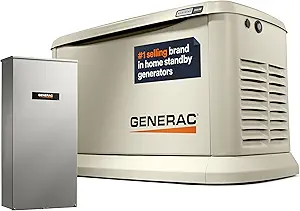
If you are looking for a whole-house standby generator that can handle a large number of electrical loads during an outage, the Generac Guardian 26kW Home Standby Generator Model 7291 is one of the larger air-cooled residential options in Generac’s lineup.
The Model 7291 is designed for automatic backup power and operates on either liquid propane (LP) or natural gas (NG). It includes a 200-amp automatic transfer switch and Wi-Fi connectivity for remote monitoring through Generac’s Mobile Link system.
There is one important detail to understand before buying it, though: 26kW is the maximum continuous output when operating on propane. On natural gas, the published maximum continuous output is 22.5kW. That difference can matter when you are sizing a generator for a home with multiple air conditioners, electric appliances, well pumps, or other large loads.
This review looks at the Model 7291’s power capacity, fuel consumption, transfer switch, noise level, monitoring features, maintenance requirements, and the situations where its size makes sense.
Generac Guardian 26kW Model 7291 Specifications
| Feature | Generac Guardian Model 7291 |
|---|---|
| Maximum output on LP | 26,000 watts |
| Maximum output on NG | 22,500 watts |
| Fuel type | Liquid propane or natural gas |
| Engine | Generac G-Force 1000 Series |
| Engine displacement | 999cc |
| Engine configuration | V-Twin, 2-cylinder |
| Voltage | 120/240V |
| Phase | Single phase |
| Main-line circuit breaker | 110 amps |
| Automatic transfer switch | 200 amps |
| Enclosure | Aluminum |
| Dimensions | 48 x 25 x 29 inches |
| Weight | About 518 lbs |
| Noise at 23 feet, normal load | About 67 dBA |
| Quiet-Test mode | About 57 dBA |
| NG consumption at 50% load | 188 ft³/hour |
| NG consumption at full load | 333 ft³/hour |
| LP consumption at 50% load | 2.06 gal/hour |
| LP consumption at full load | 3.63 gal/hour |
| Monitoring | Mobile Link Wi-Fi |
| Controller | Evolution |
| Warranty | 5-year limited warranty |
The specifications above are based primarily on Generac’s current product information and specification sheet.
How Much Power Does the Generac 7291 Actually Produce?
The biggest reason to consider the Model 7291 is its high output.
On liquid propane, Generac lists the generator at 26,000 watts of maximum continuous power. On natural gas, the maximum continuous output is 22,500 watts.
That distinction is easy to miss when comparing 26kW standby generators online.
For example, a homeowner may see “26kW” in a product listing and assume that the generator produces 26,000 watts regardless of fuel. That is not the case here.
The natural-gas rating is still substantial, but the difference becomes relevant when a home has several large electrical loads operating simultaneously.
A 22.5kW natural-gas output can provide considerable whole-house capacity, but you should not automatically assume it will run every electrical appliance in a large home at the same time.
The correct generator size depends on the home’s actual electrical demand and the starting requirements of motor-driven equipment.
Is the Generac 7291 a Whole-House Generator?
The Model 7291 is designed for whole-house backup applications and comes with a 200-amp automatic transfer switch in the 7291 package. Retail listings also identify the unit as a whole-house standby generator.
However, “whole house” does not mean that every home automatically gets unlimited simultaneous power.
The generator still has a finite output.
A typical home may have many electrical circuits, but the important question is how much power those circuits consume at the same time. Central air conditioning, heat pumps, electric water heaters, well pumps, sump pumps, ovens, dryers, pool equipment, and EV chargers can create significant loads.
For that reason, a proper load calculation is important before installation.
The Model 7291 makes the most sense when you need substantially more capacity than a smaller 14kW, 18kW, or 22kW standby generator can provide.
200-Amp Transfer Switch: An Important Detail
One of the most useful features of the Model 7291 package is the included 200-amp automatic transfer switch.
The transfer switch is responsible for switching the home’s electrical system from utility power to generator power when an outage is detected. When utility power returns, the system transfers the home back to the grid and the generator returns to standby operation.
There is an important distinction here, however.
The transfer switch is rated at 200 amps, while Generac’s specification sheet lists a 110-amp main-line circuit breaker for the generator itself. These are not the same specification and should not be presented as though the generator produces 200 amps.
This is one of the technical details that is often lost in simplified product descriptions.
Natural Gas vs. Liquid Propane
The ability to operate on either natural gas or liquid propane gives homeowners flexibility, but the two fuels have different operating characteristics.
Natural Gas
Natural gas can be convenient if your property already has an appropriate gas connection.
The main advantage during a long outage is that you do not have to refill a propane tank. However, the generator’s rated output is lower on natural gas.
Generac lists consumption at approximately 188 cubic feet per hour at 50% load and 333 cubic feet per hour at full load.
Liquid Propane
Liquid propane provides the generator’s full published 26kW output.
At 50% load, Generac lists consumption of approximately 2.06 gallons per hour, increasing to about 3.63 gallons per hour at full load.
Actual fuel consumption varies with electrical load, ambient conditions, fuel supply, and other factors.
If you live in an area where extended outages are common, it is worth calculating how much propane storage you would need before installation.
G-Force 1000 Series Engine
The Model 7291 uses Generac’s G-Force 1000 Series engine with 999cc displacement.
It is a two-cylinder engine with pressure lubrication and is designed specifically for standby-generator applications. The system uses a 12-volt starting system and requires a suitable battery; Generac’s published specifications list either a Group 26R battery with a minimum of 540 CCA or a Group 35 AGM battery with a minimum of 650 CCA. The battery is not included in the listed specification.
That last point is easy to overlook when budgeting for installation.
The generator itself is only part of the complete backup-power system. Depending on the installation, homeowners may also need to account for the starting battery, gas work, electrical work, permits, concrete or mounting requirements, and other installation-related expenses.
Noise Level: How Loud Is the Generac 7291?
The Model 7291 is not silent.
Generac’s published specification lists approximately 67 dBA at 23 feet when operating at normal load. In Quiet-Test mode, the generator operates at lower engine speed, with the specification listing approximately 57 dBA at 23 feet.
For a standby generator, those numbers are worth considering before installation.
The generator will normally sit outside the house, but its location relative to bedrooms, neighboring properties, windows, and outdoor living areas can affect how noticeable it is.
Local noise requirements should also be checked before installation.
The Quiet-Test function is useful because the generator can perform its regular exercise cycle at reduced speed rather than running the test at its normal operating speed. Retail information also describes the exercise cycle as a lower-RPM test designed to reduce noise and fuel consumption.
Mobile Link Wi-Fi Monitoring
The Model 7291 includes Wi-Fi connectivity and support for Generac Mobile Link, allowing owners to monitor the generator remotely.
This is particularly useful if you are away from home when an outage occurs.
Instead of physically checking the generator, you can use the monitoring system to keep track of information such as operating status and maintenance-related notifications.
Remote monitoring does not eliminate the need for regular maintenance, but it can make it easier to notice a problem before an actual outage occurs.
Generac currently lists Mobile Link with the Model 7291, and its product page identifies the system as Wi-Fi enabled.
Aluminum Enclosure and Outdoor Installation
The Guardian 7291 uses an aluminum enclosure, which is designed for outdoor installation.
Generac also uses its RhinoCoat powder-coated finish on the enclosure. The aluminum construction is particularly relevant in environments where corrosion resistance matters.
That does not mean the generator can simply be installed anywhere outdoors.
Standby generators need appropriate clearance, ventilation, exhaust management, electrical connections, fuel connections, and a suitable installation location. Local building, electrical, gas, and fire requirements also need to be considered.
A professional installation is therefore an important part of purchasing a generator this size.
Fuel Consumption Can Become a Major Cost
One of the most useful things to consider before purchasing a 26kW generator is not just its power output, but how much fuel it can consume during an extended outage.
At 50% load, Generac lists approximately:
- 188 ft³/hour of natural gas
- 2.06 gallons/hour of propane
At full load, those figures increase to approximately:
- 333 ft³/hour of natural gas
- 3.63 gallons/hour of propane
These are manufacturer specifications rather than a guarantee of real-world consumption. Your actual fuel use depends on how heavily the generator is loaded.
This is particularly important for homeowners relying on propane.
A generator can be extremely capable while still consuming a substantial amount of fuel during a prolonged, high-load outage.
Maintenance Requirements
Like any engine-powered standby generator, the Guardian 7291 requires regular maintenance.
Routine maintenance can include:
- Engine oil and filter service
- Air filter inspection or replacement
- Battery inspection
- Spark plug inspection or replacement
- Checking the enclosure and surrounding area
- Inspecting fuel and electrical connections
- Checking for signs of corrosion, leaks, or damage
- Maintaining the generator according to the manufacturer’s service schedule
Some basic inspections can be performed by a homeowner, but generator servicing and installation work may require a qualified technician depending on the task and local requirements.
The goal is simple: a standby generator needs to be maintained while it is sitting unused because the entire purpose of the system is to start reliably when the utility power fails.
What Owners Say About the Generac 7291
Current retailer feedback provides another useful perspective.
Lowe’s currently shows thousands of reviews for Model 7291, with many owners mentioning automatic operation during outages, whole-house coverage, quiet operation relative to expectations, and the convenience of the weekly exercise cycle. There are also individual reports describing startup problems, installation frustrations, or connectivity issues, showing that ownership experiences are not completely uniform.
That is worth mentioning because a good product review should not simply repeat manufacturer specifications.
A standby generator is also an installed system. The quality of the installation, gas supply, electrical configuration, maintenance, and local service support can affect the ownership experience.
Pros and Cons of the Generac Guardian 26kW Model 7291
Pros
- High 26,000-watt maximum output on liquid propane
- 22,500-watt maximum output on natural gas
- Designed for whole-house standby applications
- 200-amp automatic transfer switch included with the 7291 package
- Automatic operation during utility outages
- Natural gas and liquid propane compatibility
- 999cc G-Force 1000 Series engine
- Wi-Fi connectivity with Mobile Link
- Aluminum outdoor enclosure
- Quiet-Test exercise mode
- 5-year limited warranty
- Suitable for homes with substantial electrical loads
Cons
- Large and heavy at roughly 518 pounds
- Higher fuel consumption than smaller standby generators
- Natural-gas output is lower than the advertised 26kW LP rating
- Installation can be a significant additional expense
- Requires regular engine and battery maintenance
- Not every home actually needs a generator this large
- Noise is still noticeable during normal operation
- The battery is not included in the published generator specifications
- A professional load calculation is still important for large homes
Who Should Consider the Generac Guardian 7291?
The Model 7291 is most relevant to homeowners who need substantial backup capacity and want an automatic standby system rather than a portable generator.
It can make sense for a larger home with several major electrical loads, especially when maintaining HVAC systems, refrigeration, pumps, and other important equipment during an outage is a priority.
It may also be worth considering for properties in areas where extended power interruptions are a recurring concern.
However, bigger is not automatically better.
If your home’s calculated electrical demand is comfortably below the capacity of a smaller standby generator, paying for a 26kW system may not provide a meaningful advantage.
Likewise, if your home has several exceptionally large electrical loads, you should have the system professionally sized rather than assuming that “26kW” guarantees that everything can run simultaneously.
Is the Generac 7291 Good for Large Homes?
It can be a strong fit for a large home because of its high output, particularly when running on propane.
The important question is not simply the square footage of the house. Two homes with the same square footage can have dramatically different electrical requirements.
For example, a home with gas appliances and modest HVAC equipment may have a much lower electrical demand than a similarly sized home with multiple heat pumps, electric water heating, a pool, well equipment, and an EV charger.
A load calculation provides a much better basis for determining whether the 7291 is appropriately sized.
Generac 7291 vs. a Smaller Standby Generator
One reason to choose a 26kW model is to reduce the possibility of having to turn off major appliances during an outage.
Smaller standby generators can still provide excellent backup power, but the available capacity may require more careful management of high-demand appliances.
The 7291 gives homeowners substantially more capacity than many smaller air-cooled residential models.
On the other hand, the additional capacity comes with higher equipment cost, greater fuel consumption, and potentially higher installation costs.
The right comparison is therefore not simply “more watts versus fewer watts.” It is how much capacity your home actually needs versus how much you are paying to have available.
Generac Guardian 26kW Model 7291 Warranty
Generac lists a 5-year limited warranty for the residential Model 7291. Retail listings also identify the product as being backed by a five-year warranty.
Warranty terms can depend on the exact purchase, installation, and applicable conditions, so homeowners should review the current warranty documentation before purchasing.
It is also important to distinguish between the generator warranty and the installation itself. Problems related to site preparation, electrical work, gas connections, or installation may not be treated the same way as a manufacturing defect.
Frequently Asked Questions
How many watts does the Generac 7291 produce?
The Generac Guardian Model 7291 is rated for up to 26,000 watts on liquid propane and 22,500 watts on natural gas. The difference is important when calculating the available backup capacity for a home.
Does the Generac 7291 run on natural gas?
Yes. The Model 7291 can operate on natural gas or liquid propane. Natural gas provides a maximum continuous rating of 22.5kW, while liquid propane provides the full 26kW rating.
Does the Generac 7291 include a transfer switch?
Yes. The 7291 package is sold with a 200-amp automatic transfer switch for whole-house applications. The generator itself has a separate 110-amp main-line circuit breaker, so these two ratings should not be confused.
How loud is the Generac 7291?
Generac lists approximately 67 dBA at 23 feet under normal load and approximately 57 dBA during Quiet-Test operation. Actual perceived noise will depend on distance, installation location, surrounding structures, and operating load.
Does the Generac 7291 include a battery?
The published specifications identify the required 12V battery type and minimum CCA, but the battery is listed as not included. This should be confirmed with the seller and installer when purchasing the complete system.
How much propane does the Generac 7291 use?
Generac lists approximately 2.06 gallons per hour at 50% load and 3.63 gallons per hour at full load. Actual consumption will vary depending on the electrical load and operating conditions.
Can the Generac 7291 power an entire house?
It is designed for whole-house backup, but whether it can run every load in a particular home at the same time depends on the home’s electrical demand. A professional load calculation is recommended, especially for homes with multiple HVAC systems, electric heating, pool equipment, well pumps, or EV charging.
Is the Generac 7291 air cooled?
Yes. The Model 7291 is an air-cooled standby generator using Generac’s G-Force 1000 Series engine.
Final Verdict: Generac Guardian 26kW Model 7291 in 2026
The Generac Guardian 26kW Model 7291 is a high-capacity residential standby generator designed for homeowners who need considerably more backup power than a typical smaller standby unit can provide.
Its main strengths are its 26kW LP rating, 22.5kW NG rating, dual-fuel capability, automatic transfer switch, Mobile Link connectivity, aluminum enclosure, and 5-year limited warranty.
The biggest thing to understand is that the advertised 26kW figure applies to propane. Natural-gas operation is rated at 22.5kW. Fuel consumption, installation requirements, and the actual electrical demand of the home should also be considered before making a purchase.
For a large home with substantial electrical requirements, the Model 7291 provides a considerable amount of available backup capacity in an air-cooled residential package.
The better question is not whether 26kW sounds impressive, but whether that capacity matches your home’s actual electrical needs. A professional load calculation and installation assessment can help answer that before you commit to the equipment and installation cost.