As an Amazon Associate I earn from qualifying purchases.
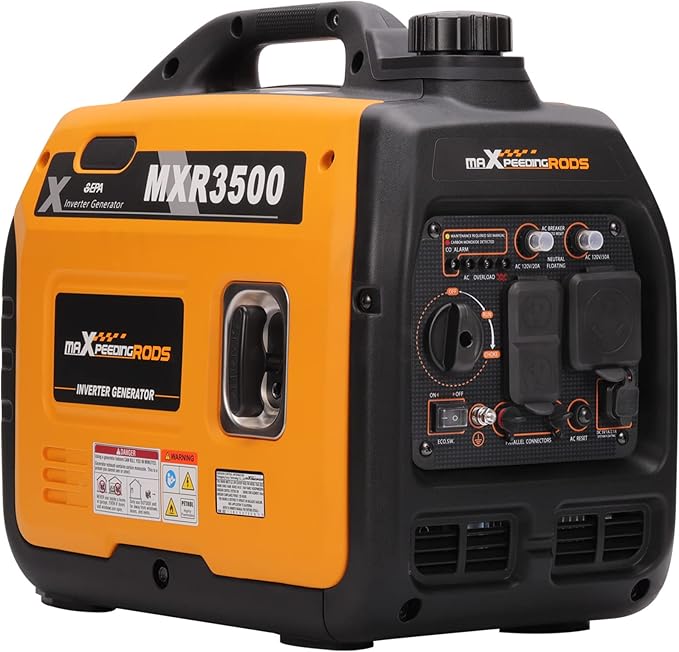
A good 3500-watt generator for RV travel and camping sits in a useful middle ground: enough power for many travel trailers and campers without moving into the size and fuel consumption of a large home-backup generator.
For RV use, however, the number printed on the generator is only part of the story. You also need to look at running watts, starting watts, RV receptacles, noise level, weight, fuel type, runtime, and carbon monoxide safety features.
There is another important detail that is easy to overlook: not every 3500-watt generator is an inverter generator. Some conventional portable generators are marketed in the same wattage range, but they should not be treated as equivalent to an inverter model.
I compared the models in this guide based on their published specifications and how those specifications translate to RV travel, camping, and portable power use in 2026.
3500-Watt Generators for RVs: Quick Comparison
| Model | Rated/Running Power | Peak/Starting Power | Fuel | RV Outlet | Approx. Weight | Best Use |
|---|---|---|---|---|---|---|
| maXpeedingrods 3500W | 3,000W | 3,500W | Gasoline | 120V 30A | 47 lb | Lightweight RV camping |
| Champion 3500W | 3,500W | 4,375W | Gasoline | 120V 30A TT-30R | — | RV and general backup |
| Champion 4250W Dual Fuel Inverter | 3,500W gas | 4,250W | Gasoline/Propane | 120V 30A TT-30R | 79 lb | RVs needing fuel flexibility |
| PowerSmart DB5035 | 3,200W | 3,600W | Gasoline | 120V 30A | Approx. 50 lb | Lightweight RV and camping |
| LIFAN LF3800i | 3,000W | 3,500W | Gasoline | Verify configuration | 46.3 lb | Portable inverter power |
Important: The Champion 3500W model listed above is a conventional portable generator rather than an inverter generator. It is included because it is a relevant 3500W-class RV option, but it should not be confused with Champion’s open-frame inverter models.
1. maXpeedingrods 3500W Portable Inverter Generator
Check Amazon Price [Click Here]
The maXpeedingrods 3500W inverter generator is aimed at campers and RV owners who want a relatively lightweight generator without moving into a much heavier open-frame design.
It produces 3,500 starting watts and 3,000 running watts, making it a reasonable match for a number of smaller and mid-size RV electrical loads. The manufacturer lists a 120V 30A outlet, two 120V 20A outlets and USB outputs. It also includes Eco Mode, parallel capability and CO shutdown protection.
Key Specifications
- Starting watts: 3,500W
- Running watts: 3,000W
- Fuel: Gasoline
- Weight: About 47 lb
- Noise: About 58 dB at 23 feet
- Runtime: Up to about 8.3 hours at 25% load
- RV outlet: 120V 30A
- Starting system: Recoil
- Eco Mode: Yes
- Parallel capable: Yes
- CO shutdown: Yes
- THD: ≤3%
One of the biggest advantages is the weight. At about 47 pounds, this generator is considerably easier to load into a truck, SUV or RV storage compartment than many 70–100-pound open-frame models.
The trade-off is that 3,000 running watts gives you less continuous power than a generator rated at 3,500 running watts.
Best For
The maXpeedingrods is particularly interesting for weekend RV trips, camping, tailgating and lightweight setups where portability matters almost as much as output.
2. Champion 3500W Generator with CO Shield
Check Amazon Price [Click Here]
The Champion 3500W is a good example of why shoppers should pay attention to generator technology instead of relying only on the wattage number.
Champion’s current 3500W model 201286 produces 4,375 starting watts and 3,500 running watts, includes a 120V 30A RV receptacle and features CO Shield® carbon monoxide auto shutoff. Champion also lists a 120V 30A locking outlet and a 120V 20A household duplex outlet.
However, this model is not an inverter generator. That distinction matters because the original version of this article incorrectly grouped it with inverter models.
Key Specifications
- Starting watts: 4,375W
- Running watts: 3,500W
- Fuel: Gasoline
- Runtime: Up to 12 hours at 50% load
- Noise: 68 dBA at 23 feet
- RV outlet: 120V 30A TT-30R
- CO protection: CO Shield®
- Monitoring: Intelligauge
- Warranty: 3-year limited warranty
- Start: Recoil
Champion says this model can provide enough power to start and run a 15,000 BTU RV air conditioner, although actual performance depends on the air conditioner’s starting demand and the other loads connected at the same time.
Best For
This Champion is better suited to RV owners who prioritize 3,500 watts of continuous output, a built-in 30A RV connection and Champion’s support network over the quieter operation and design advantages of a true inverter generator.
3. Champion 4250W Dual Fuel Open-Frame Inverter
Check Amazon Price [Click Here]
If you specifically want an inverter generator, the Champion 4250W Dual Fuel model is a much closer match to the purpose of this guide.
The Champion 200914 produces 4,250 starting watts and 3,500 running watts on gasoline. On propane, it produces 4,250 starting watts and 3,150 running watts. It uses Champion’s Quiet Technology, Economy Mode and inverter electronics with less than 3% THD.
Key Specifications
- Gasoline starting watts: 4,250W
- Gasoline running watts: 3,500W
- Propane starting watts: 4,250W
- Propane running watts: 3,150W
- Fuel: Gasoline or propane
- Noise: About 64 dBA
- Weight: About 79 lb
- Gasoline runtime: Up to 22 hours at 25% load
- Propane runtime: Up to 21 hours at 25% load
- RV outlet: 120V 30A TT-30R
- THD: Less than 3%
- Parallel capable: Yes
- Start: Recoil
The long advertised runtime is one of the strongest reasons to consider this model. Keep in mind, however, that the 22-hour gasoline figure is measured at 25% load, not at the generator’s maximum output. Runtime will drop as electrical demand increases.
The dual-fuel design is also useful for RV travelers. Gasoline can be convenient when you’re traveling, while propane may be easier to store for longer trips.
Best For
This model makes the most sense for RVers who want 3,500 running watts, inverter technology and the flexibility to use either gasoline or propane.
Its main disadvantage is portability. At around 79 pounds, it is considerably heavier than the small suitcase-style models in this comparison.
4. PowerSmart 3600W Inverter Generator
Check Amazon Price [Click Here]
The PowerSmart DB5035 3600W inverter generator is another compact option for RV travel and camping.
PowerSmart lists 3,600 peak watts and 3,200 rated watts, along with a 120V 30A RV outlet. The unit also includes 120V 20A, 12V DC and USB connections, parallel capability and Eco Control.
Key Specifications
- Peak watts: 3,600W
- Rated watts: 3,200W
- Fuel: Gasoline
- Engine: 149cc 4-stroke
- RV outlet: 120V 30A
- Parallel capable: Yes
- Eco Control: Yes
- Starting system: Recoil
- Warranty: 2 years
With 3,200 watts of rated output, it gives RV owners a little more continuous capacity than a 3,000W-rated portable inverter.
The relatively compact design also makes it easier to transport than many open-frame generators.
Best For
The PowerSmart is worth considering for RV owners, campers and tailgaters who want a compact inverter generator with a built-in 30A RV outlet without moving to a much larger machine.
5. LIFAN LF3800i 3500W Portable Inverter Generator
Check Amazon Price [Click Here]
The LIFAN LF3800i is one of the lighter generators in this group. Despite its 3,500W peak rating, it is rated at 3,000 watts of continuous output.
Available specifications list a 1.6-gallon fuel tank, up to 6.5 hours of runtime at 50% load, electric start, CO-MINDER protection and less than 3% THD. The listed weight is approximately 46.3 pounds.
Key Specifications
- Peak watts: 3,500W
- Rated watts: 3,000W
- Fuel: Gasoline
- Fuel tank: 1.6 gallons
- Runtime: Up to 6.5 hours at 50% load
- Noise: As low as 58 dB at 50% load
- Weight: About 46.3 lb
- Start: Electric
- THD: Less than 3%
- CO protection: CO-MINDER
- EPA compliant: Yes
The electric start is particularly convenient when the generator is being used frequently during RV trips.
Its relatively low weight is another advantage. At roughly 46 pounds, it is considerably easier to move than an open-frame 3500W-class generator.
One Important RV Detail
Before buying the LIFAN specifically for an RV, verify the exact outlet configuration of the version being sold. A generator producing 3,500 peak watts is not automatically RV-ready simply because its power output is suitable.
Best For
The LIFAN is a good fit for campers who prioritize low weight, inverter-style clean power, electric start and CO protection.
What Can a 3500-Watt Generator Run in an RV?
A generator with around 3,000 to 3,500 watts of running power can handle many common RV loads, but you still need to manage simultaneous demand.
For example, an RV may use:
- Rooftop air conditioner
- Refrigerator
- Microwave
- Television
- Laptop chargers
- Lights
- Coffee maker
- Battery charger
- Small kitchen appliances
The important number is running watts, while the generator’s peak or starting wattage provides additional short-term capacity for motors and compressors.
A rooftop air conditioner is often the most important load to consider because the compressor can require considerably more power when starting than it uses after it is running.
That means a generator that looks powerful enough on paper can still struggle if the air conditioner starts while another high-demand appliance is operating.
For this reason, don’t simply add the running wattage of your appliances. Check their actual nameplate ratings and consider startup requirements.
Do You Need a 3500-Watt Inverter Generator for a 30-Amp RV?
Not necessarily, but 3,000–3,500 running watts is a useful range for many 30A RV setups.
A standard 30A RV connection is rated for 30 amps at 120 volts, which corresponds to a theoretical maximum of approximately 3,600 watts.
That does not mean you should expect a 3,500W generator to operate continuously at its maximum rating.
You need some headroom for startup surges and changing loads.
A generator with a built-in TT-30R outlet is also more convenient because you can connect a compatible RV power cord directly instead of relying on adapters.
Inverter Generator vs. Conventional Generator for RV Camping
An inverter generator and a conventional portable generator are not the same thing.
Inverter Generators
Inverter models are generally designed to provide stable electrical output and can reduce engine speed when demand is low. Many are also designed with quieter operation in mind.
This makes them particularly attractive for:
- RV parks
- Campgrounds
- Tailgating
- Sensitive electronics
- Quiet outdoor environments
Conventional Generators
Traditional open-frame generators can provide substantial power and may cost less, but they can be heavier and louder.
The Champion 3500W discussed earlier is an example of a conventional portable generator rather than an inverter generator.
If your priority is specifically quiet RV camping and inverter power, make sure the product you’re buying actually uses inverter technology.
How Important Is Generator Noise at a Campground?
Noise can become a major issue when you’re camping close to other people.
A generator rated around 58–60 dBA may be considerably more comfortable than a louder conventional generator, particularly when Eco Mode allows the engine to slow down during lighter loads.
However, don’t compare decibel numbers without checking the testing conditions.
A manufacturer may specify noise at a particular distance and load, so 58 dBA at 25% load should not be treated as equivalent to 58 dBA at full output.
For RV camping, a quieter inverter design is generally more desirable, especially when the generator may run for several hours.
Gasoline vs. Dual Fuel for RV Travel
Gasoline remains the most common fuel choice for portable generators, but dual-fuel models add flexibility.
A dual-fuel generator can operate on gasoline or propane.
Gasoline
Advantages include:
- Widely available
- Usually higher output than propane
- Convenient for road trips
Propane
Advantages include:
- Convenient long-term storage
- Useful as an alternative fuel
- Can be attractive for emergency preparedness
The Champion 4250W Dual Fuel inverter is particularly interesting because it produces 3,500 running watts on gasoline and 3,150 running watts on propane.
Remember that switching from gasoline to propane can reduce available output, so use the propane running-watt rating, not the gasoline rating, when planning your RV load.
Carbon Monoxide Safety for RV Generators
Carbon monoxide is one of the most important safety issues when using any portable generator.
A generator must never be operated inside an RV, garage, shed, tent, or other enclosed or partially enclosed area.
CO is colorless and odorless and can build up rapidly.
Features such as Champion CO Shield® and LIFAN CO-MINDER can automatically shut down the engine when dangerous carbon monoxide levels are detected, but these systems are an additional safety feature — they are not a replacement for proper generator placement and ventilation.
Always follow the owner’s manual for the exact generator and keep exhaust directed away from the RV, people and occupied areas.
What Should You Look for in a 3500-Watt RV Generator?
Before buying, compare these specifications rather than looking only at the advertised wattage.
1. Running Watts
This is the continuous output you should use when calculating your normal RV electrical load.
2. Starting Watts
This provides temporary additional capacity for appliances with motors and compressors.
3. TT-30R Outlet
If you have a 30A RV, a built-in TT-30R outlet can make connection much easier.
4. Weight
If you will load the generator by yourself, a 45–50-pound inverter can be much easier to handle than a 75–100-pound open-frame machine.
5. Noise
Look for a published dBA figure and check the distance and load at which it was measured.
6. Fuel Type
Gasoline-only models can be simpler. Dual-fuel models provide more flexibility.
7. Parallel Capability
If the generator supports parallel operation, you may be able to connect a compatible second unit later for additional output.
8. CO Protection
CO shutdown technology is an important additional safety feature, but correct outdoor placement remains essential.
Which 3500-Watt Generator Is Right for You?
Your choice ultimately depends on how you use your RV.
Choose the maXpeedingrods 3500W if:
You want a lightweight gasoline inverter generator with Eco Mode, parallel capability and a built-in 30A outlet.
Choose the Champion 3500W if:
You want 3,500 running watts, a 30A RV connection and Champion’s CO Shield® system, and you don’t specifically require inverter technology.
Choose the Champion 4250W Dual Fuel if:
You want 3,500 running watts, inverter technology and gasoline/propane flexibility. This is also the better option if longer runtime and additional capacity are important.
Choose the PowerSmart 3600W if:
You want a compact 3,200W-rated inverter generator with a 30A RV outlet and parallel capability.
Choose the LIFAN LF3800i if:
Your priorities are low weight, electric start, clean inverter power and CO-MINDER protection.
Final Thoughts
A 3500-watt generator for RV travel and camping can be an excellent middle-ground solution, but the best model depends on much more than the number on the front of the generator.
If portability is your priority, the approximately 46–50-pound inverter models are easier to load and move. If you need more continuous output and fuel flexibility, an open-frame dual-fuel inverter such as the Champion 4250W offers considerably more capability while still providing RV-ready power.
One of the biggest lessons from comparing these models is that 3500 watts does not automatically mean inverter generator or RV-ready. Always check the actual technology, rated output, TT-30R connection, fuel type and safety features before buying.
For most RV shoppers, the key questions are simple: How much continuous power do I need? Can the generator start my air conditioner? How much weight can I comfortably move? How quiet does it need to be? And do I want gasoline only or dual fuel?
Answer those questions first, and choosing the right 3500-watt-class generator becomes much easier.