As an Amazon Associate I earn from qualifying purchases.
If you’re looking for a 9000 watt generator for home backup, the first thing to understand is that the number on the box does not always mean 9,000 watts of continuous power.
Some generators marketed as 9,000-watt models produce around 9,000 watts of starting power but considerably less running power. Others, such as the Champion tri-fuel inverter, can actually deliver 9,000 running watts on gasoline.
That difference matters when you’re trying to keep a refrigerator, sump pump, furnace, well pump, lights, appliances, and other essential loads running during a power outage.
For 2026, the best choices in this category include tri-fuel, dual-fuel, and inverter generators, giving homeowners more flexibility in fuel selection, power quality, noise, and backup options.
Best 9000 Watt Generators for Home Backup
| Generator | Rated/Running Power | Peak/Starting Power | Fuel | Inverter |
|---|---|---|---|---|
| Champion Tri-Fuel Inverter | 9,000W gas / 8,100W propane / 7,290W natural gas | 11,000W | Gas, propane, natural gas | Yes |
| Westinghouse WGen9500DF | 9,500W gas / 8,500W propane | 12,500W gas / 11,200W propane | Gas, propane | No |
| WEN DF1100T | 8,300W gas / 7,500W propane | 11,000W gas / 9,500W propane | Gas, propane | No |
| GENMAX GM9000iED | 7,600W | 9,000W | Gas, propane | Yes |
| Pulsar PGL9000BCO | 7,200W gas / 6,500W propane | 9,000W gas / 8,100W propane | Gas, propane | No |
The most important takeaway is simple: do not choose a generator based only on the advertised wattage. Check the rated or running wattage for the fuel you plan to use.
1. Champion 9000-Watt Tri-Fuel Inverter Generator
Check Amazon Price Click Here!
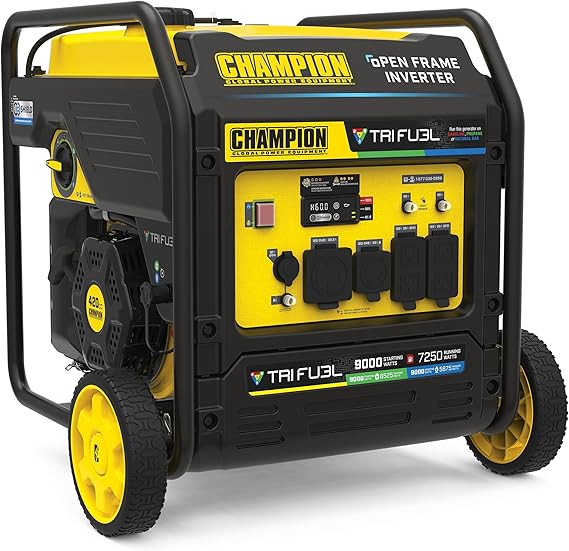
The Champion tri-fuel inverter is one of the most interesting choices if you want a 9000 watt generator for home backup and don’t want to give up inverter technology.
It is designed to run on gasoline, propane, or natural gas. On gasoline, it provides 9,000 running watts and 11,000 starting watts. Output drops to 8,100 running watts on propane and 7,290 running watts on natural gas.
That fuel-related power difference is important when sizing the generator for large appliances.
Key Specifications
- Running watts: 9,000W gasoline
- Starting watts: 11,000W gasoline
- Propane running watts: 8,100W
- Natural gas running watts: 7,290W
- Fuel: Gasoline, propane, natural gas
- Technology: Inverter
- Start: Electric and wireless remote start
- Safety: CO Shield
- Voltage: 120/240V
The inverter design is a major advantage for homeowners who want cleaner electrical output for electronics while still having enough capacity for larger household loads.
The tri-fuel configuration is another major benefit. If you have a natural gas connection, you don’t have to depend entirely on stored gasoline during a long outage.
Champion’s CO Shield system can automatically shut the generator down when dangerous carbon monoxide levels are detected. However, CO Shield is a safety feature, not permission to operate the generator indoors. Portable generators must always be operated outdoors and away from occupied buildings.
Best for: Homeowners who want high continuous output, inverter technology, and gasoline, propane, and natural-gas flexibility.
2. Westinghouse WGen9500DF Dual-Fuel Generator
Check Amazon Price Click Here!
The Westinghouse WGen9500DF is slightly above the 9,000-watt class in gasoline running power, making it an excellent option if you want additional capacity for larger home loads.
It produces up to 9,500 running watts and 12,500 peak watts on gasoline. On propane, it provides 8,500 running watts and 11,200 peak watts.
Key Specifications
- Running watts: 9,500W gasoline
- Peak watts: 12,500W gasoline
- Running watts: 8,500W propane
- Peak watts: 11,200W propane
- Fuel: Gasoline and propane
- Engine: 457cc 4-stroke OHV
- Fuel tank: 6.6 gallons
- Runtime: Up to 12 hours at 25% load
- Start: Electric, remote, and recoil
- Voltage: 120/240V
- Transfer-switch ready: Yes
The WGen9500DF is a conventional open-frame generator rather than an inverter generator, so it should not be treated as equivalent to the Champion or GENMAX inverter models simply because their advertised wattages are similar.
Its biggest advantage is straightforward: lots of conventional generator power, 120/240V capability, dual-fuel operation, and a design intended for home backup.
Westinghouse also lists GFCI outlets, automatic low-oil shutdown, a fuel gauge, and a VFT display showing voltage, frequency, and operating hours.
Best for: Homeowners who prioritize high running wattage and conventional-generator value over inverter technology.
3. WEN DF1100T Dual-Fuel Generator
Check Amazon Price Click Here!
The WEN DF1100T is another generator that is often included in the 9,000-watt category because of its high starting output.
However, it is important to be precise about its actual capacity.
The DF1100T produces 8,300 running watts and 11,000 surge watts on gasoline. When operating on propane, output is 7,500 running watts and 9,500 surge watts.
Key Specifications
- Gasoline: 8,300 running / 11,000 starting watts
- Propane: 7,500 running / 9,500 starting watts
- Fuel: Gasoline and propane
- Engine: 457cc 4-stroke OHV
- Fuel tank: 6.6 gallons
- Runtime: Up to 8.5 hours at half load
- Start: Electric
- Voltage: 120/240V
- Outlets: 120V GFCI, 30A twist-lock, 120/240V 50A
- Transfer-switch compatible: Yes
One of the most useful features for home backup is its 120/240V output. That makes it more suitable for installations involving a properly installed transfer switch or compatible inlet setup.
The NEMA 14-50R outlet also provides flexibility for larger 120/240V loads, although you should never assume that an appliance can be connected simply because the receptacle matches. The generator, circuit, transfer equipment, and appliance must all be correctly rated.
The DF1100T is not an inverter generator, so it belongs in a different category from the Champion and GENMAX models.
Best for: Home backup users who want a high-output dual-fuel generator with 120/240V capability without paying for inverter technology.
4. GENMAX GM9000iED Dual-Fuel Inverter Generator
Check Amazon Price Click Here!
If quiet operation and inverter technology are high on your list, the GENMAX GM9000iED deserves attention.
The generator is rated at approximately 7,600 running watts and 9,000 peak watts, placing it slightly below the Champion in continuous output even though both are marketed around the 9,000-watt class.
Key Specifications
- Peak output: 9,000W
- Running output: 7,600W
- Fuel: Gasoline and propane
- Technology: Inverter
- Noise: Approximately 62 dBA under the manufacturer’s specified conditions
- Start: Electric and remote
- Parallel capable: Yes
- Digital display: Yes
- Fuel tank: Approximately 6.9 gallons
The major reason to consider the GM9000iED is not simply its wattage. It is the combination of inverter power, dual-fuel capability, remote starting, and relatively low noise for this output class.
That makes it particularly attractive when generator noise is a concern.
Its 7,600-watt running capacity is still enough for many essential-home backup applications, but homeowners should calculate their actual simultaneous load before assuming it can handle every large appliance at once.
Best for: Homeowners who want a quieter dual-fuel inverter generator and don’t require a full 9,000 watts of continuous output.
5. Pulsar PGL9000BCO Dual-Fuel Generator
Check Amazon Price Click Here!
The Pulsar PGL9000BCO illustrates exactly why you should look at rated watts instead of relying on the generator’s marketing number.
It is advertised as a 9,000-watt generator, but its gasoline output is 9,000 peak watts and 7,200 running watts. On propane, it produces 8,100 peak watts and 6,500 running watts.
Key Specifications
- Gasoline: 7,200 running / 9,000 peak watts
- Propane: 6,500 running / 8,100 peak watts
- Fuel: Gasoline and propane
- Engine: 340cc 4-stroke OHV
- Fuel tank: 7 gallons
- Runtime: Up to 9.5 hours at 50% load
- Start: Electric and recoil
- Voltage: 120/240V
- Noise: Approximately 75 dBA
- CO protection: Yes
- Weight: Approximately 149 lb
The PGL9000BCO is also considerably lighter than some of the larger open-frame generators in this group.
It includes a mobility kit, digital display, automatic low-oil shutdown, voltage regulation, and CO shutdown protection.
This generator makes sense if you want a relatively straightforward dual-fuel generator with a high peak rating but don’t need 9,000 watts of continuous output.
Best for: Buyers who want a lighter conventional dual-fuel generator for home backup, jobsites, or outdoor applications.
What Can a 9000 Watt Generator Run?
A properly sized generator in this class can handle a substantial number of household loads, but you cannot simply add the maximum starting wattage of every appliance.
A typical home backup setup might include:
- Refrigerator
- Freezer
- Sump pump
- Furnace blower
- Gas furnace controls
- Well pump
- Lights
- Television
- Internet equipment
- Microwave
- Garage door opener
- Selected kitchen appliances
- Window or portable air conditioner
- Some central HVAC systems, depending on their starting requirements
The critical issue is simultaneous demand.
For example, a refrigerator may have a relatively modest running load but require substantially more power for a short period when its compressor starts.
The same principle applies to sump pumps, well pumps, air conditioners, and other motor-driven equipment.
That’s why a generator with 11,000 starting watts and 8,300 running watts should not be treated as an 11,000-watt continuous generator.
Running Watts vs. Starting Watts
This is one of the most important concepts when shopping for a 9000 watt generator.
Running watts
Running watts are the amount of power the generator can continuously provide under its rated conditions.
Starting watts
Starting watts, also called surge or peak watts, represent the additional short-term power available to start motors and other equipment with high startup demands.
Consider a generator rated:
9,000 running watts / 11,000 starting watts
That means you can continuously plan around approximately 9,000 watts, while the additional 2,000 watts are available for short startup demands.
You should size your generator using running watts plus the largest relevant startup requirement, not by adding every appliance’s maximum starting wattage together.
Is a 9000 Watt Generator Enough for a Whole House?
For many homes, a 9,000-watt-class portable generator can provide substantial emergency backup power, but it may not power everything simultaneously.
Whether it can handle your home depends on:
- Central air-conditioning size
- Electric water heater
- Electric range
- Electric dryer
- Well pump
- Sump pump
- Furnace
- Refrigerator and freezer
- Electric vehicle charger
- Other high-demand appliances
Homes with gas appliances generally have an easier time staying within a portable generator’s capacity because gas furnaces, gas water heaters, and gas ranges usually require less electrical power than their all-electric counterparts.
If your home uses electric resistance heating, an electric water heater, electric dryer, electric range, and central AC, 9,000 watts may not be enough to operate all of them at once.
9000 Watt Generator for Central Air Conditioning
Central air conditioning is often the most difficult load for a portable generator.
The running wattage is only part of the equation. The compressor can require a significant startup surge.
Before purchasing a generator, check the air conditioner’s:
- Rated load
- Locked-rotor amps or startup requirements
- Voltage
- Breaker size
- Compatibility with your transfer equipment
A soft-start system can sometimes reduce the startup demand of an air-conditioning compressor, but it should be installed and evaluated by a qualified professional.
Do not assume that a 9,000-watt generator will automatically start your central AC simply because its advertised peak output is 9,000 or 11,000 watts.
Dual-Fuel vs. Tri-Fuel 9000 Watt Generators
Fuel flexibility is one of the biggest reasons homeowners choose this class of generator.
Dual-Fuel
A dual-fuel generator typically runs on:
- Gasoline
- Propane
This gives you two fuel options during an extended outage.
Gasoline is convenient and generally provides higher output on many models. Propane is attractive because it can be stored for longer periods when properly handled and does not depend on the same supply chain as gasoline.
Tri-Fuel
Tri-fuel generators add:
- Natural gas
For homeowners with a suitable natural-gas connection, this can be especially useful during long outages.
However, natural gas often produces less power than gasoline. The Champion tri-fuel model, for example, is rated at 9,000 running watts on gasoline, 8,100 watts on propane, and 7,290 watts on natural gas.
Therefore, always calculate your load using the actual output for your selected fuel.
Inverter vs. Conventional 9000 Watt Generators
Not every 9,000-watt generator is an inverter generator.
This distinction matters.
Inverter Generators
Inverter generators typically provide cleaner electrical output and can offer better efficiency at lighter loads.
They are particularly appealing when you want:
- Cleaner power for electronics
- Lower operating noise
- Better fuel efficiency at reduced loads
- Modern electronic controls
- Parallel capability on compatible models
The Champion and GENMAX options in this guide use inverter technology.
Conventional Generators
Traditional open-frame generators can provide a lot of power for the money and are often simpler and less expensive.
They are attractive when your priorities are:
- High running wattage
- Home backup
- 120/240V output
- Transfer-switch compatibility
- Lower purchase cost
The Westinghouse, WEN, and Pulsar models in this comparison are conventional generators rather than inverter models.
How Quiet Is a 9000 Watt Generator?
Noise varies substantially between models.
A generator rated around 62 dBA is in a very different noise category from one operating around 74–75 dBA.
The GENMAX inverter is listed around 62 dBA under its specified test conditions, while the Pulsar PGL9000BCO is listed at approximately 75 dBA.
Remember that noise measurements depend on:
- Distance
- Load
- Operating mode
- Test conditions
- Generator design
- Surrounding surfaces
Don’t compare two dBA numbers unless the measurement conditions are reasonably comparable.
If your generator will operate near neighbors or bedrooms, an inverter model may be worth the additional cost.
What Size Transfer Switch Do You Need?
A large portable generator should not be connected to your home’s electrical system by simply plugging it into a wall outlet.
For home backup, a properly installed transfer switch or approved interlock system with the appropriate inlet equipment is typically required.
The generator’s output, breaker configuration, inlet, transfer equipment, wiring, and home’s electrical panel must all be compatible.
Some of the generators listed here provide 120/240V output and transfer-switch-ready connections, but that does not mean every transfer switch is compatible.
For permanent home connections, have the installation evaluated by a qualified electrician and follow local electrical requirements.
Generator Safety: What You Need to Know
A 9,000-watt generator can produce dangerous carbon monoxide and must be operated outdoors.
Never operate a portable generator:
- Inside your home
- Inside a garage
- Inside a basement
- Inside an attached garage
- Near open windows or doors
- Near ventilation openings
Carbon monoxide can accumulate quickly even when a garage door is open.
CO shutdown systems such as Champion CO Shield and other carbon-monoxide sensors are useful additional safety features, but they do not make indoor operation safe.
Keep the generator outdoors, follow the manufacturer’s clearance requirements, point exhaust away from the home, and use working carbon monoxide alarms inside the house.
How to Choose the Best 9000 Watt Generator
Before buying, consider these seven factors.
1. Determine Your Actual Running Load
Make a list of everything you want to operate at the same time.
Don’t size the generator based on the largest number printed on the box.
2. Check Motor Starting Loads
Pay particular attention to:
- HVAC compressors
- Well pumps
- Sump pumps
- Refrigerators
- Freezers
- Compressors
- Power tools
3. Decide Which Fuel You Prefer
Choose dual-fuel if gasoline and propane meet your needs.
Choose tri-fuel if natural gas is important to your backup strategy.
4. Decide Whether You Need an Inverter
Choose an inverter if quieter operation and cleaner electrical output are important.
Choose a conventional generator if maximum power per dollar is your priority.
5. Look for 120/240V Output
If you plan to connect selected household circuits through a properly installed transfer system, 120/240V capability may be important.
6. Check Weight and Mobility
Large portable generators are heavy.
Look for:
- Wheel kit
- Folding or fixed handles
- Good tire size
- Convenient control panel
- Easy-access oil drain
- Fuel gauge
7. Consider Long-Term Fuel Storage
If the generator is part of your emergency-preparedness plan, think about how much fuel you can safely store and how you will rotate it.
Propane can be useful for long-term preparedness, while gasoline can provide higher output on many models.
Which 9000 Watt Generator Should You Buy?
The answer depends on what matters most to you.
Choose the Champion if you want:
- 9,000 running watts on gasoline
- Inverter technology
- Tri-fuel operation
- Natural gas capability
- Remote start
- CO Shield
- 120/240V capability
Choose the Westinghouse if you want:
- 9,500 running watts on gasoline
- 12,500 peak watts
- Dual-fuel operation
- Remote and electric start
- 120/240V output
- Transfer-switch compatibility
- High conventional-generator output
Choose the WEN if you want:
- 8,300 running watts on gasoline
- Dual-fuel capability
- 120/240V operation
- Electric start
- Transfer-switch-ready output
- A more budget-oriented conventional generator
Choose the GENMAX if you want:
- Inverter technology
- Dual-fuel capability
- Approximately 7,600 running watts
- Approximately 9,000 peak watts
- Relatively quiet operation
- Remote start
- Parallel capability
Choose the Pulsar if you want:
- 7,200 running watts on gasoline
- 9,000 peak watts
- Dual-fuel capability
- 120/240V output
- CO shutdown
- A relatively lighter conventional generator
Final Thoughts
The best 9000 watt generator for home backup is not necessarily the generator with “9000 watts” printed in the largest letters on the product page.
What matters most is the generator’s running wattage, starting wattage, fuel-specific output, voltage configuration, generator technology, and safety features.
For homeowners who want the highest continuous output in this group with inverter technology and three fuel options, the Champion tri-fuel inverter is particularly compelling.
The Westinghouse WGen9500DF is a strong alternative if you want even more conventional-generator running capacity on gasoline. The WEN DF1100T offers a practical dual-fuel and 120/240V configuration, while the GENMAX focuses on inverter operation and quieter performance. The Pulsar provides a lighter conventional option with dual-fuel flexibility.
Before making a purchase, calculate your actual household load and identify which appliances need to start at the same time. Then compare the rated watts—not just the peak wattage—for the fuel you expect to use.
That approach will give you a much better chance of choosing a generator that can actually handle your home’s essential loads when the power goes out.