As an Amazon Associate I earn from qualifying purchases.
Looking for a fuel-efficient generator that can provide dependable electricity without wasting fuel? The right choice depends on more than the size of the fuel tank. Generator type, electrical load, engine design, fuel source, inverter technology, and runtime at a stated load all affect how much fuel you actually use.
For light loads, a compact inverter generator can be a practical choice because it can reduce engine speed as electrical demand drops. For larger emergency loads, a dual-fuel or tri-fuel generator gives you more flexibility when gasoline, propane, or natural gas availability becomes an issue.
The five generators below cover very different power requirements, from a lightweight 1,900-running-watt inverter generator for camping and basic backup to high-output tri-fuel models designed for 120/240V home backup.
The important point is not simply choosing the generator with the biggest advertised runtime. A properly sized generator can be more fuel-conscious because you are not carrying the fuel consumption of a much larger engine to power a relatively small load.
Fuel-Efficient Generators for 2026
| Generator | Fuel | Running Watts | Best For |
|---|---|---|---|
| PowerSmart PS5025 | Gasoline | 1,900W | Camping and light backup |
| Westinghouse WGen9500DF | Gasoline / Propane | 9,500W / 8,500W | Larger home backup |
| WEN DF680iX | Gasoline / Propane | 5,100W / 4,500W | RVs and moderate backup |
| Westinghouse WGen14500TFc | Gasoline / Propane / Natural Gas | 14,500W / 13,000W / 11,600W | High-demand home backup |
| WEN TF1450X | Gasoline / Propane / Natural Gas | 11,500W / 10,300W / 8,750W | Large 120/240V loads |
1. PowerSmart 2500-Watt PS5025 – Compact Fuel-Efficient Inverter Generator
Check Amazon Price Click Here!
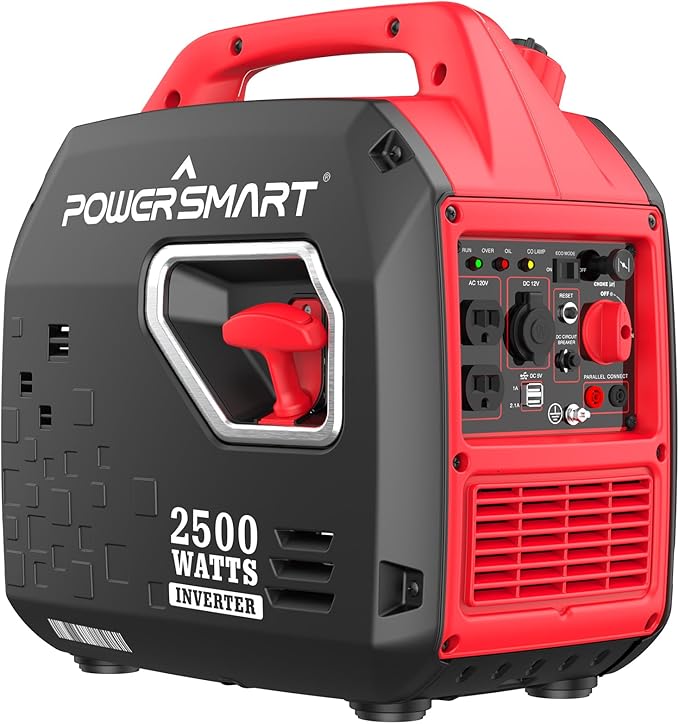
If your priority is keeping a small generator easy to carry and economical for light-duty applications, the PowerSmart PS5025 is worth considering.
This gasoline-powered inverter generator produces 2,500 starting watts and 1,900 running watts. It uses a 79cc engine and has a 1.05-gallon fuel tank. Current product specifications list approximately 5.7 hours of runtime at 50% load.
The important advantage here is size. A 1,900-running-watt generator is designed for a very different job than a 10,000- or 14,000-watt portable generator. If you only need to charge electronics, run a few small appliances, power selected emergency loads, or support a campsite, carrying a much larger generator may make little sense.
The inverter design also makes the PS5025 better suited to applications where clean electrical power matters.
PowerSmart PS5025 Highlights
- 2,500 starting watts
- 1,900 running watts
- 79cc gasoline engine
- 1.05-gallon fuel tank
- Inverter technology
- Eco/automatic idle control
- Parallel capability
- CARB compliant
- Lightweight portable design
- Designed for camping, tailgating, light backup, and similar applications
One thing to keep in mind is that 1,900 running watts is not enough for many high-demand household appliances. A central air conditioner, electric water heater, electric dryer, or large well pump can require considerably more capacity.
For that reason, the PS5025 makes the most sense when portability and modest electrical demand are more important than maximum output.
Best Use
Camping, tailgating, charging electronics, and basic emergency loads.
2. Westinghouse WGen9500DF – High-Output Dual-Fuel Generator
Check Amazon Price Click Here!
The Westinghouse WGen9500DF moves into a completely different class of generator. It is designed for homeowners who need substantially more power than a compact inverter generator can provide.
The WGen9500DF produces 12,500 peak watts and 9,500 running watts on gasoline. When operating on propane, it produces 11,200 peak watts and 8,500 running watts.
It uses a 457cc four-stroke OHV engine and a 6.6-gallon gasoline tank. Westinghouse lists up to 12 hours of runtime at 25% load on gasoline, while the gasoline runtime at 50% load is listed at about 8 hours.
Propane provides another useful option, with the manufacturer listing approximately 7 hours at 50% load using a 20-pound propane tank.
Westinghouse WGen9500DF Highlights
- 12,500 peak / 9,500 running watts on gasoline
- 11,200 peak / 8,500 running watts on propane
- 457cc OHV engine
- 6.6-gallon gasoline tank
- Dual-fuel operation
- Electric start
- Remote start key fob
- 120/240V output
- NEMA L14-30R and 14-50R outlets
- Transfer-switch ready
- GFCI outlets
- Automatic low-oil shutdown
- Fuel gauge
- RV ready
The dual-fuel design is particularly useful during extended outages. Gasoline provides the generator’s highest rated output, while propane gives you another fuel option when gasoline availability becomes a problem.
One important distinction is worth mentioning: the WGen9500DF and WGen9500DFc are different versions. The DFc version adds a carbon monoxide sensor/shutdown feature, so buyers should check the exact model number before purchasing.
Best Use
Home backup, RVs, job sites, and situations requiring substantially more power than a compact inverter generator can provide.
3. WEN DF680iX – Efficient Dual-Fuel Inverter Generator
Check Amazon Price Click Here!
The WEN DF680iX is one of the most interesting choices in this comparison because it combines dual-fuel capability with inverter technology.
It produces up to 6,800 surge watts and 5,100 rated watts on gasoline. On propane, it produces 6,000 surge watts and 4,500 rated watts.
That makes it substantially more powerful than the PowerSmart PS5025 while remaining smaller and more efficiency-focused than many large open-frame generators.
The DF680iX has a 2.9-gallon gasoline tank and WEN lists up to 6.1 hours of runtime at half load on gasoline. On a 20-pound propane tank, WEN lists up to 9 hours at half load.
WEN DF680iX Highlights
- 6,800 surge / 5,100 rated watts on gasoline
- 6,000 surge / 4,500 rated watts on propane
- Dual-fuel operation
- Inverter technology
- 120/240V capability
- Electric start
- CO Watchdog automatic shutdown
- Fuel shutoff
- Eco Mode
- RV-ready TT-30R outlet
- NEMA L14-30R outlet
- Parallel capability
- Low-oil and overload protection
- Three-year limited warranty
The Eco Mode is particularly relevant if fuel consumption is one of your main concerns. Instead of operating the engine at a higher speed regardless of electrical demand, the generator can adjust fuel consumption as the connected load changes.
The fuel-shutoff feature is another useful detail. WEN designed it to allow remaining fuel in the carburetor to be consumed before shutdown, helping reduce problems associated with stagnant fuel during storage.
The DF680iX also produces very clean inverter power. WEN lists total harmonic distortion below 0.3% at no load and below 1.2% at full load.
Best Use
RVs, moderate home backup, camping, sensitive electronics, and users who want both inverter technology and dual-fuel flexibility.
4. Westinghouse WGen14500TFc – High-Capacity Tri-Fuel Generator
Check Amazon Price Click Here!
If your backup-power requirements are significantly higher, the Westinghouse WGen14500TFc provides three fuel options: gasoline, propane, and natural gas.
This model should not be compared directly with a small inverter generator. It is designed for high-demand applications where substantial 120/240V output is more important than lightweight portability.
On gasoline, the WGen14500TFc produces 18,000 peak watts and 14,500 running watts. On propane, output is rated at 16,000 peak and 13,000 running watts. Natural gas output is rated at 14,400 peak and 11,600 running watts.
The generator uses a large 713cc V-twin OHV engine and a 10.5-gallon gasoline tank.
Westinghouse lists up to 16 hours of gasoline runtime at 25% load and up to 9 hours at 50% load.
Westinghouse WGen14500TFc Highlights
- 18,000 peak / 14,500 running watts on gasoline
- 16,000 peak / 13,000 running watts on propane
- 14,400 peak / 11,600 running watts on natural gas
- Tri-fuel operation
- 713cc V-twin OHV engine
- 10.5-gallon gasoline tank
- Up to 16 hours at 25% load on gasoline
- CO shutdown sensor
- Remote and electric start
- Less than 5% THD
- 120/240V operation
- 50A transfer-switch ready outlet
- Interlock-kit ready
- GFCI outlets
- RV ready
The natural-gas capability can be especially useful for homeowners who already have a suitable natural-gas connection. Unlike stored gasoline or propane, a utility fuel source can potentially support extended operation without repeatedly transporting fuel.
However, the available wattage changes depending on the fuel being used. Do not assume that a tri-fuel generator produces the same output on all three fuels.
Best Use
Large-home emergency backup, high-demand appliances, workshops, and applications requiring substantial 120/240V power.
5. WEN TF1450X – Tri-Fuel Generator for Large 120/240V Loads
Check Amazon Price Click Here!
The WEN TF1450X is another high-output tri-fuel generator designed for users who want gasoline, propane, and natural gas flexibility.
Its specifications are much more substantial than those of a compact portable inverter generator.
The TF1450X produces 14,500 surge watts and 11,500 running watts on gasoline. On propane, it produces 12,500 surge and 10,300 running watts. Natural gas output is rated at 10,500 surge and 8,750 running watts.
WEN pairs the generator with a 500cc four-stroke OHV engine and an 8.2-gallon gasoline tank.
The manufacturer lists up to 12 hours of runtime at half load on gasoline. Propane runtime is listed at approximately 6 hours at half load using a 20-pound tank.
WEN TF1450X Highlights
- 14,500 peak / 11,500 running watts on gasoline
- 12,500 peak / 10,300 running watts on propane
- 10,500 peak / 8,750 running watts on natural gas
- Gasoline, propane, and natural gas operation
- 8.2-gallon fuel tank
- 500cc OHV engine
- Electric start
- CO Watchdog
- 120/240V output
- NEMA L14-30R outlet
- NEMA 14-50R outlet
- Transfer-switch ready
- Wheel and handle kit
- Three-year limited warranty
The main advantage here is fuel flexibility combined with high output. During a prolonged outage, having three potential fuel sources can make planning easier.
The trade-off is size and weight. This is not the type of generator you casually move around a campsite. It is better suited to a prepared backup-power setup where the generator has a designated outdoor operating location.
Best Use
Large-home backup, high-demand appliances, workshops, and users who want gasoline, propane, and natural gas flexibility.
What Makes a Generator Fuel Efficient?
A common mistake is assuming that the generator with the longest advertised runtime is automatically the most fuel efficient.
That’s not necessarily true.
Fuel efficiency depends on several factors:
1. Generator Size
A generator should be large enough to handle your electrical load, but buying substantially more capacity than you need can be inefficient.
For example, a 1,900-running-watt inverter generator may be a sensible solution for a few small loads. A 14,500-running-watt generator makes more sense when you actually need to operate multiple large appliances.
2. Electrical Load
Generator runtime figures are almost always tied to a particular load.
A generator running at 25% load can consume significantly less fuel than the same generator operating at 50% or 100% load.
That is why you should always look for runtime figures that specify the load.
3. Inverter Technology
Inverter generators can vary engine speed according to electrical demand. When the load drops, the engine can slow down instead of continuing to operate at a higher speed.
This is one reason inverter generators are often attractive to campers, RV owners, and people running variable loads.
4. Fuel Type
Gasoline, propane, and natural gas have different energy characteristics and can produce different wattage and runtime figures.
A dual-fuel or tri-fuel generator is therefore not automatically more fuel efficient simply because it supports more fuels.
Its main advantage is fuel flexibility.
5. Maintenance
A poorly maintained engine will not operate as efficiently as one that receives regular maintenance.
Follow the manufacturer’s recommendations for:
- Engine oil
- Air filter
- Spark plug
- Fuel system
- Oil level
- Fuel storage
- Generator storage
Gasoline vs. Propane vs. Natural Gas
Choosing the right fuel can be just as important as choosing the generator.
| Fuel | Main Advantage | Main Consideration |
|---|---|---|
| Gasoline | High output and easy availability | Requires proper storage and stabilization |
| Propane | Convenient long-term storage and fuel flexibility | Output can be lower than gasoline |
| Natural Gas | Useful for extended home backup when utility service is available | Requires an appropriate gas connection and installation |
There is no universal rule that one fuel will always cost less per kilowatt-hour.
Local fuel prices, generator efficiency, electrical load, and the generator’s specifications all matter.
For that reason, compare the manufacturer’s fuel-consumption and runtime information with the actual fuel prices in your area before deciding which fuel will cost less.
Which Fuel-Efficient Generator Should You Choose?
Choose the PowerSmart PS5025 for light loads
The PowerSmart is the smallest generator in this comparison. It makes the most sense when portability and modest power requirements are your priorities.
Choose the WEN DF680iX for inverter efficiency and dual-fuel flexibility
The WEN DF680iX offers considerably more power than the PowerSmart while adding dual-fuel operation, inverter technology, Eco Mode, and 120/240V capability.
Choose the Westinghouse WGen9500DF for larger backup loads
The WGen9500DF is designed for substantially higher electrical demand and provides gasoline/propane flexibility, 120/240V output, electric start, and transfer-switch-ready connections.
Choose the Westinghouse WGen14500TFc for maximum output and three fuel options
The WGen14500TFc is designed for users who need high-output 120/240V power and want the option of gasoline, propane, or natural gas.
Choose the WEN TF1450X for high-output tri-fuel backup
The TF1450X provides a similar high-capacity concept with three fuel options and is suited to large backup-power requirements.
How to Reduce Generator Fuel Consumption
Even a fuel-efficient generator can waste fuel if it is operated inefficiently.
Match the generator to your load
Before buying, make a list of the appliances you expect to operate simultaneously.
Separate running watts from starting watts, especially for equipment with electric motors.
Avoid unnecessary loads
During an outage, you do not need to operate every electrical device in your home simultaneously.
Prioritize essentials such as:
- Refrigerator
- Freezer
- Sump pump
- Furnace controls
- Selected lights
- Internet equipment
- Essential electronics
Use Eco Mode when appropriate
If your inverter generator has an Eco Mode, use it when the connected equipment is compatible with the feature and the manufacturer recommends it.
Don’t oversize the generator unnecessarily
A larger generator gives you more capacity, but that does not automatically mean lower fuel consumption.
Choose enough capacity to handle your expected running load and starting surges with an appropriate margin.
Maintain the engine
Follow the maintenance schedule in the owner’s manual. Clean filters, correct oil levels, fresh fuel, and a properly maintained spark plug all contribute to reliable operation.
Generator Safety in 2026
Fuel efficiency should never come before safe operation.
Portable generators produce carbon monoxide (CO), an odorless and potentially deadly gas.
The CDC and U.S. Consumer Product Safety Commission recommend operating portable generators outside and at least 20 feet from the home, with exhaust directed away from windows, doors, and vents.
Never operate a portable generator inside a:
- House
- Garage
- Basement
- Shed
- Crawlspace
- Carport
- Other enclosed or partially enclosed area
Opening a garage door or window does not make generator operation safe.
A generator with a CO shutoff feature is an additional safety feature, but it does not make indoor operation safe.
Always follow the safety instructions in the generator’s owner’s manual, particularly when using extension cords, transfer switches, interlock equipment, or the generator during wet weather.
Frequently Asked Questions
What is the most fuel-efficient type of generator?
For many portable applications, an appropriately sized inverter generator can be very fuel-conscious because the engine can adjust its speed as electrical demand changes. Actual fuel consumption depends on the model, connected load, fuel type, and operating conditions.
Are inverter generators more fuel efficient?
They can be, particularly when operating at lighter or variable loads. Inverter technology allows many models to adjust engine speed according to electrical demand rather than maintaining a higher engine speed continuously.
Is propane cheaper to run than gasoline?
Not necessarily. Propane and gasoline have different energy content and generator output characteristics, while local fuel prices vary considerably. Compare the generator’s published fuel consumption and output with current prices in your area.
Does a bigger generator use more fuel?
It can, especially if you operate a large engine to power a relatively small electrical load. Generator size should be matched to the equipment you actually need to run.
Is a dual-fuel generator worth it?
Dual-fuel capability can be valuable because it gives you gasoline and propane as two fuel options. This can be particularly useful during long outages when one fuel may be unavailable or inconvenient to obtain.
What is the advantage of a tri-fuel generator?
A tri-fuel generator can operate on gasoline, propane, or natural gas. This gives homeowners more flexibility during extended outages, especially if natural gas service is available at the property.
How far should a portable generator be from a house?
Current CDC and CPSC guidance recommends operating portable generators outdoors at least 20 feet from homes and buildings, with exhaust directed away from windows, doors, and vents.
Can a fuel-efficient generator power a whole house?
It depends on the generator’s running and starting wattage and the electrical demands of the home. A compact generator may handle selected essential loads, while high-output 120/240V models can support substantially larger loads when properly connected.
Final Thoughts
The best fuel-efficient generator is not necessarily the generator with the largest fuel tank or the longest advertised runtime.
The better approach is to choose a generator that matches the electrical load you actually need to power.
For lightweight camping and basic emergency power, the PowerSmart PS5025 provides a compact 1,900-running-watt inverter platform.
For users who need more power along with inverter technology and dual-fuel flexibility, the WEN DF680iX offers a useful middle ground.
For larger home backup requirements, the Westinghouse WGen9500DF provides substantially higher output and gasoline/propane operation.
If maximum capacity and fuel flexibility are the priority, the Westinghouse WGen14500TFc and WEN TF1450X move into high-output tri-fuel territory with gasoline, propane, and natural gas capability.
Before purchasing, calculate your running and starting wattage requirements, compare runtime at the same load, consider which fuels will realistically be available during an outage, and follow the manufacturer’s installation and operating instructions.
A properly sized generator can give you dependable backup power while helping you avoid paying for fuel consumption you don’t actually need.