As an Amazon Associate I earn from qualifying purchases.
When you are traveling in a travel trailer, reliable electricity can make the difference between a comfortable camping trip and a frustrating one. Your refrigerator, air conditioner, microwave, lights, battery charger, television, and other essentials all depend on having enough usable power when shore power is unavailable.
The best generator for a travel trailer is not necessarily the biggest model you can buy. You need to match the generator to your trailer’s electrical service, air conditioner, appliances, camping style, noise restrictions, and how much weight you are willing to carry.
For many 30-amp travel trailers, a quiet inverter generator in the roughly 3,500- to 4,500-watt class is a practical starting point. Larger 50-amp trailers or trailers with multiple high-demand appliances may require substantially more capacity or a carefully configured parallel-generator setup.
This updated 2026 guide looks at the generators and RV power equipment in this lineup, explains where each option makes sense, and shows what to consider before buying.
Best Generators for Travel Trailers in 2026
| Product | Best For | Amazon |
|---|---|---|
| WEN DF680iX | High-power travel trailers and dual-fuel flexibility | Amazon Link |
| maXpeedingrods 3500W | Lightweight 30A trailers | Amazon Link |
| Champion 4500W Inverter | Balanced RV power and portability | Amazon Link |
| Westinghouse 2550W Inverter | Small trailers and lighter electrical loads | Amazon Link |
| Stromberg Carlson Gen Secure | Generator storage and theft deterrence | Amazon Link |
Important: The Stromberg Carlson Gen Secure is an accessory rather than a generator. It is included because secure generator storage can be particularly useful for travel-trailer owners who carry a portable generator outside the trailer.
1. WEN DF680iX Dual Fuel Inverter Generator
Check Amazon Price Click Here!
Best for: High-power travel trailers and dual-fuel flexibility
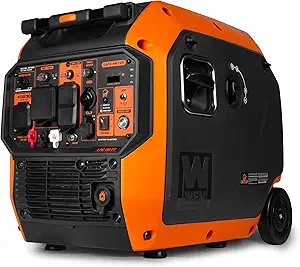
The WEN DF680iX is the most powerful generator in this lineup and makes the most sense for RV owners who want substantial power capacity rather than the lightest generator possible.
One of its biggest advantages is its dual-fuel capability. It can operate on gasoline or propane, giving travelers another option when gasoline availability is limited or propane is more convenient.
WEN currently lists the DF680iX at 6,800 surge watts and 5,100 rated watts on gasoline, or 6,000 surge watts and 4,500 rated watts on propane. It also includes a TT-30R RV receptacle, making it directly relevant to RV use.
Specifications
- Gasoline starting watts: 6,800W
- Gasoline rated watts: 5,100W
- Propane starting watts: 6,000W
- Propane rated watts: 4,500W
- Fuel: Gasoline and propane
- Engine: 224cc
- RV outlet: 120V TT-30R
- Electric start: Yes
- CO protection: WEN Watchdog CO shutdown sensor
- Noise: Approximately 64 dB at 1/4 load
- Warranty: 3 years
Why it stands out
The DF680iX has considerably more output than a typical compact RV inverter generator. That extra capacity can be useful when your trailer has several electrical loads running at the same time.
It also produces inverter power with very low total harmonic distortion, which makes it appropriate for electronics such as laptops, televisions, chargers, and other sensitive equipment. WEN lists THD below 1.2% at full load.
Another useful feature is its fuel shutoff system. Instead of simply shutting the engine down, the system can use remaining fuel from the carburetor before stopping, helping reduce problems associated with stagnant fuel during storage.
The drawback
This is not the generator I would choose if your priority is easy one-person handling. It is a substantially larger machine than compact 2,000- to 3,500-watt inverter generators.
For a small travel trailer with modest electrical demands, the additional weight and capacity may not be worth it.
For a larger trailer, however, that extra power can be very useful.
Best choice if: You want high output, dual-fuel capability, and enough capacity for demanding RV loads.
2. maXpeedingrods 3500W Inverter Generator
Check Amazon Price Click Here!
Best for: Lightweight 30-amp travel trailers
The maXpeedingrods 3500W inverter generator is aimed at RV owners who want a more manageable generator without moving into the heavier 4,500- to 7,000-watt class.
The manufacturer lists 3,500 watts of maximum output and 3,200 watts of running output for the gasoline version, along with a 58 dB rating at 7 meters under its specified test conditions.
That makes it an interesting option for smaller travel trailers and campers where portability matters.
Specifications
- Starting watts: 3,500W
- Running watts: 3,200W
- Fuel: Gasoline
- Engine: 145cc OHV
- Noise: Approximately 58 dB under the manufacturer’s stated test conditions
- Inverter technology: Yes
- Parallel capable: Yes
- Weight: Approximately 46 lb class, depending on configuration
Why it makes sense for RV use
A 3,500-watt inverter generator is much easier to live with than a large open-frame generator when you are moving equipment between the truck, campsite, and trailer.
The inverter design also allows the engine to reduce its speed when the electrical demand drops. That can help reduce fuel consumption and noise compared with a conventional generator running at a fixed engine speed.
The 3,200-watt running rating is particularly important. Buyers sometimes focus only on the 3,500-watt peak figure, but the continuous output is what determines how much equipment you can realistically operate for an extended period.
Watch the air conditioner load
This is where generator sizing becomes important.
If your travel trailer has a rooftop air conditioner, don’t assume that a 3,500-watt label automatically guarantees trouble-free operation. The compressor can require considerably more power during startup than while running.
You may need to turn off other high-draw appliances while the A/C starts, particularly if the trailer has a larger 15,000 BTU unit.
The drawback
This is better suited to lighter-duty RV electrical loads than the WEN DF680iX.
If you regularly want to run the air conditioner, microwave, coffee maker, converter, refrigerator, and other appliances simultaneously, a larger generator may be a better choice.
Best choice if: You want a relatively portable inverter generator for a smaller 30-amp travel trailer and can manage simultaneous loads.
3. Champion 4500W Inverter Generator
Check Amazon Price Click Here!
Best for: A balanced combination of power, RV compatibility, and portability
The Champion 4500W Inverter Generator is one of the most practical choices in this lineup for a typical 30-amp travel trailer.
Champion rates this model at 4,500 starting watts and 3,500 running watts. It includes a dedicated 120V TT-30R RV outlet, which means a compatible RV power cord can connect directly without relying on a household-style outlet.
Specifications
- Starting watts: 4,500W
- Running watts: 3,500W
- Fuel: Gasoline
- Engine: 212cc
- Noise: 61 dBA
- RV outlet: 120V 29.2A TT-30R
- Parallel capable: Yes
- CO protection: CO Shield
- Run time: Up to 14 hours at 1/4 load
- Weight: Approximately 92 lb
Why it is a strong travel-trailer choice
The 4,500-watt starting capacity gives the generator more headroom than many lightweight 2,000- to 3,000-watt models.
That is useful when an RV air conditioner starts while another appliance is already operating.
Champion also includes Quiet Technology and Economy Mode. The latter adjusts engine speed according to electrical demand, helping reduce unnecessary fuel consumption and noise.
The unit produces less than 3% THD, making it appropriate for sensitive electronics.
RV-ready connection
The TT-30R outlet is one of the most useful features for travel-trailer owners.
A typical 30-amp RV connection is designed around 120 volts and 30 amps, which equals a theoretical maximum of 3,600 watts. That does not mean every 30-amp trailer will continuously use 3,600 watts, but it illustrates why a generator in this general power class can make sense for a single-AC trailer.
The drawback
At more than 90 pounds, this is not a lightweight generator.
If you have to lift it in and out of a truck bed by yourself, weight should be part of the buying decision.
It is also a gasoline-only model, so travelers who specifically want propane capability should look at a dual-fuel alternative.
Best choice if: You want a well-balanced 30-amp travel-trailer generator with a direct RV outlet and enough starting capacity for demanding loads.
4. Westinghouse 2550W Inverter Generator
Check Amazon Price Click Here!
Best for: Small trailers and lighter electrical loads
The Westinghouse 2550W inverter generator is the portability-oriented option in this group.
It is much more appropriate for travelers who need electricity for smaller loads than for someone expecting to run a large rooftop air conditioner alongside multiple appliances.
The current iGen2550 family specifications show a 2,550-watt gasoline peak rating and approximately 1,900 watts of gasoline running output for the dual-fuel iGen2550DFc configuration.
What it is good at
A compact inverter generator like this can be useful for:
- Charging phones and laptops
- Running LED lighting
- Charging trailer batteries
- Powering small kitchen appliances
- Running entertainment equipment
- Supporting basic electrical needs at a small campsite
Its compact format also makes transportation much easier than a 90- or 100-pound generator.
Where it falls short
This is the product in the lineup where buyers need to be especially careful about expectations.
A 2,500-watt-class generator should not automatically be considered a full-power solution for every travel trailer.
If your main goal is running a rooftop A/C, particularly a larger 13,500 or 15,000 BTU unit, you should carefully calculate the startup requirement before buying.
For many RV owners, stepping up to a 3,500- or 4,500-watt inverter generator will provide a much larger margin.
Best choice if: Your trailer has relatively modest electrical requirements and portability is more important than maximum output.
5. Stromberg Carlson Gen Secure
Check Amazon Price Click Here!
Best for: Securing and storing a portable generator
The Stromberg Carlson Gen Secure is different from the other products in this guide because it is not a generator.
It is a generator storage and security solution designed for RV applications.
The current Gen Secure II is designed to mount to the Stromberg Carlson CC-255 Trailer Tray and uses aluminum diamond-plate construction. Stromberg Carlson lists an approximate weight of 58 pounds and an interior height of 25 inches for the Gen Secure II.
Why an RV owner might want one
Portable generators are expensive equipment, and leaving one sitting outside a travel trailer can create an obvious theft risk.
A lockable storage box adds another layer of physical security while also giving you a dedicated place to carry the generator and related equipment.
The manufacturer includes ventilation features for residual fuel and propane fumes. However, this should not be confused with permission to operate the generator closed inside the box.
Stromberg Carlson’s documentation specifically states that the lid must remain open while the generator is operating to provide sufficient airflow for cooling.
Important limitation
A storage box can discourage theft, but it is not theft-proof.
The manufacturer itself warns that a locked box can slow down a thief but cannot guarantee that stored equipment will never be stolen.
Best choice if: You already own a portable RV generator and want a dedicated storage and security solution.
Which Generator Is Best for a Travel Trailer?
There is no single generator that is perfect for every travel trailer.
Your trailer’s electrical service and your camping habits should determine the answer.
| Generator | Best Use | Main Advantage | Main Limitation |
|---|---|---|---|
| WEN DF680iX | High-demand RV use | High output + dual fuel | Heavy |
| maXpeedingrods 3500W | Smaller 30A trailers | Portable and compact | Less power headroom |
| Champion 4500W | Most demanding 30A setups | Strong balance of output and RV features | Heavy |
| Westinghouse 2550W | Small trailers | Lightweight and easy to transport | Limited for rooftop A/C |
| Stromberg Carlson Gen Secure | Generator storage | Security and organized storage | Not a generator |
How Much Generator Power Does a Travel Trailer Need?
This is one of the most important questions to answer before buying.
A generator should be sized according to the actual electrical loads in your trailer, not simply according to the length of the trailer.
30-Amp Travel Trailers
A 30-amp RV connection operates at 120 volts.
The theoretical maximum is:
30 amps × 120 volts = 3,600 watts
That makes a generator around the 3,500- to 4,500-watt class a common choice for travel trailers with a single rooftop air conditioner, although the exact requirement depends on the appliances and A/C system.
A smaller generator can work if you carefully manage electrical loads.
For example, you may need to avoid running the microwave while the air conditioner compressor is starting.
50-Amp Travel Trailers
A 50-amp RV connection is a different situation.
Many larger trailers and fifth wheels use 50-amp service because they can support substantially larger electrical loads and may have multiple air conditioners.
If you own a 50-amp trailer, don’t assume that simply buying a 4,500-watt generator will provide the same capabilities as campground shore power.
You may need a larger generator, a properly configured pair of parallel generators, or a power-management strategy depending on your equipment.
Starting Watts vs. Running Watts
This distinction is easy to overlook.
Running watts describe the power a generator can continuously provide.
Starting watts describe the temporary additional capacity available when equipment with a motor starts.
Air conditioners, refrigerators, pumps, and some other appliances can require a surge of power when their motors or compressors start.
For example, a generator advertised as 4,500 starting watts and 3,500 running watts does not continuously provide 4,500 watts.
The 3,500-watt rating is the figure you should pay close attention to when calculating your sustained electrical load.
Do You Need an Inverter Generator for a Travel Trailer?
For most campground-oriented travel-trailer applications, an inverter generator is an attractive choice.
Inverter generators are designed to produce stable electrical power and can vary engine speed according to demand.
That can provide several advantages:
- Lower noise at lighter loads
- Better fuel efficiency
- Cleaner electrical output
- Better suitability for electronics
- More comfortable operation around campsites
The Champion 4500W, for example, uses inverter technology and produces less than 3% THD.
For RV use, noise can be just as important as wattage.
A generator that has plenty of power but is extremely loud may be a poor choice at a campground with strict quiet hours.
Gasoline vs. Propane vs. Dual Fuel
Gasoline
Gasoline is widely available and generally provides strong generator output.
It is often the simplest choice if you already carry gasoline for your vehicle or other outdoor equipment.
The downside is storage. Gasoline needs to be handled and stored appropriately, especially when the generator will sit unused for long periods.
Propane
Propane is convenient for RV owners because many already carry propane cylinders for cooking, heating, or other equipment.
It also has advantages for longer-term storage because propane does not degrade in the same way as gasoline stored improperly.
The tradeoff is that generators commonly produce less running power on propane than gasoline.
Dual Fuel
Dual-fuel generators offer the most flexibility.
You can use gasoline when you need maximum output or propane when convenience and fuel storage are more important.
The WEN DF680iX is a good example of this approach, with substantially different rated outputs depending on the selected fuel.
What About a Travel Trailer Air Conditioner?
For many RV owners, the air conditioner is the most important appliance to consider.
A generator that runs your lights, refrigerator, television, and chargers may still fail when the rooftop A/C compressor starts.
Before buying, check:
- The BTU rating of your A/C.
- The running amperage.
- The startup requirement.
- Whether your trailer uses one or multiple A/C units.
- Whether a soft-start system is installed.
- What other appliances you expect to operate at the same time.
A soft-start device can reduce the initial electrical demand of an air-conditioner compressor and may allow some RV owners to use a smaller generator more effectively.
However, a soft-start does not magically turn a small generator into a high-capacity power source. Your generator still needs sufficient continuous output for the total load.
What Does “RV Ready” Mean?
When shopping for a travel-trailer generator, look for a dedicated TT-30R RV outlet if your trailer uses a standard 30-amp RV connection.
A TT-30R outlet allows the trailer’s compatible power cord to plug directly into the generator.
That is much more convenient than relying on multiple adapters.
The Champion 4500W, for example, includes a 120V TT-30R RV outlet rated at 29.2 amps.
Always confirm your trailer’s actual plug configuration before purchasing.
How Quiet Should a Travel Trailer Generator Be?
Noise matters more in a campground than it does in a remote hunting camp.
A generator rated around the 50- to low-60-dBA range is generally much more suitable for campground use than a large open-frame generator producing significantly more noise.
The Champion 4500W, for example, is rated at 61 dBA.
But don’t compare dB numbers without checking how they were measured.
Manufacturers may specify different distances and load conditions.
When comparing generators, try to compare noise measurements taken under similar conditions.
Generator Safety for Travel Trailers
A portable generator should always be operated outdoors and according to the manufacturer’s instructions.
Never operate a gasoline or propane generator inside a travel trailer, garage, enclosed storage compartment, or other enclosed area.
Carbon monoxide is colorless and odorless and can accumulate quickly.
CO shutdown technology is useful, but it is not a substitute for safe generator placement.
Keep exhaust away from the trailer and occupied areas, and follow the clearance requirements specified by the generator manufacturer and your RV’s operating instructions.
Also check campground rules before running a generator. Some campgrounds restrict generator operation to specific hours.
How to Maintain a Travel Trailer Generator
A little maintenance can prevent many generator problems.
Change the Oil
Follow the manufacturer’s recommended oil-change intervals.
Generators that operate for extended periods should not be treated like equipment that only runs for a few minutes at a time.
Use Fresh Fuel
Old gasoline can create carburetor and fuel-system problems.
If you plan to store a gasoline generator for an extended period, follow the manufacturer’s storage procedure and use an appropriate fuel stabilizer if recommended.
Check the Air Filter
A dirty air filter can reduce engine performance and increase fuel consumption.
Inspect it according to the maintenance schedule.
Inspect the Spark Plug
A worn or fouled spark plug can make starting more difficult.
Replace it according to the manufacturer’s recommendations.
Test the Generator Before a Trip
Don’t wait until you reach a remote campsite to discover that the generator will not start.
Run it before your trip and verify that it can handle the electrical loads you expect to use.
Check Cords and Connections
Inspect the RV power cord, generator receptacle, and any adapters for damage, heat discoloration, loose connections, or worn insulation.
Travel Trailer Generator Buying Checklist
Before purchasing, ask yourself these questions:
1. Is my trailer 30 amp or 50 amp?
This should be one of the first things you determine.
2. How many air conditioners do I have?
One rooftop A/C has very different power requirements from two.
3. What are the starting and running watts?
Don’t focus only on the headline peak-watt number.
4. Do I need propane?
If you already travel with propane cylinders, a dual-fuel generator may be particularly convenient.
5. How much weight can I handle?
A generator can be excellent on paper and still be frustrating if you cannot move it safely.
6. How important is campground noise?
If you frequently camp near other RVers, noise should be a major buying criterion.
7. Does the generator have a TT-30R outlet?
For a 30-amp travel trailer, this can make connection much simpler.
8. Do I need electric start?
Electric start can be convenient, particularly with larger generators.
9. Can I use a parallel setup?
Parallel capability can provide a path to additional capacity with compatible inverter generators.
10. Where will I store it?
Plan for transportation, weather protection, ventilation, fuel storage, and theft prevention before purchasing.
Best Travel Trailer Generator by Use Case
Best high-power option: WEN DF680iX
Its high output and dual-fuel capability make it the strongest choice here when power capacity is the priority.
Best balanced 30-amp option: Champion 4500W
The combination of 4,500 starting watts, 3,500 running watts, 61 dBA operation, and a TT-30R outlet makes it a practical match for many 30-amp travel trailers.
Best lightweight option: maXpeedingrods 3500W
It offers a useful middle ground between compact portability and the power required by many small RVs.
Best for light electrical loads: Westinghouse 2550W
This makes more sense when portability is the priority and you don’t expect to run a demanding rooftop A/C setup.
Best generator storage accessory: Stromberg Carlson Gen Secure
It is useful for RV owners who need a dedicated storage and security solution for their portable generator.
Frequently Asked Questions
What size generator is best for a travel trailer?
For many 30-amp travel trailers, a generator in the 3,500- to 4,500-watt class provides a useful balance of starting capacity and continuous power. The correct size depends on your A/C, appliances, and how many loads you expect to run simultaneously.
Can a 2,500-watt generator run a travel trailer?
It can run some travel trailers’ basic electrical loads, but it may not have enough starting capacity for a rooftop air conditioner. Before buying, compare the generator’s running and starting output with your A/C requirements.
Can a 3,500-watt generator run a 30-amp RV?
A 3,500-watt generator can be a good match for many 30-amp RVs, particularly when electrical loads are managed carefully. However, air-conditioner startup and other appliances can temporarily increase demand.
Is a 4,500-watt generator too big for a 30-amp travel trailer?
Not necessarily. A 30-amp RV connection has a theoretical 3,600-watt limit, but additional generator capacity can provide useful starting-watt headroom. The trailer’s electrical system still determines how much power can ultimately be delivered through the 30-amp connection.
Is dual fuel worth it for an RV generator?
For many RV owners, yes. Gasoline can provide strong output, while propane offers convenient fuel storage and an alternative when gasoline is unavailable. Dual fuel gives you the ability to choose between the two.
What is the quietest generator for a travel trailer?
The answer depends on the generator and the conditions used for the noise measurement. In general, enclosed inverter generators are better suited to campground use than loud conventional open-frame generators.
Can I run my RV generator in the rain?
Follow the generator manufacturer’s instructions regarding weather protection. Never operate a generator where rainwater can create an electrical hazard, and never place it inside an enclosed compartment simply to keep it dry.
Should I buy a generator with a TT-30R outlet?
If your travel trailer uses a standard 30-amp RV connection, a generator with a TT-30R outlet is usually the most convenient option because it allows a direct RV connection without unnecessary adapters.
Do I need a soft start for my RV air conditioner?
Not necessarily. Some generator and A/C combinations work without one. However, a soft-start system can reduce compressor startup demand and may make it easier for a properly sized generator to handle the A/C.
Final Verdict: Choosing the Best Generator for Your Travel Trailer
The best travel trailer generator depends on what you actually need to power.
If you want maximum capacity and fuel flexibility, the WEN DF680iX is the most powerful option in this lineup. Its gasoline and propane ratings give it considerable flexibility for demanding RV applications.
If you want a more balanced solution for a typical 30-amp travel trailer, the Champion 4500W Inverter Generator is particularly compelling. Its 4,500 starting watts, 3,500 running watts, RV-ready TT-30R outlet, inverter technology, and CO Shield system make it a strong all-around choice.
For travelers who care more about portability, the maXpeedingrods 3500W offers a useful middle ground between power and manageable size.
The Westinghouse 2550W is better suited to smaller trailers and lighter electrical demands, especially when easy transportation is more important than running a large rooftop air conditioner.
And if you already have a portable generator and need a way to carry and secure it, the Stromberg Carlson Gen Secure can add useful storage and theft-deterrence capabilities.
Before buying, identify your trailer’s amp service, calculate your major electrical loads, check the starting requirements of your air conditioner, consider generator noise, and decide whether gasoline or dual fuel fits your travel style.
A generator is one of the most important pieces of equipment for serious boondocking, but the best model is not necessarily the one with the largest number printed on the box. It is the one that provides enough usable power for your trailer while remaining practical to transport, operate, maintain, and store.
For the latest availability and current pricing, check the product listings before purchasing.