As an Amazon Associate I earn from qualifying purchases.
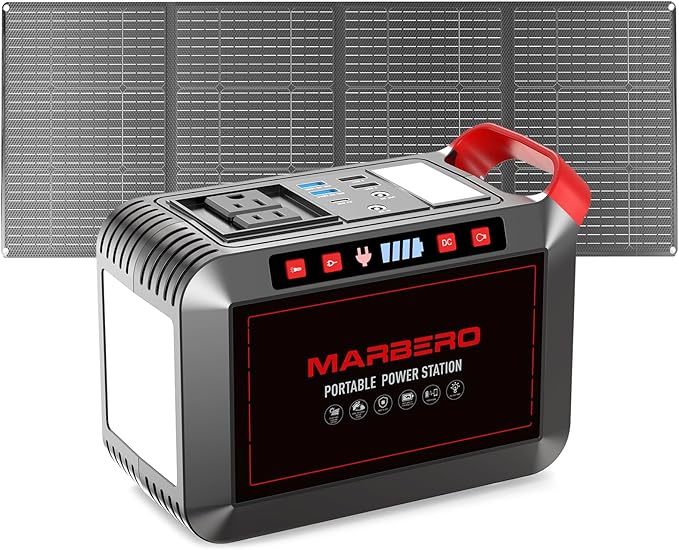
A good solar generator for camping should do more than keep your phone charged. Depending on the trip, you may need enough stored energy for lights, cameras, laptops, a portable fridge, CPAP equipment, or other small appliances while still being easy enough to carry to your campsite.
Today’s solar generators are generally portable power stations that store electricity in a battery and can be recharged from solar panels, AC outlets, or a vehicle. Unlike gas generators, they produce no exhaust while operating and can run quietly at a campsite.
But bigger isn’t always better for camping. A 2,000Wh power station may provide impressive runtime, yet a 200Wh or 300Wh unit can make more sense if you’re carrying everything yourself.
For this 2026 guide, the focus is on capacity, output, portability, solar charging, battery technology, and the type of camping each unit makes the most sense for.
Top Solar Generators for Camping in 2026
| Solar Generator | Capacity | AC Output | Best For | Solar Panel |
|---|---|---|---|---|
| MARBERO 237Wh + 60W Panel | 237Wh class | 120W class | Lightweight camping | 60W included |
| ZeroKor 300W + 60W Panel | 280Wh | 300W | Budget weekend camping | 60W included |
| Jackery Explorer 1000 v2 | 1,070Wh | 1,500W | Family and extended camping | Optional |
| Anker SOLIX C1000 | 1,056Wh | 1,800W | High-power camping | Bundle dependent |
| GRECELL 230Wh Class | 230Wh class | 300W | Budget and compact use | Model/bundle dependent |
Specifications and bundle contents can vary by retailer and product version. Always check the current Amazon listing before purchasing.
1. MARBERO 237Wh Solar Generator with 60W Panel
Check Amazon Price Click Here!
If portability is your biggest concern, the MARBERO 237Wh Solar Generator with 60W Panel is aimed at campers who don’t need to power large appliances.
A power station in this capacity range is best suited to basic camping loads such as smartphones, cameras, LED lights, small fans, and other low-power electronics.
Key Specifications
- Battery Capacity: Approximately 237Wh
- AC Output: Up to 120W class
- Solar Panel: 60W included with this configuration
- Design: Compact portable power station
- Best For: Lightweight camping and short trips
Why Choose the MARBERO?
The main advantage is simple: you don’t have to carry a large battery when your electrical needs are small.
For a one- or two-night camping trip where your primary goal is keeping phones, lights, cameras, and other electronics charged, a compact power station can be more convenient than a 20- to 30-pound unit.
The included 60W solar panel also gives you the option to recharge away from an electrical outlet.
However, don’t expect a 237Wh-class power station to run high-wattage appliances for long periods. It is better viewed as a compact camping battery with AC output rather than a replacement for a large generator.
Best For
Best lightweight option for basic camping power.
2. ZeroKor 300W Solar Generator with 60W Panel
Check Amazon Price Click Here!
The ZeroKor 300W Solar Generator with 60W Panel moves into a slightly more capable category while remaining relatively compact.
This model is built around a 280Wh battery and a 300W maximum AC output, making it more flexible than very small camping power stations.
Key Specifications
- Battery Capacity: 280Wh
- AC Output: Up to 300W
- Solar Panel: 60W included in the original configuration
- AC Output: 110V
- Battery Type: Lithium-ion
- Best For: Weekend camping and basic off-grid electronics
The 300W output gives you more flexibility for devices such as laptops, lights, fans, cameras, chargers, and other relatively small loads.
It is still important to look at running watts rather than simply the device name. A device that draws more than the power station’s continuous output can trigger overload protection or prevent the unit from operating correctly.
What I Like About It
The biggest attraction is the combination of a 300W inverter and a portable 280Wh battery without moving into the size and weight of a 1,000Wh power station.
The included 60W panel can also provide a useful way to recharge the battery during a sunny day, although actual solar charging speed depends heavily on sunlight, panel orientation, temperature, and other conditions.
Best For
Best for budget-conscious weekend campers who need more flexibility than a tiny power bank.
3. Jackery Explorer 1000 v2
Check Amazon Price Click Here!
The Jackery Explorer 1000 v2 is in a completely different class from the compact MARBERO and ZeroKor models.
With a current rated capacity of 1,070Wh, LiFePO4 battery chemistry, and up to 1,500W of AC output, it offers enough stored energy and inverter power for much more demanding camping setups. Jackery lists a 3,000W surge rating and a weight of approximately 10.8 kg (23.8 lb).
Key Specifications
- Battery Capacity: 1,070Wh
- Battery Chemistry: LiFePO4
- AC Output: 1,500W
- Surge Capacity: 3,000W
- Weight: Approximately 23.8 lbs
- Solar Charging: Up to 400W according to Jackery’s current specifications
- Best For: Family camping, longer trips, CPAP users, and higher-power devices
The LiFePO4 battery is an important upgrade compared with older lithium-ion camping power stations. Jackery rates the battery for approximately 4,000 cycles before retaining at least 70% of its original capacity.
Why the Explorer 1000 v2 Makes Sense for Camping
A 1,000Wh-class power station is a practical middle ground for many car campers.
It provides substantially more energy than a 200Wh or 300Wh unit without reaching the size of the large 2,000Wh-plus power stations designed primarily for heavy-duty backup.
You could use it for combinations of:
- Smartphones and tablets
- Cameras and camera batteries
- Laptops
- LED lighting
- Small fans
- Portable refrigerators
- CPAP equipment
- Small kitchen appliances
- Other electronics within the 1,500W output limit
Jackery also lists quiet operation around 30 dB, which is particularly useful at a campground where generator noise can quickly become annoying.
Solar Charging
Solar charging is where a 1,000Wh power station becomes much more useful for multi-day camping.
Jackery’s current specifications support up to 400W of solar input when using the appropriate configuration.
Remember that a panel’s advertised wattage is its maximum under favorable conditions. Clouds, shade, heat, panel angle, and time of day can substantially reduce actual charging power.
Best For
Best balanced option for family camping and longer off-grid trips.
4. Anker SOLIX C1000
Check Amazon Price Click Here!
The Anker SOLIX C1000 is another 1,000Wh-class power station designed for campers who want significantly more output than compact 200Wh or 300Wh units.
Anker lists a 1,056Wh capacity and 1,800W AC output, with SurgePad technology capable of handling loads up to 2,400W. The unit also supports up to 600W of solar input.
Key Specifications
- Battery Capacity: 1,056Wh
- AC Output: 1,800W
- SurgePad: Up to 2,400W for compatible loads
- Solar Input: Up to 600W
- USB-C: Up to 100W on the primary USB-C port
- Total Outputs: 11
- Weight: Approximately 28.4 lbs
Why Consider the C1000?
The biggest advantage over the smaller camping generators in this guide is output capability.
An 1,800W inverter gives you considerably more flexibility for higher-draw equipment. That can be useful when camping with several people or when you want to use appliances such as a coffee maker, electric cooking equipment, or other devices that would be difficult to operate from a 300W-class power station.
Anker also supports app-based monitoring and control, allowing you to check battery status and power usage from your phone.
Solar Charging Advantage
The C1000 supports up to 600W of solar input, which is particularly useful for campers who want to replenish a substantial battery during the day rather than relying primarily on AC charging.
Anker states that the C1000 can reach a full charge in approximately 1.8 hours when using the maximum supported solar input under suitable conditions.
The actual Amazon bundle linked above may change over time, so verify whether the current listing includes a 200W solar panel before purchasing.
Best For
Best for campers who want high AC output and fast solar-charging capability.
5. GRECELL 230Wh Class Solar Generator
Check Amazon Price Click Here!
The GRECELL 230Wh-class portable power station is designed for campers who want a compact battery with enough inverter power for common electronics without stepping up to a 1,000Wh system.
Current GRECELL documentation for its 300W HW01 model lists approximately 230.4Wh of LiFePO4 storage, 300W rated output, and 600W peak output.
Key Specifications
- Battery Capacity: Approximately 230Wh
- Battery Type: LiFePO4 on the current HW01 version
- Rated Output: 300W
- Peak Output: 600W
- AC Output: 110V
- USB-C: Up to 100W
- Solar Input: Up to 100W on the current HW01 version
- Weight: Approximately 7.9 lbs for the current HW01 version
Why It Is Worth Considering
The GRECELL makes sense when portability and price are more important than long runtime.
A 230Wh-class battery is enough for charging phones, cameras, tablets, laptops, lights, and other small electronics. The 300W inverter also gives it more flexibility than a standard USB power bank.
The current HW01 version also uses LiFePO4 chemistry, which is a useful feature for people who expect to use the power station regularly over several camping seasons.
One Important Limitation
Don’t confuse 300W output with long runtime.
For example, a device drawing 300W can consume roughly 300Wh in about one hour before accounting for conversion losses. In real use, available runtime will be shorter than a simple Wh ÷ watts calculation.
That’s why this type of power station is better for short-duration loads than for running large appliances continuously.
Best For
Best for compact camping setups and budget-conscious users who want LiFePO4 battery technology.
How Much Battery Capacity Do You Need for Camping?
Battery capacity is measured in watt-hours (Wh). This tells you approximately how much energy the battery can store.
Output power is measured in watts (W). This tells you how much power the inverter can provide to your devices at one time.
These are two different specifications.
For example, a power station with 1,000Wh of capacity and a 1,500W inverter can store a lot of energy, but that does not mean it can run a 1,500W appliance for an entire hour.
A simplified estimate is:
Runtime ≈ Battery capacity × 0.85 ÷ Device wattage
The 0.85 factor is only a rough way to account for conversion losses. Real-world results vary.
Approximate Camping Categories
| Capacity | Typical Camping Use |
|---|---|
| 150–300Wh | Phones, cameras, lights, laptops, small fans |
| 500–800Wh | Weekend camping, electronics, small coolers |
| 1,000–1,200Wh | Family camping, CPAP, refrigerators, multiple devices |
| 2,000Wh+ | Multi-day base camps and heavy off-grid use |
You don’t necessarily need the largest battery available. The better choice is the smallest power station that comfortably covers your actual electrical needs.
What Can a Solar Generator Run While Camping?
The answer depends on both battery capacity and inverter output.
Typical camping equipment includes:
Smartphones
Very low energy consumption. Even compact 200Wh-class power stations can recharge phones many times.
Laptops
Most laptops are easy for these power stations to handle, although the actual energy required depends on the computer and how long you use it.
LED Lights
Excellent candidates for portable solar power because they use relatively little electricity.
Portable Refrigerators
A 1,000Wh-class power station becomes much more useful if you’re camping with a portable refrigerator or cooler because refrigeration can consume power continuously throughout the day.
CPAP Machines
A 1,000Wh-class station can be useful for CPAP camping, but users should calculate their specific machine’s overnight energy requirements. Heated humidifiers and heated tubing can significantly increase consumption.
Coffee Makers and Cooking Appliances
These can require considerably more power than phones or laptops. Check both the appliance’s running wattage and the power station’s continuous output before using them.
Solar Generator vs. Gas Generator for Camping
For many camping situations, a solar generator has several advantages over a conventional gasoline generator.
| Feature | Solar Generator | Gas Generator |
|---|---|---|
| Fuel | Sun/electricity | Gasoline or other fuel |
| Exhaust | None during operation | Carbon monoxide and exhaust |
| Noise | Very low | Usually much louder |
| Maintenance | Minimal | Oil, fuel, engine maintenance |
| Indoor Use | Follow manufacturer location requirements | Never operate indoors |
| Refueling | Solar or AC | Requires fuel |
| Long Continuous High Power | Limited by battery/solar input | Better suited |
| Camping Convenience | High | Lower for quiet campsites |
A solar power station is particularly attractive for campgrounds, national parks, quiet outdoor settings, and places where generator noise is undesirable.
However, solar generators aren’t automatically the best solution for every situation. If you need continuous high power for heavy appliances over several days with limited sunlight, a conventional fuel generator may have advantages.
How to Choose the Best Solar Generator for Camping
1. Start With Your Devices
Make a list of everything you plan to power.
Include:
- Phones
- Cameras
- Laptops
- Lights
- Fans
- CPAP machines
- Portable refrigerators
- Speakers
- Cooking appliances
- Other electronics
Then check the wattage or energy consumption of each device.
2. Check Battery Capacity
For simple electronics, a 200Wh to 300Wh power station may be sufficient.
For family camping or longer trips, moving into the 1,000Wh class gives you considerably more flexibility.
If you’re staying off-grid for several days, consider a larger expandable system.
3. Check Continuous AC Output
Don’t look only at battery capacity.
A 1,000Wh battery with a 300W inverter cannot operate a 1,000W appliance simply because it has 1,000Wh of stored energy.
The inverter must be capable of handling the appliance’s running wattage and startup surge.
4. Look at Solar Input
This is one of the most overlooked specifications.
If your goal is true off-grid camping, solar input determines how quickly you can replace the energy you consume during the day.
A larger solar input can be particularly valuable with 1,000Wh or larger batteries.
5. Consider Battery Chemistry
LiFePO4 batteries have become increasingly common in modern portable power stations.
They are generally favored for their long cycle life and durability compared with older lithium battery chemistries.
For frequent camping, a LiFePO4 power station can make sense as a long-term investment.
6. Don’t Ignore Weight
This matters much more for camping than it does for home backup.
A 2,000Wh power station may provide excellent runtime, but moving a large unit from your vehicle to a campsite isn’t the same as carrying a 7- to 10-pound camping battery.
For car camping, weight is less critical.
For hiking or dispersed camping, every pound matters.
7. Check the Solar Panel Configuration
Some power stations are sold alone.
Others are sold as bundles with one or more solar panels.
Always check the exact Amazon listing because bundle contents can change.
A power station without a compatible solar panel isn’t necessarily a bad purchase, but you’ll need to budget separately for solar charging if you want extended off-grid use.
Solar Charging Isn’t Always Fast
One of the biggest misconceptions about solar generators is that a 200W panel will constantly produce 200W.
It won’t.
Solar output changes throughout the day depending on:
- Cloud cover
- Shade
- Panel angle
- Temperature
- Time of day
- Geographic location
- Panel efficiency
- Cable and conversion losses
For camping, position the panel where it receives direct sunlight for as much of the day as possible.
Even partial shading can significantly reduce output.
This is why solar input capability should be considered together with battery capacity.
Are Solar Generators Safe for Camping?
Portable power stations eliminate the exhaust produced by combustion generators while operating, which is one of their major advantages for outdoor recreation.
However, they still need to be used responsibly.
Keep these precautions in mind:
- Read the manufacturer’s operating instructions.
- Don’t exceed the rated output.
- Use compatible charging equipment.
- Protect the power station from water unless it is specifically rated for wet conditions.
- Avoid leaving the unit in extreme heat.
- Don’t cover ventilation openings.
- Use the manufacturer’s recommended charging temperature range.
- Inspect cables and connectors before use.
- Keep the unit away from standing water.
- Follow the manufacturer’s instructions for CPAP and medical-device use.
A power station may be weather-resistant in some cases, but weather-resistant does not mean waterproof. Check the specific model’s rating before exposing it to rain.
Maintaining a Solar Generator for Camping
Proper storage can extend the useful life of your power station.
Keep It Clean
Dust and dirt can accumulate around vents and ports. Keep the unit clean and make sure ventilation openings aren’t blocked.
Store It in a Cool, Dry Location
Avoid storing lithium batteries in extreme heat or freezing conditions.
Check the Battery Periodically
If you won’t use the power station for several months, check the manufacturer’s recommended storage charge level.
Maintain Your Solar Panels
Keep panels clean and free from dirt, leaves, and other debris.
Update Firmware
If your power station supports an app or firmware updates, check periodically for manufacturer updates.
Inspect Cables
Look for damaged insulation, loose connectors, or bent plugs before your next camping trip.
Which Solar Generator Is Best for Camping?
The best option depends on the type of camping you do rather than simply choosing the biggest battery.
Best for Lightweight Camping: MARBERO 237Wh
The MARBERO is the better fit when your main goal is charging small electronics while keeping your gear compact.
Best Budget Weekend Option: ZeroKor 300W
The ZeroKor provides more inverter capacity while remaining much smaller than a 1,000Wh-class power station.
Best All-Around Camping Choice: Jackery Explorer 1000 v2
With 1,070Wh of LiFePO4 storage, 1,500W of continuous AC output, and a relatively manageable 23.8-pound weight, the Explorer 1000 v2 hits a useful balance for many car-camping situations.
Best for Higher-Power Camping: Anker SOLIX C1000
The C1000 offers 1,056Wh of storage and 1,800W of continuous output, plus up to 600W of solar input. It’s particularly interesting for campers who want to run higher-wattage equipment and recharge quickly when sunlight is available.
Best Compact LiFePO4 Budget Option: GRECELL
The current 230Wh-class GRECELL 300W model provides a compact form factor with LiFePO4 battery technology and enough inverter capacity for many common camping electronics.
Final Thoughts: Choosing a Solar Generator for Camping in 2026
The best solar generator for camping isn’t necessarily the one with the biggest battery or highest wattage.
If you’re taking short trips and mainly need to charge phones, cameras, lights, and small electronics, a compact 200Wh to 300Wh model can save weight and money.
For family camping, CPAP equipment, portable refrigerators, and longer trips, a 1,000Wh-class power station makes considerably more sense.
The Jackery Explorer 1000 v2 offers a strong balance of capacity, output, battery longevity, and portability. The Anker SOLIX C1000 is better suited to campers who want higher AC output and substantial solar input. Smaller options such as the MARBERO, ZeroKor, and GRECELL are more appropriate when keeping weight and cost under control is the priority.
Before buying, pay particular attention to three numbers:
Battery capacity (Wh), continuous inverter output (W), and maximum solar input (W).
Those three specifications will tell you far more about whether a power station is right for your camping setup than the phrase “solar generator” alone.
And remember that solar charging depends on real-world sunlight. If you’re planning a multi-day off-grid trip, size the battery and solar panels around your actual daily energy consumption rather than relying solely on the manufacturer’s maximum ratings.