As an Amazon Associate I earn from qualifying purchases.
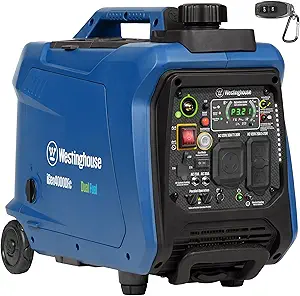
When a power outage hits, the last thing you want to do is fight with a recoil starter in the dark. An electric start generator lets you start the engine with the push of a button, while some models add remote start, dual-fuel or tri-fuel capability, CO shutdown protection, RV-ready outlets, and 120/240V power.
But electric start is only one part of the buying decision.
The right generator also depends on how much running wattage you need, how much starting power your appliances require, which fuel you want to use, whether you need clean inverter power, and whether the generator will be used for an RV, jobsite, workshop, or home backup.
For 2026, these five models cover a wide range of needs:
- Westinghouse iGen4000DFc — compact dual-fuel inverter power
- WEN DF680iX — mid-size dual-fuel inverter with 120/240V capability
- Westinghouse WGen9500DFc — high-output dual-fuel home backup
- Westinghouse WGen11500TFc — large tri-fuel generator with natural gas capability
- WEN GN5602X — straightforward electric-start gasoline generator
Below, you’ll find the important specifications, strengths, limitations, and best uses for each model.
Quick Comparison: Electric Start Generators for 2026
| Generator | Gasoline Output | Propane Output | Fuel | Start System | Type |
|---|---|---|---|---|---|
| Westinghouse iGen4000DFc | 4,000 / 3,300W | 3,600 / 2,970W | Gas/Propane | Electric/Remote/Recoil | Inverter |
| WEN DF680iX | 6,800 / 5,100W | 6,000 / 4,500W | Gas/Propane | Electric/Recoil | Inverter |
| Westinghouse WGen9500DFc | 12,500 / 9,500W | 11,200 / 8,500W | Gas/Propane | Electric/Remote/Recoil | Open Frame |
| Westinghouse WGen11500TFc | 14,500 / 11,500W | 13,500 / 10,500W | Gas/Propane/NG | Electric/Remote/Recoil | Open Frame |
| WEN GN5602X | 5,600 / 4,500W | — | Gasoline | Electric | Open Frame |
Starting/peak watts are shown first; running/rated watts are shown second.
1. Westinghouse iGen4000DFc Dual-Fuel Inverter Generator
Check Amazon Price Click Here!
If you want the convenience of electric and remote start without moving into a huge home-backup generator, the Westinghouse iGen4000DFc is one of the more practical options in this group.
It produces up to 4,000 peak watts and 3,300 running watts on gasoline. On propane, output is approximately 3,600 peak watts and 2,970 running watts.
Because this is an inverter generator, it is a better fit for applications where stable power and lower electrical distortion matter. Westinghouse specifies less than 3% THD for the model.
The iGen4000DFc also supports gasoline or propane, giving you the option to use gasoline when maximum output is important or propane when convenient fuel storage is a priority.
One of its biggest advantages is portability. At roughly 63 pounds depending on configuration, it is considerably easier to move than the larger open-frame generators in this guide.
The generator can be started electrically, remotely, or with the recoil starter. That gives you additional flexibility if the battery is discharged.
Noise is another reason to consider this model. Its published operating level can be as low as approximately 52 dBA, although actual noise depends on load and operating conditions.
Best for
- RV and camping use
- Tailgating
- Small emergency backup
- Sensitive electronics
- Buyers who want dual-fuel flexibility
- People who prefer inverter technology
What to keep in mind
The biggest limitation is output. With 3,300 running watts on gasoline, it is not intended to run an entire large home with multiple high-demand appliances at the same time.
For an RV refrigerator, lights, electronics and selected smaller appliances, however, its combination of portability, inverter power and electric start makes much more sense.
2. WEN DF680iX 6800-Watt Dual-Fuel Inverter Generator
Check Amazon Price Click Here!
The WEN DF680iX moves into a completely different power class while keeping the advantages of inverter technology.
On gasoline, the 224cc engine produces 6,800 surge watts and 5,100 rated watts. On propane, it produces 6,000 surge watts and 4,500 rated watts.
That extra capacity makes it considerably more useful for larger RVs, workshops, emergency backup, and situations where a 3,000-watt-class inverter is simply too small.
The DF680iX uses an electric starter with recoil backup and includes WEN’s Watchdog CO shutdown sensor.
One of the most interesting features is its 120/240V configuration. WEN states that the bonded-neutral 240V configuration can provide low-power Level 2 charging capability for battery and hybrid electric vehicles. That does not mean it replaces a dedicated EV charging installation, but it can make the generator more versatile for emergency vehicle charging.
The generator also includes an L14-30R 120/240V receptacle, TT-30R RV receptacle, standard 120V outlets, USB ports, and a 12V DC outlet.
WEN lists operating noise around 64 dBA at a quarter load, which is relatively reasonable for a generator producing this amount of power, although it is noticeably larger and heavier than compact inverter models.
The 2.9-gallon gasoline tank provides approximately 6.1 hours of runtime at 50% load according to current published specifications.
Best for
- Larger RVs
- Mid-size home backup
- Workshops
- Power tools
- Sensitive electronics
- Buyers who want inverter technology and 120/240V capability
- Emergency EV or hybrid vehicle charging
What to keep in mind
The DF680iX is substantially heavier than a small camping inverter. At roughly 95 pounds, it is portable, but it is not something most people will want to carry long distances.
Also remember that the advertised 6,800 watts is starting/surge power. The continuous gasoline rating is 5,100 watts.
3. Westinghouse WGen9500DFc 12,500-Watt Dual-Fuel Generator
Check Amazon Price Click Here!
If your priority is home backup rather than quiet camping, the Westinghouse WGen9500DFc is in a much more appropriate class.
It produces 12,500 peak watts and 9,500 running watts on gasoline. On propane, output is 11,200 peak watts and 8,500 running watts.
The generator uses a 6.6-gallon fuel tank and can run for up to approximately 12 hours at a light 25% load on gasoline. At a 50% load, published runtime is closer to 8 hours.
It includes electric start, remote start, and recoil backup, giving you several ways to start the engine.
The WGen9500DFc is also designed with home backup in mind. It has 120/240V output, a 50A receptacle, a 30A L14-30R outlet, GFCI protection, CO shutdown capability, and transfer-switch-ready connections.
One important correction from many online descriptions is noise. This is a large open-frame generator, not a quiet inverter. Its published operating volume is around 74 dBA, so it should not be described as a 60-dBA-class generator.
It is also important to understand that this is not an inverter generator. If you are specifically shopping for very low THD for sensitive electronics, the DF680iX or iGen4000DFc may be a better category to investigate.
Best for
- Home emergency backup
- Refrigerators and freezers
- Sump pumps
- Central or portable AC systems, depending on starting requirements
- Workshops
- Larger RV applications
- Extended outages
- Buyers who want gasoline and propane flexibility
What to keep in mind
At roughly 212 pounds, this is not a lightweight portable generator.
Also, 9,500 running watts does not automatically mean it can power every appliance in your home simultaneously. Large air conditioners, well pumps, electric water heaters and other motor-driven loads can have substantial starting requirements.
Before buying, calculate the running and starting wattage of the appliances you actually need to operate.
4. Westinghouse WGen11500TFc 14,500-Watt Tri-Fuel Generator
Check Amazon Price Click Here!
For homeowners who want maximum fuel flexibility, the Westinghouse WGen11500TFc is the most capable generator in this group.
The name can be confusing because the model is often marketed using its 14,500-watt peak output, while its continuous gasoline rating is 11,500 watts.
Its published output is:
| Fuel | Peak Watts | Running Watts |
|---|---|---|
| Gasoline | 14,500W | 11,500W |
| Propane | 13,500W | 10,500W |
| Natural Gas | 12,000W | 9,500W |
That third fuel option is the major advantage.
With access to a properly installed natural gas supply, you don’t necessarily have to depend entirely on stored gasoline or propane during a prolonged outage.
The generator uses a large 550cc four-stroke engine and a 9.5-gallon gasoline tank. Westinghouse rates gasoline runtime at up to 19 hours at 25% load, while a 20-pound propane cylinder is rated for approximately 7 hours at 50% load.
It also includes push-button electric start, remote start and recoil backup.
For home backup, the generator includes both an L14-30R transfer-switch-ready receptacle and a 14-50R 120/240V outlet.
Unlike some traditional open-frame generators, the WGen11500TFc is also advertised with less than 5% THD, making its output cleaner than many conventional portable generators.
It is still a large machine, however. Westinghouse lists its weight at approximately 230 pounds and noise at approximately 74 dBA.
Best for
- Large-home backup
- Long power outages
- Natural gas users
- Whole-home backup applications
- Large HVAC loads
- Buyers who want three fuel choices
- Users who need 50A-class output
What to keep in mind
This is a large generator. Storage space, transportation, fuel connections, ventilation and electrical installation all require more planning than with a compact inverter.
It is also not RV-ready in the same sense as a generator equipped with a TT-30R RV receptacle, so RV buyers should inspect the outlet configuration carefully before purchasing.
5. WEN GN5602X 5,600-Watt Portable Generator
Check Amazon Price Click Here!
The WEN GN5602X is a straightforward option for buyers who want electric start and useful backup power without paying for inverter technology or dual-fuel capability.
The important specification correction is that this generator produces 5,600 starting watts and 4,500 running watts.
It uses a 224cc gasoline engine and a 4.3-gallon fuel tank. WEN rates it for up to 12.5 hours of runtime at half load.
Starting is handled by an electric starter, and the generator also includes WEN’s Watchdog CO shutdown sensor.
For practical use, the GN5602X includes two standard 120V 20A outlets, a 120V 30A TT-30R RV outlet, and a 120V 30A L5-30R twist-lock outlet intended for transfer-switch applications.
This makes it useful for emergency home power, RV use, tools and other equipment that does not require inverter-generated power.
Best for
- Home emergency backup
- RV use
- Job sites
- Workshops
- Power tools
- Buyers who want electric start at a lower cost
- Users who don’t need dual-fuel operation
What to keep in mind
This is a gasoline-only open-frame generator, so it does not provide the fuel flexibility of the Westinghouse dual-fuel and tri-fuel models.
It is also not an inverter generator.
If your priority is clean inverter power, the iGen4000DFc or DF680iX are more appropriate categories to consider.
Electric Start vs. Remote Start: What’s the Difference?
These terms are sometimes used interchangeably, but they aren’t exactly the same.
Electric start
An electric-start generator uses a battery-powered starter motor. Instead of pulling a recoil cord, you turn a switch or press a button.
This is especially convenient when the generator is difficult to start manually or when you don’t want to repeatedly pull a recoil starter.
Remote start
Remote start takes the idea a step further.
A generator equipped with a remote-start key fob can be started from a distance without standing directly next to the control panel.
Several of the larger Westinghouse models in this guide offer both electric and remote starting.
Recoil backup
A recoil starter is the traditional pull-cord system.
It may seem old-fashioned, but it is useful as a backup if the electric starter battery becomes discharged.
For that reason, having electric + remote + recoil start can be a valuable combination for emergency backup.
Why Dual-Fuel and Tri-Fuel Generators Are Useful
Fuel availability can become a serious issue during a prolonged power outage.
A dual-fuel generator gives you two options, usually:
- Gasoline
- Propane
A tri-fuel generator adds:
- Natural gas
Gasoline generally provides strong output and is widely available, but it requires safe storage and can degrade over time.
Propane can be convenient for longer-term storage and emergency preparedness.
Natural gas can be especially attractive for home backup because it is supplied through a utility line rather than requiring a stored tank. However, natural-gas output is often lower than gasoline output, as demonstrated by the WGen11500TFc.
The best fuel depends on your situation rather than simply choosing the generator with the longest list of fuel options.
Do You Need an Inverter Generator?
This is one of the most important questions to answer before buying.
An inverter generator electronically produces and regulates its electrical output, generally providing cleaner power with lower harmonic distortion.
The Westinghouse iGen4000DFc and WEN DF680iX are the inverter choices in this group.
Traditional open-frame generators such as the WGen9500DFc and WEN GN5602X use conventional generator technology.
The WGen11500TFc is also an open-frame model, but Westinghouse specifies THD of 5% or less.
If you primarily need to run refrigerators, pumps, heaters, power tools and other conventional appliances, a conventional generator can make sense.
If your priority includes sensitive electronics, inverter technology can be worth considering.
How Much Generator Power Do You Need?
Don’t choose a generator based only on its peak-watt number.
There are two numbers to understand:
Running watts are the amount of power the generator can continuously produce.
Starting watts or peak watts provide additional temporary capacity for equipment that requires extra power when its motor starts.
For example, a refrigerator may use considerably more power for a short period when its compressor starts.
The same issue applies to:
- Air conditioners
- Well pumps
- Sump pumps
- Freezers
- Compressors
- Power tools
- Some electric motors
Before buying, make a list of the appliances you actually need during an outage and determine their running and starting requirements.
Don’t assume that a generator’s peak rating represents its continuous capacity.
Which Electric Start Generator Should You Choose?
| Your Priority | Generator to Consider |
|---|---|
| Compact dual-fuel inverter | Westinghouse iGen4000DFc |
| Mid-size inverter with 120/240V capability | WEN DF680iX |
| High-output dual-fuel home backup | Westinghouse WGen9500DFc |
| Gasoline, propane and natural gas | Westinghouse WGen11500TFc |
| Simple electric-start gasoline backup | WEN GN5602X |
The right choice depends more on your actual electrical load than on the largest wattage number.
Important Safety Tips for Electric Start Generators
Electric start makes a generator easier to operate, but it does not make a generator safe to use indoors.
Never run a gasoline, propane or natural-gas portable generator inside a home, garage, basement, crawlspace, shed or other enclosed or partially enclosed area.
Carbon monoxide is colorless and odorless, and a built-in CO sensor should be considered an additional safety feature—not permission to operate the generator in an enclosed space.
Always:
- Operate the generator outdoors.
- Keep it away from doors, windows and ventilation openings.
- Follow the clearance requirements in the owner’s manual.
- Keep the generator dry and protected from rain according to the manufacturer’s instructions.
- Refuel only after the engine has cooled.
- Keep fuel containers stored safely and away from ignition sources.
- Use appropriately rated extension cords.
- Never connect a portable generator directly to a home’s electrical wiring through an ordinary wall outlet.
- Use an approved transfer switch or appropriate inlet/interlock system when connecting generator power to a home’s electrical system.
- Have permanent electrical connections installed by a qualified professional.
A generator’s CO shutdown system is an important protection feature, but it should never replace proper placement and ventilation.
Final Thoughts: Best Electric Start Generators for 2026
Electric start is one of the most useful convenience features you can get on a portable generator, especially during a nighttime outage or emergency when pulling a recoil cord is the last thing you want to deal with.
The Westinghouse iGen4000DFc makes the most sense when portability, quiet inverter power and dual-fuel capability are priorities.
The WEN DF680iX steps up the output while keeping inverter technology and adds 120/240V capability that can be useful in more demanding applications.
For substantial home backup, the Westinghouse WGen9500DFc provides considerably more power and dual-fuel flexibility.
If fuel flexibility is your main concern, the Westinghouse WGen11500TFc stands out because it can operate on gasoline, propane or natural gas while providing up to 14,500 peak watts.
Finally, the WEN GN5602X is a simpler gasoline-only option for buyers who want electric start, useful output and a practical price without paying for inverter or multi-fuel technology.
Before choosing any generator, focus first on your actual running and starting watt requirements. Then consider fuel availability, noise, portability, outlet configuration, transfer-switch compatibility and the type of equipment you need to power.
A generator with more watts is not automatically the better generator. The best model is the one that provides the right amount of continuous power, starts easily when you need it, and fits the way you actually plan to use it.