As an Amazon Associate I earn from qualifying purchases.
A power outage can turn a normal day into a serious inconvenience surprisingly quickly. Refrigerators, freezers, sump pumps, medical equipment, internet equipment, lights, and other essential appliances may all depend on electricity. For RV owners and campers, reliable portable power can be just as important.
A dual fuel portable generator gives you an important advantage: the ability to run on either gasoline or propane. Gasoline is convenient when you need maximum output, while propane can be easier to store for emergency preparedness and can give you another fuel option when gasoline is difficult to find.
But choosing the right generator involves more than looking at the largest wattage number on the box. Starting watts, running watts, propane output, noise, portability, outlet configuration, inverter technology, and carbon monoxide protection can all make a significant difference.
Below, I compare five dual fuel portable generators that cover different needs, from high-output home backup to quieter inverter power for RVs and recreational use.
Best Dual Fuel Portable Generators for Reliable Backup Power in 2026
| Generator Model | Best For | Gasoline Output | Propane Output | Type |
|---|---|---|---|---|
| Westinghouse WGen9500DF | Home backup | 12,500 peak / 9,500 running W | 11,200 peak / 8,500 running W | Conventional |
| WEN DF680iX | Quiet portable power | 6,800 peak / 5,100 running W | 6,000 peak / 4,500 running W | Inverter |
| DuroMax XP13000EH | High-power backup | 13,000 peak / 10,500 running W | 12,350 peak / 9,975 running W | Conventional |
| WEN DF1100T | High-output value | 11,000 peak / 8,300 running W | 9,500 peak / 7,500 running W | Conventional |
| Westinghouse 4000W Dual Fuel Inverter | Compact and quiet power | 4,000 peak / 3,300 running W | Dual fuel | Inverter |
Generator specifications can vary by model revision. Always verify the current manufacturer specifications and owner’s manual before purchasing.
1. Westinghouse WGen9500DF 12,500-Watt Dual Fuel Generator
Check Amazon Price Click Here!
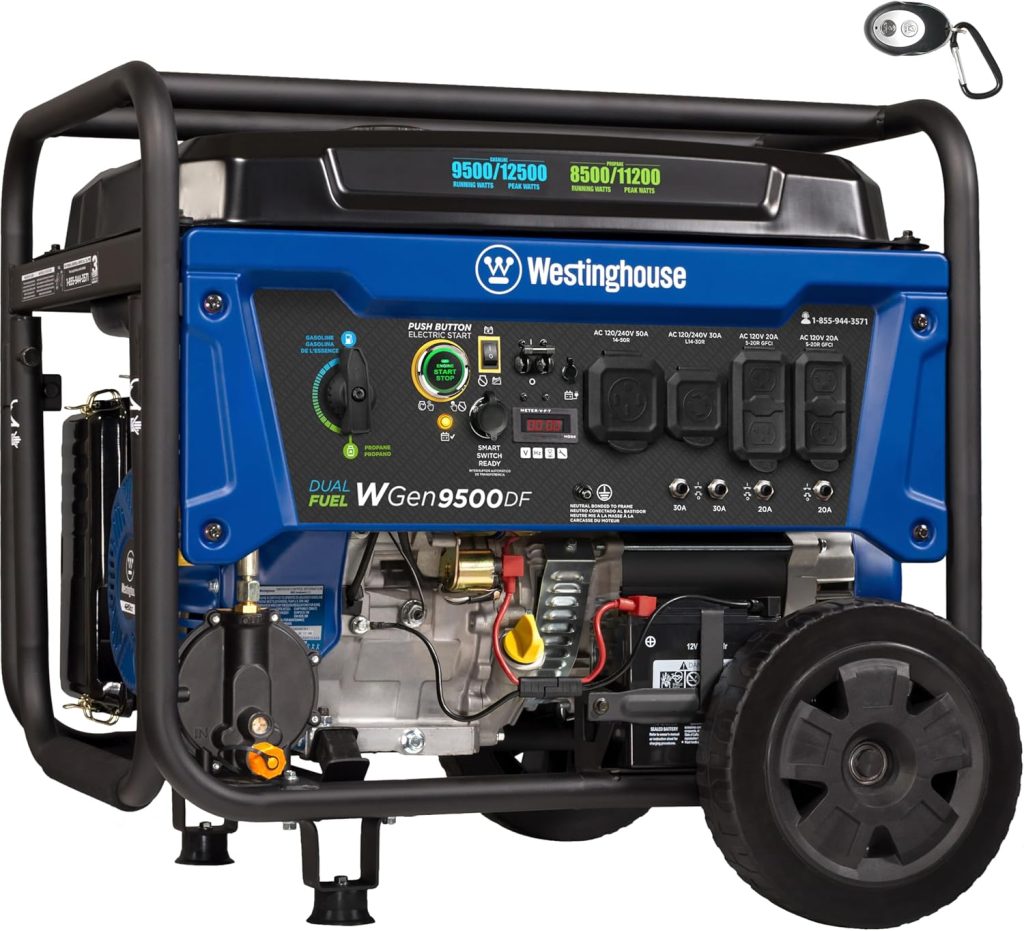
The Westinghouse WGen9500DF is designed for homeowners who need substantial portable backup power without moving into the size and cost of a permanently installed standby generator.
Its headline figure is 12,500 peak watts on gasoline, but the more important number for most applications is its 9,500 running watts. On propane, it produces 11,200 peak watts and 8,500 running watts.
That difference between starting and running watts is important. Appliances with electric motors, such as refrigerators, pumps, and some HVAC equipment, can require extra power when they start.
Key Specifications
- Gasoline: 12,500 peak / 9,500 running watts
- Propane: 11,200 peak / 8,500 running watts
- Fuel tank: 6.6 gallons
- Voltage: 120/240V
- Starting: Electric, remote, and recoil
- RV ready: Yes
- Transfer switch ready: Yes
- Outlets: Includes 120V household outlets, L14-30R, and 14-50R
- Noise: About 74 dBA
- Engine: 457cc OHV
- Low-oil shutdown: Yes
- GFCI protection: Yes
Westinghouse lists up to 12 hours of gasoline runtime at 25% load, and the generator includes a remote key fob along with electric and recoil starting options.
Why Choose the WGen9500DF?
The biggest advantage is its combination of output and home-backup features. The 120/240V configuration and transfer-switch-ready outlet make it much more practical for emergency household power than a small recreational generator.
It is also large and heavy, so this isn’t the model I would choose if your priority is easy transportation or quiet camping.
Best for: Homeowners who want high-output portable backup power for essential household circuits.
2. WEN DF680iX 6,800-Watt Dual Fuel Inverter Generator
Check Amazon Price Click Here!
The WEN DF680iX takes a different approach. Instead of competing primarily on maximum output, it combines dual-fuel capability with inverter technology, making it a more interesting option for RV owners, camping, tailgating, and users who want a quieter portable generator.
On gasoline, the DF680iX produces 6,800 surge watts and 5,100 rated watts. On propane, those numbers become 6,000 surge watts and 4,500 rated watts.
Key Specifications
- Gasoline: 6,800 peak / 5,100 running watts
- Propane: 6,000 peak / 4,500 running watts
- Engine: 224cc 4-stroke OHV
- Fuel tank: 2.9 gallons
- Voltage: 120/240V
- Type: Inverter generator
- Starting: Electric and recoil
- CO protection: WEN Watchdog automatic shutdown
- RV outlet: TT-30R
- Weight: Approximately 95 pounds in the manufacturer’s specifications
- Gasoline runtime: Up to 6.1 hours at half load
- Propane runtime: Up to 9 hours at half load
WEN also includes a fuel-shutoff function designed to use remaining fuel in the carburetor before shutdown, which can be useful for storage and maintenance.
The generator is rated around 64 dBA at quarter load, making it considerably more appealing for recreational situations than many large open-frame generators.
Why Choose the WEN DF680iX?
This is a good middle ground for someone who wants more power than a typical 2,000- or 3,000-watt inverter but doesn’t want a large 200-plus-pound open-frame generator.
Its inverter design and CO Watchdog system are especially useful features for recreational and backup applications.
Best for: RV owners, campers, tailgaters, and homeowners who want quieter dual-fuel inverter power.
3. DuroMax XP13000EH 13,000-Watt Dual Fuel Generator
Check Amazon Price Click Here!
If maximum portable output is the priority, the DuroMax XP13000EH is one of the most capable generators in this group.
It produces 13,000 peak watts and 10,500 running watts on gasoline. When operating on propane, it delivers 12,350 peak watts and 9,975 running watts.
That makes it particularly useful for demanding loads where a smaller portable generator may not have enough running capacity.
Key Specifications
- Gasoline: 13,000 peak / 10,500 running watts
- Propane: 12,350 peak / 9,975 running watts
- Engine: 500cc 4-stroke OHV
- Voltage: 120/240V
- Starting: Electric, remote, and recoil
- Fuel tank: 8.3 gallons
- RV ready: Yes
- Home backup ready: Yes
- CO shutdown: Yes
- GFCI outlets: Yes
- 50A outlet: Yes
- Weight: Approximately 248 pounds
- Noise: About 74 dBA
DuroMax also lists an L14-30R outlet and a 14-50R outlet, which gives the XP13000EH the type of connection flexibility often needed for larger portable backup systems.
Why Choose the DuroMax XP13000EH?
The major reason is straightforward: power.
With more than 10,000 running watts on either fuel, the XP13000EH is better suited to high-demand applications than smaller dual-fuel models. It can be useful for large homes, job sites, workshops, and situations where multiple appliances need to operate simultaneously.
The tradeoff is size. At roughly 248 pounds, this is not a generator you will casually load into a vehicle by yourself.
Best for: High-demand home backup, workshops, job sites, and users who need substantial running wattage.
4. WEN DF1100T 11,000-Watt Dual Fuel Generator
Check Amazon Price Click Here!
The WEN DF1100T is a practical option for buyers who want high output without moving all the way up to the largest generators in this category.
Its gasoline rating is 11,000 surge watts and 8,300 running watts. On propane, it produces 9,500 surge watts and 7,500 running watts.
Key Specifications
- Gasoline: 11,000 peak / 8,300 running watts
- Propane: 9,500 peak / 7,500 running watts
- Engine: 457cc 4-stroke OHV
- Fuel tank: 6.6 gallons
- Voltage: 120/240V
- Starting: Electric
- Outlets: 120V GFCI, 30A twist-lock, and 120/240V 50A
- Wheel kit: Included
- Propane hose: Included
- Warranty: 2 years
WEN states that the 6.6-gallon tank can provide up to 8.5 hours of runtime at half load on gasoline.
Why Choose the WEN DF1100T?
One of the biggest benefits is its 120/240V capability. That makes it more suitable for certain home-backup applications than generators limited to 120V.
The wheel and handle kit also makes moving this large generator considerably easier, although it is still a substantial piece of equipment.
Best for: Homeowners looking for high-output dual-fuel backup power with 120/240V capability.
5. Westinghouse 4000-Watt Dual Fuel Inverter Generator
Check Amazon Price Click Here!
Not everyone needs 10,000 watts or more. If your priority is a compact and quiet dual fuel generator, the Westinghouse 4000-watt inverter model deserves consideration.
It produces 4,000 peak watts and 3,300 running watts and uses inverter technology to provide a quieter alternative to many conventional open-frame generators. One documented version is rated as low as approximately 52 dBA.
Key Specifications
- Starting watts: 4,000W
- Running watts: 3,300W
- Fuel: Gasoline and propane
- Type: Inverter generator
- Engine: 141cc
- Fuel tank: Approximately 1.66 gallons
- CO protection: Yes
- Low-oil shutdown: Yes
- Parallel capable: Yes on applicable versions
- Weight: Approximately 59 pounds for the documented recoil-start version
- Noise: As low as 52 dBA
Its compact size makes it substantially easier to move than the 200-plus-pound generators in this list. It is therefore better suited to camping, RV use, tailgating, and smaller emergency loads.
Why Choose the Westinghouse 4000W?
The answer is portability and noise.
A 4,000-watt inverter generator won’t replace a 13,000-watt unit for heavy household loads, but it can be a much better fit when you need to run selected appliances, electronics, recreational equipment, or an RV.
Best for: Camping, RVs, tailgating, smaller emergency loads, and buyers who prioritize portability.
Dual Fuel Generator Comparison
| Model | Gas Running Watts | Propane Running Watts | Generator Type | Best Use |
|---|---|---|---|---|
| Westinghouse WGen9500DF | 9,500W | 8,500W | Conventional | Home backup |
| WEN DF680iX | 5,100W | 4,500W | Inverter | RV and quieter backup |
| DuroMax XP13000EH | 10,500W | 9,975W | Conventional | High-demand backup |
| WEN DF1100T | 8,300W | 7,500W | Conventional | Home and jobsite use |
| Westinghouse 4000W | 3,300W | Lower than gasoline | Inverter | Camping and compact backup |
The most important column here is running watts, not peak watts. Peak watts are available temporarily to help start equipment with motors, while running watts represent the power the generator can continuously provide under its rated conditions.
What Makes a Dual Fuel Generator Useful?
1. You Have Two Fuel Options
The main advantage is flexibility.
Gasoline is widely available and generally provides higher output. Propane, however, gives you another option when gasoline is unavailable or when you want to keep a fuel source stored for emergency preparedness.
You don’t have to rely exclusively on one fuel type.
2. Propane Can Be Convenient for Emergency Preparedness
Propane can be stored for extended periods when handled correctly, whereas gasoline requires more attention to storage conditions and fuel freshness.
For someone preparing for hurricanes, winter storms, wildfire-related outages, or other emergencies, keeping an appropriate propane supply can provide an additional backup option.
3. Larger Models Can Support Essential Household Loads
A high-output dual-fuel generator can potentially run several essential circuits at the same time.
However, that does not automatically mean it can power an entire house.
Your home’s electrical loads need to be calculated, and the generator must be connected using an appropriate transfer switch or other code-compliant setup installed according to local requirements.
4. Inverter Models Can Be Better for Quiet Applications
If you are camping or using a generator around an RV, noise can become a major consideration.
Models such as the WEN DF680iX use inverter technology and are designed to operate more quietly than many conventional open-frame generators.
For residential emergency backup, noise may be less important than running watts and outlet configuration.
5. Carbon Monoxide Protection Matters
Modern portable generators may include automatic CO shutdown systems.
For example, the WEN DF680iX uses its CO Watchdog system to shut the generator down if dangerous carbon monoxide levels are detected, while the DuroMax XP13000EH also includes CO sensor shutdown.
A CO sensor is an additional safety feature, not permission to operate a generator indoors.
How to Choose the Right Dual Fuel Portable Generator
Calculate Running Watts First
Start by listing the appliances you expect to use during an outage.
For example:
- Refrigerator
- Freezer
- Sump pump
- Furnace blower
- Internet modem and router
- Lights
- Television
- Microwave
- Portable air conditioner
- Selected power tools
Add their running watt requirements and then account for the additional starting power required by appliances with motors or compressors.
The goal is to choose a generator whose running watt capacity comfortably exceeds your expected continuous load.
Consider Starting Watts
Refrigerators, freezers, pumps, compressors, and some HVAC equipment can require significantly more power when their motors start.
A generator that appears large enough based only on running watts may still struggle if several motor-driven appliances start simultaneously.
Compare Gasoline and Propane Ratings
Don’t assume a generator produces the same output on both fuels.
Most dual-fuel generators have different ratings depending on the fuel being used. For example, the DuroMax XP13000EH produces 10,500 running watts on gasoline compared with 9,975 on propane.
If propane will be your primary emergency fuel, size your generator using its propane rating.
Decide Whether You Need 120V or 120/240V
A 120/240V generator can be more useful for home backup because some household equipment and transfer-switch installations require 240V.
Before buying, check the electrical requirements of the circuits or equipment you intend to power.
Don’t Ignore Generator Weight
High-output generators are heavy.
The DuroMax XP13000EH weighs approximately 248 pounds, while the WEN DF680iX is under 100 pounds according to its manufacturer’s specifications.
That difference can matter just as much as wattage if you need to move the generator frequently.
Consider Noise
If the generator will be used near an RV, campsite, or neighbors, check the manufacturer’s noise rating.
An inverter generator can be particularly attractive for these situations.
For a large home-backup generator, however, the priority may reasonably shift toward output, fuel capacity, and electrical connections.
Portable Generator Safety Tips
A dual fuel generator can be extremely useful, but it also needs to be operated correctly.
Always Operate It Outdoors
Never run a gasoline or propane portable generator inside a home, garage, basement, shed, or other enclosed or partially enclosed area.
Carbon monoxide is colorless and odorless and can accumulate rapidly.
Keep the Generator Away From Doors and Windows
Position the generator well away from the home and direct exhaust away from the building. Follow the clearance requirements in the owner’s manual and local safety guidance.
Never Backfeed a Home
Do not attempt to connect a portable generator directly to a household wall outlet.
If you want to power household circuits, use an appropriately installed transfer switch or another approved connection method handled by a qualified electrician.
Let the Generator Cool Before Refueling
Turn the generator off and allow it to cool before adding gasoline. Spilled fuel near a hot engine creates a serious fire hazard.
Use the Fuel You Actually Plan to Store
If propane is your emergency backup fuel, test the generator on propane before an emergency occurs.
Likewise, don’t assume that having gasoline stored means the generator will automatically start after months of inactivity. Regular inspection and maintenance are important.
Dual Fuel vs. Single-Fuel Generators
A gasoline-only generator can make sense if gasoline is readily available and you don’t need another fuel option.
A propane-only generator may appeal to users who already maintain a propane supply.
A dual fuel portable generator offers greater flexibility because you can choose between the two.
The tradeoff is that dual-fuel models may cost more or be somewhat more complicated than basic single-fuel generators.
For emergency preparedness, however, having two fuel options can be a significant advantage.
Which Dual Fuel Generator Should You Choose?
The right choice depends on how you plan to use it.
For high-output home backup: The Westinghouse WGen9500DF offers 9,500 running watts on gasoline and 8,500 on propane, along with 120/240V operation and transfer-switch-ready connections.
For maximum power: The DuroMax XP13000EH provides 10,500 running watts on gasoline and 9,975 on propane, making it one of the strongest options here for demanding loads.
For quieter inverter power: The WEN DF680iX combines 5,100 running watts on gasoline, inverter technology, dual-fuel operation, and CO Watchdog protection.
For a high-output 120/240V option: The WEN DF1100T provides 8,300 running watts on gasoline and 7,500 on propane and includes a 120/240V configuration.
For compact recreational use: The Westinghouse 4000W dual-fuel inverter is much smaller and quieter than the high-output models, making it a better match for camping, RV use, and smaller loads.
Frequently Asked Questions
Are dual fuel generators worth it?
For many homeowners and recreational users, dual fuel generators are worth considering because they provide two fuel options. Gasoline can deliver higher output on many models, while propane provides an alternative fuel source for emergencies and can be convenient for long-term preparedness.
Is it better to run a dual fuel generator on gasoline or propane?
It depends on your priorities. Gasoline commonly provides the highest output, while propane offers convenient fuel storage and an alternative when gasoline isn’t available. Always compare the manufacturer’s running-watt ratings for both fuels before choosing.
Can a dual fuel generator power a whole house?
Some high-output portable generators can supply many essential household circuits, but “whole house” depends on the home’s electrical demand and the generator’s capacity. A proper transfer-switch installation is required for connecting a portable generator to household circuits.
Are dual fuel generators safe for electronics?
Inverter dual-fuel generators such as the WEN DF680iX are designed to provide regulated electrical output and are generally a better choice for sensitive electronics than many conventional generators. You should still check the generator’s specifications and the requirements of your equipment.
Can I run a propane generator indoors?
No. Never operate a gasoline or propane portable generator indoors or in an enclosed or partially enclosed space. The engine produces carbon monoxide, which can become deadly without warning.
Does a generator produce less power on propane?
Often, yes. Many dual-fuel generators have a lower wattage rating when operating on propane. For example, the DuroMax XP13000EH is rated at 10,500 running watts on gasoline and 9,975 running watts on propane.
What size dual fuel generator do I need for a house?
There is no universal wattage number because homes have different electrical loads. Add the running watts of the appliances you need during an outage and account for motor starting loads. For a larger home, a 9,000- to 10,000-plus running-watt portable generator may be appropriate, but the actual requirement should be calculated before purchasing.
Can I use a dual fuel generator for an RV?
Yes. Several dual-fuel generators are designed with RV-friendly outlets. Smaller inverter models can be especially attractive for RV use because they are generally easier to transport and quieter than large open-frame generators.
Final Thoughts
A dual fuel portable generator can provide an extra layer of flexibility when reliable electricity matters most. Instead of depending on gasoline alone, you have the option of switching to propane when circumstances make it more practical.
For serious home backup, high-output models such as the Westinghouse WGen9500DF and DuroMax XP13000EH provide substantial running watt capacity. The WEN DF1100T is another high-output option with 120/240V capability.
If portability and noise are more important, the WEN DF680iX and Westinghouse 4000W inverter generator make more sense for RVs, camping, tailgating, and smaller backup loads.
Before buying, focus on the numbers that actually matter: running watts, starting watts, output on your preferred fuel, voltage, outlet configuration, noise, weight, and safety features.
Most importantly, size the generator for the loads you actually need to run and follow the manufacturer’s safety instructions every time you use it.