As an Amazon Associate I earn from qualifying purchases.
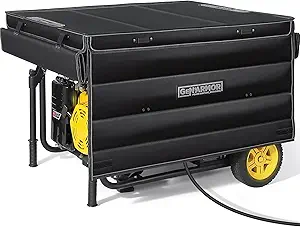
When a power outage happens during heavy rain or snow, keeping a portable generator protected from the weather can be a real challenge. A standard storage cover is not designed to remain over a running engine, but a generator running cover is built specifically to provide weather protection while the generator continues operating outdoors.
The important distinction is that a running cover is not simply a waterproof tarp. Purpose-built models use a raised frame, openings, vents, or other design features to keep rain and snow away from sensitive electrical components while maintaining the airflow and exhaust clearance required by the generator.
For 2026, the market includes several popular options from brands such as GENARMOR, Westinghouse, IGAN, JIAHOO, and Porch Shield. However, the right cover depends on your generator’s physical dimensions, frame design, wattage range, weather conditions, and the manufacturer’s installation requirements.
Below are five running-cover options worth considering, followed by a buying guide and important safety information.
Best Generator Running Covers for 2026
| Generator Running Cover | Approx. Generator Range | Design | Best For |
|---|---|---|---|
| GENARMOR Generator Cover While Running | 4,000–13,000W | Metal frame + waterproof canopy | Heavy-duty weather protection |
| Westinghouse WGenTent | 80–107″ perimeter | Frame-mounted canopy | Westinghouse open-frame generators |
| JIAHOO Generator Cover While Running | Varies by model | Heavy-duty fabric + frame | Budget-conscious buyers |
| IGAN Generator Cover While Running | 3,500–12,000W | Metal frame + waterproof tarp | Broad open-frame compatibility |
| Porch Shield Running Generator Cover | 3,500–12,000W | Pre-assembled frame + 600D fabric | Quick setup and everyday protection |
Important: Wattage is only one part of compatibility. Always compare the cover’s stated dimensions and mounting requirements with your generator before ordering.
1. GENARMOR Generator Cover While Running
Check Amazon Price Click Here!
If you need a heavy-duty running cover for a mid- to high-output portable generator, the GENARMOR Generator Cover While Running is one of the options worth looking at in 2026.
The current product information describes a reinforced waterproof tarpaulin combined with an integrated metal frame. The design is intended for most generators in the approximately 4,000W to 13,000W range, although buyers should still verify their generator’s actual dimensions and frame configuration before purchasing.
Key Features
- Designed for most 4,000W–13,000W portable generators
- Heavy-duty waterproof tarpaulin
- Integrated metal frame
- Approximately 14 pounds
- Access to the control panel
- Flip-top access for refueling
- Designed for use while the generator is operating
- Available in different versions, including a windproof-kit configuration
The metal frame is particularly useful because the canopy is held above the generator instead of simply being draped over the engine. That distinction is important for a running cover because the generator still needs adequate cooling airflow.
The cover is also designed so you can access the control panel and fuel area without completely removing the weather shelter.
Best For
The GENARMOR is a practical choice for homeowners who want a sturdy frame-based running cover for a larger open-frame portable generator.
Before buying, check the exact generator model against the current Amazon listing because compatibility can vary between generator designs even when two machines have similar wattage ratings.
2. Westinghouse WGenTent Generator Running Cover
Check Amazon Price Click Here!
The Westinghouse WGenTent is designed for open-frame portable generators and is particularly interesting for owners of compatible Westinghouse models.
The current Westinghouse specifications list compatibility with open-frame generators having an 80- to 107-inch perimeter, calculated from the generator’s length and width while excluding wheels and handles. It is designed for Westinghouse generators up to the 11500 Series and the ecoGen10000.
Key Features
- Fits generators with an 80–107-inch perimeter
- Designed for open-frame portable generators
- Vented top for cooling airflow
- Dedicated refueling access
- Tool-free setup
- Approximately 4.4 pounds
- 12 inches of rain per hour rating
- 70 mph forecast-wind rating
- 18-inch/55-pound snow-load rating
- 1-year limited warranty
One advantage of the WGenTent is its relatively light weight compared with some heavier metal-frame running covers.
It is also designed to remain attached while you reposition the generator, which can be convenient when you need to move the unit without exposing it to the weather.
An Important 2026 Update
Westinghouse’s running-cover lineup has expanded. The newer WGenTent XL is designed for larger WGen14500 and WGen20000 generators and was introduced in 2026. The XL version has significantly higher published weather-performance ratings than the original WGenTent.
That means buyers with a very large Westinghouse generator should not automatically choose the standard WGenTent. Check whether your model requires the XL version.
Best For
The standard WGenTent is a good match for compatible Westinghouse open-frame generators that fall within its published perimeter range.
3. JIAHOO Generator Cover While Running
Check Amazon Price Click Here!
JIAHOO offers several generator covers designed for outdoor use, including running-cover configurations aimed at larger portable generators.
The original version of this article listed a 5,000W–10,000W range. Because JIAHOO has multiple cover sizes and versions, it is better in 2026 to avoid treating one wattage range as universal for every JIAHOO running cover.
What to Look For
Depending on the version, features can include:
- Heavy-duty Oxford or waterproof fabric
- Reinforced construction
- Zippered or opening top section
- Access to the generator control panel
- Adjustable side panels
- Weather protection for outdoor operation
- Portable construction
One of the biggest advantages of this type of cover is portability. A fabric-based running shelter can be easier to store than a larger rigid enclosure.
However, compatibility is especially important. Do not buy a cover based solely on the advertised wattage range. Check the listed dimensions against your generator and make sure the frame or support system does not interfere with the exhaust, cooling openings, fuel system, or electrical panel.
Best For
JIAHOO is worth considering if you want a relatively lightweight running-cover solution and your generator matches the dimensions of the specific model.
4. IGAN Generator Cover While Running
Check Amazon Price Click Here!
The IGAN Generator Cover While Running is one of the more established alternatives in this category and remains relevant in 2026.
IGAN currently lists its standard running cover for most 3,500W to 12,000W portable generators. The design uses a heavy-duty waterproof tarp with a high-strength metal frame, and the manufacturer describes it as suitable for both running and storage use.
Key Features
- Designed for approximately 3,500W–12,000W portable generators
- Waterproof tarp
- High-strength metal frame
- Tool-free installation
- Designed for tubular or square generator frames
- Can be used as a running cover and storage cover
- Refueling access
- Foldable design for storage
One of the more interesting aspects of the IGAN design is the suspended-flap system. The manufacturer says the flaps can be positioned to maintain access and airflow while the generator is running, with the electrical-panel flap treated differently.
That design makes the IGAN different from an ordinary fitted storage cover.
What I Like About It
The broad compatibility range is useful for owners of common open-frame portable generators, especially in the 3,500W–12,000W category.
The metal frame also provides more structure than a simple fabric cover, while the tool-free installation makes it easier to deploy when weather conditions change quickly.
Best For
The IGAN is a strong option for owners who want a combination running-and-storage cover with a substantial frame and broad compatibility.
5. Porch Shield Running Generator Cover
Check Amazon Price Click Here!
The Porch Shield Running Generator Cover is another option aimed at portable generators in the approximately 3,500W–12,000W range.
Current product information describes a 36 x 28 x 20-inch running shelter using heavy-duty 600D PVC polyester and a pre-assembled support structure. The design includes Velcro locks and adjustable nylon ties for securing the frame.
Key Features
- Designed for approximately 3,500W–12,000W generators
- 36 x 28 x 20-inch cover dimensions
- Heavy-duty 600D PVC polyester
- Pre-assembled pole design
- Top opening for refueling
- Roll-up side sections
- Adjustable nylon ties
- Velcro fastening system
- Designed for rain, snow, UV exposure, and dust
The pre-assembled frame is one of its biggest conveniences. Instead of dealing with a complicated multi-piece frame, the basic setup involves unfolding the support structure and securing it to the generator.
This can be useful during an outage when you want a running cover that can be deployed relatively quickly.
Best For
Porch Shield makes the most sense for buyers looking for a relatively straightforward running cover with a pre-assembled support structure.
As always, confirm that the dimensions and frame attachment points work with your particular generator before ordering.
Running Cover vs. Storage Cover: What’s the Difference?
This is one of the most important things to understand before buying a generator cover.
A storage cover is intended for a generator that is turned off and has cooled down. It protects the machine from dust, sunlight, moisture, and debris while it is sitting in storage.
A running cover is specifically designed around the requirements of an operating generator.
A running cover normally uses a raised support structure so the fabric does not simply rest against the hot generator. It also provides openings or clearance for cooling airflow, exhaust, controls, and fueling access.
Never assume that a waterproof generator cover can remain installed while the generator is running just because it fits the machine.
If the manufacturer describes a product as a storage-only cover, remove it before starting the generator.
Can You Run a Generator in the Rain?
A portable generator should never be treated like ordinary outdoor equipment that can simply be left exposed to rain.
Water reaching electrical outlets, connections, or control components can create serious electrical hazards and damage the generator.
A purpose-built running cover can provide weather protection, but the cover does not eliminate the other hazards associated with generator operation.
Most importantly, a running cover does not make it acceptable to operate a generator inside a garage, shed, house, basement, enclosed porch, or other partially enclosed location.
The U.S. Consumer Product Safety Commission recommends operating portable generators outdoors and at least 20 feet away from the house, with the exhaust directed away from the home.
Keep doors, windows, and other openings out of the exhaust path.
How to Choose a Generator Running Cover
1. Check the Generator’s Physical Dimensions
Do not choose a cover based only on wattage.
Measure the generator’s:
- Length
- Width
- Height
- Frame perimeter, if required
- Frame tube shape and diameter
- Exhaust location
- Fuel-cap location
- Control-panel location
For example, the standard Westinghouse WGenTent uses an 80–107-inch generator perimeter rather than simply saying that it fits a particular wattage class.
This is a much better way to determine compatibility.
2. Confirm That Your Generator Is Open-Frame or Inverter Style
Not every running cover works with every generator.
Traditional open-frame generators usually expose a tubular frame around the engine and alternator. Many running covers attach directly to those frame tubes.
Closed-case inverter generators have a different shape and cooling arrangement.
Some manufacturers make separate running covers for inverter generators, so do not assume an open-frame cover will work on a fully enclosed inverter model.
3. Look at the Exhaust Location
Exhaust clearance is critical.
The cover must not block the exhaust outlet or allow hot exhaust gases to blow directly against the canopy.
For example, the Westinghouse WGenTent XL manual specifically warns against obstructing the exhaust muffler and says the product should not be used on generators with an openly exposed muffler at the top.
Always follow the instructions supplied with both the generator and the running cover.
4. Make Sure Cooling Air Can Move Freely
A generator needs airflow to remove engine and alternator heat.
A cover that completely wraps the generator and blocks its cooling openings is not an acceptable substitute for a purpose-designed running cover.
Look for:
- Raised canopy construction
- Open or vented sides
- Clear exhaust path
- Clear intake areas
- Proper distance between the canopy and the generator
- Access to controls
This is one reason a running tent is fundamentally different from a simple waterproof storage cover.
5. Consider Wind Resistance
Wind can turn a generator canopy into a sail.
For storm-prone locations, look closely at how the cover attaches to the generator.
Metal clamps, reinforced frame systems, adjustable straps, and secure fastening points can all matter.
Published weather ratings can also be useful. For example, the current GenTent platform publishes independently tested ratings of up to 110 mph forecast winds, 18 inches of rain per hour, and 20 inches of wet snow, depending on the specific system.
That does not mean every generator or every cover should be operated in those conditions. Always follow the generator manufacturer’s operating limits.
6. Check Refueling Access
A running cover should not force you to completely remove the shelter every time you need access to the fuel system.
Look for a dedicated refueling opening or a top section that can be opened without dismantling the entire cover.
However, always shut the generator off and allow the engine to cool before refueling.
The Westinghouse WGenTent XL manual specifically instructs users to shut the generator off before fueling or performing maintenance.
What About Severe Weather?
A good running cover can help protect a portable generator from rain, snow, and wind, but it should not be treated as a guarantee that the generator can operate in any weather condition.
Severe weather can create additional problems such as:
- Flooding
- Standing water
- Falling debris
- Extreme wind
- Snow accumulation
- Blocked air intakes
- Blocked exhaust
- Damaged electrical connections
The generator should always remain on a stable, suitable surface and be positioned according to the generator manufacturer’s instructions.
If water is rising around the generator, moving the generator into a garage or other enclosed location is not a safe solution. The carbon monoxide hazard remains.
2026 Generator Running Cover Recommendations
Best Heavy-Duty Option: GENARMOR
The GENARMOR is worth considering when you want a substantial metal-frame running cover for a larger open-frame portable generator. Its advertised 4,000W–13,000W compatibility range covers many common home-backup generators.
Best for Compatible Westinghouse Generators: WGenTent
Check Westinghouse WGenTent on Amazon
The WGenTent is designed around specific Westinghouse-compatible dimensions and offers a lightweight frame-mounted design with published weather ratings. Larger Westinghouse models may require the newer WGenTent XL instead.
Best Broad-Range Alternative: IGAN
IGAN’s running cover is designed for many 3,500W–12,000W portable generators and uses a metal frame with a waterproof tarp. It is a useful option for buyers who want a running and storage cover in one system.
Best for Quick Setup: Porch Shield
The pre-assembled support structure and 600D PVC polyester construction make Porch Shield an interesting option for buyers who prioritize straightforward setup and broad 3,500W–12,000W compatibility.
Lightweight Fabric Option: JIAHOO
JIAHOO offers several sizes and configurations, so it is particularly important to check the exact listing before buying. Its fabric-based design can appeal to buyers who want something easier to store than a larger rigid enclosure.
Generator Running Cover Safety Checklist
Before operating a portable generator with a running cover, check all of the following:
- The generator is outdoors.
- The generator is at least 20 feet from the house, according to CPSC guidance.
- The exhaust is pointed away from the house.
- Doors, windows, and vents are not in the exhaust path.
- The running cover is specifically designed for operation, not just storage.
- The cover does not block the exhaust.
- Cooling-air openings remain unobstructed.
- The cover is correctly attached to the generator.
- The generator is on a stable surface.
- Electrical connections are protected from direct water exposure.
- The generator’s CO safety system is functioning properly.
- You have followed the generator owner’s manual.
- You shut the generator off and let it cool before refueling.
A running cover addresses weather exposure. It does not eliminate carbon monoxide, fire, fuel, electrical, or mechanical hazards.
Frequently Asked Questions
Can you cover a generator while it is running?
Yes, but only with a running cover specifically designed for generator operation. A standard storage cover, tarp, or fitted fabric cover should not be used on an operating generator because it may restrict airflow or interfere with exhaust and cooling.
Can I run a generator in the rain?
A purpose-built running cover can protect a compatible portable generator from rain while it operates outdoors. However, the generator must still be positioned safely and operated according to its owner’s manual. Never operate a portable generator inside a garage, shed, home, or other enclosed or partially enclosed area.
How far should a portable generator be from the house?
The CPSC recommends operating portable generators outdoors and at least 20 feet away from the house, with the exhaust directed away from the home.
Are generator running covers the same as storage covers?
No. A storage cover is designed for a generator that is switched off and cool. A running cover is engineered to provide weather protection while maintaining the airflow, exhaust clearance, and access required during operation.
Does generator wattage determine which cover I need?
Not by itself. Wattage is useful for narrowing down options, but physical dimensions, frame perimeter, frame shape, exhaust location, fuel-cap location, and control-panel position can be equally important.
Can I use a running cover on an inverter generator?
Only if the cover is specifically compatible with that inverter generator. Closed-case inverter generators can have different cooling and exhaust arrangements than open-frame models, so always verify compatibility before installation.
Can I refuel a generator without removing the running cover?
Some running covers provide access to the fuel cap while installed. However, you should always turn the generator off and allow it to cool before refueling. Never refuel a hot or operating gasoline generator.
What is the best material for a generator running cover?
Waterproof vinyl, tarpaulin, and heavy-duty coated fabrics are commonly used. The material itself is only part of the equation. The frame, attachment system, ventilation, seams, exhaust clearance, and generator compatibility are equally important.
Should I leave a generator running cover on when the generator is stored?
Follow the cover manufacturer’s instructions. Some running covers are designed for both operation and storage, while others are intended primarily for use during generator operation.
Final Thoughts
A generator running cover can be a valuable accessory when you need portable power during rain, snow, or other wet weather. The key is choosing a purpose-built system rather than treating a standard storage cover or tarp as an operating shelter.
For 2026, GENARMOR, Westinghouse WGenTent, IGAN, JIAHOO, and Porch Shield offer different approaches to the problem. The best choice depends on your generator’s size, frame design, exhaust position, weather conditions, and how quickly you need to deploy the cover.
The most important buying rule is simple: match the cover to the generator, not just the generator’s wattage.
And remember that weather protection is only one part of generator safety. Keep the generator outdoors, maintain the recommended distance from the home, keep exhaust directed away from openings, maintain adequate airflow, and follow the instructions supplied with your generator and cover.
A well-designed running cover can help keep your generator protected when bad weather arrives, but it should never be used as a reason to compromise the basic safety requirements for portable generator operation.