As an Amazon Associate I earn from qualifying purchases.
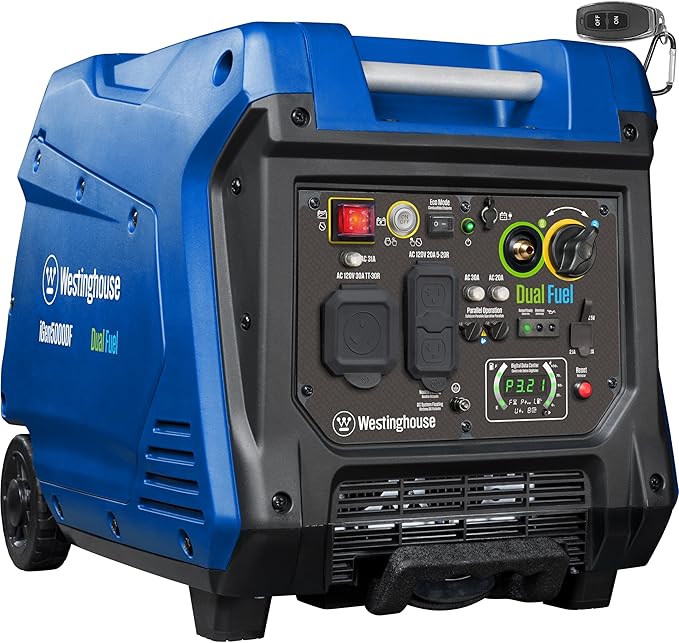
If you need portable power for an RV, campsite, home emergency, or outdoor project, a 3500 watt inverter generator can be a very useful middle ground between a lightweight 2,000-watt unit and a much larger home backup generator.
The important thing is to look beyond the number printed on the box. A generator advertised as 3,500 watts may produce considerably less power continuously, while another model with a higher peak rating may provide more useful running capacity for an RV air conditioner, refrigerator, microwave, or other appliances.
For 2026, the best choices in this category include gasoline-only and dual-fuel models, RV-ready generators with 30-amp outlets, and quieter inverter designs intended for camping and residential backup.
This guide compares the most useful 3500-watt-class inverter generators for home use, RVing, camping, and emergency power, with an emphasis on actual running watts, starting capacity, noise, fuel flexibility, portability, and useful features.
Quick Comparison: Best 3500-Watt-Class Inverter Generators for 2026
| Model | Fuel | Running Watts | Starting Watts | RV Outlet | Electric Start | Best For |
|---|---|---|---|---|---|---|
| Champion 200988 | Gas/Propane | 3,500 gas | 4,500 | Yes, TT-30R | Yes | RV and emergency backup |
| WEN 56380i | Gasoline | 3,400 | 3,800 | Yes, TT-30R | Yes | Quiet RV and camping |
| Westinghouse iGen4500DF | Gas/Propane | 3,700 gas | 4,500 | Yes | Yes | Higher-output RV backup |
| GENMAX GM3500iAED | Gas/Propane | 3,200 gas | 3,500 | 30A | Yes | Compact dual-fuel power |
| A-iPower SUA3500i | Gasoline | Around 3,000 class | Around 3,500 class | Check current configuration | Varies | Budget-focused buyers |
Important: Running watts are more important than starting watts when deciding whether a generator can continuously handle your appliances.
Check the current Amazon listings
Always verify the current Amazon listing, model number, and configuration before purchasing. Generator specifications and availability can change.
What Does a 3500-Watt Inverter Generator Actually Mean?
One of the easiest mistakes to make when shopping for a generator is confusing starting watts with running watts.
Running watts are the amount of power the generator can continuously produce.
Starting watts, sometimes called surge watts, are the additional power available for a short period when an appliance with an electric motor starts.
For example, a refrigerator may require considerably more power for a moment when its compressor starts than it uses once it is running.
That’s why a generator with 3,500 running watts and 4,500 starting watts can be more useful than one advertised simply as a “3500-watt generator.”
When calculating your requirements, add the running wattage of the appliances you expect to use simultaneously and then account for the largest starting surge.
What Can a 3500-Watt Inverter Generator Run?
A generator in this class can handle many common household, RV, and camping loads, but it is not designed to power an entire large house at once.
Depending on the specific generator and the appliances involved, a 3500-watt-class unit may be capable of running combinations such as:
- Refrigerator or freezer
- Television
- Wi-Fi router and modem
- LED lights
- Laptop and phone chargers
- Microwave
- Coffee maker
- Small kitchen appliances
- Battery chargers
- Small power tools
- RV air conditioner
- RV refrigerator
- RV converter
- Fans
The key is load management.
You may be able to run an RV air conditioner and several smaller electrical devices, for example, but adding a microwave, coffee maker, electric heater, and other high-wattage appliances at the same time can overload a generator in this class.
For home emergency use, think of a 3500-watt inverter generator as a selective backup power source, not a replacement for a whole-house standby generator.
Why Choose an Inverter Generator?
Traditional portable generators and inverter generators work differently.
An inverter generator produces electricity through an electronic inverter system that allows the generator to deliver a more stable electrical output. This is particularly useful for modern electronics such as:
- Laptops
- Smartphones
- Televisions
- Routers
- Gaming systems
- Battery chargers
- Other sensitive electronic equipment
Inverter generators can also reduce engine speed when electrical demand is lower, which can help reduce noise and fuel consumption.
However, “clean power” does not mean a generator can safely be operated indoors.
Every gasoline or propane portable generator should be operated outdoors and away from doors, windows, vents, and other openings where exhaust could enter the building.
Best 3500-Watt Inverter Generators for 2026
1. Champion Power Equipment 200988 — Best Dual-Fuel Option for RVs
The Champion 200988 is one of the most useful choices for shoppers who specifically want a generator in the 3500-running-watt class with both gasoline and propane capability.
It produces 4,500 starting watts and 3,500 running watts on gasoline. On propane, the output is lower, at 4,500 starting watts and 3,150 running watts.
That distinction is important because propane gives you fuel flexibility but does not provide exactly the same continuous output as gasoline.
The Champion also includes an RV-ready 30-amp connection, making it especially attractive for travel trailers and other RV applications.
Champion 200988 Specifications
| Specification | Details |
|---|---|
| Gasoline Starting Watts | 4,500W |
| Gasoline Running Watts | 3,500W |
| Propane Starting Watts | 4,500W |
| Propane Running Watts | 3,150W |
| Fuel | Gasoline / Propane |
| Start | Electric / Manual |
| RV Outlet | 120V 30A TT-30R |
| Noise | About 61 dBA |
| THD | Less than 3% |
| Weight | About 103 lb |
| Fuel Tank | 2.25 gallons |
Pros
- 3,500 running watts on gasoline
- Dual-fuel flexibility
- RV-ready 30A outlet
- Electric start
- Clean inverter power
- Useful for emergency and recreational applications
Cons
- Heavy compared with smaller inverter generators
- Louder than some enclosed inverter competitors
- Propane produces less continuous power than gasoline
Best for: RV owners and homeowners who want a substantial portable generator with gasoline and propane flexibility.
Check the Champion 200988 on Amazon
2. WEN 56380i — Best Quiet 3500-Watt-Class Generator
The WEN 56380i is a strong choice when noise matters.
Rather than being exactly 3,500 watts, this model is rated for 3,400 running watts and 3,800 surge watts. That puts it squarely in the 3500-watt-class category while providing enough capacity for many RV, camping, and backup-power applications.
WEN lists the generator at approximately 57 dBA at quarter load, making it one of the more appealing options for users who do not want the constant noise associated with traditional open-frame generators.
It is gasoline-only, so buyers who want propane capability should look at a dual-fuel alternative.
WEN 56380i Specifications
| Specification | Details |
|---|---|
| Starting Watts | 3,800W |
| Running Watts | 3,400W |
| Fuel | Gasoline |
| Engine | 212cc 4-stroke OHV |
| Runtime | Up to 8.5 hours at half load |
| Noise | About 57 dBA at quarter load |
| RV Outlet | 120V TT-30R |
| Start | Electric |
| USB | Yes |
| Weight | About 99 lb |
The WEN also includes two 120V household receptacles, a TT-30R RV receptacle, a 12V DC outlet, and USB ports.
The built-in fuel shutoff is another useful feature because it allows the generator to use remaining fuel from the carburetor before shutting down.
Pros
- Quiet operation
- RV-ready
- 3,400 running watts
- Electric start
- Fuel shutoff
- USB charging
- Clean inverter power
Cons
- Gasoline only
- Relatively heavy
- Less continuous power than some larger dual-fuel models
Best for: RV owners and campers who prioritize quieter operation and clean inverter power.
Check the WEN 56380i on Amazon
3. Westinghouse iGen4500DF — Best for Higher Output and RV Use
The Westinghouse iGen4500DF is technically above the 3500-watt category, but it deserves consideration if you are shopping for a 3500-watt-class generator and want additional headroom.
It delivers 4,500 peak watts and 3,700 running watts on gasoline. On propane, the published rating drops to 4,050 peak watts and 3,330 running watts.
The generator also supports gasoline and propane, giving owners additional fuel flexibility during extended outages or RV trips.
Westinghouse lists the iGen4500DF at less than 3% THD, while the design includes electric and remote starting capability.
Westinghouse iGen4500DF Specifications
| Specification | Details |
|---|---|
| Gasoline Peak | 4,500W |
| Gasoline Running | 3,700W |
| Propane Peak | 4,050W |
| Propane Running | 3,330W |
| Fuel | Gasoline / Propane |
| Engine | 224cc |
| Noise | About 52 dBA |
| Start | Electric / Recoil / Remote |
| THD | Less than 3% |
| RV Outlet | Yes |
| Fuel Tank | 3.4 gallons |
The lower noise rating is one of its strongest advantages.
If you are trying to run an RV air conditioner while also powering a refrigerator, converter, lights, and smaller electronics, the extra running-watt capacity can provide useful breathing room compared with a smaller 3,000-watt unit.
Pros
- 3,700 running watts on gasoline
- Dual fuel
- Very low published noise rating
- Electric and remote start
- RV-friendly
- Less than 3% THD
Cons
- Heavier than compact inverter generators
- Larger than necessary for some camping applications
- Propane output is lower than gasoline output
Best for: RV owners and homeowners who want more headroom without moving to a conventional open-frame generator.
Check the Westinghouse generator listing on Amazon
4. GENMAX GM3500iAED — Best Compact Dual-Fuel Alternative
The GENMAX GM3500iAED is particularly interesting because it combines dual-fuel operation with a considerably lighter design than some traditional 3500-watt-class generators.
The manufacturer lists 3,500 starting watts and 3,200 running watts on gasoline, with 3,100 starting watts and 2,800 running watts on propane.
It also includes electric start, remote start, a digital display, CO detection, and parallel capability.
One important correction from the original article is that this is not a gasoline-only generator. GENMAX specifically identifies the GM3500iAED as a gasoline/propane model.
GENMAX GM3500iAED Specifications
| Specification | Details |
|---|---|
| Gasoline Starting Watts | 3,500W |
| Gasoline Running Watts | 3,200W |
| Propane Starting Watts | 3,100W |
| Propane Running Watts | 2,800W |
| Fuel | Gasoline / Propane |
| Engine | 145cc |
| Fuel Tank | 1.7 gallons |
| Start | Electric / Recoil |
| Noise | About 62 dBA |
| Weight | About 56.2 lb |
| RV Outlet | 30A |
| Parallel Capability | Yes |
| CO Detection | Yes |
The weight is a major advantage. At roughly 56 pounds, it is substantially easier to move than many larger enclosed generators.
The trade-off is that its propane running output drops to 2,800 watts, and its published noise rating is not as low as some of the quieter competitors.
Pros
- Much lighter than many 3500-watt-class generators
- Gasoline and propane operation
- Electric and remote-start features
- CO detection
- Parallel capability
- 30A outlet
- Compact footprint
Cons
- Lower propane output
- Around 62 dBA
- Not CARB compliant according to the manufacturer’s current specifications
- Smaller fuel tank
Best for: Buyers who want dual-fuel capability and easier portability.
Check the GENMAX GM3500iAED on Amazon
5. A-iPower SUA3500i — A Simple Alternative
The A-iPower SUA3500i is another name that frequently appears in the 3500-watt portable generator category.
Its appeal is straightforward: buyers looking for a relatively simple gasoline inverter generator may prefer it over a more feature-heavy dual-fuel model.
However, this is one area where shoppers should pay close attention to the exact current configuration before buying. Outlet configuration, emissions certification, weight, runtime, and other specifications should be verified against the current listing rather than relying on an older specification table.
Pros
- Straightforward design
- Gasoline operation
- Inverter technology
- Suitable for recreational and backup applications
- Potentially attractive for value-oriented buyers
Cons
- Fewer features than some newer competitors
- Gasoline-only configuration
- Current availability and specifications should be checked before purchase
Best for: Buyers who want a simpler 3500-watt-class gasoline inverter generator and do not need dual-fuel operation.
3500 Watts vs. 4000 or 4500 Watts: Which Should You Buy?
This is one of the most important questions to ask before purchasing.
If your main requirements are:
- Lights
- Refrigerator
- Internet equipment
- Television
- Chargers
- Small appliances
- Basic camping equipment
then a generator around 3,000 to 3,500 running watts may be enough.
But if you want to operate an RV air conditioner while also using other appliances, the additional headroom from a 3,700- to 4,000-watt model can be valuable.
That’s why models such as the Westinghouse iGen4500DF and newer 4,000-watt-class alternatives continue to appear in current comparisons.
The important point is not to buy based solely on the “3500W” label.
Buy based on the continuous wattage you actually need.
Gasoline vs. Propane: Which Fuel Is Better?
There is no universal winner.
Gasoline
Gasoline generally provides the highest output from a dual-fuel generator.
Advantages include:
- Maximum rated power
- Easy availability in many areas
- High energy density
- Convenient for short-term heavy loads
The disadvantage is storage. Gasoline needs proper storage and fuel maintenance if it is kept for emergencies.
Propane
Propane is particularly attractive for emergency preparedness.
Advantages include:
- Long-term storage
- No gasoline deterioration while stored in a sealed cylinder
- Convenient 20-pound tanks
- Useful alternative when gasoline is difficult to obtain
The trade-off is reduced output on many dual-fuel generators.
For example, the Champion 200988 drops from 3,500 running watts on gasoline to 3,150 running watts on propane. The GENMAX GM3500iAED drops from 3,200 to 2,800 running watts.
Is a 3500-Watt Generator Enough for an RV?
For many 30-amp RVs, yes—but the answer depends heavily on the RV’s appliances.
A generator with a 120V 30A TT-30R outlet is particularly convenient because it can connect directly to a typical 30-amp RV shore-power connection without requiring the same type of workaround you might need with a standard household outlet.
A 3,500-watt-class generator can often handle an RV air conditioner, but you need to manage other high-draw appliances.
For example, running the following simultaneously could push a smaller generator toward its limit:
- RV air conditioner
- Microwave
- Coffee maker
- Electric water heater
- Hair dryer
- Electric space heater
The safest approach is to calculate your expected running watts and identify the appliance with the largest startup surge.
How Quiet Is a 3500-Watt Inverter Generator?
Noise is one of the biggest reasons people choose an inverter generator instead of an open-frame portable generator.
For camping and RV use, lower dBA ratings are generally preferable.
Among the models discussed here, the published ratings vary considerably:
- Westinghouse iGen4500DF: approximately 52 dBA
- WEN 56380i: approximately 57 dBA at quarter load
- Champion 200988: approximately 61 dBA
- GENMAX GM3500iAED: approximately 62 dBA
Keep in mind that dBA numbers are not always measured under identical conditions. Load level, measurement distance, and operating mode can affect the result.
For campground use, also check campground generator-hour restrictions. A quiet generator may still be prohibited outside designated operating periods.
Safety: Never Run a Portable Generator Indoors
This deserves its own section because generator-related carbon monoxide poisoning is a serious hazard.
Never operate a gasoline or propane generator:
- Inside your house
- In a garage
- Inside an RV
- In a basement
- Inside a shed
- On an enclosed porch
- Near an open window or door
Place the generator outdoors in a properly ventilated location and follow the clearance requirements in the owner’s manual.
CO shutdown technology is an important additional safety feature, but it is not permission to operate a generator indoors.
The generator’s exhaust can contain carbon monoxide even when the machine appears to be operating normally.
What Features Matter Most?
When comparing 3500-watt inverter generators, prioritize these features:
1. Running Watts
This is the first specification to check.
Do not choose a generator solely because the box says “3500 watts.”
2. Starting Watts
A higher starting-watt rating can make it easier to start compressors, pumps, refrigerators, and air conditioners.
3. RV-Ready 30A Outlet
If you own a 30-amp RV, a TT-30R outlet can make connection much easier.
4. Dual-Fuel Capability
Gasoline and propane flexibility can be extremely useful for emergency preparedness.
5. Noise
For camping and residential neighborhoods, look for a lower published dBA rating.
6. CO Detection and Automatic Shutdown
A CO safety system adds another layer of protection, although it does not replace proper outdoor operation.
7. Electric Start
Electric start is especially useful for heavier generators or users who do not want to rely exclusively on a recoil starter.
8. Parallel Capability
Some inverter generators can be connected to another compatible generator to increase available power.
Always use the manufacturer’s approved parallel equipment and compatible models.
9. Portability
A 100-pound generator may be easy to roll on wheels but difficult to lift into a truck.
Weight matters.
Are 3500-Watt Inverter Generators Good for Home Backup?
They can be excellent for essential-load backup.
Instead of trying to power the entire house, use the generator for priority equipment such as:
- Refrigerator
- Freezer
- Internet router
- Lights
- Television
- Phone chargers
- Selected kitchen appliances
- Small medical equipment when appropriate and when the equipment’s power requirements are known
If you need to power central air conditioning, a well pump, electric heating, multiple refrigerators, or an entire electrical panel, a much larger generator may be necessary.
Never connect a portable generator directly to a home’s electrical system through an improvised connection.
If you want generator power connected to household circuits, use the appropriate transfer equipment installed according to local electrical requirements by a qualified professional.
Final Verdict: Which 3500-Watt Inverter Generator Is Best?
The best 3500 watt inverter generator for 2026 depends on what matters most to you.
Best overall dual-fuel choice: The Champion 200988 is a strong option for RV owners and emergency-preparedness buyers who want 3,500 running watts on gasoline, propane capability, electric start, and an RV-ready outlet.
Best quiet option: The WEN 56380i is worth considering if low noise is a priority and gasoline-only operation is acceptable.
Best higher-output alternative: The Westinghouse iGen4500DF makes sense when you want more running-watt capacity without moving to a conventional open-frame generator.
Best lightweight dual-fuel option: The GENMAX GM3500iAED stands out for buyers who want gasoline and propane while keeping the generator considerably easier to move.
Best simple budget-oriented alternative: The A-iPower SUA3500i may appeal to buyers who prefer a simpler gasoline inverter design.
Ultimately, don’t choose a generator simply because it is labeled “3500 watts.” Compare the running watts, starting watts, fuel type, RV outlet, noise rating, weight, safety features, and actual electrical loads you plan to use.
For an RV, camping trip, or emergency backup setup, those details matter far more than the number printed on the front of the box.
Before ordering, check the current Amazon listing for the exact model, configuration, price, warranty, and availability because generator specifications and availability can change over time.