As an Amazon Associate I earn from qualifying purchases.
In 2026, portable inverter generators remain a practical option for camping, RV travel, tailgating, job sites, and emergency power. The best value models are not necessarily the cheapest generators. Instead, they combine useful power output with reasonable fuel consumption, manageable noise levels, practical outlets, portability, and features that make the generator easier to operate and maintain.
When comparing portable inverter generators, it is important to look beyond the advertised peak wattage. Rated running watts, runtime at a stated load, noise level, fuel type, starting method, outlet configuration, warranty, and safety features can make a significant difference in everyday use.
Dual-fuel generators add another level of flexibility because they allow users to operate on gasoline or propane. That can be useful during extended outages or trips when one fuel may be easier to obtain than the other.
Best Value Portable Inverter Generators for 2026
| Generator Model | Fuel Type | Starting Watts | Running Watts | Key Feature |
|---|---|---|---|---|
| Champion 4000-Watt Inverter | Gasoline | 4,000 | 3,000 | Lightweight design |
| WEN DF680iX | Gasoline/Propane | 6,800 | 5,100 | Dual fuel and 120/240V capability |
| Westinghouse iGen5000 | Gasoline | 5,000 | 3,900 | Up to 18 hours at 25% load |
| Westinghouse iGen11000DFc | Gasoline/Propane | 11,000 | 9,000 | 120/240V and transfer-switch ready |
| Champion 4500-Watt Inverter | Gasoline | 4,500 | 3,500 | 61 dBA and RV-ready design |
Specifications can vary by model revision and operating conditions. Always verify the current manufacturer’s specifications before purchasing.
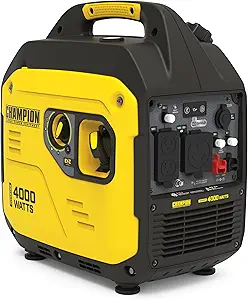
Champion 4000-Watt Inverter Generator
The Champion 4000-Watt Inverter Generator is designed for buyers who want portable power without moving into the size and weight of larger 5,000-watt-class generators. The 149cc engine produces 4,000 starting watts and 3,000 running watts, while the enclosed inverter design operates at about 64 dBA from 23 feet. Champion lists up to 10 hours of runtime, making this model suitable for camping, tailgating, and selected home essentials during a power outage.
One of its main advantages is portability. Champion lists the generator at less than 49 pounds, making it considerably easier to move than many larger inverter generators.
The generator also includes CO Shield carbon monoxide protection and can be connected in parallel with another compatible Champion inverter when additional output is required.
For buyers who primarily need a compact generator for moderate loads, this type of 4,000-watt inverter can provide a useful balance between output and portability.
WEN DF680iX Quiet 6800-Watt Dual Fuel
The WEN DF680iX is a larger dual-fuel inverter generator designed for users who need more output than a typical 3,000- to 4,500-watt portable inverter can provide.
On gasoline, the generator produces 6,800 starting watts and 5,100 running watts. When operating on propane, it produces 6,000 starting watts and 4,500 running watts.
The DF680iX also includes features that make it more versatile for demanding applications. These include electric start, CO Watchdog protection, fuel shutoff, a TT-30R RV receptacle, 120/240V capability, USB ports, and wheels with a telescoping pull handle.
The dual-fuel system gives users the option of choosing gasoline or propane depending on fuel availability and the requirements of the situation. This can be particularly useful for people who want a generator that can serve both recreational and emergency-power roles.
Its larger output also makes it more appropriate for power tools, multiple appliances, and other higher-demand equipment than smaller portable inverter generators.
Westinghouse iGen5000 Inverter Generator
The Westinghouse iGen5000 is a gasoline-powered inverter generator rated at 5,000 peak watts and 3,900 running watts.
Its 224cc engine and variable-speed inverter system are designed to balance power output and fuel consumption. Westinghouse lists up to 18 hours of runtime at 25% load from its 3.4-gallon fuel tank.
The iGen5000 is also designed with portability in mind. It includes a telescoping handle and never-flat wheels, while the manufacturer lists a noise level as low as 52 dBA.
An RV-ready TT-30R outlet adds flexibility for recreational use, while the inverter system produces power with total harmonic distortion of 3% or less according to Westinghouse specifications.
This model can be a practical middle ground for users who need more capacity than a typical 4,000-watt generator but do not need the size and weight of an 11,000-watt portable generator.
Westinghouse iGen11000DFc Dual-Fuel Inverter Generator
The Westinghouse iGen11000DFc is the largest generator in this group and is designed for substantially higher electrical loads than typical RV-size inverter generators.
On gasoline, it produces 11,000 peak watts and 9,000 running watts. On propane, output is rated at 10,000 peak watts and 8,100 running watts.
Westinghouse lists up to 17 hours of gasoline runtime at 25% load from its 7.92-gallon fuel tank. The generator also includes electric start, remote start, a digital display, GFCI outlets, a 120/240V L14-30R connection, and a 14-50R outlet.
The iGen11000DFc is transfer-switch ready, making it relevant for properly installed home backup systems. It also includes a carbon monoxide sensor with automatic shutdown.
The size is an important consideration. This generator weighs about 187 pounds dry, so it is much less convenient to move than the smaller Champion models.
For homeowners who need substantially more output and want gasoline/propane flexibility, its higher capacity can make it a useful portable backup option. However, it should not be treated like a lightweight camping generator.
Champion 4500-Watt RV Ready Inverter Generator
The Champion 4500-Watt Inverter Generator is a gasoline-powered option aimed at RV owners, campers, and homeowners who need portable power without moving to a much larger generator.
Its 212cc engine produces 4,500 starting watts and 3,500 running watts. Champion rates the unit at 61 dBA from 23 feet and lists up to 14 hours of gasoline runtime at 25% load.
The generator includes a 120V 30A RV outlet, a 120V household outlet, clean power with less than 3% THD, an Economy Mode, CO Shield automatic carbon monoxide shutdown, and parallel capability.
The 61 dBA noise rating is particularly relevant for RV owners and campers who want to reduce the amount of noise around their campsite.
Compared with the smaller 4,000-watt Champion, this model provides additional running and starting capacity while remaining substantially smaller than high-output 8,000- or 11,000-watt generators.
Gasoline vs. Propane: Which Fuel Makes More Sense?
Fuel choice can affect convenience, storage, runtime, and operating cost.
Gasoline is widely available and generally provides strong energy output, but it requires appropriate storage and can deteriorate over time if it is not properly maintained.
Propane has an important advantage for long-term storage because it does not deteriorate in the same way gasoline does. However, propane availability and operating cost vary by location, and generators generally produce different wattage and runtime figures when operating on propane.
Dual-fuel generators provide additional flexibility because users can choose gasoline when maximum output is important or propane when storage and fuel availability make it more practical.
The WEN DF680iX and Westinghouse iGen11000DFc are examples of dual-fuel inverter generators with different gasoline and propane output ratings.
When comparing a dual-fuel model, always check the specifications for both fuels rather than assuming the generator produces the same output on gasoline and propane.
How Important Is Generator Noise?
Noise matters when a generator will be used around campsites, RVs, neighbors, or occupied outdoor areas.
Inverter generators can vary engine speed according to electrical demand. When the load is relatively light, this can reduce fuel consumption and operating noise compared with running an engine continuously at a fixed speed.
Noise ratings should always be compared at the same distance and under similar testing conditions.
For example, Champion lists its 4500-watt inverter at 61 dBA from 23 feet, while its 4000-watt inverter is listed at 64 dBA from 23 feet.
Actual perceived noise can change depending on electrical load, distance, surrounding surfaces, weather, and operating conditions.
For camping or RV use, noise should therefore be considered alongside power output and runtime rather than treated as an isolated specification.
Runtime and Fuel Efficiency
Runtime figures are useful for comparing generators, but they need to be read in context.
Manufacturers commonly publish maximum runtime at a specified load, often 25%. A generator operating at a substantially higher electrical load will normally consume fuel faster.
The Champion 4500-watt model, for example, is rated for up to 14 hours at 25% load, while the Westinghouse iGen11000DFc is rated for up to 17 hours at 25% load on gasoline.
Eco or Economy modes can also help reduce fuel consumption when electrical demand is lower. However, buyers should avoid comparing runtime numbers without checking the load, fuel tank capacity, and fuel type used for the manufacturer’s test.
A generator with a larger fuel tank is not automatically more efficient. Tank size, engine design, load, inverter technology, and operating conditions all affect actual fuel consumption.
Who Are These Generators Best Suited For?
RV owners and campers: The Champion 4000-watt and 4500-watt models are appropriate for buyers who prioritize portability, RV compatibility, and relatively low operating noise.
Homeowners preparing for outages: The Westinghouse iGen5000 and iGen11000DFc provide higher electrical capacity for emergency loads. The iGen11000DFc is transfer-switch ready, making it particularly relevant for properly installed home backup systems.
Job sites and outdoor work: The WEN DF680iX provides higher output than smaller RV-focused inverter generators while adding dual-fuel capability, 120/240V operation, and a range of receptacles.
Buyers prioritizing portability: The Champion 4000-watt model is significantly lighter than the larger generators in this comparison, making it easier to transport and position.
Users who want fuel flexibility: The WEN DF680iX and Westinghouse iGen11000DFc allow operation on gasoline or propane, providing another option when fuel availability changes.
What to Check Before Buying a Portable Inverter Generator
Before choosing a generator, calculate the running watts required by the devices you plan to operate and account for appliances with higher starting or surge requirements.
Do not select a generator based only on its advertised peak wattage.
For example, a generator advertised as producing 4,500 starting watts may have a considerably lower continuous running rating. The running-watt figure is especially important when determining how much equipment the generator can support continuously.
The outlet configuration also matters. RV users may need a TT-30R connection, while homeowners planning an approved transfer-switch installation may need 120/240V capability and a compatible locking outlet.
Noise, fuel type, tank capacity, electric or recoil start, CO protection, warranty coverage, weight, wheel design, and parallel capability can also affect the long-term value of a generator.
Buyers should also check whether a particular model is intended for gasoline only or supports propane, and whether the published runtime refers to gasoline or propane at a specific load.
Finally, always follow the manufacturer’s operating instructions. Portable fuel-burning generators must be operated outdoors and away from doors, windows, vents, and other openings because their exhaust contains carbon monoxide.
Never attempt to backfeed a home through a standard electrical outlet. A properly installed transfer switch or other approved connection method should be used when connecting a portable generator to a home’s electrical system.
Final Thoughts
The best value portable inverter generator for 2026 depends on how much power you actually need and how you plan to use it.
A smaller Champion model can make more sense for camping, tailgating, or basic emergency loads, while the WEN DF680iX provides more capacity and dual-fuel flexibility for users with higher power requirements.
The Westinghouse iGen5000 sits in a higher-output category while maintaining the portability and efficiency benefits associated with inverter technology.
For substantially larger electrical loads, the Westinghouse iGen11000DFc provides 120/240V output, dual-fuel operation, transfer-switch readiness, and up to 9,000 running watts on gasoline.
Rather than choosing a generator based solely on peak wattage or advertised runtime, compare rated running watts, fuel type, runtime at a stated load, noise level, outlet configuration, portability, safety features, and warranty.
That approach makes it easier to find a portable inverter generator that provides the right combination of power and value for your particular situation.