As an Amazon Associate I earn from qualifying purchases.
Running an RV air conditioner without campground hookups is one of the biggest challenges of boondocking. A typical rooftop A/C can draw well over 1,000 watts while running, and the compressor can demand a much larger surge when it starts.
That is why choosing an off-grid RV air conditioner setup is about more than buying the biggest battery you can afford. You need to consider running watts, startup surge, battery capacity, inverter output, solar charging capability, and the size of your RV air conditioner.
For many RVers, a large solar generator such as the EcoFlow DELTA Pro can provide enough inverter power and battery capacity for a rooftop A/C. Adding an RV-specific soft starter can make the compressor easier to start when your available inverter or generator capacity is limited.
For smaller RVs, vans, and campers, a portable unit such as the EcoFlow WAVE 3 offers another approach: instead of powering the RV’s rooftop A/C, you use a smaller, dedicated air conditioner with its own optional battery system.
Below are the most practical options to consider in 2026.
1. EF ECOFLOW DELTA Pro 3600Wh Solar Generator
Check Amazon Price Click Here!
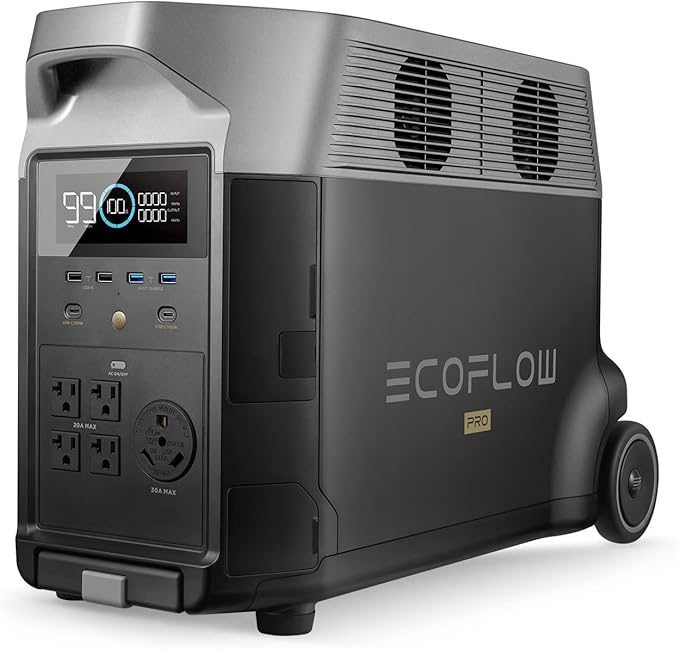
The EcoFlow DELTA Pro remains one of the more capable portable power stations for RVers who want to run high-demand appliances away from shore power.
Its 3,600Wh LFP battery and 3,600W AC output give it enough inverter capacity for many RV air conditioners, while its expandable battery system can increase total storage substantially. EcoFlow lists expansion up to 25kWh and solar input up to 1,600W.
| Specification | Details |
|---|---|
| Battery Capacity | 3,600Wh |
| Battery Chemistry | LFP |
| AC Output | 3,600W continuous |
| X-Boost | Up to 4,500W for compatible devices |
| Expandable Capacity | Up to 25kWh with additional batteries |
| Solar Input | Up to 1,600W |
| Weight | Approximately 99 lb |
| RV Use | Suitable for high-demand appliances including many RV A/C systems |
Why the DELTA Pro Works for RV Air Conditioning
The major advantage is not simply the battery capacity. The 3,600W inverter gives the DELTA Pro considerably more headroom than smaller 1,000W–2,000W power stations.
EcoFlow specifically lists air-conditioning use among the applications for the DELTA Pro and estimates approximately 1.8–3.6 hours of A/C runtime under its test conditions. Actual runtime will vary depending on the air conditioner, thermostat cycling, ambient temperature, insulation, and other loads running at the same time.
For an RV with a 13,500 or 15,000 BTU rooftop A/C, I would not treat the published runtime as a guarantee. Think of it as a reference point for what a large 3,600Wh-class battery can do.
The DELTA Pro becomes considerably more useful for extended boondocking when paired with adequate solar panels because the battery can be recharged during the day while the RV is using power.
The Main Drawback
At roughly 99 pounds, the DELTA Pro is not a lightweight camping accessory. It is closer to a portable battery system than a small weekend power station.
For RVers who only need to charge phones, lights, laptops, and small appliances, it may be excessive. For running an A/C, microwave, refrigerator, and other larger loads, its higher inverter capacity makes much more sense.
2. EF ECOFLOW WAVE 3 Portable AC + Battery
Check Amazon Price Click Here!
The EcoFlow WAVE 3 takes a different approach to off-grid RV cooling.
Instead of powering the RV’s existing rooftop A/C, it is a portable air conditioner designed for smaller spaces, including RVs, vans, tents, and other compact environments.
The WAVE 3 provides 6,100 BTU of cooling and can be paired with a 1,024Wh LFP battery. EcoFlow advertises up to eight hours of wireless operation under its specified conditions.
| Specification | Details |
|---|---|
| Cooling Capacity | 6,100 BTU |
| Battery Option | 1,024Wh LFP battery |
| Maximum Wireless Runtime | Up to 8 hours under specified conditions |
| Heating Capacity | 6,800 BTU |
| Best For | Small RVs, vans, campers and compact spaces |
| Main Advantage | Dedicated portable cooling without running the RV rooftop A/C |
When the WAVE 3 Makes More Sense
The WAVE 3 can be attractive when you don’t need to cool the entire RV or when your rooftop A/C would require a much larger power system.
A smaller sleeping area, van conversion, truck camper, or compact RV may benefit from directing cooling where it is actually needed.
However, 6,100 BTU is substantially less cooling capacity than a common 13,500–15,000 BTU RV rooftop unit. Therefore, it should not be presented as a direct replacement for every RV rooftop A/C.
It is better viewed as an alternative cooling strategy for smaller spaces.
3. RV Air Conditioner Soft Starters
Check Amazon Price Click Here!
A soft starter can solve a different problem from a large battery.
When an RV air conditioner starts, the compressor can briefly demand much more current than it needs during normal operation. This startup surge can overload a small generator or inverter even when the same system has enough capacity to keep the A/C running once the compressor is operating.
Soft starters reduce this startup demand by gradually bringing the compressor up to speed.
SoftStartRV currently states that its system can reduce RV A/C startup power demand by up to 70%, while Micro-Air’s current RV-specific EasyStart Breeze advertises startup-current reduction of up to 75%.
This does not mean the air conditioner suddenly uses 70% less electricity while cooling. The primary benefit is reducing the initial startup surge.
SoftStartRV Soft Start Kit
Check Amazon Price Click Here!
SoftStartRV is specifically designed for RV air conditioners and is intended to reduce the startup power demand of the compressor.
The manufacturer states that it can reduce startup demand by up to 70% and can help RV air conditioners start with smaller generators and limited power sources.
Key Features
- Designed specifically for RV A/C systems
- Startup power reduction of up to 70%
- Designed for 110V/120V-class RV applications
- Compact installation
- Can help reduce generator and inverter startup stress
- Useful for boondocking and limited electrical hookups
A soft starter is especially useful when your power station is large enough to run the A/C but struggles with the compressor’s initial surge.
MICRO-AIR EasyStart FLEX 398
Check Amazon Price Click Here!
The MICRO-AIR link from the original article should be retained, but the product needs to be described more carefully.
The EasyStart family includes different models for different air-conditioning applications. Micro-Air’s current RV-focused product is the EasyStart Breeze, which is specifically designed for RV rooftop and basement air conditioners and heat pumps.
The FLEX line is aimed at residential and larger air-conditioning applications rather than being the most natural choice for a typical RV rooftop A/C.
What This Means for RV Owners
If you are shopping specifically for an RV rooftop air conditioner, verify the exact Micro-Air model and compatibility before purchasing.
The important point is that soft starters are application-specific electrical components. You should not assume that a model designed for a residential system is automatically the correct choice for an RV.
Briidea Soft Start for RV AC
Check Amazon Price Click Here!
Briidea is another soft-start option found in the RV electrical accessory market.
Its primary purpose is the same: reduce the initial electrical demand when the compressor starts.
Because compatibility can vary between air-conditioner models, the correct approach is to check the specifications of your exact rooftop A/C before installation rather than relying on a generic “universal” claim.
For any soft starter, confirm:
- Your A/C voltage
- Compressor compatibility
- Maximum operating current
- Installation requirements
- Manufacturer instructions
- Whether professional installation is recommended
Solar Generator vs. Portable AC: Which Setup Makes Sense?
The biggest decision is whether you want to power your existing rooftop A/C or use a dedicated portable A/C.
| Setup | Best For | Main Advantage | Main Limitation |
|---|---|---|---|
| EcoFlow DELTA Pro | Larger RVs | High inverter output and large battery | Heavy and expensive |
| DELTA Pro + Soft Starter | Rooftop A/C boondocking | Easier compressor startup | Still consumes substantial battery energy |
| EcoFlow WAVE 3 + Battery | Small RVs and vans | Dedicated portable cooling | Lower BTU capacity |
| SoftStartRV + Existing Generator | RV rooftop A/C | Reduces startup demand | Does not provide battery energy |
The important distinction is that a soft starter does not replace a solar generator.
It makes the A/C easier to start.
The solar generator provides the actual electrical energy needed to operate the compressor.
How Much Power Does an RV Air Conditioner Need?
RV rooftop air conditioners commonly fall around the 13,500–15,000 BTU range, although larger units also exist.
The exact electrical consumption depends on the model.
A 15,000 BTU unit can consume well over 1,000 watts while operating, and startup demand can be substantially higher.
For that reason, you should look at the A/C’s actual electrical specifications instead of sizing your battery based only on BTU.
Check:
- Rated running amps
- Rated watts
- Locked-rotor amps (LRA)
- Voltage
- Compressor type
- Whether a soft starter is installed
The LRA rating is particularly important because it illustrates why an A/C that appears manageable while running can still overload a small inverter during startup. SoftStartRV explains that compressor startup current can be several times higher than normal running current.
How Big Should a Solar Generator Be for an RV AC?
For a rooftop A/C, I would look at the system in two separate parts:
1. Inverter Output
The inverter must be capable of starting the compressor.
A 2,000W-class power station may work with some RV A/C setups when a suitable soft starter is installed, but that depends on the particular compressor and inverter.
A larger 3,000W–3,600W-class inverter provides considerably more headroom.
2. Battery Capacity
Battery capacity determines how long the A/C can operate.
A simple theoretical calculation is:
Runtime ≈ Battery Wh × usable efficiency ÷ A/C watts
For example, a 3,600Wh battery running a hypothetical 1,500W A/C would have a theoretical runtime of:
3,600 ÷ 1,500 = 2.4 hours
But real-world runtime will be lower because of inverter losses, battery reserve, temperature, compressor cycling, and other RV loads.
If the compressor cycles on and off instead of running continuously, actual cooling time can be considerably longer.
Why Solar Input Matters
Battery size is only half of an off-grid system.
If you run the A/C for several hours during the day, the battery can drain quickly. Solar panels allow you to replace some of the energy being consumed.
The DELTA Pro supports up to 1,600W of solar input according to EcoFlow’s specifications.
However, maximum solar input is not the same as guaranteed solar production.
Clouds, shade, panel angle, heat, wiring losses, and the time of day all affect actual solar output.
For serious summer boondocking, think of the system as:
Solar panels → solar generator → inverter → RV A/C
The battery acts as the buffer between variable solar production and the A/C’s changing demand.
Do You Need a Soft Starter for an RV Air Conditioner?
Not necessarily.
If your inverter has plenty of surge capacity and starts your A/C reliably, you may not need one.
A soft starter becomes much more valuable when:
- Your inverter is close to its maximum output.
- Your generator shuts down when the compressor starts.
- The A/C causes voltage drops.
- You want to use a smaller inverter generator.
- You are trying to run other appliances at the same time.
- You want smoother compressor startup.
SoftStartRV specifically markets its product for starting RV A/C units with smaller generators and limited electrical sources.
A Practical 2026 Off-Grid RV A/C Setup
For a larger travel trailer or motorhome, a practical configuration could look like this:
Large RV Rooftop A/C
3,600Wh-class power station + 3,000W–3,600W inverter + adequate solar + RV soft starter
The EcoFlow DELTA Pro is designed for this type of high-demand application and has enough inverter capacity to make it a much more realistic choice than a small portable power station.
Small RV or Van
Portable A/C + dedicated battery
The EcoFlow WAVE 3 can make more sense when you only need to cool a compact interior space rather than power a large rooftop compressor. Its 6,100 BTU cooling capacity and optional 1,024Wh LFP battery make it a different type of off-grid solution.
Important RV Solar Cooling Tips
Run the A/C Early
Don’t wait until the RV interior is extremely hot.
Starting cooling earlier can allow the A/C to cycle rather than operating continuously at maximum demand.
Use RV Shade Strategically
Parking in shade can reduce the cooling load significantly.
Awnings, window shades, reflective coverings, and good insulation can also reduce how hard the A/C has to work.
Turn Off Unnecessary Loads
If your power station is running the A/C, avoid simultaneously using high-wattage appliances such as:
- Microwave ovens
- Electric coffee makers
- Toasters
- Hair dryers
- Electric water heaters
Reducing simultaneous loads gives the inverter more headroom.
Monitor Actual Power Consumption
Do not rely only on the A/C’s advertised BTU rating.
Use the power station’s display or another appropriate meter to see how many watts your particular A/C is actually consuming.
That number is much more useful when estimating runtime.
Final Recommendations for 2026
For a full-size RV rooftop A/C
EF ECOFLOW DELTA Pro 3600Wh
Check Amazon Price Click Here!
The DELTA Pro is the strongest fit from the products covered here when the goal is powering a conventional RV rooftop A/C. Its 3,600Wh battery, 3,600W AC output, expandable storage, and up to 1,600W solar input make it suitable for a serious off-grid power setup.
For a small RV, van, or compact space
EF ECOFLOW WAVE 3
Check Amazon Price Click Here!
The WAVE 3 is a different solution rather than a direct replacement for a 13,500–15,000 BTU rooftop A/C. Its 6,100 BTU cooling capacity makes it better suited to smaller spaces where targeted cooling is enough.
For reducing RV A/C startup demand
SoftStartRV
Check Amazon Price Click Here!
An RV-specific soft starter can make a major difference when an inverter or generator has enough capacity to run the A/C but struggles with compressor startup. SoftStartRV states that its system can reduce startup power demand by up to 70%.
For Micro-Air users
MICRO-AIR EasyStart
Check Amazon Price Click Here!
Verify the exact model before installation. Micro-Air’s current RV-specific EasyStart Breeze is designed for RV rooftop and basement air conditioners and heat pumps, making model compatibility especially important.
Additional soft-start option
Briidea Soft Start
Check Amazon Price Click Here!
Check compatibility with your exact A/C before purchase and installation.
FAQ: Off-Grid RV Air Conditioning
Can I run my RV air conditioner from a solar generator?
Yes. A sufficiently large solar generator can power an RV air conditioner, but you need enough inverter output to handle compressor startup and enough battery capacity to provide the required runtime.
How many watts does an RV air conditioner use?
It depends on the model. A typical rooftop RV A/C can consume more than 1,000 watts while running, while startup demand can be substantially higher. Check the manufacturer’s electrical specifications for your exact unit.
Will a soft starter make my RV A/C use less electricity?
Not necessarily during normal operation. A soft starter primarily reduces the compressor’s startup surge. It can allow a smaller generator or inverter to start the A/C without being overloaded.
Can a 3,600Wh battery run an RV air conditioner all night?
Usually, you should not assume that. Runtime depends on the A/C’s actual wattage, compressor cycling, outside temperature, insulation, inverter losses, and other loads. A 3,600Wh battery can provide useful A/C runtime, but continuous overnight operation may require additional battery capacity and solar recharge.
Is the EcoFlow WAVE 3 powerful enough for a whole RV?
Not necessarily. The WAVE 3 provides 6,100 BTU of cooling, making it much better suited to smaller spaces and targeted cooling than replacing a conventional 13,500–15,000 BTU rooftop A/C.
What is the best off-grid setup for a 15,000 BTU RV air conditioner?
Start with the air conditioner’s actual electrical requirements. A large power station such as the DELTA Pro provides substantial inverter and battery capacity, while an RV-specific soft starter can reduce compressor startup demand. Adequate solar capacity is also important if you want to recharge while boondocking.
Is solar power enough to run an RV A/C?
It can be, but the answer depends on solar production, battery capacity, A/C consumption, weather, and how long the compressor runs. The most reliable setup combines solar panels with a sufficiently large battery rather than relying on solar panels alone.
Bottom Line
The best off-grid RV air-conditioning setup in 2026 is not necessarily the power station with the biggest battery.
You need to match inverter output to compressor startup demand, battery capacity to desired runtime, and solar input to how much energy you need to replace each day.
For a conventional rooftop RV A/C, the EcoFlow DELTA Pro provides the type of inverter and battery capacity that makes off-grid air conditioning practical. Adding an RV-specific soft starter can make compressor startup easier and reduce the stress placed on a generator or inverter.
For smaller RVs and vans, the EcoFlow WAVE 3 offers another strategy by providing dedicated portable cooling rather than powering the RV’s main rooftop A/C.
The key is to size the complete system—not just the battery.