As an Amazon Associate I earn from qualifying purchases.
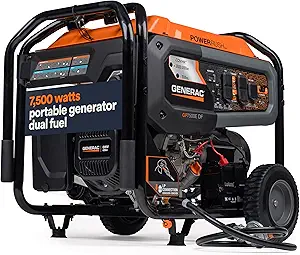
If you need serious portable power for a home backup situation, workshop, jobsite, RV, or outdoor event, a 7,500-watt generator is a useful middle ground between smaller portable generators and much larger home backup units.
The important detail is understanding what “7,500 watts” actually means. In most cases, a generator marketed as a 7,500-watt generator produces approximately 7,500 running watts, while its starting or surge output is higher. That extra starting capacity is important for appliances and tools with electric motors.
Fuel flexibility is another major advantage in this category. Depending on the model, you can choose gasoline, propane, or natural gas. Dual-fuel generators can be useful when you want gasoline and propane, while tri-fuel models add natural gas as another option.
For 2026, these are the models and configurations worth considering if your priority is substantial portable power, home backup capability, and fuel flexibility.
7500W Generators for Home & Outdoor Use in 2026
| Generator | Fuel | Running / Rated Output | Starting / Peak Output | Best Use |
|---|---|---|---|---|
| Generac GP7500EDF | Gasoline / Propane | Up to 7,500W | Up to 9,400W | Home backup and outdoor power |
| Champion 8125W Tri-Fuel | Gasoline / Propane / Natural Gas | 6,500W gasoline | 8,125W gasoline | Fuel flexibility |
| Westinghouse WGen9500TF | Gasoline / Propane / Natural Gas | 9,500W gasoline / 7,500W NG | 12,500W gasoline | Higher-capacity home backup |
| Champion 9375W Dual-Fuel | Gasoline / Propane | 7,500W gasoline | 9,375W gasoline | 7,500W-class backup power |
| Westinghouse WGen7500DFc | Gasoline / Propane | 7,500W gasoline | 9,500W gasoline | Dual-fuel home backup |
Important: The products above do not all produce exactly 7,500 running watts on every fuel. For example, the Champion tri-fuel model produces 6,500W on gasoline, 6,000W on propane, and 5,500W on natural gas.
1. Generac GP7500EDF 7,500W Dual-Fuel Portable Generator
Check Amazon Price Click Here!
The Generac GP7500EDF is aimed at homeowners who want substantial portable power without moving all the way into the size and cost of a very large generator.
Its dual-fuel capability lets you operate it with gasoline or propane, giving you another option when fuel availability becomes an issue during a prolonged outage.
The 7,500-watt running-output class is particularly useful when you need to operate several essential loads at the same time rather than relying on a small generator for only a refrigerator, lights, or a few electronics.
Key Features
- Up to 7,500 running watts
- Up to 9,400 starting watts
- Gasoline and propane operation
- Electric starting
- CO safety technology
- Large portable-generator format
- 120/240V capability
- Suitable for selected home circuits when properly connected
- Wheels and handles for moving the unit
Who Should Consider It?
The GP7500EDF makes the most sense for homeowners who want a dual-fuel 7,500-watt-class generator for outages, outdoor projects, or larger electrical loads.
Keep in mind that a portable generator should not be treated as an automatic whole-house generator. The actual appliances you can operate simultaneously depend on their running wattage and startup requirements.
2. Champion 8125W Tri-Fuel Portable Generator
Check Amazon Price Click Here!
The name “8125W” can be confusing because 8,125 watts is the gasoline starting output, not the continuous running output.
Champion identifies this model as a 6,500-watt tri-fuel generator. It produces 8,125 starting watts and 6,500 running watts on gasoline, 7,500 starting and 6,000 running watts on propane, and 6,875 starting and 5,500 running watts on natural gas.
That makes fuel flexibility its biggest advantage.
Key Specifications
| Specification | Gasoline | Propane | Natural Gas |
|---|---|---|---|
| Starting Watts | 8,125W | 7,500W | 6,875W |
| Running Watts | 6,500W | 6,000W | 5,500W |
| Runtime | Up to 12 hrs. @ 50% | Up to 6.5 hrs. @ 50% | — |
| Voltage | 120/240V | 120/240V | 120/240V |
Champion lists an 8.5-gallon gasoline tank and up to 12 hours of runtime at 50% load on gasoline. With a 20-pound propane cylinder, the published runtime is up to 6.5 hours at 50% load.
The generator also includes a 120/240V L14-30R locking receptacle and GFCI-protected household outlets.
Why Choose a Tri-Fuel Generator?
Natural gas can be particularly convenient during a long outage because you do not have to store gasoline in the same way. However, the available output is lower on natural gas, so you should size your electrical loads accordingly.
This Champion is therefore better described as a 6,500W running-watt tri-fuel generator, rather than a true 7,500W running-watt generator.
3. Westinghouse WGen9500TF 12,500W Peak Tri-Fuel Generator
Check Amazon Price Click Here!
If you need more than a conventional 7,500W portable generator can provide, the Westinghouse WGen9500TF moves into a higher power class.
This is a particularly interesting option because its natural-gas rating is 7,500 running watts, while gasoline output reaches 9,500 running watts and 12,500 peak watts.
Key Specifications
| Fuel | Running Watts | Peak Watts |
|---|---|---|
| Gasoline | 9,500W | 12,500W |
| Propane | 8,500W | 11,200W |
| Natural Gas | 7,500W | 9,500W |
The generator uses a 457cc four-stroke OHV engine and a 6.6-gallon fuel tank. Westinghouse lists up to 12 hours of runtime at 25% load on gasoline and approximately 8 hours at 50% load for the standard WGen9500TF configuration.
It also provides 120/240V output, GFCI outlets, an L14-30R connection, and a 14-50R receptacle. The unit is designed to be transfer-switch ready.
Why Consider a Larger Generator?
A generator of this size gives you more headroom for starting motors and operating multiple larger loads simultaneously.
For example, a homeowner may need to operate a refrigerator, freezer, lights, sump pump, internet equipment, selected kitchen appliances, and other essential circuits. The extra capacity can make load management easier.
However, the larger output also means greater fuel consumption, higher weight, and a less convenient portable package.
4. Champion 9375W Dual-Fuel Portable Generator
Check Amazon Price Click Here!
This Champion is one of the clearest matches for shoppers specifically searching for a 7,500-watt generator.
The manufacturer rates it at 7,500 running watts and 9,375 starting watts on gasoline. On propane, it produces 6,750 running watts and 8,400 starting watts.
Key Specifications
| Specification | Gasoline | Propane |
|---|---|---|
| Running Watts | 7,500W | 6,750W |
| Starting Watts | 9,375W | 8,400W |
| Runtime | Up to 10 hrs. @ 50% | Up to 5.5 hrs. @ 50% |
| Fuel Tank | 7.7 gal. | — |
| Engine | 439cc | 439cc |
| Voltage | 120/240V | 120/240V |
The unit uses a 439cc engine and includes electric and recoil starting. It also has CO Shield, GFCI receptacles, a 120/240V L14-30R locking outlet, and a 120V L5-30R outlet.
Champion lists a noise level of approximately 74 dBA at 23 feet. This is not a quiet inverter generator, so noise should be part of your buying decision if you live in a densely populated neighborhood.
Best For
This model is a strong fit for someone specifically looking for 7,500 running watts, dual-fuel operation, electric start, and 120/240V capability.
5. Westinghouse WGen7500DFc 7,500W Dual-Fuel Generator
Check Amazon Price Click Here!
The Westinghouse WGen7500DFc is another direct match for the 7,500-watt category.
It produces 7,500 running watts and 9,500 peak watts on gasoline. On propane, output is rated at 6,750 running watts and 8,550 peak watts.
Key Specifications
| Specification | Gasoline | Propane |
|---|---|---|
| Running Watts | 7,500W | 6,750W |
| Peak Watts | 9,500W | 8,550W |
| Runtime | Up to 11 hrs. @ 25% | Up to 8 hrs. @ 25% |
| Fuel Tank | 6.6 gal. | — |
| Engine | 420cc | 420cc |
| Noise | About 72 dBA | — |
The WGen7500DFc features electric and remote starting, a 6.6-gallon tank, GFCI outlets, a 120/240V L14-30R receptacle, and transfer-switch readiness.
At about 202 pounds dry weight, it is still a substantial machine, but the wheel kit and handles make moving it much easier than lifting the generator itself.
Best For
This model is a practical option for homeowners who want 7,500 running watts, dual-fuel capability, remote starting, and home-backup connectivity.
What Can a 7,500-Watt Generator Run?
A 7,500-watt generator can handle considerably more than a small emergency generator, but it does not automatically mean you can run every appliance in your house simultaneously.
The first number to calculate is your running load.
For example, a possible emergency load might include:
| Appliance | Approximate Running Watts |
|---|---|
| Refrigerator | 150–400W |
| Freezer | 100–300W |
| LED lighting | 50–200W |
| Wi-Fi/router | 10–50W |
| Television | 80–200W |
| Sump pump | 800–1,500W |
| Microwave | 1,000–1,500W |
| Coffee maker | 800–1,500W |
| Window AC | 500–1,500W |
| Well pump | Varies significantly |
These are only examples. Actual wattage varies considerably by appliance, motor size, age, efficiency, and operating conditions.
The bigger issue is starting wattage.
A refrigerator, pump, air conditioner, furnace blower, or power tool may require considerably more power for a short period when its motor starts.
That is why you should not simply add the running watts of your appliances and assume that number is enough.
7,500 Running Watts vs. 7,500 Starting Watts
This distinction is one of the most important things to understand before buying a generator.
Running watts are the power the generator can continuously produce.
Starting watts, also called surge or peak watts, are the additional short-term capacity available for motor startup.
For example, the Champion 201281 is rated at:
- 7,500 running watts on gasoline
- 9,375 starting watts on gasoline
- 6,750 running watts on propane
- 8,400 starting watts on propane
Therefore, a generator advertised as a “9,375-watt generator” may actually be a 7,500-running-watt generator.
When comparing models, always look for both numbers.
Dual-Fuel vs. Tri-Fuel: Which Is Better?
Dual-Fuel Generators
Dual-fuel generators typically operate on:
- Gasoline
- Propane
The major advantage is flexibility.
Gasoline is convenient and generally provides the generator’s highest output, while propane can be stored for longer periods when properly handled.
Tri-Fuel Generators
Tri-fuel models add:
- Natural gas
This can be especially attractive for home backup because a home’s natural-gas supply may remain available during some power outages.
However, natural gas usually produces less power than gasoline.
The Champion 201169, for example, produces 6,500 running watts on gasoline, 6,000W on propane, and 5,500W on natural gas.
The Westinghouse WGen9500TF is another example where fuel choice affects output: 9,500W gasoline, 8,500W propane, and 7,500W natural gas.
What to Look for in a 7500W Generator
1. Running Wattage
Start with running watts rather than peak watts.
If your calculated continuous load is close to 7,500W, a generator rated at exactly 7,500W leaves little reserve capacity.
A little headroom is preferable.
2. Starting Wattage
Look at the starting wattage when you have equipment with electric motors.
Pumps, refrigerators, compressors, air conditioners, and power tools can create substantial startup demand.
3. 120/240V Output
For home backup, 120/240V capability can be important.
Many larger portable generators include an L14-30R receptacle designed for appropriate transfer-switch connections.
Some larger models also provide a 14-50R outlet.
4. Transfer-Switch Compatibility
Never connect a portable generator directly to a home’s electrical wiring through a household outlet.
If you want generator power distributed through your home’s circuits, use a properly installed transfer switch or another code-compliant solution designed for the generator and electrical service.
A qualified electrician can determine the appropriate setup.
5. CO Safety Features
Carbon monoxide is one of the most important safety considerations.
Modern generators increasingly include automatic CO shutdown systems or sensors.
These systems are useful safety features, but they do not make a generator safe to operate indoors.
Never operate a gasoline, propane, or natural-gas portable generator inside a home, garage, basement, shed, or other enclosed or partially enclosed area. Champion specifically warns that generators must be operated outdoors and away from doors, windows, and vents.
6. Noise
Most open-frame generators in this power class are noticeably louder than inverter generators.
For example, Champion lists approximately 74 dBA at 23 feet for its 7,500W dual-fuel model.
If noise is a major concern, consider whether you really need this much output or whether a smaller inverter generator would be more appropriate.
7. Weight and Portability
A 7,500W generator is not a lightweight portable appliance.
Expect a machine weighing roughly 200 pounds or more in many configurations.
Wheels, handles, and a good storage location are therefore important considerations.
Is a 7500-Watt Generator Enough for a House?
For many homes, 7,500 running watts can be enough to power essential circuits during an outage, but it is not necessarily enough to operate every electrical appliance simultaneously.
A typical backup strategy is to prioritize:
- Refrigerator
- Freezer
- Lighting
- Internet equipment
- Television
- Sump pump
- Furnace blower
- Selected kitchen appliances
- Selected outlets
- Some air-conditioning equipment, depending on its starting requirements
Large central air conditioners, electric water heaters, electric ranges, electric dryers, pool equipment, and other high-demand loads can quickly consume the available capacity.
Before purchasing, make a list of the appliances you actually want to operate during an outage and calculate both their running and starting requirements.
Generator Safety Tips
A generator can provide valuable emergency power, but it must be operated correctly.
Always operate it outdoors
Never run a portable generator inside a house, garage, basement, shed, or other enclosed area.
Keep exhaust away from the home
Position the generator so exhaust cannot enter through windows, doors, vents, or other openings.
Use a carbon monoxide alarm
A generator’s built-in CO shutdown system is not a replacement for properly installed carbon monoxide alarms in your home.
Keep the generator dry
Use the generator according to the manufacturer’s instructions and protect electrical connections from rain and standing water.
Refuel only after shutdown
Turn the generator off and allow it to cool before adding gasoline.
Follow the owner’s manual
Fuel requirements, grounding, extension-cord requirements, maintenance intervals, and electrical connections vary by model.
Which 7500W Generator Should You Buy?
The right choice depends more on your power requirements and fuel situation than on the biggest peak-watt number printed on the box.
For a true 7,500-running-watt dual-fuel generator
The Champion 201281 and Westinghouse WGen7500DFc are both directly aligned with the 7,500-running-watt category on gasoline.
For maximum fuel flexibility
The Champion tri-fuel model gives you gasoline, propane, and natural gas, although its continuous output is 6,500W on gasoline rather than 7,500W.
For more power than a typical 7,500W generator
The Westinghouse WGen9500TF provides up to 9,500 running watts on gasoline and 7,500 running watts on natural gas, with 12,500 peak watts available on gasoline.
For homeowners focused on dual-fuel flexibility
A dual-fuel model lets you keep gasoline as the higher-output option while having propane available as an alternative fuel.
Final Thoughts
A 7,500-watt portable generator is a powerful option for homeowners who need substantially more capacity than a small emergency generator can provide.
The most important thing is not to judge a generator solely by its peak-watt number. Pay close attention to running watts, starting watts, fuel-specific output, runtime at a stated load, voltage, receptacles, CO safety features, noise, and transfer-switch compatibility.
For shoppers specifically looking for a true 7,500-running-watt generator, models such as the Champion 201281 and Westinghouse WGen7500DFc are particularly relevant.
If fuel flexibility is your priority, a tri-fuel generator can provide another useful option through natural gas, although its output will normally be lower on natural gas than on gasoline.
And if your electrical requirements are higher, stepping up to a generator such as the Westinghouse WGen9500TF gives you considerably more capacity while still offering gasoline, propane, and natural-gas operation.
Before buying, calculate the actual loads you expect to use during an outage. Then choose a generator with enough running capacity and sufficient starting-watt headroom.
Most importantly, use the generator only outdoors and exactly according to the manufacturer’s safety instructions. A correctly sized generator can be an extremely useful part of a home emergency-power plan, but safe installation and operation matter just as much as wattage.