As an Amazon Associate I earn from qualifying purchases.
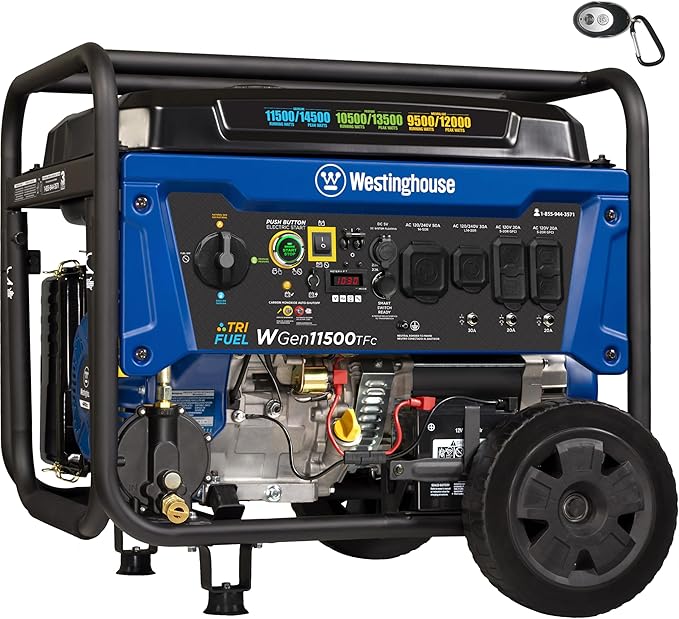
When the power goes out, having more than one fuel option can make a big difference. Tri-fuel portable generators can run on gasoline, propane, or natural gas, giving homeowners more flexibility when one fuel source is unavailable or difficult to obtain.
For 2026, the tri-fuel generator market includes everything from mid-size units designed for essential home circuits to high-output models capable of supplying substantial portions of a home’s electrical load. The right choice depends on more than peak wattage, though. Running watts, fuel-specific output, transfer-switch compatibility, natural gas performance, carbon monoxide protection, runtime, and outlet configuration all matter.
Below, we compare several popular tri-fuel portable generators and explain what to look for before buying one.
Top Tri-Fuel Portable Generators for 2026
| Model | Fuel Options | Gasoline Running Watts | Gasoline Starting Watts | Best For |
|---|---|---|---|---|
| Westinghouse WGen14500TFc | Gasoline / Propane / Natural Gas | 14,500W | 18,000W | High-output home backup |
| DuroMax XP13000HXT | Gasoline / Propane / Natural Gas | 10,500W | 13,000W | Home backup and job sites |
| WEN TF1450X | Gasoline / Propane / Natural Gas | 11,500W | 14,500W | High-output backup on a budget |
| Westinghouse WGen20000TFc | Gasoline / Propane / Natural Gas | 20,000W | 28,000W | Very high-demand backup |
| Champion 201169 | Gasoline / Propane / Natural Gas | 6,500W | 8,125W | Essential circuits and smaller homes |
The exact output changes when switching from gasoline to propane or natural gas, so don’t compare generators using gasoline peak watts alone. For example, the Westinghouse WGen14500TFc is rated at 14,500 running watts on gasoline, 13,000 on propane, and 11,600 on natural gas.
What Is a Tri-Fuel Portable Generator?
A tri-fuel generator is a portable generator designed to operate using three different fuel sources:
- Gasoline
- Propane (LPG)
- Natural gas (NG)
The generator uses one fuel source at a time. You select the available fuel according to the generator’s design and operating instructions.
Gasoline is widely available and generally provides the highest output on many tri-fuel generators. Propane can be convenient to store for emergency use, while natural gas can be particularly useful for extended outages if your home’s natural gas service remains available.
The biggest advantage is flexibility. Instead of depending entirely on a gasoline supply during a long outage, you have additional options.
That flexibility can be especially useful during severe storms, hurricanes, winter outages, or other emergencies when gasoline stations may be closed or fuel supplies may be limited.
Why Choose a Tri-Fuel Portable Generator?
The main reason to consider a tri-fuel model is fuel flexibility.
A generator that can operate on gasoline, propane, and natural gas gives you several ways to keep producing electricity during a prolonged outage.
More Fuel Options
If gasoline becomes difficult to obtain, you can switch to propane or natural gas when those options are available.
Natural Gas for Extended Outages
Natural gas can be convenient for longer outages because it comes through a utility line rather than requiring you to store a large amount of liquid fuel.
However, natural gas is not automatically available during every emergency. Severe storms, earthquakes, or other events can affect utility service, which is why having gasoline or propane as a backup can still be useful.
Propane for Stored Backup Fuel
Propane can be stored in approved containers for emergency use, subject to local regulations and proper storage practices.
Useful for Home Backup
Many high-output tri-fuel generators include 120/240V outlets and connections designed to work with a properly installed transfer switch or interlock system.
That makes them substantially more useful for home backup than a small portable generator designed only for individual appliances.
Tri-Fuel Generator Power: Starting Watts vs. Running Watts
One of the most important things to understand before buying a generator is the difference between starting watts and running watts.
Running watts represent the amount of power the generator can continuously produce under its rated conditions.
Starting watts, sometimes called surge watts, represent the additional power available for a short period when appliances with electric motors start.
Air conditioners, refrigerators, freezers, well pumps, sump pumps, and some power tools can require significantly more power when their motors start.
For that reason, don’t choose a generator based only on its peak wattage.
For example, the Champion 201169 produces 8,125 starting watts but 6,500 running watts on gasoline. On natural gas, those figures drop to 6,875 starting watts and 5,500 running watts.
This difference becomes even more important when you are trying to determine whether a generator can support an air conditioner or other high-starting-load appliance.
Detailed Reviews of the Top Tri-Fuel Portable Generators
Westinghouse WGen14500TFc Tri-Fuel Generator
The Westinghouse WGen14500TFc is one of the highest-output portable tri-fuel generators in this group. It produces up to 18,000 starting watts and 14,500 running watts on gasoline.
Its output changes depending on the fuel:
- Gasoline: 18,000 peak / 14,500 running watts
- Propane: 16,000 peak / 13,000 running watts
- Natural gas: 14,400 peak / 11,600 running watts
Westinghouse lists a 713cc 4-stroke OHV engine, a 10.5-gallon gasoline tank, remote and electric start, and up to 12 hours of runtime under its specified load conditions. The unit also includes a 50-amp 120/240V outlet and is designed to work with transfer-switch setups.
The model includes a carbon monoxide sensor with automatic shutdown and GFCI-protected outlets. Westinghouse also specifies less than 5% THD for this model, making the electrical output suitable for many household electronic devices when operated according to the manufacturer’s instructions.
Why Consider the WGen14500TFc?
- High running-watt output
- Gasoline, propane, and natural gas operation
- Remote and electric start
- 50-amp 120/240V outlet
- Transfer-switch ready
- CO sensor with automatic shutdown
- Useful for larger home-backup applications
One thing to remember is its size. At roughly 348 pounds, this is not a generator you will want to move frequently by hand. It is better suited to a planned location where the wheels and handles can be used to position it safely.
DuroMax XP13000HXT Tri-Fuel Generator
The DuroMax XP13000HXT remains an important model in the high-output tri-fuel category. It is rated for up to 13,000 starting watts and 10,500 running watts on gasoline.
It can operate on gasoline, propane, or natural gas and includes a 50-amp connection intended for higher-demand applications.
One advantage of this generator is that DuroMax publishes natural-gas requirements for the model. The company states that the XP13000HXT requires 6 to 9 inches of water column pressure and approximately 225,000 BTU at full load when operating on natural gas.
The generator also features DuroMax’s CO Alert system and remote-start functionality.
The XP13000HXT has been widely covered because it combines substantial output with three fuel options. Popular Mechanics previously highlighted its ability to provide significant 240V power for home backup, while current DuroMax information continues to list it among the company’s tri-fuel portable generators.
Why Consider the XP13000HXT?
- 13,000 starting watts on gasoline
- 10,500 gasoline running watts
- Gasoline, propane, and natural gas
- Remote start
- CO Alert protection
- 50-amp outlet
- Designed for substantial home-backup loads
This model is worth considering if you want a large portable generator without moving all the way into the very largest 20,000-watt class.
WEN TF1450X 14,500-Watt Tri-Fuel Generator
The WEN TF1450X is another high-output tri-fuel option for 2026.
WEN rates it at:
- Gasoline: 14,500 surge / 11,500 running watts
- Propane: 12,500 surge / 10,300 running watts
- Natural gas: 10,500 surge / 8,750 running watts
It uses a 500cc 4-stroke OHV engine and features electric start. The generator also includes both a 30-amp L14-30R and a 50-amp NEMA 14-50R outlet designed for transfer-switch applications.
The TF1450X also includes WEN Watchdog CO protection, which can automatically shut down the generator when dangerous carbon monoxide levels are detected.
WEN lists an 8.2-gallon fuel tank with up to 12 hours of runtime at half load.
Why Consider the WEN TF1450X?
- 11,500 running watts on gasoline
- Three fuel options
- Electric start
- 120/240V operation
- 50-amp outlet
- Transfer-switch ready
- CO Watchdog shutdown system
- Wheel kit included
The biggest point to remember is that its output drops substantially when using natural gas. If natural gas is your primary fuel, look at the natural-gas running-watt rating rather than the gasoline rating when sizing the generator for your home.
Westinghouse WGen20000TFc Tri-Fuel Generator
If you need significantly more power than the typical 10,000- to 15,000-watt portable generator, the Westinghouse WGen20000TFc moves into a different class.
Westinghouse rates the generator at:
- Gasoline: 28,000 peak / 20,000 running watts
- Propane: 25,200 peak / 18,000 running watts
- Natural gas: 22,400 peak / 16,000 running watts
The manufacturer also lists up to 13 hours of runtime at 25% load, along with remote and electric start, tri-fuel capability, and transfer-switch readiness.
This amount of output can make the WGen20000TFc attractive for very demanding residential backup situations where a smaller portable generator would require careful load management.
However, more power also means a larger, heavier, and more expensive machine. If your essential loads only require 6,000 or 8,000 running watts, buying a 20,000-watt generator may provide more capacity than you actually need.
Why Consider the WGen20000TFc?
- Up to 20,000 running watts on gasoline
- 28,000 gasoline peak watts
- Three fuel options
- 120/240V operation
- Remote and electric start
- Transfer-switch ready
- Designed for very high electrical demand
This is a model to consider when your priority is maximum portable tri-fuel capacity rather than compact size or easy transportation.
Champion 201169 8,125-Watt Tri-Fuel Generator
The Champion Power Equipment 201169 takes a different approach from the massive Westinghouse models.
It produces:
- Gasoline: 8,125 starting / 6,500 running watts
- Propane: 7,500 starting / 6,000 running watts
- Natural gas: 6,875 starting / 5,500 running watts
Champion equips the generator with electric start, CO Shield automatic carbon monoxide shutdown, a 389cc engine, and an 8.5-gallon gasoline tank. The manufacturer lists up to 12 hours of gasoline runtime at 50% load and 6.5 hours on a 20-pound propane tank at 50% load.
It also includes a 25-foot natural-gas hose kit and a propane hose, making it ready for all three fuel types without requiring the buyer to purchase those basic connections separately.
Why Consider the Champion 201169?
- 8,125 gasoline starting watts
- 6,500 gasoline running watts
- Gasoline, propane, and natural gas
- Electric start
- CO Shield automatic shutdown
- Natural gas hose included
- Propane hose included
- Three-year limited warranty
At 206 pounds, it is still a substantial portable generator, but it is considerably smaller than the largest models in this comparison.
Gasoline vs. Propane vs. Natural Gas
Choosing the right fuel is just as important as choosing the generator itself.
Gasoline
Gasoline generally provides the highest output on many tri-fuel generators.
Advantages:
- Widely available
- High energy density
- Usually the highest generator output
- Easy to refuel when stations are operating
Drawbacks:
- Requires proper storage
- Can degrade over time
- Availability may become an issue during major emergencies
Gasoline is often the practical choice when maximum generator output is important.
Propane
Propane gives you another stored fuel option and can be useful when gasoline is unavailable.
Advantages:
- Convenient for emergency storage
- Does not degrade like gasoline
- Easy to keep additional cylinders or tanks available where permitted
- Useful as an alternative during extended outages
Drawbacks:
- Output is generally lower than gasoline
- Runtime depends on tank size and load
- Large loads can consume propane quickly
Natural Gas
Natural gas can be particularly convenient for extended outages when utility service remains available.
Advantages:
- No gasoline tank to refill
- No need to continuously replace stored liquid fuel
- Convenient for longer-duration backup
Drawbacks:
- Requires an available natural gas connection
- Utility service can fail during certain emergencies
- Output is often lower than gasoline
- Installation and gas-line requirements must be handled correctly
The natural-gas rating should therefore be an important part of your buying decision if NG will be your primary emergency fuel.
Can a Tri-Fuel Generator Power an Entire House?
Sometimes, but not automatically.
A large tri-fuel generator can provide enough electricity for many of the important loads in a home, but the actual answer depends on the home’s electrical demand.
For example, a generator may be capable of running:
- Refrigerator
- Freezer
- Lights
- Internet equipment
- Television
- Furnace blower
- Sump pump
- Well pump
- Microwave
- Some kitchen appliances
- Central air conditioning, depending on its starting and running requirements
But you should not assume that a generator can run every appliance in the house simultaneously.
The correct approach is to calculate the running and starting wattage of the appliances you want to operate and compare those requirements with the generator’s fuel-specific running and starting ratings.
For a permanent home connection, a properly installed transfer switch or approved interlock system may be required. Installation should follow local electrical codes and the generator manufacturer’s instructions.
Transfer Switch Compatibility Matters
A large portable generator is much more useful for home backup when it can safely connect to selected household circuits.
Many high-output tri-fuel generators include 120/240V connections such as a NEMA 14-50R or L14-30R.
These connections can be used as part of a properly designed home-backup setup, but a generator should never be connected to a home’s electrical panel by simply plugging it into a household outlet.
A qualified electrician can determine the appropriate transfer switch or interlock configuration for your electrical panel and generator.
This is particularly important when you want to power 240V loads such as certain well pumps, electric water heaters, HVAC equipment, or other large appliances.
Generator Safety: Carbon Monoxide Is a Serious Risk
A portable generator should always be operated outdoors.
Never operate a gasoline, propane, or natural-gas portable generator inside a home, garage, basement, crawlspace, shed, or other enclosed or partially enclosed area.
Carbon monoxide is an invisible, odorless gas that can accumulate rapidly and cause serious injury or death.
Champion’s official safety information specifically warns against using its generator inside a home or garage, even if doors and windows are open.
Always follow the clearance requirements in your generator’s owner’s manual and keep exhaust directed away from doors, windows, and ventilation openings.
A built-in CO sensor is an important additional safety feature, but it should never be treated as permission to operate a generator indoors.
What Is THD and Does It Matter?
Total Harmonic Distortion (THD) describes the distortion present in the generator’s electrical output.
This can matter when powering electronics with sensitive power supplies or control boards.
Many modern devices have their own power regulation, but sensitive equipment can still benefit from cleaner electrical output.
Some conventional portable generators publish THD specifications. For example, Westinghouse lists less than 5% THD for the WGen14500TFc.
If clean power is a major priority, compare the manufacturer’s published THD specification instead of assuming that every generator produces the same quality of electrical output.
You may also want to consider an inverter generator. Inverter technology is designed to provide a cleaner, more tightly controlled electrical output and is often associated with quieter operation, although high-output inverter generators can cost considerably more.
Portable Tri-Fuel Generator vs. Standby Generator
A portable tri-fuel generator and a permanently installed standby generator are not the same thing.
A portable tri-fuel generator can be moved and gives you the flexibility to use gasoline, propane, or natural gas. It can also provide substantial power without requiring permanent generator installation.
A standby generator, on the other hand, is permanently installed and normally connected to an automatic transfer switch. It can start automatically when the electrical grid fails.
For homeowners who want automatic backup without manually positioning and starting a generator, a standby system may be more appropriate.
For people who want flexibility, multiple fuel options, and the ability to use the generator at different locations, a portable tri-fuel model can make more sense.
How to Choose the Right Tri-Fuel Generator
Before buying, consider these factors.
1. Calculate Your Required Running Watts
Add the running wattage of the appliances you expect to operate at the same time.
Don’t simply add every appliance in the house. Focus on the equipment you realistically need during an outage.
2. Check Starting Watt Requirements
Motors can require substantially more power when starting.
Central air conditioners, refrigerators, freezers, pumps, and similar equipment can create temporary surge demands.
3. Check the Natural Gas Rating
If you intend to rely primarily on natural gas, don’t use the gasoline rating when sizing the generator.
For example, the WEN TF1450X produces 11,500 running watts on gasoline but 8,750 running watts on natural gas.
4. Look at the 240V Output
If you need to operate 240V appliances or connect the generator to a home’s electrical panel, check the available 120/240V receptacles and amperage.
5. Consider CO Protection
Look for a generator with a properly integrated carbon monoxide detection and automatic shutdown system.
6. Check the Weight
High-output portable generators can be extremely heavy.
The WGen14500TFc, for example, weighs approximately 348 pounds.
Make sure you have a realistic way to move and position the generator before an emergency occurs.
7. Compare Runtime at the Same Load
A statement such as “up to 12 hours” is not enough by itself.
Always check the load percentage associated with the manufacturer’s runtime claim.
A generator operating at 25% load will generally run much longer than the same generator operating at 50% or 75% load.
Are Tri-Fuel Generators Worth It in 2026?
A tri-fuel generator can be useful if you want multiple fuel options for emergency backup.
The biggest advantage is not necessarily higher power. It is fuel flexibility.
Gasoline can provide high output, propane can provide another stored-fuel option, and natural gas can be convenient for extended outages when utility service is available.
The most important thing is to choose a generator based on your actual electrical requirements rather than buying the largest wattage number you can find.
For smaller essential loads, a 6,500-running-watt-class generator such as the Champion 201169 may be sufficient. For substantially larger electrical loads, models such as the DuroMax XP13000HXT, WEN TF1450X, Westinghouse WGen14500TFc, or larger WGen20000TFc provide progressively more capacity.
The right choice ultimately comes down to your home’s electrical load, available fuel sources, required runtime, connection method, and how much generator you can realistically transport and store.
Final Thoughts
The tri-fuel generator market has expanded considerably, and the best option for one household may be completely different from the best fit for another.
Before purchasing, compare running watts, starting watts, output on each fuel, runtime, 120/240V connections, transfer-switch compatibility, CO protection, weight, and warranty.
Most importantly, size the generator according to the loads you actually need to operate during an outage. A generator with fewer peak watts but the right running-watt capacity and fuel options can be more useful than simply choosing the biggest number on the product box.
If natural gas is available at your home, pay close attention to the generator’s natural-gas output. If you want maximum flexibility during an emergency, make sure you have a practical supply of propane or properly stored gasoline available as backup fuel.
For 2026, tri-fuel portable generators remain a flexible option for homeowners who want substantial backup power without committing to a permanently installed standby system.