As an Amazon Associate I earn from qualifying purchases.
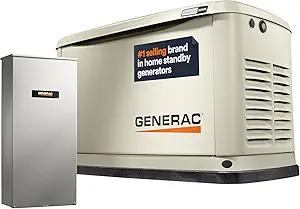
When the power goes out, the right generator can make the difference between waiting for the grid to come back and keeping your most important appliances and systems running. Generac offers several ways to prepare for outages, but two models target very different needs: the Generac GP9500E TF portable tri-fuel generator and the Generac Guardian 22kW Home Standby Generator Model 7043.
The GP9500E TF is designed for homeowners who want a large portable generator with the flexibility to use gasoline, propane, or natural gas. The Guardian 22kW, meanwhile, is a permanently installed standby system designed to automatically restore power through a transfer switch when utility electricity fails.
For 2026, there is an important distinction to make when comparing these generators. The GP9500E TF model 8063-0 is rated at up to 9,500 running watts on gasoline, while the Guardian 7043 reaches 22kW on liquid propane and 19.5kW on natural gas. They are not interchangeable solutions, even though both are intended for backup power.
This comparison looks at their specifications, fuel options, power capabilities, installation requirements, practical advantages, and limitations so you can see which type of backup generator makes sense for your home.
Generac GP9500E TF vs. Guardian 22kW at a Glance
| Feature | Generac GP9500E TF | Generac Guardian 22kW Model 7043 |
|---|---|---|
| Generator type | Portable tri-fuel | Home standby |
| Model | 8063-0 | 7043 |
| Fuel | Gasoline, propane, natural gas | Natural gas or liquid propane |
| Running watts | 9,500 / 8,550 / 7,000 | Up to 22,000 LP / 19,500 NG |
| Starting watts | 12,500 / 11,250 / 9,000 | Standby system rating rather than portable starting-watt rating |
| Engine | 500cc OHV | Generac G-Force engine |
| Starting system | Electric and recoil | Automatic |
| Transfer switch | Not included as an automatic whole-house system | 200-amp automatic transfer switch |
| CO protection | COsense | Standby installation safety features |
| Mobility | Yes | No |
| Wi-Fi monitoring | No built-in standby-style monitoring system | Yes, Mobile Link compatible |
| Installation | Portable setup or compatible manual transfer equipment | Professional installation required |
| Best suited for | Flexible emergency and jobsite power | Automatic whole-home backup |
The GP9500E TF’s output varies according to fuel. Generac lists 9,500 running watts and 12,500 starting watts on gasoline, 8,550/11,250 watts on propane, and 7,000/9,000 watts on natural gas.
The Guardian 7043 operates at up to 22kW on liquid propane and 19.5kW on natural gas, making fuel selection relevant when estimating how much electrical load it can support.
Generac GP9500E TF Review
The Generac GP9500E TF is a high-output portable generator built around one of its most useful features: fuel flexibility.
The 8063-0 model can run on gasoline, liquid propane, or natural gas, allowing homeowners to choose the fuel that makes the most sense for their situation. That can be particularly useful during extended outages, when gasoline availability may become an issue.
On gasoline, it produces 9,500 running watts and 12,500 starting watts. On propane, output drops to 8,550 running watts and 11,250 starting watts. Natural gas provides 7,000 running watts and 9,000 starting watts.
That difference is worth remembering. A tri-fuel generator does not necessarily produce identical power on all three fuels.
GP9500E TF Power Output
| Fuel | Running Watts | Starting Watts |
|---|---|---|
| Gasoline | 9,500W | 12,500W |
| Liquid propane | 8,550W | 11,250W |
| Natural gas | 7,000W | 9,000W |
For many homeowners, 9,500 running watts is enough to cover a substantial collection of essential loads. Depending on the electrical requirements of the house, it can potentially support appliances such as refrigerators, freezers, sump pumps, lighting, a furnace, selected air-conditioning equipment, and other household circuits.
However, the available wattage should always be compared with the starting and running requirements of the appliances you actually intend to operate.
Fuel Flexibility Is the GP9500E TF’s Biggest Advantage
The biggest reason to consider the GP9500E TF is not simply its wattage. It is the ability to switch between three fuel sources.
Gasoline is convenient when you already have fuel stored and need the generator to produce its highest rated output.
Propane can be attractive for emergency preparedness because properly stored propane does not degrade in the same way gasoline can. The tradeoff is lower output and shorter runtime from a typical 20-pound cylinder.
Natural gas can provide a convenient fuel source for a property that already has an appropriate natural gas connection. The tradeoff is that the generator produces less power on natural gas than it does on gasoline or propane.
Generac’s specifications for the 8063-0 list a 7.5-gallon fuel tank and approximately 8.5 hours of gasoline runtime at 50% load. A 20-pound propane tank is listed at approximately 4.5 hours at 50% load. Actual runtime varies with electrical demand and operating conditions.
Engine, Starting System, and CO Protection
The GP9500E TF uses a 500cc OHV engine with splash lubrication and automatic voltage regulation. It includes both electric and recoil starting, with the battery included.
Low-oil shutdown is another useful protection feature. If the oil level becomes too low, the generator can shut down rather than continuing to operate under potentially damaging conditions.
Generac also equips the model with COsense technology, which is designed to provide protection against hazardous carbon monoxide levels.
That feature does not eliminate the need for safe generator placement. A portable generator should always be operated outdoors, away from doors, windows, and other openings where exhaust could enter the home.
Is the GP9500E TF Easy to Move?
“Portable” is technically correct, but it is important not to interpret that word as lightweight.
The GP9500E TF weighs approximately 219 pounds. It has a folding handle and 9.5-inch never-flat wheels to make movement easier, but this is still a large machine that one person may find difficult to lift or load into a vehicle.
Its approximate dimensions are 27.5 inches long, 27.1 inches wide, and 27.6 inches high, with the extended length reaching approximately 44.9 inches.
For emergency home use, its portability is more useful for positioning the generator in an appropriate outdoor location than for carrying it around like a small camping generator.
What Can the Generac GP9500E TF Power?
The answer depends on the fuel being used and the electrical loads in the home.
At 9,500 running watts on gasoline, the GP9500E TF has enough capacity for many essential household circuits. It can be a practical option for homeowners who want to keep refrigerators, freezers, lights, networking equipment, pumps, heating equipment, and selected larger appliances running during an outage.
Large central air-conditioning systems, electric water heaters, electric ranges, EV chargers, and other high-demand equipment can consume a significant portion of the available capacity.
That is why a portable generator rated at 9,500 watts should not automatically be described as a “whole-house generator.” With the right transfer equipment and load planning it can provide substantial home backup, but its capacity is still limited compared with a 22kW standby system.
Generac Guardian 22kW Model 7043 Review
The Generac Guardian 22kW Model 7043 takes a completely different approach.
Instead of being wheeled into position and started manually, it is designed as a permanently installed home standby generator. When utility power fails, the automatic transfer system detects the outage and transfers the home’s electrical load to the generator.
The 7043 is rated for up to 22kW on liquid propane and 19.5kW on natural gas. It is an air-cooled standby generator and is designed for residential whole-house backup applications.
The model 7043 is also sold with a 200-amp automatic transfer switch, making it fundamentally different from connecting appliances to a portable generator with extension cords.
How the Guardian 22kW Automatic Backup System Works
Under normal conditions, the home receives electricity from the utility.
When utility power fails, the automatic transfer switch detects the interruption and signals the generator to start. Once the generator reaches operating conditions, the transfer switch moves the home’s electrical supply to generator power.
When utility power returns, the system transfers the load back and the generator shuts down according to its programmed sequence.
This is the main convenience advantage of a standby generator.
You do not need to be home to start it, move it outside, connect cables, or manually refuel it.
That makes the Guardian particularly useful for homeowners who travel frequently, own a vacation property, or simply want an automated backup system.
22kW Does Not Mean 22kW on Every Fuel
One of the most important corrections to the original article is the power rating.
The Guardian 7043 is commonly described as a 22kW generator, but the actual rating depends on fuel.
Generac’s specifications list approximately:
- 22kW on liquid propane
- 19.5kW on natural gas
That distinction matters when calculating the electrical loads your home can operate during an outage.
If your home uses natural gas, you should use the natural-gas rating when evaluating the system rather than assuming the full 22kW output.
The 200-Amp Whole-House Transfer Switch
The 200-amp automatic transfer switch is one of the most important components of the 7043 package.
Instead of deciding which individual appliances to connect, the system is designed to integrate with the home’s electrical service.
That is what makes a whole-house standby generator so different from a portable generator.
However, “whole-house” does not mean that every possible electrical load can operate simultaneously without limitation. The generator still has a finite power capacity.
If a home has several large electrical loads running at once, the available generator capacity must be considered. An installer can evaluate the home’s load requirements and determine whether load management or other configuration considerations are necessary.
Natural Gas vs. Propane for the Guardian 22kW
The 7043 can operate on natural gas or liquid propane.
Natural gas can be convenient because there is no need to refill a portable fuel tank during an outage. However, the generator’s rated output is lower on natural gas.
Propane provides the higher rated output, but the homeowner needs an appropriately sized propane supply.
The correct fuel choice depends on the home’s existing infrastructure, local availability, expected outage duration, and installation requirements.
Mobile Link and Remote Monitoring
The Guardian 7043 is equipped for Wi-Fi connectivity and remote monitoring through Generac’s Mobile Link ecosystem. Generac’s current product documentation provides Mobile Link and related monitoring information for the model.
Remote monitoring can be useful because the homeowner can check generator status and receive information about maintenance or operating conditions without standing next to the unit.
This is particularly useful for people who are away from home for extended periods.
It is important, however, not to confuse Wi-Fi monitoring with the basic operation of the automatic backup system. The generator’s purpose is to provide automatic backup power when utility electricity fails; remote connectivity is an additional monitoring and management feature.
Quiet-Test Exercise Mode
Standby generators need periodic exercise cycles so the system can verify its operating condition.
The Guardian series includes Quiet-Test, which allows the generator to perform its exercise cycle at a lower engine speed. Generac’s specifications list approximately 58 dBA at 23 feet during the low-speed Quiet-Test mode for the 22kW version.
During normal operation under load, the sound level is higher.
This is one area where buyers should set realistic expectations: a 22kW air-cooled standby generator is not silent. Placement, distance from the home, landscaping, walls, and local noise requirements can all affect how noticeable it is.
Installation Requirements
Unlike the GP9500E TF, the Guardian 7043 is not a plug-and-play generator.
A proper installation involves electrical and fuel-system work and should be performed according to local codes and manufacturer requirements.
Typical considerations include:
- A suitable location outside the home
- A proper generator pad or approved mounting surface
- Installation of the automatic transfer switch
- Correct electrical connections
- Adequately sized natural gas or propane supply
- Required clearances from the structure, doors, windows, and other openings
- Local permits and inspections where required
- Appropriate grounding and electrical protection
The exact requirements vary according to the property, local codes, utility requirements, and installation configuration.
For that reason, the purchase price of a standby generator should never be treated as the complete cost of having an operational whole-house backup system.
Maintenance: Portable vs. Standby
Neither generator is maintenance-free.
The GP9500E TF requires normal portable-generator maintenance, including checking engine oil, keeping the air filter clean, inspecting the spark plug and fuel system, and making sure the battery remains ready for electric starting.
The Guardian 7043 also requires scheduled maintenance, even if it rarely runs during an actual outage. Its automatic exercise cycles help verify operation, but they do not replace routine servicing.
A standby generator that sits outside for months at a time still needs attention to oil, filters, battery condition, electrical connections, fuel supply, and other components.
Following the maintenance schedule in the owner’s documentation is important for either system.
Generac GP9500E TF vs. Guardian 22kW: Which Type Fits Your Home?
The most useful way to compare these generators is not simply by wattage.
They solve different problems.
The GP9500E TF makes more sense when:
- You want a portable generator.
- You want three fuel options.
- You need backup power but do not want a permanent standby installation.
- You want to use the generator for home emergencies and other applications.
- You are comfortable setting up the generator when an outage occurs.
- You want to control which electrical loads operate.
The Guardian 22kW Model 7043 makes more sense when:
- You want automatic backup power.
- You want a permanent whole-house installation.
- You have natural gas or propane available.
- You do not want to move or manually start a generator during an outage.
- You want a 200-amp automatic transfer system.
- You want remote monitoring capabilities.
- Your home has larger electrical loads that exceed what a portable generator can comfortably support.
Important Downsides to Consider
Neither model is perfect for every homeowner.
The GP9500E TF is heavy at approximately 219 pounds, and its output drops when operating on propane or natural gas. It also requires the homeowner to manage setup, fuel, placement, and electrical connections during an outage.
The Guardian 22kW is considerably more convenient once installed, but it requires professional installation and a substantially larger overall investment. It also occupies a permanent outdoor location and requires ongoing maintenance.
Noise is another consideration. Large air-cooled standby generators are quieter during their low-speed exercise cycle than under heavy load, but they are still mechanical engines operating outdoors.
Generac GP9500E TF vs. Guardian 22kW: Final Comparison
| Category | GP9500E TF | Guardian 22kW Model 7043 |
|---|---|---|
| Portability | Excellent for a large portable unit | Permanent installation |
| Fuel flexibility | Gasoline, propane, natural gas | Natural gas or propane |
| Maximum listed output | 12,500 starting / 9,500 running watts on gasoline | 22kW LP / 19.5kW NG |
| Automatic outage response | No | Yes |
| Whole-house transfer system | Requires appropriate separate equipment/configuration | 200A automatic transfer switch |
| Manual setup | Required | No routine manual setup during outages |
| Remote monitoring | Not its primary feature | Mobile Link/Wi-Fi enabled |
| Installation complexity | Lower | Much higher |
| Best use | Flexible backup power | Permanent home backup |
Final Verdict: Which Generac Generator Should You Consider?
The Generac GP9500E TF and Generac Guardian 22kW Model 7043 are designed for two different backup-power strategies.
The GP9500E TF is the more flexible portable solution. Its ability to use gasoline, propane, or natural gas gives homeowners several fuel options, while its 9,500-watt gasoline running output provides substantial capacity for essential household loads. Its 500cc OHV engine, electric start, COsense technology, and wheel-and-handle configuration make it a practical high-output portable generator.
The Guardian 22kW Model 7043 is designed for homeowners who want the convenience of an automatic standby system. With up to 22kW on propane, 19.5kW on natural gas, a 200-amp automatic transfer switch, and remote monitoring capabilities, it is built around permanent whole-house backup rather than portable emergency power.
The important question is therefore not simply which generator produces more watts. It is whether you need portable, fuel-flexible backup power or a permanently installed system that can automatically take over when the grid goes down.
For a portable generator, evaluate the actual running and starting wattage of the appliances you need during an outage. For a standby generator, have the home’s electrical loads, fuel supply, transfer equipment, installation location, and local code requirements evaluated before purchasing.
For 2026, those distinctions make the Generac GP9500E TF and Guardian 22kW Model 7043 two substantially different approaches to residential backup power rather than two versions of the same solution.