As an Amazon Associate I earn from qualifying purchases.
A reliable source of portable electricity can make a big difference when you’re camping, traveling in an RV, working off-grid, or dealing with a power outage. A modern solar generator can keep essential electronics and appliances running without gasoline, engine noise, or exhaust fumes.
For many buyers, the 2000W solar generator category is a practical middle ground. These portable power stations have enough inverter capacity to handle many everyday appliances while still being considerably easier to move and set up than larger home backup systems.
However, shopping by the “2000W” number alone can be misleading. A power station’s wattage tells you how much power it can deliver at once, while its watt-hour (Wh) capacity tells you how much stored energy is available. Solar input, battery chemistry, weight, expansion options, charging speed, and available outlets also make a major difference.
In 2026, the market includes several 2,000W-class power stations using LiFePO4 batteries, fast AC charging, higher solar-input limits, app controls, and expandable battery systems. The models below cover different use cases, from portable camping to longer emergency backup.
Best 2000W Solar Generators for 2026
| Solar Generator | Battery Capacity | AC Output | Max Solar Input | Expandable | Best For |
|---|---|---|---|---|---|
| OUPES Mega 1 | 1024Wh | 2000W | 800W | Yes, up to 5120Wh | Portable backup and camping |
| Dabbsson DBS1000 Pro | 1024Wh | 2000W | 1200W | Yes, up to 10240Wh | Expandable backup |
| Jackery Solar Generator 2000 v2 | 2042Wh | 2200W | 400W | No | Longer runtime and portability |
| EBL Voyager 1000 | 999Wh | 1000W | 100W | No | Basic portable power |
| Eco Play 3600 Pro | 3840Wh | 3600W | 2000W | Yes | High-capacity backup |
The table also shows an important distinction: not every product in the original list is technically a 2,000W power station. The EBL Voyager 1000 is a 1,000W unit, while the Eco Play 3600 Pro is a 3,600W unit. They can still be useful comparisons for shoppers considering a wider range of portable solar generators, but they should not be treated as direct 2,000W competitors.
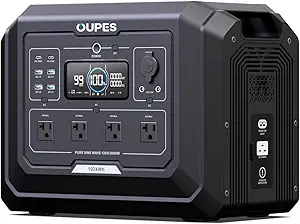
1. OUPES Mega 1 Portable Power Station – Compact 2000W Solar Generator
Check Amazon Price Click Here!
Battery Capacity: 1024Wh
Battery Type: LiFePO4
Rated Output: 2000W continuous
Surge Output: 4500W
Solar Input: Up to 800W
AC Charging: Up to 1400W
Expandable Capacity: Up to 5120Wh
Weight: 27.8 lbs
The OUPES Mega 1 is one of the more interesting choices if portability matters but you still want a full 2000W inverter.
Its 1024Wh LiFePO4 battery provides a useful amount of stored energy for camping, tailgating, emergency electronics, refrigerators, networking equipment, and other moderate loads. The 2000W pure sine wave inverter gives it considerably more appliance flexibility than smaller 500W or 1000W power stations.
OUPES lists more than 3,500 battery cycles to 80% capacity, along with an expandable architecture that can increase total storage to 5120Wh using two B2 expansion batteries. The unit also supports up to 800W of solar input.
The relatively low 27.8-pound weight is another advantage. That’s particularly useful if you plan to move the station between a vehicle, campsite, garage, and home rather than keeping it permanently installed.
Key Features
- 2000W continuous AC output
- 4500W surge capacity
- 1024Wh LiFePO4 battery
- Up to 800W solar input
- Expandable to 5120Wh
- Wi-Fi and Bluetooth connectivity
- 100W USB-C ports
- Pure sine wave inverter
- UPS/EPS functionality
What Is the OUPES Mega 1 Good For?
The Mega 1 makes sense for buyers who want high inverter output without carrying a 50- or 60-pound power station.
It’s particularly well suited to:
- Camping and overlanding
- Emergency refrigerator backup
- CPAP and other essential electronics
- Laptops and work equipment
- Wi-Fi routers and networking equipment
- Small appliances
- RV and van use
- Short power outages
Its main limitation is the 1024Wh battery. A 2000W inverter does not mean it can operate a 2000W appliance for a long time. A high-power appliance will consume the battery much faster than a refrigerator, fan, laptop, or LED light.
2. Dabbsson DBS1000 Pro – 2000W Power With Extensive Expansion
Check Amazon Price Click Here!
Battery Capacity: 1024Wh
Battery Type: Semi-solid-state LiFePO4
Rated Output: 2000W
Surge Output: 4000W
Power-Boost Output: Up to 3000W
Solar Input: Up to 1200W
AC Input: Up to 1200W
Expandable Capacity: Up to 10240Wh
Weight: 34.39 lbs
The Dabbsson DBS1000 Pro is aimed at users who want a portable power station today but may need considerably more storage later.
The base unit has a 1024Wh battery and 2000W pure sine wave AC output. Dabbsson also lists a 1200W maximum solar input, which is higher than the OUPES Mega 1’s 800W limit.
Its biggest selling point, however, is expandability. The system can be expanded up to 10240Wh when using compatible DBS1000 Pro and DBS2000B batteries. Two DBS1000 Pro units can also be connected in parallel for up to 4400W in the supported configuration.
The DBS1000 Pro weighs about 34.39 pounds and includes Wi-Fi/app connectivity. Its battery is rated for 4,500 cycles to 80% capacity according to Dabbsson’s current specifications.
Key Features
- 2000W pure sine wave AC output
- 4000W surge output
- Up to 3000W Power-Boost mode
- 1024Wh LiFePO4 battery
- 1200W maximum solar input
- Expansion capability up to 10240Wh
- App control
- Multiple USB-C outputs
- Five-year warranty listed by the manufacturer
What Is the Dabbsson DBS1000 Pro Good For?
This model is more interesting for people who view a portable power station as the foundation of a larger backup system.
It can be useful for:
- Emergency preparedness
- RV travel
- Remote work
- Off-grid cabins
- Longer outages
- Solar-powered setups
- Users who expect their energy requirements to increase
The trade-off is that the base battery is still only 1024Wh. If you’re primarily interested in maximum runtime without purchasing expansion batteries, a 2000Wh-class station may be a better fit.
3. Jackery Solar Generator 2000 v2 – 2042Wh of Portable Backup Power
Check Amazon Price Click Here!
Battery Capacity: 2042Wh
Battery Type: LiFePO4
Rated Output: 2200W
Solar Input: Up to 400W
AC Input: Up to 1800W
Expandable: No
Weight: Approximately 39.5 lbs
The Jackery Explorer 2000 v2 is one of the most straightforward choices in this group for someone who wants a relatively large battery without adding expansion batteries.
Its 2042Wh LiFePO4 battery provides roughly twice the stored energy of the 1024Wh OUPES and Dabbsson base units. That doesn’t mean twice the runtime in every situation, because actual runtime depends on the appliance load and conversion losses, but the additional capacity can be very useful during extended outages or multi-day trips.
Jackery’s current specifications list 2200W of AC output and a LiFePO4 battery rated for 4,000 cycles to at least 70% capacity. The unit weighs around 39.5 pounds.
One of the compromises is solar charging. The current Jackery specifications list a maximum of 400W of solar input, so it is not as solar-input-heavy as the Dabbsson DBS1000 Pro or BLUETTI AC200L.
Key Features
- 2042Wh battery capacity
- LiFePO4 battery chemistry
- 2200W AC output
- Approximately 39.5-pound weight
- Pure sine wave output
- Up to 400W solar input
- Fast AC charging
- Large battery for longer runtimes
What Is the Jackery 2000 v2 Good For?
The Jackery is particularly attractive for users who prioritize battery capacity and relatively simple operation.
It can be useful for:
- Home emergency backup
- Refrigerators
- CPAP machines
- Camping
- RV trips
- Laptops and home networking
- TVs and entertainment equipment
- Small kitchen appliances
The larger battery also makes it easier to run lower-wattage equipment for extended periods.
For example, a 50W device theoretically uses 50Wh per hour, although real-world consumption will be higher once inverter and system losses are considered. A 1000W appliance, by comparison, can consume roughly 1000Wh in about one hour before accounting for those losses.
That is why battery capacity matters just as much as the 2000W output rating.
4. EBL Portable Power Station Voyager 1000 – A Smaller and More Affordable Alternative
Check Amazon Price Click Here!
Battery Capacity: 999Wh
Rated Output: 1000W
Surge Output: 2000W
Solar Input: Up to 100W
Expandable: No
The EBL Voyager 1000 is the outlier in this comparison because it isn’t a 2000W power station.
That distinction is important. If you’re specifically searching for a 2000W solar generator, this model should not be your first consideration. However, it can make sense for shoppers who realize they don’t actually need a 2000W inverter.
A 1000W power station can handle many of the devices people commonly take camping or keep available for emergencies, including laptops, phones, lights, routers, fans, and some small appliances.
The 999Wh battery also gives it nearly 1kWh of nominal storage, although usable energy will be lower after normal conversion losses.
Key Features
- 999Wh battery
- 1000W continuous output
- 2000W surge capability
- Compact design
- Solar charging support
- Suitable for lower-power electronics
Who Should Consider the Voyager 1000?
This type of station makes more sense for:
- Weekend camping
- Emergency electronics
- Portable lighting
- Laptops and tablets
- Wi-Fi equipment
- Phones and cameras
- Small refrigerators
- Users who don’t need to run high-wattage appliances
If your goal is to run a microwave, coffee maker, space heater, large power tool, or other high-demand appliance, move up to a genuine 2000W-class station.
5. Eco Play 3600 Pro – High-Capacity Option for Extended Backup
Check Amazon Price Click Here!
Battery Capacity: 3840Wh
Rated Output: 3600W
Solar Input: Up to 2000W
Expandable: Up to 11520Wh
The Eco Play 3600 Pro is another model that falls outside the strict 2000W category.
Its 3600W inverter and 3840Wh battery put it in a larger class of portable power stations. That makes it worth considering when your primary goal is longer emergency runtime rather than minimum weight.
The larger battery can be particularly useful when several essential loads need to operate at the same time. A refrigerator, modem, lights, computers, and other electronics can consume a significant amount of energy during an extended outage.
The system’s reported 2000W solar input also gives it considerably more solar-charging potential than the smaller stations in this comparison.
Key Features
- 3840Wh battery capacity
- 3600W continuous output
- Up to 2000W solar input
- Expandable storage
- Designed for higher-demand applications
- Better suited to extended backup than lightweight camping
Who Is the Eco Play 3600 Pro For?
This type of power station is better suited to:
- Extended power outages
- Off-grid properties
- Workshops
- Larger RV setups
- Multiple appliances
- Emergency preparedness
- Users who need substantial battery capacity
The obvious downside is portability. A larger battery and inverter generally mean more weight and bulk, so it isn’t the same kind of product as a lightweight camping power station.
What Can a 2000W Solar Generator Actually Run?
One of the most common mistakes when shopping for a solar generator is assuming that a 2000W rating tells you how long the battery will last.
It doesn’t.
Watts (W) describe the amount of electrical power the inverter can deliver at a given moment.
Watt-hours (Wh) describe the amount of energy stored in the battery.
For example, a 2000W power station may be capable of running a 1500W appliance, but a 1500W load will drain a 1000Wh battery much faster than a 100W load.
Depending on the actual starting surge and running wattage, a 2000W-class station may be capable of powering equipment such as:
- Refrigerators
- Freezers
- Microwaves
- Coffee makers
- Televisions
- Laptops
- Wi-Fi routers
- Fans
- CPAP machines
- Small power tools
- Lights
- Chargers
- Small kitchen appliances
The important point is to check both the continuous wattage and startup surge of the appliance.
Motors and compressors can briefly demand significantly more power when they start. A refrigerator, for example, may have a relatively modest running consumption but require additional startup power.
How Long Will a 2000W Solar Generator Last?
There isn’t one fixed runtime because every appliance uses a different amount of electricity.
A simple estimate is:
Runtime ≈ Battery Capacity (Wh) × 0.85 ÷ Appliance Power (W)
The 0.85 figure is only a rough allowance for conversion losses and should not be treated as a guaranteed result.
For a 1024Wh power station:
- A 50W device could theoretically run for many hours.
- A 100W load could provide several hours of operation.
- A 500W load would drain the battery considerably faster.
- A 1000W load could use most of the stored energy in around an hour.
- A 1500W load would consume the battery very quickly.
Actual results vary with inverter efficiency, battery temperature, appliance cycling, standby consumption, and the condition of the battery.
This is why a refrigerator can sometimes run much longer than its listed wattage might suggest: its compressor cycles on and off instead of drawing its maximum power continuously.
2000W vs. 2000Wh: What’s the Difference?
The terms 2000W and 2000Wh sound similar but describe two completely different things.
A 2000W inverter tells you the maximum continuous power the station can provide.
A 2000Wh battery tells you how much energy it stores.
A power station could therefore have:
- 2000W output and 1000Wh capacity
- 2000W output and 2000Wh capacity
- 2400W output and 2048Wh capacity
- 3600W output and 3840Wh capacity
The larger battery generally provides longer runtime, while the higher inverter rating allows the station to operate higher-wattage appliances.
For emergency backup, both specifications matter.
LiFePO4 vs. Older Lithium-Ion Batteries
Battery chemistry is another important consideration when buying a portable power station in 2026.
Many current models use LiFePO4, or lithium iron phosphate, batteries. These batteries are popular in portable power stations because manufacturers can design them for long cycle life and stable operation.
For example, OUPES lists more than 3,500 cycles to 80% capacity for the Mega 1, while Dabbsson lists 4,500 cycles to 80% for the DBS1000 Pro. Jackery lists 4,000 cycles to at least 70% for the Explorer 2000 v2.
These figures should not be interpreted as a promise that every battery will behave identically. Usage patterns, temperature, charging habits, storage conditions, and battery management all affect longevity.
Still, LiFePO4 is an important feature to look for when comparing modern power stations.
Solar Input Matters More Than Many Buyers Realize
A solar generator isn’t necessarily useful as an off-grid system simply because it has a solar charging port.
You also need to look at maximum solar input.
For example:
- OUPES Mega 1: up to 800W
- Dabbsson DBS1000 Pro: up to 1200W
- Jackery Explorer 2000 v2: up to 400W
These differences can have a significant impact on how quickly a depleted battery can be replenished during good sunlight.
Solar panel ratings are also based on ideal conditions. Real-world output changes with cloud cover, panel orientation, temperature, shading, cable losses, and the position of the sun.
If you’re building a system specifically for repeated off-grid use, a higher solar-input limit can be worth paying attention to.
What Should You Look For in a 2000W Solar Generator?
Before buying, compare the following specifications rather than focusing only on the headline wattage.
1. Continuous AC Output
Make sure the continuous output is high enough for the appliances you want to use.
If an appliance requires 1800W continuously, a 2000W inverter leaves relatively little headroom.
2. Surge Capacity
Some appliances require additional power when their motors or compressors start.
A higher surge rating can therefore be useful for refrigerators, pumps, and power tools.
3. Battery Capacity
If longer runtime is important, look for a larger Wh rating.
A 2000W inverter does not automatically mean a large battery.
4. Solar Input
Higher solar input can reduce recharge time when sufficient sunlight and appropriately rated panels are available.
5. Battery Chemistry
LiFePO4 is now common in modern portable power stations and is generally worth considering for long-term use.
6. Weight
A 2000Wh-class power station can be substantially heavier than a 1000Wh model.
Think about where you’ll use it before buying. A station that stays in a garage has different portability requirements from one that you carry to a campsite.
7. Expansion Batteries
Expandable systems can be useful if your energy requirements may increase.
The Dabbsson DBS1000 Pro, OUPES Mega 1, and several competing 2kWh-class stations support additional battery capacity.
8. UPS or EPS Function
If you’re buying a power station for home backup, check whether it includes UPS/EPS functionality and understand its transfer time.
This can be particularly useful for networking equipment and other electronics that you don’t want to shut down during a brief outage.
Are 2000W Solar Generators Good for Emergency Backup?
Yes, but their usefulness depends on what you want to keep running.
A 2000W-class power station can be very useful for essential-load backup, such as:
- Refrigerator
- Internet modem and router
- Phones
- Laptops
- Lights
- CPAP machine
- Television
- Small kitchen appliances
It is not automatically a replacement for a permanently installed whole-home generator.
Central air conditioning, electric water heaters, electric ranges, well pumps, large HVAC systems, and other high-demand equipment can require considerably more power or specialized electrical connections.
For a larger home backup system, a portable power station may be one component of the solution rather than the entire solution.
2000W Solar Generator vs. Gas Generator
Portable solar power stations and gasoline generators solve similar problems in very different ways.
Solar Power Stations
Advantages:
- No gasoline required
- No engine exhaust while operating
- Quiet operation
- Can be used indoors when operated according to the manufacturer’s instructions
- Can recharge from solar panels
- Low routine maintenance
Limitations:
- Limited battery capacity
- Solar charging depends on weather and available sunlight
- High-power appliances can drain the battery quickly
- Larger battery systems can become expensive
Gas Generators
Advantages:
- Can refuel quickly
- Long runtime with sufficient fuel
- Suitable for sustained high-power loads
- Available in very high-output configurations
Limitations:
- Exhaust emissions
- Noise
- Fuel storage
- Engine maintenance
- Carbon monoxide risk
For outdoor emergency power, solar power stations offer a very different ownership experience from traditional fuel-powered generators.
Safety Tips for Using a Solar Generator
Even though a battery power station doesn’t have an internal combustion engine, it still stores a large amount of electrical energy.
Follow the manufacturer’s instructions and keep these points in mind:
- Do not exceed the station’s continuous output rating.
- Check appliance startup requirements.
- Use compatible solar panels and cables.
- Keep the power station away from water unless it has the appropriate weather-resistance rating.
- Avoid exposing the battery to extreme temperatures.
- Don’t cover ventilation openings.
- Inspect cables and connectors before use.
- Store the unit according to the manufacturer’s recommendations.
- Use only compatible expansion batteries and accessories.
- Follow the manufacturer’s charging and storage instructions.
Also remember that a portable power station should not be treated as a substitute for a properly installed transfer switch or other code-compliant home electrical equipment.
If you want to connect backup power to household circuits, use the appropriate equipment and a qualified electrician rather than improvising a connection.
Which 2000W Solar Generator Should You Choose?
The right choice depends on how you plan to use the power station.
Choose the OUPES Mega 1 if you want a relatively lightweight 2000W station with expansion capability and strong solar input.
Choose the Dabbsson DBS1000 Pro if expansion potential and higher solar charging capability are important to you.
Choose the Jackery Explorer 2000 v2 if you want a substantially larger 2042Wh battery in a straightforward portable package.
Consider the EBL Voyager 1000 if your actual requirements are modest and you don’t need a 2000W inverter.
Consider the Eco Play 3600 Pro if you’re willing to move into a larger, heavier power station in exchange for substantially more battery capacity and output.
If you’re shopping strictly for a 2000W-class power station, focus primarily on the OUPES, Dabbsson, and Jackery options above. The EBL and Eco Play models are included because they show how much the specifications can vary when shoppers move down or up the power range.
Final Thoughts on 2000W Solar Generators in 2026
The portable solar generator market has changed considerably, and the biggest mistake is to judge a power station by its advertised wattage alone.
A useful comparison should look at continuous AC output, surge capability, battery capacity, battery chemistry, solar input, charging speed, weight, expansion options, and the appliances you actually need to run.
For camping and mobile use, a lighter 2000W station can be more practical than a much larger system. For emergency backup, however, battery capacity becomes increasingly important because a high-output inverter does not automatically provide long runtime.
The OUPES Mega 1 and Dabbsson DBS1000 Pro offer expandable 2000W-class configurations, while the Jackery Explorer 2000 v2 takes a different approach with a much larger built-in 2042Wh battery. The EBL Voyager 1000 provides a lower-power alternative, while the Eco Play 3600 Pro demonstrates what happens when you move into a much larger power class.
Before buying, calculate the wattage of the appliances you need to operate and estimate how many hours you want them to run. That simple step can prevent you from paying for more inverter power than you need—or buying a station whose battery is too small for your actual backup requirements.
For outdoor adventures, RV travel, remote work, and short-term outages, a well-sized portable power station can provide convenient backup electricity without the noise and fuel requirements of a traditional gas generator.