As an Amazon Associate I earn from qualifying purchases.
RV travel gives you the freedom to camp farther from the grid, but that freedom comes with one basic requirement: dependable power.
Whether you need electricity for a rooftop air conditioner, refrigerator, microwave, coffee maker, CPAP machine, TV, battery charger, or simply your phones and other electronics, choosing the right generator can make a huge difference.
The tricky part is that small RV generators are not all designed for the same job. A lightweight 1,800-watt inverter generator may be perfect for charging electronics and running a few basic appliances, while a 3,000- to 5,000-watt model is a much better match for an RV with a rooftop air conditioner.
For 2026, I would focus on four things before anything else: running watts, starting watts, RV-ready outlets, and portability.
Below are five portable generators worth considering, ranging from lightweight options for basic RV power to higher-output models designed for more demanding loads.
Best Compact Generators for RV Use in 2026
| Generator | Starting Watts | Running Watts | Fuel | Approx. Weight | Best For |
|---|---|---|---|---|---|
| WEN DF680iX | 6,800W | 5,100W | Gas/Propane | 94.8 lbs | High-power RV use |
| Champion 100809 | 4,000W | 3,000W | Gasoline | 48.1 lbs | Lightweight 30A RVs |
| ERAYAK 2400P | 2,400W | 1,800W | Gasoline | 42 lbs | Light RV loads |
| Westinghouse iGen5000DF | 5,000W | 3,900W | Gas/Propane | 104.7 lbs | AC and higher loads |
| maXpeedingrods 3500W | 3,500W | 3,000W | Gasoline | About 47–52 lbs | Portable 30A RV power |
Generator specifications can vary by production version and operating conditions. Always verify the current Amazon listing and manufacturer’s specifications before purchasing.
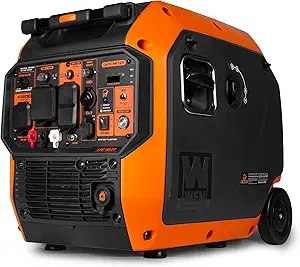
1. WEN 6800-Watt Dual Fuel Inverter Generator
Check Amazon Price: Amazon Link
The WEN DF680iX is the most powerful generator in this group, and it is better described as a high-output portable inverter generator than a lightweight suitcase generator.
It produces up to 6,800 starting watts and 5,100 running watts on gasoline. When operating on propane, output is rated at 6,000 starting watts and 4,500 running watts. It also includes a TT-30R RV receptacle, making it much more useful for RV owners than a generic portable generator without a dedicated RV connection.
Specifications
- Gasoline starting power: 6,800W
- Gasoline running power: 5,100W
- Propane starting power: 6,000W
- Propane running power: 4,500W
- Fuel: Gasoline or propane
- Weight: Approximately 94.8 lbs
- Engine: 224cc
- Voltage: 120V/240V
- RV outlet: TT-30R
- Gasoline runtime at half load: About 6.1 hours
Why Consider the WEN?
The biggest advantage is power. If your RV has a rooftop air conditioner and you also want enough capacity for other appliances, the extra running wattage gives you considerably more breathing room than a 1,800- or 2,000-watt generator.
The dual-fuel system is another useful feature for RV travel. Gasoline provides the higher output, while propane gives you another fuel option that can be convenient for extended trips.
The generator also includes WEN Watchdog carbon monoxide protection, electric start, wheels, a telescoping handle, USB outputs, and an RV-ready TT-30R outlet.
The Trade-Off
At nearly 95 pounds, this is not the generator you want to carry long distances by hand. It makes more sense for RVers who prioritize power over minimum weight.
Best for: RV owners who need substantial power and want gasoline/propane flexibility.
2. Champion 4000-Watt RV Ready Portable Inverter Generator
Check Amazon Price: Amazon Link
If portability matters, the Champion 4000-Watt RV Ready inverter generator is much easier to live with than the larger WEN.
The Champion model 100809 produces 4,000 starting watts and 3,000 running watts, while weighing only about 48.1 pounds. That combination makes it particularly interesting for RV owners who frequently set up and tear down camp.
Specifications
- Starting power: 4,000W
- Running power: 3,000W
- Fuel: Gasoline
- Weight: 48.1 lbs
- Noise level: 64 dBA at 23 feet
- Fuel tank: 1.54 gallons
- Runtime: Up to 10 hours at 25% load
- RV outlet: TT-30R
- Start: Recoil
Why Consider the Champion?
The built-in TT-30R outlet is one of its biggest advantages for RV use. You can connect a compatible 30-amp RV cord directly to the generator rather than relying on an adapter.
It also provides clean inverter power with less than 3% THD and includes CO Shield carbon monoxide protection. Parallel capability gives you the option of connecting another compatible Champion inverter generator when you need additional capacity.
The biggest attraction, however, is the weight. At roughly 48 pounds, it is dramatically easier to move than the 90- to 100-pound class generators.
The Trade-Off
The Champion uses recoil starting, not electric start. Its 3,000 running watts may also be limiting if your RV has a demanding 15,000 BTU air conditioner and you want to run several high-wattage appliances at the same time.
Best for: RV owners who want a relatively lightweight generator with a dedicated 30A RV connection.
3. ERAYAK 2400W Portable Inverter Generator
Check Amazon Price: Amazon Link
The ERAYAK 2400P occupies a completely different part of the RV generator market.
With 2,400 peak watts and 1,800 running watts, it is designed for smaller loads rather than being an all-purpose replacement for campground shore power. The manufacturer currently lists a weight of about 42 pounds and up to 10 hours of runtime, depending on load and conditions.
Specifications
- Starting power: 2,400W
- Running power: 1,800W
- Fuel: Gasoline
- Weight: About 42 lbs
- Voltage: 120V
- Noise: Approximately mid-50 dBA range depending on test conditions
- Runtime: Up to 10 hours, depending on load
What Can You Run With an 1,800-Watt Generator?
This is where shoppers need to be realistic.
An 1,800-watt generator can be useful for:
- Phones and tablets
- Laptop chargers
- LED lighting
- Small TVs
- Routers
- Battery chargers
- Some CPAP machines
- Other relatively low-power electronics
It is not the first choice for running a typical rooftop RV air conditioner.
That distinction is important because many buyers see the 2,400W number and assume it can handle every RV appliance. Starting a compressor is very different from continuously powering a small electronic device.
Why Consider the ERAYAK?
Its compact size and lower weight make it easier to transport. If your RV trips are mostly about boondocking without air conditioning, or you simply want backup power for electronics and smaller appliances, a generator in this class can make more sense than hauling a 100-pound machine.
Best for: Small campers, light-duty RV power, electronics, and travelers who prioritize portability.
4. Westinghouse iGen5000DF Dual Fuel Inverter Generator
Check Amazon Price: Amazon Link
The Westinghouse iGen5000DF is another high-output option, but it combines that power with dual-fuel capability, electric start, remote start, and an RV-ready outlet.
On gasoline, it produces 5,000 peak watts and 3,900 running watts. Propane output is rated at 4,500 peak watts and 3,500 running watts. Westinghouse lists up to 18 hours of gasoline runtime at 25% load.
Specifications
- Gasoline starting power: 5,000W
- Gasoline running power: 3,900W
- Propane starting power: 4,500W
- Propane running power: 3,500W
- Fuel: Gasoline/propane
- Weight: 104.7 lbs
- Noise: As low as 52 dBA
- Gasoline tank: 3.4 gallons
- Gasoline runtime: Up to 18 hours at 25% load
- RV outlet: TT-30R
- Starting: Electric, remote, or recoil
Why Consider the Westinghouse?
This generator is a strong option for RVers who need more than the typical lightweight 2,000-watt class can provide.
The 3,900 running watts on gasoline provide useful headroom for an RV air conditioner plus additional appliances, although actual capability depends on the startup requirements of your specific equipment.
It also has an LED data center, remote start, electric start, wheels, telescoping handle, parallel capability, and less than 3% THD.
The 52 dBA specification is particularly attractive for camping because noise can be a major concern in RV parks and campgrounds.
The Trade-Off
The downside is weight. At 104.7 pounds, this is not a lightweight generator despite its enclosed inverter design.
It also takes considerably more storage space than a compact suitcase-style generator.
Best for: RV owners who need substantial output, want dual-fuel flexibility, and value remote/electric starting.
5. maXpeedingrods 3500W Portable Inverter Generator
Check Amazon Price: Amazon Link 1
Additional Amazon link from the original article: Amazon Link 2
The maXpeedingrods 3500W is an interesting middle ground between lightweight generators and much larger RV power units.
It is rated at 3,500 starting watts and 3,000 running watts, with a 120V 30A RV outlet, two 20A household outlets, USB outputs, and parallel capability. Sources list its Eco-mode noise around 58 dB at 23 feet.
Specifications
- Starting power: 3,500W
- Running power: 3,000W
- Fuel: Gasoline
- Engine: 145cc
- Weight: Approximately 47–52 lbs depending on listing
- Noise: About 58 dB in Eco mode
- Fuel tank: 4 liters
- RV outlet: 120V 30A
- Runtime: Up to about 8.3 hours at 25% load
Why Consider It?
The main appeal is the combination of output and portability.
A 3,000-watt running capacity is significantly more useful for RV applications than a 1,800-watt generator, while the relatively low weight keeps the generator manageable for many campers.
It also produces inverter power suitable for sensitive electronics and includes an Eco mode that adjusts engine operation according to the load.
The Trade-Off
The 4-liter fuel tank is relatively small for a generator in this power class, so runtime depends heavily on how hard you are running it.
As with any less-established generator brand, buyers should also pay attention to warranty coverage, parts availability, and current customer feedback before purchasing.
Best for: RV owners who want a portable 3,000-running-watt generator without moving into the 90- to 100-pound class.
What Size Generator Do You Need for an RV?
This is more important than simply choosing the generator with the biggest wattage number.
Start by making a list of everything you may operate at the same time.
For example:
| RV Appliance | Approximate Running Power |
|---|---|
| Refrigerator | 100–400W |
| TV | 50–200W |
| Laptop | 50–100W |
| Microwave | 900–1,500W |
| Coffee maker | 800–1,500W |
| Battery converter/charger | Varies |
| Rooftop AC | Varies significantly |
| Small electronics | Usually low |
These numbers are only examples. Actual consumption varies by appliance, model, operating mode, and startup conditions.
The important point is that starting watts can be much higher than running watts, especially for motors and compressors.
That’s why a generator that appears large enough on paper may still struggle when an RV air conditioner starts.
Do You Need a 2,000-Watt or 3,500-Watt Generator for an RV?
If you do not need air conditioning, a lightweight 1,800- to 2,000-running-watt inverter generator may be enough for basic camping loads.
If you want to run a rooftop AC, the situation changes.
Current RV generator guides commonly place 3,500 to 4,500 running watts in the practical range for many 30-amp RVs with rooftop air conditioning.
That does not mean every 3,500-watt generator will start every AC unit. Your air conditioner’s startup demand, other appliances operating simultaneously, and whether the RV has a soft-start system all matter.
What Does RV Ready Mean?
An RV-ready generator normally includes a dedicated TT-30R 30-amp RV receptacle.
That is useful because a 30-amp travel trailer can connect directly with the appropriate RV power cord.
However, don’t confuse “RV ready” with “will run every appliance in my RV.”
A generator may have a TT-30R outlet but still lack enough running or starting capacity for your particular air conditioner and other loads.
Always compare the generator’s output with your RV’s actual electrical requirements.
Gasoline vs. Dual Fuel for RV Travel
Gasoline remains convenient because it is widely available and generally gives a generator its highest rated output.
Dual-fuel generators give you another option.
Gasoline
Advantages:
- Widely available
- Usually provides the highest output
- Convenient for short trips
Disadvantages:
- Fuel has a limited storage life
- Spilled gasoline is messy
- Requires more attention during long-term storage
Propane
Advantages:
- Easier long-term storage
- Convenient for RVers who already carry propane
- Useful as a backup fuel
Disadvantages:
- Some generators produce less power on propane
- You need an appropriate propane cylinder and connection
- Cold-weather performance can vary
For extended RV trips, dual fuel can be a useful form of redundancy.
Inverter Generator vs. Conventional Generator
For RV camping, inverter generators are generally the more attractive option because they are designed to produce stable electrical power while adjusting engine speed according to load.
That can provide advantages in three areas:
- Lower noise
- Better fuel efficiency at lighter loads
- Cleaner power for sensitive electronics
A conventional open-frame generator can still provide useful power, but it is often louder and less pleasant around a campsite.
How Important Is Generator Noise at a Campground?
Very important.
A generator that seems acceptable in your driveway may feel much louder when you are sitting inside an RV or camping near other people.
Noise specifications should also be compared carefully because manufacturers may measure sound at different loads and distances.
Instead of assuming that one number tells the whole story, look at the stated measurement conditions.
The Westinghouse iGen5000DF, for example, is listed as low as 52 dBA, while the Champion 100809 is listed at 64 dBA from 23 feet.
Always check campground rules before running a portable generator. Some locations restrict generator hours or prohibit them entirely.
RV Generator Safety Tips
A portable generator can be extremely useful, but carbon monoxide is a serious hazard.
Follow these basic rules:
- Operate the generator outdoors only.
- Never run it inside the RV.
- Never run it inside a garage, storage compartment, or enclosed structure.
- Keep it away from doors, windows, vents, and other air intakes.
- Follow the clearance requirements in the owner’s manual.
- Allow the engine and exhaust system to cool before refueling.
- Never refuel a running or hot generator.
- Keep fuel away from ignition sources.
- Use the generator’s CO protection system as an additional safety feature, not as permission to operate it near the RV.
- Inspect cords and connections before use.
CO protection systems can help shut down a generator when dangerous carbon monoxide levels are detected, but proper placement and ventilation remain essential.
How to Maintain a Portable RV Generator
Regular maintenance is one of the easiest ways to avoid generator problems while traveling.
Check the oil
Follow the manufacturer’s oil-change schedule rather than waiting until the generator develops a problem.
Keep the air filter clean
A dirty filter can restrict airflow and affect engine performance.
Maintain the fuel system
If the generator will be stored for an extended period, follow the manufacturer’s storage procedure. Fuel stabilizer or draining the fuel system may be appropriate depending on the model.
Exercise the generator
If your owner’s manual recommends periodic operation, follow that schedule. Running the generator under an appropriate load can help you confirm that it is ready before your next trip.
Inspect the spark plug
Replace or service the spark plug according to the maintenance schedule.
Check cables and outlets
Look for damaged insulation, loose connections, or signs of overheating before connecting the generator to your RV.
Best Compact RV Generators for 2026: Final Comparison
| Generator | Best For | Main Advantage | Main Limitation |
|---|---|---|---|
| WEN DF680iX | High-power RV use | 5,100W running on gas | Heavy |
| Champion 4000W | Lightweight 30A RVs | 48.1-lb weight + TT-30R | 3,000W running |
| ERAYAK 2400P | Light loads | Compact and portable | Not suited to demanding AC loads |
| Westinghouse iGen5000DF | AC and heavier loads | 3,900W running + dual fuel | Over 100 lbs |
| maXpeedingrods 3500W | Portable 30A RV power | 3,000W running at moderate weight | Smaller fuel tank |
Which Compact Generator Is Right for Your RV?
There is no single generator that makes sense for every RV.
If your priority is maximum output, the WEN DF680iX gives you the most running power in this group while also offering gasoline and propane capability.
If you want a lighter generator for a 30-amp RV, the Champion 4000-Watt model is particularly interesting because it combines 3,000 running watts with a weight of roughly 48 pounds and a dedicated TT-30R outlet.
If you mainly need basic electrical power, the ERAYAK 2400P is easier to carry and store than the larger units.
For higher-output RV use with dual-fuel flexibility, the Westinghouse iGen5000DF offers 3,900 running watts on gasoline, remote start, and a TT-30R outlet.
And if you want a middle ground between portability and output, the maXpeedingrods 3500W provides 3,000 running watts in a substantially lighter package than the largest generators.
The key is not to buy based solely on the largest peak-wattage number. Start with your RV’s actual electrical loads, determine whether you need to run the rooftop air conditioner, check the generator’s running and starting wattage, and then consider weight, noise, fuel type, and outlet configuration.
For many RV travelers, that approach will lead to a much better purchase than simply choosing the biggest generator available.